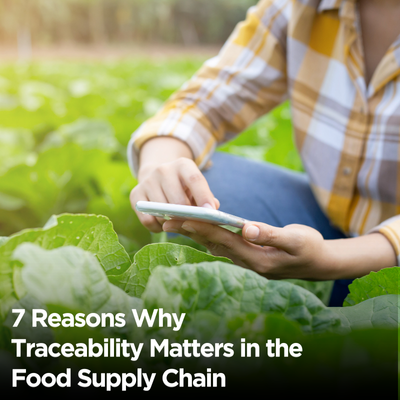
Food products today travel long distances before reaching our plates, moving from farms and fishing vessels to processing plants, warehouses, retailers, and ultimately consumers.
With so many stages and participants involved, maintaining visibility across the entire journey has become increasingly important.
As a result, consumers, regulators, and buyers expect greater transparency about where food comes from, how it is handled, and whether it meets safety and quality standards. This growing demand has made food supply chain traceability an essential part of modern food systems.
Traceability is the ability to trace a food product’s journey through all stages of production, processing, and distribution. In a traceable system, each movement is recorded and linked to key data elements such as origin, batch numbers, processing conditions, and transport temperatures.
Beyond meeting regulatory expectations, traceability also supports better operational control. It allows companies to respond quickly to safety issues, reduce waste, manage product recalls more accurately, and verify claims such as “organic” or “fair trade.”
In this blog, we will explore seven key reasons why traceability matters in the food supply chain, from improving safety and efficiency to strengthening consumer confidence.
Section 1: Traceability Improves Food Safety
The primary reason for investing in traceability is to protect public health. According to the World Health Organization (WHO), contaminated food causes around 600 million illnesses and 420,000 deaths globally each year.
This is where traceability systems play a key role. However, it does not prevent contamination, but it makes it much easier to identify, locate, and remove contaminated products quickly.
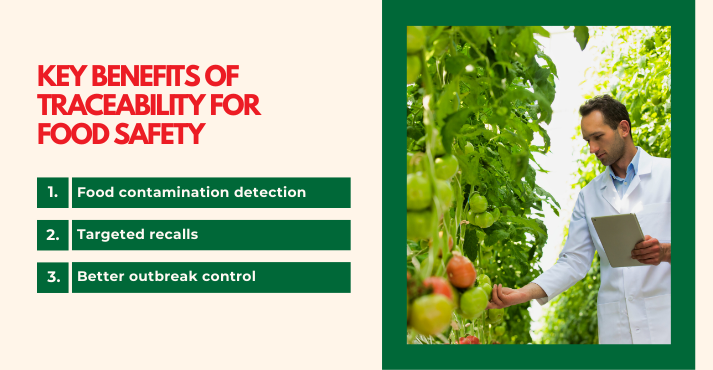
Key benefits of traceability for food safety:
- Faster food contamination detection: Traceability helps identify the source of contamination quickly by tracking a product back to its origin.
- Targeted recalls: Companies can recall only affected batches instead of entire product lines, reducing waste and financial losses.
- Better outbreak control: Faster trace-back allows authorities to remove unsafe products quickly, limiting consumer exposure.
Many supply chains are now adopting end-to-end food traceability, enabling products to be tracked from the original producer to the consumer and providing greater visibility and faster responses to safety risks.
For example, in 2022, Singapore recalled eggs imported from a Malaysian farm after authorities detected Salmonella Enteritidis contamination. Because eggs carried identifiable farm codes, regulators were able to trace the affected batches back to a specific farm and suspend imports from that facility while recalling only the contaminated eggs.
These examples show that without effective traceability, food safety incidents can escalate rapidly. This leads to:
- Higher financial losses from unnecessary recalls
- Greater public health risks as contaminated products remain in circulation longer
- Long-term brand damage and loss of consumer trust
Therefore, it is important to invest in digital traceability solutions, such as barcodes, RFID tags, and lot‑tracking software, to protect consumers and reduce the financial impact of food safety incidents.
Section 2: Ensuring Regulatory Compliance

Traceability provides the documented trail regulators expect: who handled a product, when, and under what conditions. That recordkeeping directly supports businesses’ obligations under modern food laws during inspections.
Regulatory bodies such as the U.S. FDA and the European Commission enforce rules to prevent foodborne illness and hold businesses accountable.
- The U.S. Food and Drug Administration’s Food Traceability Final Rule (under FSMA) requires additional traceability records for high-risk foods to speed outbreak response and removal of unsafe products.
- In the EU, Regulation (EC) No 178/2002 (Article 18) legally requires traceability of food, feed, and any substance intended for food use so that authorities can identify the origin and distribution chains.
For example, in 2015, Indian authorities ordered a nationwide recall and temporary ban on Nestlé’s Maggi noodles after tests found excessive lead in some samples, leading to major product withdrawals, legal scrutiny, and significant brand damage.
Similarly, the 2014 Taiwan adulterated-oil scandal revealed that contaminated cooking oil had passed through multiple suppliers and entered hundreds of food products. Investigations resulted in fines, factory closures, and stricter regulatory oversight, highlighting how weak traceability can amplify supply chain risks.
Therefore, failing to meet food safety and regulatory requirements can mean fines, forced recalls, lost market access, and long-term reputational damage, costs that usually far exceed the investment required for effective traceability.
To mitigate the risks, integrate traceability technology into existing operations, such as electronic record‑keeping and cloud‑based supply‑chain management systems, to ensure businesses meet compliance obligations with less paperwork.
Section 3: Building Transparency & Consumer Confidence

Today’s consumers want to know more about the food they buy, where it comes from, how it is produced, and whether it meets ethical and sustainability standards. This growing demand has made food supply chain transparency a key priority for food businesses.
When companies share traceability data, they create greater transparency across the supply chain. This openness helps build consumer trust because customers can verify claims about product origin, safety, and quality.
As a result:
- Consumers can see where food was grown or produced.
- Companies can prove ethical sourcing and responsible farming practices.
- Transparent data reassures buyers that products meet safety standards.
For example, Walmart introduced blockchain-based traceability systems that allow the company to track produce such as mangoes and leafy greens from farm to store. This system reduced the time needed to trace a product’s origin from several days to just a few seconds, improving transparency and strengthening trust in the supply chain.
When businesses provide supply chain visibility, consumers can verify claims such as “organic,” “fair trade,” “local,” or “animal welfare certified.”
For this, businesses can integrate systems like blockchain in food supply chains, allowing consumers to scan a food label via QR code on a product and instantly access information about where it was produced, how it was transported, and whether it meets sustainability standards.
Section 4: Enabling Efficient Recalls

According to the World Resources Institute, about one-third of the world’s food is never consumed, and a more recent estimate puts the figure at up to 40% across the food value chain.
Thus, producing uneaten food uses vast resources, land areas larger than China, nearly one-quarter of the world’s agricultural water, and contributes roughly 8–10% of global greenhouse gas emissions.
For this reason, traceability systems enable pinpointing which batches or lots are affected, allowing companies to act quickly and accurately.
Here’s how traceability improves food recall management
- Faster identification of affected products
- Reduced waste and financial loss
- Better customer satisfaction
- Lower operational disruption
For example, in one of the largest listeriosis outbreaks in South Africa on record, investigators linked the outbreak to ready‑to‑eat processed meats. Traceability data helped link clinical cases to a specific production facility, enabling authorities to remove affected products from shelves and implement corrective action.
Thus, when food safety issues arise, efficient food recall management is critical. To implement a systematic recall system in food safety cases, consider the following steps:
- Implement end-to-end traceability: Track all batches from raw materials to finished products.
- Digitize records: Use software to quickly log production, transport, and storage data.
- Define recall procedures: Establish clear steps for notification, isolation, and removal of affected products.
- Train staff regularly: Ensure everyone in the supply chain understands their role in recall management.
- Test recall readiness: Conducting mock recalls to identify gaps and improve response time.
Efficient recall systems supported by traceability help prevent unnecessary disposal by ensuring that only affected products are recalled, reducing food waste and protecting valuable resources.
Section 5: Boosting Supply Chain Efficiency

When businesses can see where every pallet, carton, or ingredient is at any moment, they reduce stockouts, cut excess inventory, and make forecasting far more reliable.
How real-time tracking streamlines operations:
- Speeds up inventory reconciliation and order fulfilment, so stores are stocked when customers need items.
- Reduces safety stock and holding costs by improving visibility into lead times and movement.
- Lowers waste through better rotation (FIFO/LIFO) and by identifying slow-moving SKUs earlier.
- Enables faster response to disruptions (weather, supplier delays) with dynamic re-routing and re-allocation.
For example, Carrefour used blockchain traceability for select product lines to give shoppers clear origin data while improving internal supply-chain visibility, a move that also helped with inventory oversight for premium SKUs.
Bottom-line benefits
- Cost savings
- Reduced waste
- Faster decisions
To boost supply chain resilience, integrate real‑time tracking technologies into supply‑chain operations. Use predictive analytics to anticipate demand, manage inventory more accurately, and reduce waste.
Section 6: Enhancing Quality Control

Quality control focuses on maintaining food safety, consistency, and product standards throughout the supply chain.
With access to real-time data, companies can detect problems early and ensure only high-quality products reach consumers.
Traceability in the supply chain improves quality control by:
- Early detection of quality issues
- Tracking quality across production stages
- Supporting continuous improvement
Several food companies are already using advanced traceability tools to strengthen quality control.
For example, Chipotle implemented RFID technology to track food shipments across its thousands of restaurants. This system helps ensure ingredients arrive fresh, are stored correctly, and are used within appropriate timeframes.
To strengthen quality control, businesses should implement monitoring devices and digital data systems that capture key conditions across the supply chain. Here’s how:
- Track temperature during storage and transportation
- Monitor humidity levels to prevent spoilage
- Record handling and storage practices at each stage
- Use collected data to enforce quality standards
- Analyze insights to improve processes continuously
Remember, better quality control reduces food waste and improves customer satisfaction.
Section 7: Supporting Sustainability & Ethical Practices
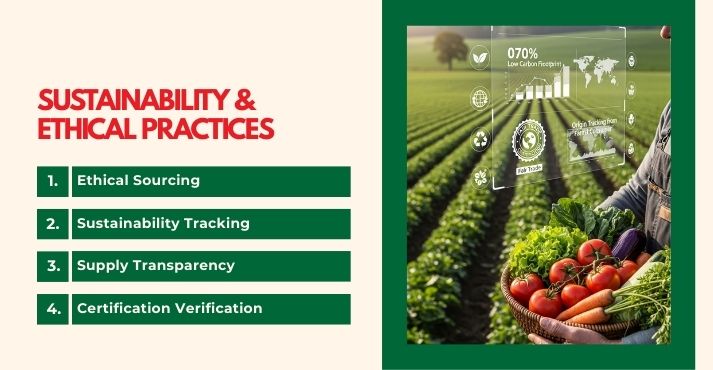
Food safety and traceability are powerful enablers of ethical sourcing and sustainability: when you can trace an ingredient from its origin to the store shelf, you can measure environmental impacts, verify fair pay and labor practices, and prove that products meet sustainability claims.
What traceability can track:
- Carbon and energy footprints across production and transport
- Land-use and deforestation information tied to origin farms
- Fisheries legality and catch method (to prevent IUU fishing)
- Worker conditions and fair-wage evidence at supplier sites
- Certification status (organic, Fairtrade, Rainforest Alliance) linked to specific lots
- Inputs and chemical use (pesticides, antibiotics) for product compliance
For example, Starbucks launched a digital traceability tool that lets consumers see bean-to-cup information, helping validate sustainability and origin claims for coffee offerings.
Similarly, Thai Union makes full catch-to-consumer traceability central to its sustainability strategy, using trace data to show legality and improve consumer confidence in seafood sourcing.
Adding to this, a survey found that shoppers are willing to spend an average of 9.7% more on sustainably produced or sourced products. This shows that traceability can be a real commercial advantage when companies surface credible data.
Therefore, use traceability not just to comply, but to prove and promote your sustainability story. Capture verifiable sourcing data, display it clearly on product pages, and turn traceability into a competitive and ethical advantage.
Conclusion
Food supply chain traceability is no longer just a regulatory requirement; it is a strategic tool that strengthens the entire food system.
This can be achieved by implementing effective traceability systems, and businesses can quickly identify contaminated products, meet regulatory requirements, and build stronger consumer trust through greater transparency and responsible sourcing.
Traceability also delivers clear operational benefits. It enables efficient recall management, reduces unnecessary waste, improves inventory visibility, and strengthens quality control across production and distribution.
At the same time, it helps companies verify sustainability claims and demonstrate ethical practices throughout their supply chains.
As the global traceability market continues to grow, projected to reach USD 45 billion by 2034, F&B businesses that adopt digital and technology-enabled traceability solutions will be better prepared to meet evolving regulations, rising consumer expectations, and sustainability goals.
Taking action today will protect public health, improve operational efficiency, ensure compliance, and support a more transparent and sustainable food system for the future.