Food fraud is becoming a significant issue across Asia, posing a threat to consumer safety and damaging the reputations of food businesses.
It involves dishonest practices such as mislabeling products, adding harmful or inexpensive ingredients (adulteration), substituting high-quality items with lower-grade ones, and even counterfeiting entire products.
These actions can lead to major health risks and big financial losses. In fact, food fraud costs the global food industry approximately $40 billion annually.
To address this issue, many in the industry are turning to technology, especially blockchain. Using blockchain in food fraud prevention helps create transparent, tamper-proof records that track products from farm to table.
This makes it easier to verify authenticity, build trust, and protect both consumers and brands. As supply chains in Asia become more complex, blockchain offers a promising solution.
What Is Blockchain Technology and How Does It Work in Food Safety?
Blockchain is a type of digital record-keeping system that stores information across a network of computers, rather than relying on a single central database. Once data is added to this system, it cannot be changed or deleted, which makes it highly secure and reliable.
Each record, or “block,” is connected to the previous one, creating a chain that shows a clear and permanent history of transactions.
In the food industry, blockchain is being used to improve food safety practices by allowing companies to track every step of a product’s journey. From the farm to the grocery store shelf, every movement is recorded in real-time.
This level of detail provides companies and regulators with better control, allowing them to identify problems quickly, such as contamination or mislabeling.
A survey of 47 agribusinesses found that blockchain-enabled traceability reduced recall costs by 38% due to faster identification of contamination sources. This strong focus on traceability in food supply chains helps protect consumers and strengthen trust throughout the entire system.
The Growing Problem of Food Fraud in Asia
Food fraud is a significant and growing concern across Asia, a region renowned for its intricate food supply networks and diverse production methods.
Rapid urbanization, rising demand for premium products, and uneven enforcement of food standards have made the region especially vulnerable. Clear transparency in the food industry is now essential, as more consumers seek safe and authentic products.
Food Fraud in the Asia-Pacific Region
Countries such as China, India, and those in Southeast Asia face widespread issues with food fraud. These include fake organic certifications, mislabeling of geographic origin, and the substitution of high-value ingredients with cheaper or unsafe alternatives.
For example, olive oil may be diluted with low-quality oils, or premium seafood may be swapped for less expensive species.
Operation OPSON XI, a global police operation coordinated by INTERPOL and Europol, found that almost 27,000 tonnes of food and beverages were counterfeit or substandard between December 2021 and May 2022.
To enhance oversight, regulators, including the Singapore Food Agency (SFA), are introducing more rigorous controls and monitoring systems.
The Impact of Food Fraud on Consumers and the Industry
Food fraud poses serious health risks. Adulterated ingredients and unsafe substitutions can lead to foodborne illnesses or long-term health problems.
Beyond health concerns, there are major economic consequences. Companies face lost revenue, damaged brand reputation, and heavy regulatory fines.
As businesses try to rebuild trust, solutions like blockchain in food supply chain systems and digital food certification platforms are becoming more important.
These approaches enhance food transparency in Asia by establishing transparent records of product origins, certifications, and handling processes. As a result, consumers gain confidence in the products they buy, and companies can better protect their brands against fraud.
How Blockchain Prevents Food Fraud in Asia
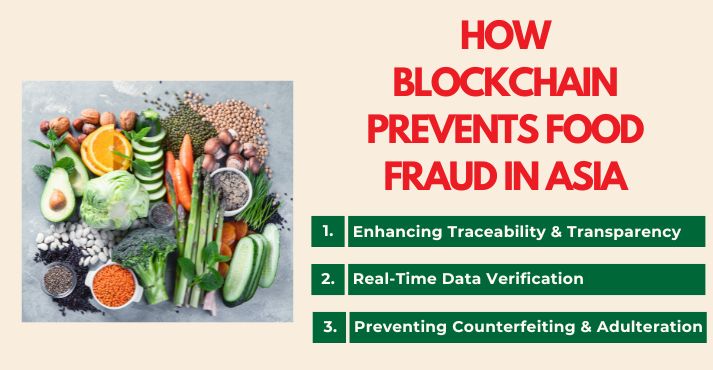
Blockchain is changing how food products are tracked and verified across Asia. Following products from farm to table helps ensure authenticity and keeps unsafe or fake items out of the market.
This is crucial in addressing food fraud in Asia, where lengthy and complex supply chains often obscure product origins.
1. Enhancing Traceability and Transparency
Blockchain enables full visibility of a product’s journey, from planting to packaging. In Japan’s Miyazaki Prefecture, farmers partnered with Information Services International‑Dentsu and Guardtime to log organic vegetables onto a distributed ledger.
This approach allows consumers and restaurant chefs to verify a product’s organic certification at every stage.
In Thailand, major seafood processors, such as Thai Union, have piloted blockchain for shrimp traceability. Using satellite data and Wholechain’s system, they record farming location, harvest date, and sustainability metrics.
This ensures the catch origin and legality before it is exported. This level of detail advances food safety and traceability in seafood supply chains.
2. Real-Time Data Verification and Authentication
Updates about harvest dates, storage, transport, and processing can be entered in real-time and verified instantly.
In Southeast Asia, fishermen and suppliers use blockchain to log fish catch locations and vessel data, creating authenticated records that regulators and buyers accept.
These immutable entries help reinforce blockchain food safety by preventing unauthorized changes or errors in origin claims.
3. Preventing Counterfeiting and Adulteration
Premium items, such as honey, olive oil, and spices, are often targets for fraud because of their high market value. Blockchain combats this by assigning each product a unique digital ID that stays with it throughout the supply chain.
This ID is accessible via smart labels or QR codes that consumers can scan using a smartphone.
By scanning the code, shoppers can see verified details about the product’s origin, harvest or production date, and certification information. This promotes transparency in food labeling, helping customers feel more confident in their purchasing decisions.
In addition to protecting consumers, this approach makes it more difficult for counterfeit goods to enter the market and provides producers with stronger protection for their brand reputation.
Blockchain Solutions in Asia: Real-World Examples
Several countries across Asia are leading the way in using blockchain to combat food fraud and enhance food safety. These projects help ensure authenticity, support better sourcing, and build trust among consumers and trading partners.
China’s Blockchain Pilot Programs in Food Safety
China has introduced several blockchain-based pilot programs to enhance food safety, especially within meat supply chains.
In Guangzhou, the Municipal Market Supervision Bureau has launched a platform that records data from farm origins and harvest dates, as well as inspections and sales, on a blockchain.
This system covers over 8,000 vendors and is already logging millions of transactions daily, significantly enhancing oversight and expediting recalls.
Furthermore, at the headquarters level, Walmart China partnered with JD.com, IBM, and Tsinghua University to form the Blockchain Food Safety Alliance.
One key effort traces pork supply chains from slaughter to packaging and retail. Early trials reduced traceability time from days to just two seconds, improving accountability across the farm-to-table process.
Southeast Asia’s Use of Blockchain for Seafood Traceability
In Southeast Asia, seafood traceability is a significant concern due to the prevalence of illegal fishing and seafood mislabeling. Singapore has taken a leading role, with its government and private sector partnering on blockchain-based seafood tracking.
The Singapore Food Agency collaborated with companies like Veritag and ST Engineering to pilot a system that logs every catch detail, including location, time, and handling, on a blockchain. Consumers can access this verified information by scanning a QR code on packaging.
Fisheries in Indonesia and Fiji have also adopted blockchain to track tuna and other seafood from catch to consumer plate.
This technology supports sustainable sourcing, helps buyers verify sustainability claims, and provides consumers with greater confidence in seafood products.
India’s Blockchain Projects for Agricultural Transparency
India is using blockchain to improve agricultural supply chains, especially to tackle pesticide fraud and mislabeling.
In Andhra Pradesh, blockchain pilots have been set up to track chili peppers and other valuable crops, recording details like seed origin, pesticide use, and transport routes.
The state has collaborated with tech companies, including IBM, and local agri-tech startups to make this possible. For example, the Spices Board of India launched a blockchain traceability project for chili and turmeric farmers to help prove product quality and support fair pricing.
These efforts help farmers share verified information with buyers at home and abroad, giving them better market access and helping ensure food is safe and properly labeled.
The Benefits of Blockchain for Food Fraud Prevention in Asia
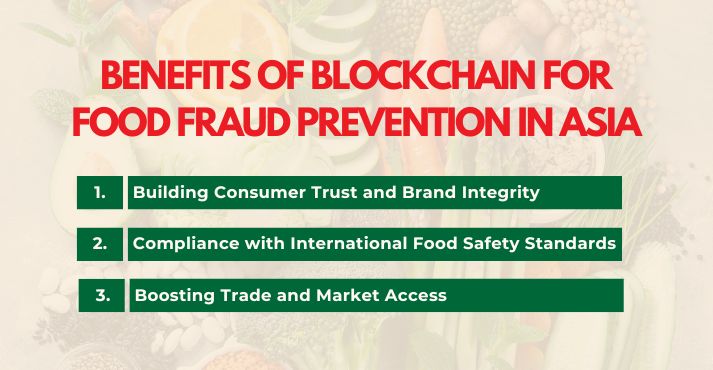
Blockchain is helping food businesses across Asia rebuild trust, adhere to safety standards, and expand into new markets. For many manufacturers, it provides a straightforward way to enhance transparency and verify product authenticity.
1. Building Consumer Trust and Brand Integrity
Food scandals and fraud have led many consumers to lose confidence in what they purchase. Blockchain helps restore that trust by making product journeys visible and verifiable.
In Thailand, Thai Union partnered with Global Aquaculture Alliance (GAA), Wholechain, and Legit Fish to implement real-time data sharing for its shrimp supply chain.
Each package carries a QR code that allows consumers to view the harvest location, processing data, and certification history, making it easy to verify product authenticity.
This example shows how transparency in food production can help brands earn trust and boost loyalty in competitive markets.
2. Compliance with International Food Safety Standards
Meeting strict food safety standards is a major challenge for exporters. Blockchain allows manufacturers to record each step of production and distribution in a secure, unchangeable system.
This supports compliance with global frameworks such as the Food Safety Modernization Act (FSMA) and FSSC 22000.
In Vietnam, Minh Phu Seafood Corporation has launched a blockchain-enabled, mobile-based app to monitor shrimp farms in real-time.
The system records data on farm conditions, harvesting, processing, and export logistics, providing verified traceability across the supply chain.
This shows how IoT and blockchain in food safety can help producers meet international requirements and maintain market access.
3. Boosting Trade and Market Access
Global buyers are demanding more verified and safe food products. Blockchain-supported traceability allows Asian producers to enter new markets with confidence, showing clear proof of origin and quality.
In India, blockchain in agriculture has helped farmers export organic produce by providing detailed data on cultivation and handling, satisfying strict import standards in Europe and North America.
Better traceability opens doors for higher-value markets and supports fair pricing for producers.
The Challenges of Implementing Blockchain in Food Fraud Prevention
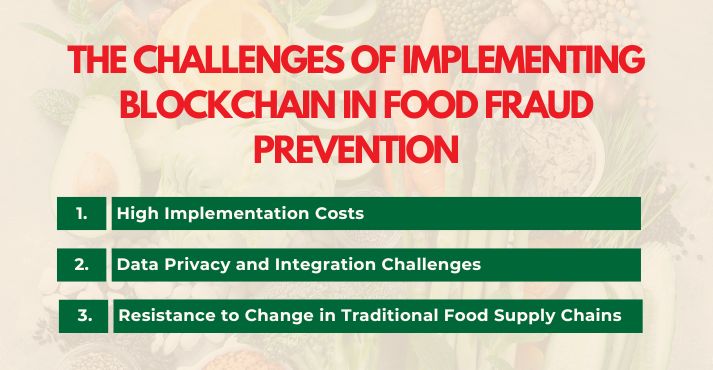
While blockchain can help combat food fraud, implementing it in the food supply chain is not always easy.
1. High Implementation Costs
Blockchain systems require significant upfront investment in technology, training, and upgrades to existing processes. Large companies might manage these costs, but smaller producers often cannot.
Many small farms or local processors struggle to scale these systems, which limits wider improvements in food authenticity verification.
2. Data Privacy and Integration Challenges
Connecting blockchain to current systems can be difficult. Many food businesses already have different tracking or record-keeping setups that don’t easily match blockchain platforms.
Another concern is data privacy. Some producers want to protect information about their sources or methods to maintain their competitive edge. Protecting private data while still sharing enough for traceability is essential when using food technology.
3. Resistance to Change in Traditional Food Supply Chains
Many suppliers still use paper records or older digital systems. Switching to blockchain means changing habits, learning new systems, and sometimes sharing data with more partners.
Some producers worry about extra work or losing control over information. To make blockchain work, farmers, processors, and exporters must all cooperate and feel confident about the benefits.
The Future of Blockchain in Food Fraud Prevention in Asia
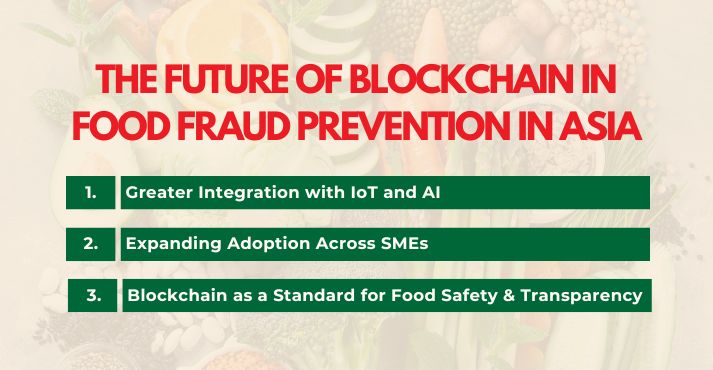
Blockchain will continue to support a more resilient food supply chain across Asia. It offers a reliable way to keep food safer and reduce fraud in the years ahead.
1. Greater Integration with IoT and AI
Blockchain is expected to work more closely with Internet of Things (IoT) devices and data analysis tools. IoT sensors can track temperature, location, and storage conditions in real time. When this data is added to the blockchain, it remains secure and cannot be altered.
Combining this with advanced data analysis can help detect possible fraud early, making prevention more proactive. Together, these systems will build stronger food fraud blockchain solutions in the region.
2. Expanding Adoption Across Small and Medium Enterprises (SMEs)
Currently, blockchain is primarily used by large exporters and major producers. In the coming years, lower costs and simpler systems may make it more accessible to small and medium-sized businesses.
Many SMEs want to prove that their products are safe and genuine, but often lack the necessary tools. As blockchain becomes more affordable, more local farmers and processors can use it, helping improve food safety and build trust.
3. Blockchain as a Standard for Food Safety and Transparency
By 2030, blockchain could become a common requirement for food exports and domestic sales. Governments and large retailers are already asking for detailed proof of origin and handling.
Blockchain can provide this information clearly, helping businesses meet local and international standards.
Over time, this approach may set a new standard for traceability and give producers across Asia more opportunities to reach new markets.
Conclusion
Blockchain is helping Asia tackle food fraud by providing clear and secure records of how food is grown, processed, and transported.
This transparency gives consumers more confidence and helps protect public health. It also supports producers and exporters in meeting strict safety standards and accessing new markets.
While there are still challenges, such as cost and data integration, more widespread use of blockchain can make food supply chains stronger and more reliable.
As governments, manufacturers, and farmers work together to adopt this technology, the region can move toward a future with safer and more authentic food products. Continued efforts will be key to making these benefits available to producers and consumers across Asia.