Key Takeaways
- Hyperlocal sourcing focuses on building stronger connections with nearby producers while complementing existing supply networks.
- Growing supply chain uncertainty is encouraging more food businesses to consider local sourcing as part of a resilient procurement strategy.
- Working with nearby suppliers can help restaurants create menus that better reflect the character and food culture of their location.
- Examples from Singapore and Indonesia show that hyperlocal approaches can support both operational objectives and stronger community engagement.
- Successful hyperlocal sourcing requires balancing authenticity, supplier capability, product consistency and long-term business needs.
Introduction
Great food remains fundamental to a successful restaurant, but it may not be enough to create lasting differentiation. As dining markets become more competitive, operators need a recognisable concept that gives customers a clear reason to choose one restaurant over another.
Hyperlocal sourcing offers one way to build that distinction. Working with nearby farms, bakeries, roasters, beverage makers and artisan producers allows restaurants to create menus and experiences that feel connected to their location.Its value extends beyond purchasing ingredients: local partnerships can influence product development, storytelling, events and customer engagement. When integrated carefully, this F&B trend can help establish a stronger restaurant brand identity rooted in genuine relationships with the surrounding community.
Understanding Hyperlocal Sourcing
Hyperlocal sourcing focuses on procuring ingredients within a tight 20-kilometer radius. Replacing broad supply chains, this proximity directly aligns with consumer preferences. Research shows visitors actively prefer venues serving hyperlocally grown food. This localized approach allows culinary teams to build menus rooted in regional identity. In fact, 86% of consumers agree local sourcing captures a destination’s authentic food culture.
The approach is defined primarily by geographic proximity. Rather than sourcing from a broad national or regional network, restaurants focus on products that originate close to where they operate, allowing the menu to reflect the character and food culture of the local area.
Local Sourcing Trends Shaping Restaurant Brands
Greater Collaboration Between Chefs and Producers
Restaurants are increasingly treating nearby suppliers as creative partners rather than interchangeable vendors. Chefs and producers may work together on recipes, seasonal releases, limited-time menus or products designed specifically for the restaurant.
Collaborations such as 1-Michelin-Starred Restaurant Labyrinth with up to 90% of their menu being locally-sourced is a key indicator of this growing trend.
Menus With a Clearer Sense of Place
Menus are becoming an important way for restaurants to express their relationship with their surroundings. Ingredients, flavours and supplier stories can reflect the neighbourhood, city or region in which a business operates.
Restaurants do not need to source every item from nearby producers. A focused selection of locally influenced dishes may create a stronger impression than a broad sourcing claim with little connection to the actual dining experience.
More Visible Producer Stories
Supplier information is moving beyond short sourcing statements at the bottom of menus. Restaurants are introducing producers through server recommendations, chef features, social media content, tasting events and in-store displays.
According to the latest NielsenIQ (NIQ) Transparency Trends Study, 76% of consumers affirm that transparent product information is essential when choosing brands, with 71% stating they are willing to pay a premium for products offering verifiable, ethical, and local origin transparency.
In restaurant settings, research from Deliverect indicates that 43% of diners will actively pay more for sustainably and locally sourced dishes, while 68% expect operators to demonstrate verifiable supply chain practices.
Selective Local Procurement
Restaurants are adopting a more balanced approach rather than attempting to purchase every ingredient nearby. Coffee, bread, desserts, condiments, fresh produce and craft beverages are practical starting points because they can be introduced without restructuring the entire supply chain.
Food wholesalers may continue to provide staple ingredients, imported products and backup inventory. This mixed model allows restaurants to maintain reliability while developing a more distinctive local character.
Community-Led Dining Experiences
Local collaborations are also influencing experiences beyond the standard menu. Producer showcases, tasting sessions, collaborative dinners and seasonal product launches can give customers new reasons to visit.
These activities allow restaurants to demonstrate their place within the surrounding food community, strengthening restaurant branding through direct participation rather than relying solely on promotional statements.
Industry Insights: Why Hyperlocal Sourcing Matters
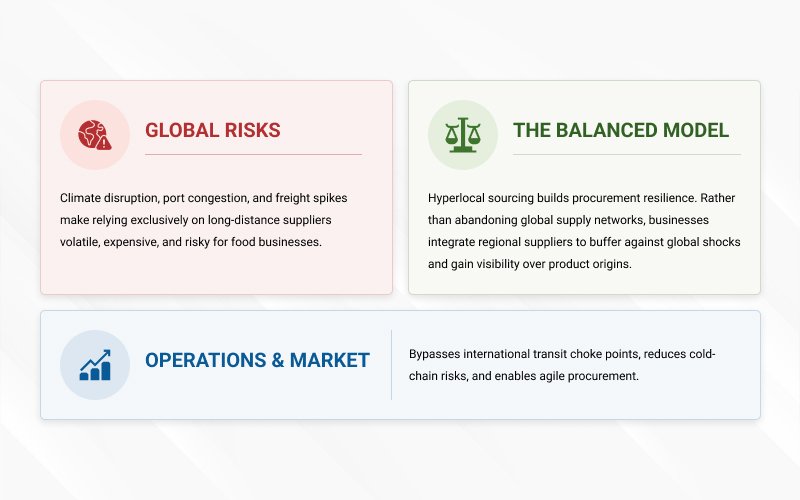
Hyperlocal food sourcing is becoming more than a sustainability measure. It can form part of a more resilient procurement model by reducing exposure to long-distance logistics, improving visibility over product origins and creating stronger links with regional food systems.
- Risks of Distant Supply Chains: Port delays, weather shocks, and freight spikes threaten long-distance logistics. Consequently, 80% of COOs are shifting to regional sourcing to safeguard supply continuity.
- Resilience & Margin Growth: Hyperlocal sourcing cuts transport overhead and improves origin traceability, driving gross margin gains of up to 30%.
- Balanced Hybrid Model: Local procurement buffers global networks while boosting revenue, 68% of diners prefer venues supporting local food ecosystems and 43% are willing to pay a premium.
Changing customer expectations add further momentum. Research by Forbes indicates that consumers increasingly want their spending to support local communities and are showing greater interest in authentic, place-based food experiences. At benchmark properties like Vivosa Apulia, 77% of all goods and services are sourced directly from local suppliers within a 20-kilometer radius, with remaining needs fulfilled at the regional level.
Examples Across Different Southeast Asian Markets
Singapore: Supporting National Food Resilience Through Local Procurement
Singapore’s Food Story 2 strategy demonstrates how local sourcing is becoming part of a broader food resilience agenda. Rather than pursuing self-sufficiency across every food category, the government has introduced targeted production goals for fresh leafy and fruited vegetables, beansprouts, mushrooms, eggs and seafood by 2035, while continuing to strengthen import diversification and stockpiling for products that cannot be produced efficiently in Singapore.
This creates practical opportunities for restaurants, hotels and catering businesses. Operators can incorporate locally farmed vegetables into seasonal menus, feature Singapore-produced eggs at breakfast buffets, or highlight locally farmed seafood in signature dishes where supply is available. By becoming consistent commercial buyers, hospitality businesses also help local farms achieve the scale and viability needed to support food sustainability and the country’s long-term food resilience.
Indonesia: Building Local Relevance Beyond the Menu
Indonesia illustrates how hyperlocal strategies can combine local sourcing with stronger community engagement. At the Retail Asia Forum 2024, industry leaders highlighted how businesses adapt their operations to the distinct cultures and preferences found across Indonesia’s regions rather than applying a single nationwide model.
Starbucks Indonesia, for example, sources around 70% of Indonesia’s Arabica coffee from producing regions such as Sumatra, Central Java, Toraja and Papua while maintaining a consistent global brand experience. Meanwhile, regional supermarket chain FreshMart works closely with local suppliers, hires and develops local employees, and incorporates local language and community-focused initiatives into its customer experience. The Indonesia Retail Merchants Association (APRINDO) also emphasised sourcing fresh regional products, supporting local festivals and tailoring marketing to local customs.
Hospitality businesses can adopt similar principles by partnering with regional producers, adapting menus to local tastes, collaborating with nearby communities and reflecting the culture of each destination across the guest experience. This allows brands to maintain a consistent identity while creating concepts that feel more authentic and relevant to the markets they serve.
How Restaurants Can Build a Brand Through Local Partnerships
Define the Purpose of Each Partnership
Restaurants should determine what each supplier contributes to the concept. Its value may come from flavour, exclusivity, craftsmanship, regional relevance or a shared production philosophy.
A clearly defined role makes it easier to choose appropriate products, develop suitable dishes and communicate the relationship to customers.
Build Relationships Rather Than Transactions
Regular communication helps restaurants understand production methods, seasonal limitations, lead times and future capacity. Suppliers also gain better visibility into menu changes and anticipated demand.
These discussions may lead to exclusive ingredients, co-developed products or limited releases. Clear expectations around pricing, quantity, quality and delivery should support the creative relationship.
Connect Supplier Stories to Specific Products
Broad claims such as “locally sourced” offer limited insight. Restaurants can communicate more effectively by explaining how a particular ingredient contributes to a dish or why a producer was selected.
Menu descriptions, staff recommendations and digital content should focus on information that improves the customer’s understanding of the food.
Introduce Products Gradually
Restaurants do not need to transform their entire purchasing model immediately. Beginning with a few carefully selected products allows operators to evaluate demand, supplier performance and menu suitability.
A gradual approach also gives kitchen and service teams time to understand each item and explain it confidently to customers.
Prepare for Changes in Supply
Smaller producers may experience seasonal fluctuations, limited capacity or delivery constraints. Restaurants should discuss these possibilities before placing an ingredient at the centre of a permanent dish.
Rotating menus, alternative ingredients and backup inventory can help protect consistency without weakening the concept’s local connection.
Communicate Consistently Across the Business
Supplier relationships should be reflected naturally across relevant customer touchpoints, including menus, staff communication, websites, social media and events.
The objective of this step is to create a coherent concept in which sourcing decisions, menu development and customer communication support the same identity.
What’s Next?
For Singapore Suppliers: Securing B2B Off-take Contracts to Achieve Scale
Local Singaporean producers (urban agri-tech farms, indoor aquaculture facilities, kelongs, and specialty artisan producers) face high energy costs, land limitations, and significant operational expenditure.
- The Need: Under Singapore’s updated Singapore Food Story 2 strategy (which sets revised targets for local farms to meet 20% of domestic vegetable/fibre needs and 30% of protein needs by 2035), local suppliers cannot rely solely on direct-to-consumer retail.
- Why It’s Relevant: The most critical aspect of hyperlocal sourcing for Singapore suppliers is securing predictable, multi-year commercial off-take agreements with large-scale buyers (hotel chains, institutional caterers, and supermarket groups). Consistent volume from commercial buyers provides local farms with the revenue stability required to lower production costs and achieve unit-economic viability.
For ASEAN Suppliers: Becoming the “Nearshore” Buffer for Regional Buyers
For producers across Malaysia, Indonesia, Thailand, Vietnam, and the Philippines, hyperlocal sourcing represents a major nearshoring opportunity within intra-ASEAN trade.
- The Need: As global long-distance shipping routes face port congestion, unpredictable freight rates, and cold-chain breakdowns, major buying hubs like Singapore are looking closer to home to hedge against global disruptions.
- Why It’s Relevant: ASEAN suppliers are ideally positioned as the “regional hyperlocal” solution, offering short 24-to-48-hour transport lead times, lower logistics carbon footprints, and verifiable regional provenance. Suppliers that invest in cold-chain tracking, food safety certifications, and export compliance can capture market share away from distant, long-haul international exporters.
Co-Creation & Customization Over Commodity Pricing
Across both Singapore and ASEAN, hyperlocal sourcing allows suppliers to move away from low-margin price wars against mass commodity importers.
- Value-Added Partnerships: By collaborating directly with chefs and corporate procurement teams (e.g., co-developing custom coffee blends, growing tailored herb varieties, or formulating exclusive food products), suppliers establish high-value relationships that are difficult for competitors to replace.
- Margin Protection: Offering specialised, locally contextualised products enables suppliers to command higher margins and build long-term business resilience.
Data Sources
Frequently Asked Questions
How can small restaurants begin working with nearby suppliers?
A restaurant can start with one or two manageable product categories, such as bread, coffee, herbs or desserts. Testing a limited range first makes it easier to assess quality, delivery reliability and customer response before extending the arrangement.
Are locally sourced products always more expensive?
Not always. Smaller production volumes can raise prices, but shorter transport routes, better freshness and lower spoilage may offset part of the difference. The final cost depends on the product, supplier scale and how efficiently it is used across the menu.
Can restaurant chains use regional suppliers?
Yes. A chain can maintain central brand and quality standards while allowing selected outlets to purchase suitable ingredients from producers in their own area. This gives individual locations greater regional relevance without changing the entire supply system.
Conclusion
Hyperlocal sourcing is becoming more valuable as food businesses look for supply models that are better connected to the markets they serve. It can help restaurants respond more effectively to supply disruption, support local producers and create menus that feel more closely tied to the surrounding community.
The strongest approaches are selective rather than absolute. Restaurants do not need to replace every established supplier, but they can identify categories where local producers offer clear advantages in freshness, relevance or customer appeal. This creates a more balanced procurement model that combines local relationships with the scale and continuity provided by broader supply networks.
Food & Hospitality Asia brings together food manufacturers, artisan producers, beverage brands, technology providers, equipment specialists and hospitality professionals from across the industry. The event offers a practical setting to compare sourcing approaches, discover regional products and explore partnerships that can support more resilient and distinctive food service concepts.
Visit us from 20 to 23 April 2027 at Singapore Expo to explore new sourcing opportunities and connect with potential partners.