Key Takeaways
- Solo dining is becoming a more deliberate restaurant choice rather than a fallback when companions are unavailable.
- Southeast Asia already has a strong foundation for independent dining through hawker centres, street food stalls, food courts and night markets.
- Rising numbers of solo guests at premium restaurants in Singapore indicate growing demand at the premium end of the market.
- Restaurants can gain an advantage by recognising solo diners as a distinct commercial audience and evaluating their contribution through repeat visits, seat utilisation and long-term spending.
Introduction
Solo diners represent a growing business opportunity and one of the most commercially relevant F&B trends. They can help restaurants fill seats during quieter periods, support faster table turnover, and generate repeat visits. As more consumers choose to dine independently for convenience, flexibility, or personal time, restaurants that adapt their seating, menus, and service can capture demand that may otherwise be overlooked.
For operators, the opportunity is not simply about serving one guest at a time. It is about improving seat utilisation, building loyalty, and creating dining experiences that encourage individual customers to return and spend across different service periods.
Who Are Solo Diners?
Solo diners are not one narrow customer type. They include:
- Business travellers, office workers, remote workers, students, and tourists who may dine independently because of flexible schedules, work commitments, or travel plans.
- Consumers choosing personal time and convenience. OpenTable found that 34% of surveyed solo diners cited “me time” as their main motivation, while 20% preferred to eat on their own schedule.
- A visible Southeast Asian customer segment. In a six-market regional survey, 54% of Singapore respondents said they regularly ate alone at hawker centres, food courts, or cafés, compared with a 25% regional average. In Vietnam, 16% relied on food-delivery apps for weekday meals.
- Guests who expect a complete restaurant experience. Comfortable single seating, suitable portions, efficient ordering, and attentive but unobtrusive service can help restaurants attract repeat visits. Several Singapore restaurants have reported increases of 20% to 50% in solo diners, with operators noting their contribution to off-peak traffic, loyalty, and repeat business.
How Solo Diners Add Value to Restaurant Operations
In Singapore, restaurants are adapting their menus, with Hansik Dining Collective offering individual sets and Michelin inspectors highlighting solo tasting menus and portioned dishes.
Together, these trends show that solo diners can help restaurants improve seat utilisation, generate repeat business, and create new revenue opportunities across both casual and premium dining.
Solo Dining by the Numbers
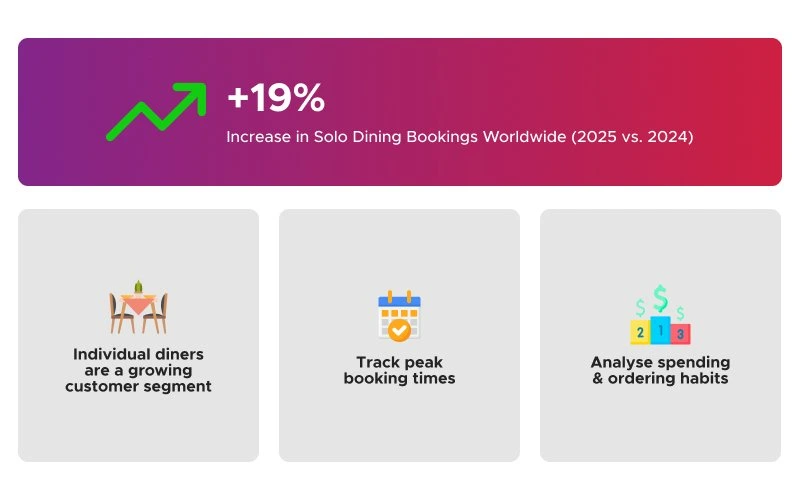
Restaurant booking data provides a clear indication of the trend’s momentum.
For restaurant operators, the figure signals that individual bookings should be treated as a measurable source of demand rather than an occasional exception. Reviewing when these reservations occur, what guests order and how much they spend can help businesses identify patterns that may otherwise be hidden within broader sales data.
How Restaurants Across Southeast Asia Are Responding
Solo dining has developed differently across markets. Japan provides one of the clearest international examples, while Southeast Asia is building on its long-established street food culture and adapting the concept for more formal restaurant settings:
Malaysia: Expanding Solo Dining Beyond Casual Meals
Malaysia’s hawker stalls, cafés and casual restaurants have long made it convenient for customers to order individual portions. More formal restaurants are now also creating experiences that suit solo guests.
The Michelin Guide highlights Malaysian restaurants offering single-person set menus, counter or bar seating and smaller portion options. At Michelin-starred Beta in Kuala Lumpur, solo diners can enjoy a seasonal set menu while watching the open kitchen, while Jalan Ipoh Claypot Chicken Rice offers a smaller portion designed for one person. These formats show how operators can welcome individual diners without simplifying the food or service experience.
Singapore: Growing Demand at Premium Restaurants
Singapore’s hawker centres and food courts have always made independent meals convenient and socially accepted. However, the growth is now becoming more visible in premium restaurants.
Michelin-starred barbecue restaurant Burnt Ends has experienced a 50% increase in solo diners in recent years. Similarly, Cloudstreet and Restaurant Born have reported increases of approximately 40% and 20% respectively. These figures suggest that guests are becoming increasingly comfortable booking high-end dining experiences for themselves, rather than reserving them only for shared occasions.
Thailand: Building on an Established Solo Food Culture
Thailand’s street stalls, food courts and night markets are naturally suited to individual diners. Single portions, open seating and quick service make it easy for customers to stop for a meal without planning around a group.
This established culture is gaining greater commercial relevance as Thailand’s solo economy expands. Research from The 1 Insight indicates that the country’s single population accounts for more than two-thirds of total consumer expenditure and is driving growth in premium lifestyle categories. For restaurants, this creates opportunities to move beyond convenience-led meals and develop more polished, personalised experiences for customers who are comfortable spending independently.
Turning Solo Dining Into a Competitive Advantage
Restaurants can make solo dining more commercially viable by focusing on three practical areas: seating, menu design, and performance measurement.
1. Optimise Seating for Solo Guests
Restaurants should consider how individual diners fit into the existing floor plan rather than automatically assigning them to communal tables or less desirable seats.
Counter seating, smaller tables, and flexible two-seater configurations can help accommodate solo guests without tying up larger tables. Where space allows, offering different seating options also lets diners choose between a quicker, more casual meal and a longer restaurant experience.
The objective is to improve seat utilisation while ensuring solo guests receive the same level of comfort and service as larger parties.
2. Redesign Menus for One Without Reducing Choice
Solo diners should still be able to experience the dishes that define the restaurant. Sharing menus, large-format dishes, and minimum-order requirements can unintentionally make some concepts difficult to access alone.
Restaurants can respond with individual set menus, smaller portions of signature dishes, tasting formats designed for one, or optional pairings and add-ons. This allows solo guests to explore more of the menu without requiring operators to create an entirely separate offering.
For premium restaurants in particular, designing for one doesn’t have to mean lowering the value of the experience. The focus should be on making the restaurant’s core proposition accessible at an appropriate portion size and price point.
3. Measure Revenue per Seat and Off-Peak Utilisation
Restaurants should treat solo dining as a distinct source of demand rather than evaluating it solely by table size.
Useful measures include:
- revenue per occupied seat
- average spend per solo diner
- table turnover time
- repeat visits
- proportion of solo bookings during quieter periods
- contribution to otherwise unused seating capacity
Tracking these measures can help operators determine whether solo diners improve utilisation during slower dayparts, return frequently, or generate commercially worthwhile spend.
The goal is not necessarily to maximise the number of solo diners, but to understand where they fit profitably within the restaurant’s broader customer and seating strategy.
Conclusion
The rise of solo dining signals a broader shift in what a restaurant visit can represent. Dining out no longer needs to be tied to a social occasion, celebration or group plan, but can be a personal choice shaped by independence, convenience and curiosity.
For the hospitality industry, this makes individual dining more than a passing behavioural trend: it reveals a changing customer mindset that values freedom and a variety of experiences. Businesses that recognise this shift can position themselves more clearly within an increasingly diverse dining market.
Food & Hospitality Asia offers a platform for restaurant operators, suppliers and hospitality professionals to explore the ideas influencing the future of food service.
At FHA 2027, businesses can discover foodservice solutions, restaurant concepts, technology, equipment and supplier partnerships that support changing dining behaviours, including the growing demand for more flexible and personalised restaurant experiences.
For operators looking to adapt menus, service formats, seating strategies, or technology around evolving customer expectations, FHA 2027 offers an opportunity to compare solutions, connect with relevant industry partners, and explore how restaurants can respond to the next phase of dining demand.
Visit us from 20 to 23 April 2027 at Singapore Expo to discover new solutions, compare ideas and connect with industry partners that can help strengthen restaurant operations and create more commercially effective dining experiences.
Frequently Asked Questions
Is solo dining more profitable for restaurants?
It can be, as solo diners may help fill otherwise empty seats, return more frequently, and support steadier revenue during quieter periods.
What types of restaurants benefit most from solo diners?
Cafés, quick-service restaurants, casual dining venues, hotel restaurants, and fine dining establishments can all benefit when they provide suitable seating, service, and menu options for one.
How can restaurants promote solo dining experiences?
Restaurants can promote solo dining by highlighting options such as tasting menus for one, counter seating, weekday lunch specials, and individual set menus across their websites, reservation platforms, and social media.
Data Sources
| Source | URL |
|---|---|
| Milieu Insight | Live, Eat, Repeat: The Real Cost of the ‘Solo Economy’ |
| OpenTable and KAYAK | Table for One |
| OpenTable Restaurant Solutions | Embracing the Solo Dining Trend: How to Make Your Restaurant a Go-To Solo Dining Destination |
| The Straits Times | Table for One: Why Singaporeans Are Dining Alone |
| MICHELIN Guide Singapore | Table for One: The Best Places for Solo Dining in Singapore |
| MICHELIN Guide Malaysia | The Ultimate Guide for Dining Solo in Kuala Lumpur and Penang |
| The Nation Thailand | Thailand’s Singles Splurge: How ‘Solo Economy’ Drives Two-Thirds of Consumer Spending |