The global halal economy is one of the most powerful forces reshaping international food trade. Serving the dietary needs of nearly two billion Muslims worldwide, halal food has evolved from a religious requirement into a mainstream quality standard embraced by a growing non-Muslim consumer base.
At the center of this shift, the halal food market Southeast Asia 2026 stands out as a region of extraordinary opportunity, demographic momentum, and global trade significance.
ASEAN uniquely combines the world’s largest concentration of Muslim consumers, a rapidly expanding middle class, accelerating urbanization, sophisticated food manufacturing capabilities, and proactive government investment in halal industries.
Countries such as Indonesia and Malaysia currently lead regional halal food development, while Thailand, Singapore, Vietnam, and the Philippines are meaningfully expanding their participation as both producers and exporters.
This guide covers what food brands, investors, and exporters need to know, from market size and growth projections to leading countries, consumer food trends in Asia, regulatory developments, and the outlook through 2030.
Southeast Asia Halal Food Market Overview
Halal food refers to products prepared in accordance with Islamic dietary law, prohibiting ingredients such as pork and alcohol while requiring specific handling and slaughter practices.
But its significance extends well beyond religious compliance. Halal certification functions today as a recognized marker of hygiene, ingredient transparency, ethical sourcing, and traceability, qualities that increasingly resonate with health-conscious buyers of all backgrounds.
It is one of the most developed ecosystems globally. The region serves as both a major consumer market and an influential production hub, supplying domestic demand while exporting certified products to the Middle East, GCC countries, South Asia, Europe, and emerging African markets.
ASEAN’s role in global food import-export trends continues to grow as certification infrastructure, halal industrial zones, and food manufacturing investment expand across the region.
Southeast Asia Halal Food Market Size in 2026

Southeast Asia represents the largest share of the Asia-Pacific halal food market. The regional halal food market was valued at USD 85.54 billion in 2025 and is projected to reach USD 2,787.66 billion by 2034, reflecting strong long-term growth driven by rising consumer demand, expanding halal certification frameworks, and increasing international trade.
Key findings:
- Southeast Asia accounted for 2.19% of the global halal food market.
- Within the Asia-Pacific region, China is expected to hold the largest halal food market share by 2034.
- South Korea is projected to be the fastest-growing market in Asia-Pacific, with its halal food market forecast to reach USD 1,638.38 billion by 2034.
- Halal organic food sales in Asia-Pacific are growing at an annual rate of 12%, highlighting increasing demand for healthier and sustainably produced halal products.
- Halal certification and compliance requirements can increase product costs by 5–10%.
- Malaysia exports halal products to more than 200 countries, reinforcing its position as one of the world’s leading halal trade and certification hubs.
Why Southeast Asia Is Becoming a Global Halal Growth Hub
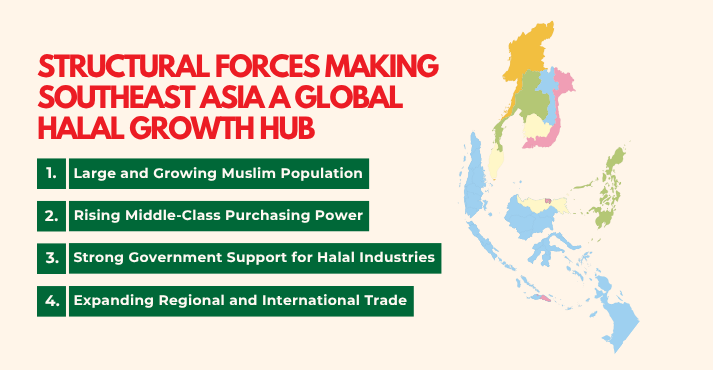
Several structural forces are converging to establish ASEAN as one of the world’s premier halal food industry markets.
1. Large and Growing Muslim Population
Southeast Asia is home to over 280 million Muslims, with Indonesia standing as the world’s single largest Muslim-majority country.
The population is notably youthful, and such consumers are brand-aware, digitally engaged, and willing to spend on certified, premium products, sustaining demand growth for decades ahead.
2. Rising Middle-Class Purchasing Power
Income growth across ASEAN is shifting preferences toward packaged, branded, and premium halal products. Indonesian per-capita halal spending reached USD 420 in 2024.
As urbanization deepens, households are allocating a greater share of wallet to food safety and quality assurance, areas where certified halal products hold a natural advantage.
3. Strong Government Support for Halal Industries
Halal industry development is a strategic national priority across the region. Indonesia’s BPJPH has mandated full halal certification compliance for food and beverages by October 2026.
Malaysia’s government has invested heavily in halal parks, export promotion, and JAKIM’s global certification network, encompassing mutual recognition agreements with 85 international certifying bodies. These programs directly expand regional production capacity and market access.
4. Expanding Regional and International Trade
ASEAN’s geographic position makes it a natural bridge between halal production and global Muslim consumer markets. Exporters in Malaysia, Indonesia, and Thailand are expanding into the Middle East, GCC, South Asia, and Africa.
Post-pandemic supply chain diversification trends are creating new opportunities for ASEAN producers, while Vietnam and Thailand have established dedicated halal export zones to attract foreign halal investment.
Country Analysis: Leading Halal Food Markets in Southeast Asia
Emerging food markets analysis shows that Southeast Asia is home to some of the world’s most established and fastest-growing food markets.
Indonesia
Indonesia is the world’s largest Muslim-majority country, with approximately 240 million Muslims. Given this, Indonesia’s halal market size was valued at USD 318.91 billion in 2024 and is expected to reach USD 922.57 billion by 2032, at a CAGR of 14.2% during the forecast period.
The country’s mandatory halal certification program, administered by Badan Penyelenggara Jaminan Produk Halal (BPJPH), is strengthening halal compliance across industries.
Indonesia is also a major halal exporter, with government initiatives focused on expanding exports, food manufacturing, and halal value chains.
Malaysia
Malaysia is widely recognized as Southeast Asia’s benchmark for halal certification and exports. Its certification authority, Jabatan Kemajuan Islam Malaysia (JAKIM), enjoys broad international recognition, helping Malaysian halal products access global markets.
Malaysia’s Halal Foods market is USD 36,554.21 million in 2025, projected to reach USD 50,233.88 million by 2034, growing at 4.2% CAGR, driven by strong domestic halal infrastructure.
Also, Malaysia exports halal products to more than 200 countries and continues to invest heavily in halal industry development through national strategies and trade initiatives.
Thailand
Thailand has established itself as one of the region’s leading halal food exporters despite being a Muslim-minority country. Thailand’s halal food market is expected to achieve a growing growth rate of 5.79% by 2027.
The country benefits from a highly developed food-processing industry, particularly in seafood, poultry, rice, and packaged foods.
Government initiatives are actively promoting Thailand as a regional halal hub, while Muslim-friendly tourism continues to support domestic demand. Thailand exports more than 200 billion baht worth of halal products annually, and food accounts for the majority of halal exports.
Singapore
Singapore serves as a premium halal market and an important regional distribution and re-export hub. Singapore’s halal ready meal sales increased 30 percent between 2022 and 2024.
Its advanced logistics infrastructure, food innovation ecosystem, and transparent regulatory environment support halal food imports, distribution, and product development. Growth in e-commerce and food delivery platforms has further improved halal food accessibility across the city-state.
Philippines
The Philippines is gradually expanding its halal ecosystem, particularly in Mindanao, where government agencies have promoted halal certification and halal industry development.
Philippines halal food market is expected to reach USD 1,22,737.7 million by 2034, exhibiting a growth rate (CAGR) of 8.20% during 2026-2034. The country sees halal products as a strategic export opportunity while serving its domestic Muslim population.
Fastest Growing Halal Food Categories in Southeast Asia

As consumer preferences evolve and halal products become increasingly mainstream, several food categories are experiencing accelerated growth across Southeast Asia.
Rising disposable incomes, urbanization, health-conscious consumption, and expanding retail and e-commerce channels are creating new opportunities for halal food manufacturers and suppliers.
Halal Packaged Foods
Convenience-driven consumption and the expansion of modern retail formats are fueling demand for halal packaged foods across the region.
In 2023, more than 35% of new packaged food products launched in Southeast Asia carried halal certification, highlighting the growing integration of halal standards into mainstream food and beverage offerings.
Halal Meat and Poultry
Halal meat, poultry, and seafood remain the foundation of the halal food industry.
Southeast Asia is both a major producer and importer of halal-certified protein, with significant imports of beef and lamb from countries such as Australia, New Zealand, and Brazil. This creates substantial opportunities throughout the regional supply chain, from processing and distribution to retail and foodservice.
Halal Beverages
The halal beverage segment is expanding rapidly, driven by growing demand for functional drinks, health-focused beverages, and ready-to-drink products.
Categories such as plant-based beverages, fortified drinks, and low-sugar alternatives are gaining traction as consumers increasingly seek products that combine halal assurance with wellness benefits.
Ready-to-Eat and Convenience Foods
Urbanization, busier lifestyles, and the rise of food delivery platforms are accelerating demand for ready-to-eat halal meals and convenience foods.
Younger consumers, in particular, are driving growth through digital purchasing channels, making convenience one of the strongest growth drivers in the regional halal food market.
Functional and Health-Focused Halal Foods
Clean-label, organic, high-protein, and nutritionally enhanced halal products are emerging as some of the fastest-growing and highest-value segments.
As consumers place greater emphasis on health, transparency, and sustainability, food manufacturers are increasingly combining halal certification with wellness-focused product positioning to capture premium market demand.
Consumer Trends Reshaping the ASEAN Halal Food Industry
Today’s halal buyers increasingly prioritize quality, convenience, transparency, sustainability, and digital accessibility, prompting food manufacturers and retailers to adapt their products, supply chains, and marketing strategies to meet changing market demands.
Premiumization of Halal Products
Muslim consumers are increasingly willing to pay more for certified quality and brand trust, creating differentiation opportunities for producers that invest in verifiable standards.
Digital Commerce and Online Food Purchasing
E-commerce, delivery apps, and mobile-first purchasing are expanding halal food access beyond major urban centers, making digital channel strategy essential for any brand competing in the ASEAN halal food industry.
Demand for Transparency and Traceability
Consumers want visibility into ingredient sourcing and production methods. Blockchain traceability and smart packaging are attracting significant investment, reinforcing the importance of sustainable food supply chain practices.
Sustainability and Ethical Consumption
Halal’s inherent emphasis on ethical treatment of animals and ingredient integrity aligns naturally with ESG values, giving forward-looking brands a powerful dual positioning around religious compliance and environmental responsibility.
Halal Certification Landscape Across Southeast Asia
Halal certification in Southeast Asia is one of the most critical drivers of growth. It does more than confirm religious compliance; it builds consumer trust, enables cross-border trade, and determines whether a product can enter key retail and export channels.
Malaysia’s JAKIM
JAKIM sets the global halal certification standard. Its 85-country mutual recognition network makes Malaysian certification the most effective export credential available to ASEAN producers, reducing market access barriers across the Middle East, Europe, and beyond.
Indonesia’s BPJPH
Mandatory halal compliance for the ASEAN food and beverage market by October 2026 is one of the most significant regulatory developments in the region. For manufacturers, it creates both compliance obligations and a more formalized, standardized competitive environment across Indonesia’s vast domestic market.
Certification Differences Across ASEAN
Each ASEAN country maintains its own certifying body: Thailand’s CICOT, Singapore’s MUIS, and the Philippines’ IDCP, with varying requirements and processes. These differences create compliance complexity and cross-border trade friction, though ASEAN’s 2024 mutual recognition push is beginning to ease some of these barriers.
Why Certification Is Becoming a Competitive Advantage
Certification now determines retail access, export eligibility, consumer trust, and brand positioning. In competitive halal food categories, the credibility of the certifying body is itself a brand asset, not a compliance checkbox.
Investment Opportunities in the Southeast Asia Halal Food Market
Investment in the Southeast Asia halal food sector is expanding rapidly as rising consumer demand, regulatory tightening, and export growth reshape the industry.
Food Manufacturing Expansion
Production capacity in Indonesia, Malaysia, and Thailand is scaling to meet domestic demand and export ambitions. Halal industrial parks offer co-location infrastructure and government incentives for new entrants.
Halal Ingredients and Supply Chains
Ingredient sourcing, cold chain logistics, and traceability solutions represent high-value infrastructure opportunities across a market that remains structurally import-dependent for several key commodity categories.
Food Technology and Innovation
Smart manufacturing, digital halal verification systems, and food safety technologies are attracting both venture capital and strategic investment from global food corporations seeking exposure to ASEAN halal consumption growth.
Export-Oriented Halal Businesses
Positioning ASEAN halal production for Middle East and GCC demand offers premium pricing and volume scale. Halal food export opportunities in ASEAN continue to grow as importing markets seek supply chain diversification away from traditional sources.
Challenges Facing the Southeast Asia Halal Food Industry

Despite strong growth potential, the halal food industry in ASEAN faces several structural challenges that can slow expansion and increase operating complexity.
Certification Complexity
Divergent national standards, compliance costs, and varying market entry requirements across ASEAN remain the most commonly cited barriers for brands operating or expanding across the region.
Supply Chain Integrity Risks
Approximately 15% of halal products globally involve some form of mislabeling, with Southeast Asia among the highest-risk regions. Investing in traceability and supply chain transparency is essential to managing this risk.
Regulatory Variations Between Countries
Inconsistent frameworks across ASEAN member states create compliance burdens that limit the efficiency of cross-border halal food trade and raise market entry costs for producers.
Increasing Competition
Both domestic brands and multinational food corporations are building dedicated halal product lines, intensifying pricing pressure and reducing the sustainable advantage of early movers who fail to continue innovating.
Southeast Asia Halal Food Market Forecast Through 2030
The Southeast Asia halal food market is expected to maintain strong and steady expansion through 2030, supported by rising Muslim populations, income growth, and the rapid formalization of food supply chains.
| Year | Estimated Market Size (USD Billion) | CAGR Range | Key Drivers |
| 2025 | 450–520 | — | Urban demand, retail expansion |
| 2026 | 480–550 | 3.5%–9% (regional variation) | Certification tightening, digital commerce |
| 2028 | 600–700 | — | Export growth, processed food expansion |
| 2030 | 700–850+ | 3.5%–9.2% | Demographics, trade integration, tourism recovery |
Note: Figures consolidated from multiple industry forecasts and regional projections showing consistent upward trajectory across ASEAN markets.
The market’s growth to 2030 will be shaped by several structural forces:
- Demographics and population growth
- Income growth and urbanization
- Digital commerce expansion
- Tourism recovery and halal travel demand
- Export-driven growth
Key Takeaways for Food Brands, Investors, and Exporters
- Indonesia is the largest market: 240+ million Muslim consumers and mandatory halal certification creating a formalized, high-growth opportunity.
- Malaysia is the premier export hub and certification benchmark, posting the fastest projected regional CAGR.
- Fastest-growing categories: packaged foods, functional beverages, ready-to-eat meals, and health-focused products.
- Certification priorities: JAKIM for global export access; BPJPH compliance is mandatory for Indonesia market entry.
- E-commerce is the fastest-growing distribution channel, requiring a dedicated digital strategy across platforms.
- Long-term outlook: A sustained 9% CAGR through 2030 makes ASEAN halal food one of the most compelling investment markets globally.
Data Sources
Frequently Asked Questions
What is the current halal food market size in Southeast Asia?
Southeast Asia represents the dominant share of the Asia-Pacific halal F&B market, estimated at approximately USD 524 billion in 2026 and growing at 9.24% CAGR through 2031.
Which ASEAN country has the largest halal food market?
Indonesia leads with over 36% of regional revenue, driven by 240+ million Muslims and a mandatory certification framework fully effective by October 2026.
What is driving halal food demand in Southeast Asia?
Key drivers of halal food demand in Southeast Asia:
- Rapid growth of the Muslim population across Indonesia, Malaysia, and surrounding ASEAN markets
- Increasing middle-class incomes driving demand for premium and packaged halal foods
- Urbanization shifting consumption toward convenience and processed food products
- Strong government support through halal certification frameworks and industrial policies
- Expansion of e-commerce and food delivery platforms improving product accessibility
- Rising trust in halal as a broader symbol of safety, hygiene, and ethical sourcing among non-Muslim consumers
Which halal food categories are growing the fastest?
Fastest-growing halal food categories are:
- Ready-to-eat and ready-to-cook meal solutions
- Functional foods with added nutritional and health benefits
- Halal-certified beverages, including health drinks and fortified products
- Packaged snacks and convenience foods for urban consumers
- Plant-based and alternative protein halal products
- Premium processed meat and poultry products
- Export-oriented halal ingredients for global food manufacturers
How important is halal certification for food brands?
Certification determines retail access, consumer trust, export eligibility, and brand positioning — making it both a compliance requirement and a competitive asset across ASEAN and international markets.
What role does e-commerce play in halal food sales?
E-commerce plays a major role in expanding halal food sales by making certified products easier to access beyond traditional retail stores. Online platforms and delivery apps help consumers find verified halal options, compare brands, and shop from a wider range of products, even in smaller cities. It also allows halal brands to reach new customers quickly, reduce reliance on physical supermarkets, and grow directly through digital marketplaces.
Which ASEAN countries offer the best investment opportunities?
Indonesia and Malaysia lead for near-term investment. Thailand, Vietnam, and the Philippines offer compelling emerging-market opportunities with longer growth horizons.
How does Indonesia compare with Malaysia in the halal food industry?
Indonesia leads in market scale and Muslim consumer population. Malaysia leads in certification credibility, international export infrastructure, and projected growth rate through 2031.
What challenges do halal food manufacturers face in ASEAN?
Key challenges halal food manufacturers face in ASEAN include:
- Different halal certification rules and approval systems across ASEAN countries
- High compliance and certification costs for manufacturers operating in multiple markets
- Supply chain traceability issues, especially for imported ingredients
- Risk of cross-border contamination or loss of halal integrity in logistics
- Inconsistent regulatory enforcement and documentation requirements between countries
- Strong competition from established local producers and global food corporations
- Pricing pressure as more players enter the halal-certified food segment
What is the outlook for the Southeast Asia halal food market through 2030?
The halal food market in Southeast Asia from 2026 through 2030 is forecast to grow at a sustained CAGR of approximately 9%, driven by demographics, digital commerce, income growth, and expanding halal export trade, confirming ASEAN as one of the most strategically important halal food markets in the world.