The Story Everyone is Telling
The headline story coming out of FHA 2026’s Young Chefs Grand Prix, contestants sourcing ingredients relay-race style before the cook-off, was framed as a showcase of Asia’s rising culinary generation. Hundreds of competitors from Australia, Korea, Singapore, Sri Lanka, Thailand, the UAE, and the United States. Cross-cultural technique on display. A living argument that fusion cuisine has arrived in Asian food and beverage.
That story is accurate. It is also the wrong story.
Where the Story Breaks Down
Watch what was actually being selected in those relay-race sourcing runs. The chefs weren’t searching through the hall for novelty. They were solving procurement problems at speed: which proteins had the right yield for the fusion cuisine, which imported ingredients were available in sufficient quantity, and which substitutions worked when the primary item ran out.
The competition format, source first, cook second, turned out to be an almost perfect metaphor for what’s happening inside Asian hotel F&B more broadly. The creativity isn’t the constraint. The supply chain is.
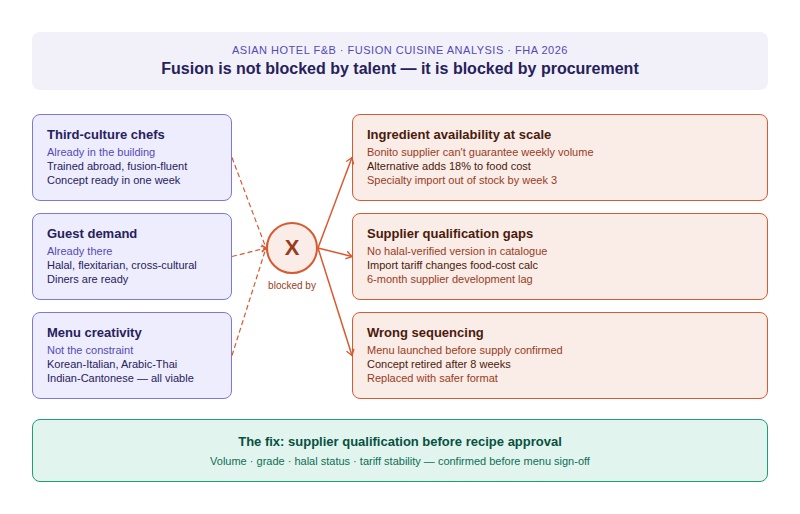
Walk into the equivalent conversation at a Bangkok or Jakarta hotel group right now, and you will hear the same thing. The culinary director wants to run a Thai-Japanese brunch concept. The procurement lead is explaining why the bonito supplier can’t guarantee weekly volume at the required grade, and why the alternative either breaks the dish or adds 18% to the food and beverage costs.
The concept doesn’t fail because the chef lacks imagination. It fails because fusion at hotel scale lives and dies on ingredient availability, and most hotel F&B strategy documents still treat that as an implementation detail.
The Thesis
Cross-cultural fusion cuisine in Asian hotel F&B is not blocked by talent or even guest demand. It is blocked by procurement architecture, and the hotels that solve for sourcing infrastructure before launching fusion concepts will outperform those that launch on creativity and patch supply problems after the menu is already on the table.
Five Signals From the Floor
1. The third-culture chef is already in the building, but the supplier relationship isn’t
The generation of Asian chefs now moving into culinary director roles at mid-tier hotel properties is, by background, already fusion-fluent.
Thitid “Ton” Tassanakajohn at Le Du and Nusara in Bangkok, Kang Min-goo at Mingles in Seoul, Han Li Guang at Labyrinth in Singapore, these are the leading edge of a cohort trained abroad, drawing on Asian heritage, and operating comfortably across culinary traditions.
The hotels with this profile at the chef level often have not extended the same investment to procurement. A third-culture chef from Asia designing a Korean-Italian menu can produce the concept in a week. Confirming that gochujang is available in bulk at a consistent grade, and that the Korean pear supplier can deliver on a weekly cadence.
And that the cheese import tariff structure doesn’t change the food-cost calculation, which takes two to three sourcing cycles, or roughly six months of active supplier development.
Because these chef-driven food concepts aren’t generic, as their creations defend brand differentiation. The talent is ready. The procurement infrastructure usually is not.
2. FHA 2026 was a direct argument for supplier development before menu development
The floor logic at FHA 2026 made this sequencing visible. IndusFood Asia’s debut in Hall 9, India’s first dedicated pavilion at the show, brought exactly the ingredient categories that Asian hotel F&B directors say they need for new fusion formats: halal-certified dairy, fresh citrus and herbs, specialty spice concentrations, paneer, and ghee in foodservice quantities.
These were not niche items for a few experimental properties. These were volume categories that have been functionally inaccessible to most Southeast Asian hotel kitchens until supply partnerships exist.
Equally, the EU’s “Region of Honour” designation at FHA 2026 was doing the same work on the European side, making hard cheeses, charcuterie, and olive oils available in the buyer-supplier conversations that produce actual contracts, not just menu inspiration.
Japanese-French fusion in Singapore became a viable hotel-menu format once katsuobushi and miso reached reliable bulk availability. The FHA floor was showing the next version of that sequence: Indian, Indonesian, and other South and Southeast Asian ingredient categories becoming procurement-stable for the first time.
3. Bangkok and Seoul are outperforming Singapore and Tokyo on fusion precisely because they built supply pipelines first
Asia’s 50 Best 2026 is doing something the hospitality trade press hasn’t fully processed yet: Bangkok now has multiple placements in the top 10, including Nusara, Gaggan, and Gaggan at Louis Vuitton.
Seoul has Mingles and Onjium in the top 15. Singapore and Tokyo remain strong, but the energy. and the commercial replication into casual-tier dining is concentrated in Bangkok and Seoul.
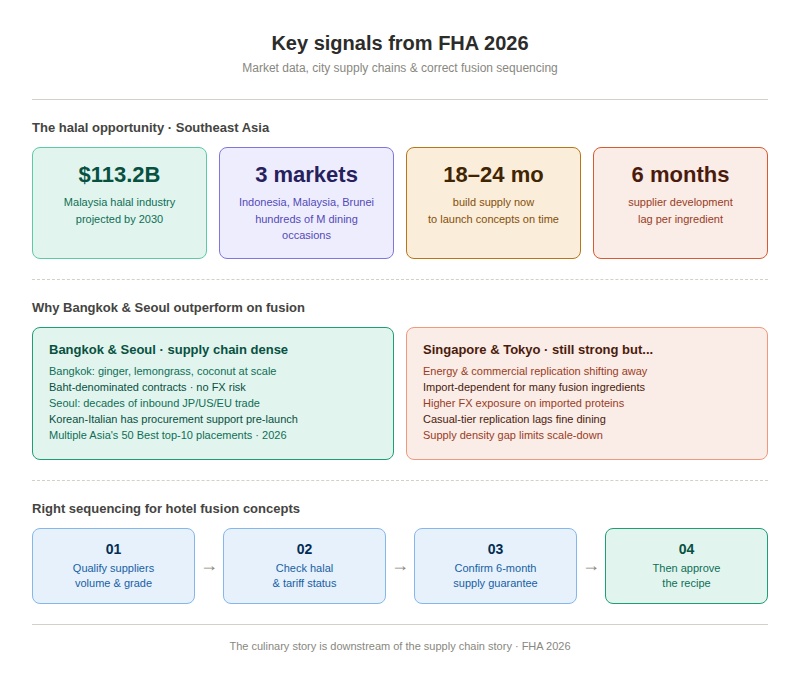
The operational reason is food supply chain density. Bangkok’s mature domestic sourcing ecosystem, with ginger, lemongrass, coconut, and fresh seafood available at scale, at quality, in baht-denominated contracts, means chefs there are working with a reliable ingredient base rather than patching supply gaps.
Seoul’s food import infrastructure, built over decades of inbound Japanese, American, and European ingredient trade, means a Korean-Italian or Korean-French concept has procurement support before it opens.
Ms. Maria & Mr. Singh in Bangkok, which fuses Malay and Indian flavors at mid-market price points, is not a fine-dining experiment, it is a commercially operational concept that works because its supply lines work. That is the model hotel groups should be studying.
4. The halal fusion gap is a procurement gap, not a concept gap
The largest underserved fusion opportunity in Asian hotel F&B is halal cuisine, and the reason it is underserved is not creative: it is sourcing. Indonesia, Malaysia, and Brunei represent hundreds of millions of dining occasions.
Sizable Muslim populations in Singapore, Thailand, and the Philippines extend that further. Malaysia’s halal industry is projected to reach USD 113.2 billion by 2030. Hotel F&B’s share of that depends on two things: certification and ingredient access.
Certification is a process. Ingredient access is a supply chain decision. A halal-certified F&B manager at an Indonesian or Malaysian hotel can build a fully fusionized menu, Arabic-Thai, Malay-Italian, Indian-Cantonese, the moment halal-verified versions of the required ingredients exist in the procurement catalogue at the right volume and price point.
A dedicated halal-certified ingredient section by suppliers at FHA 2026 was the real shift, preparing to serve that market. The hotel operators who build sourcing relationships now will be positioned to launch concepts in 18 to 24 months. The ones who wait for the concept to materialize first will spend six months discovering that the supply doesn’t exist yet.
5. Whole-menu fusion at hotel scale requires supplier pre-qualification before recipe approval
This is the operational point the industry mostly avoids discussing directly: a fusion dish that works in a 12-cover tasting menu kitchen does not automatically work in a 200-cover hotel restaurant.
The ingredient quantities are different. The consistency requirements for a six-day-a-week service are different. The failure mode is not the dish itself; it is the third week of service when the specialty import is out of stock, and the chef is improvising.
The right sequencing is formal supplier qualification before recipe sign-off:
- Can the fusion food cost support this imported ingredient?
- Are import regulations, tariffs, or halal requirements stable?
- Can the supplier guarantee volume at grade for a minimum of six months?
Treating these as post-launch questions is how fusion concepts get quietly retired from hotel menus after eight weeks and replaced with safer formats.
The Counter
The obvious objection is that the finest fusion happening in Asia, at a Nusara or a Mingles level, is not being driven by procurement strategy. It is driven by chefs with deep culinary vision who have earned the trust of owners willing to build supply chains around the food. That is true, and it matters.
World-class tasting-menu kitchens do develop supply chains precisely backward from the dish, and the dishes that result are the leading edge of where Asian cuisine is going.
But the concession is scoped. After the pandemic, high-end tasting-menu restaurants across Asia have operated under significant financial pressure, inflation, rent exposure, and diners’ reluctance to commit to marathon-length meals. The techniques that develop in those kitchens trickle into accessible formats, and the commercial value is realized not in twelve covers but in two hundred.
For hotel F&B operating at volume, which is the FHA buyer base, the procurement-first reading holds: you cannot replicate what Bangkok and Seoul’s best restaurants are doing without first solving for what they solved for, which is ingredient reliability at scale.
Implication for Hotel F&B Directors
Hotel F&B and culinary directors must note that executing fusion at scale is a cross-disciplinary task. Three action items stand out:
Track the FHA Young Chefs Grand Prix cohort as a hiring pipeline
If your culinary lead is trained in only one tradition, you may need to hire or partner differently. Track talent from programs like FHA’s Young Chefs Grand Prix 2026, as their winners and finalists (all under-25) are being groomed to bridge cuisines.
Conduct supplier qualification before recipe development, not after
For each proposed fusion dish, verify ingredient availability at your volume. Conduct formal supplier qualification rounds: Can your fusion food cost handle X imported paste? Are FDA/import regs or halal laws an issue? The hotel F&B director must ask these questions before a recipe is approved. Understanding food and beverage metrics at this stage helps frame the financial case for each sourcing decision.
Build Indian, Southeast Asian, and halal-certified supplier relationships now
If your property isn’t halal-certified in a Muslim-majority or significant-Muslim market, calculate the lost revenue. Obtaining halal certification may involve cost, but it removes a gating factor. Once certified, a hotel can confidently open fusion concepts to the Muslim demographic. Understanding religious dietary preferences across APAC is an important first step before designing the menu.
The Forward Look
In the coming few months, watch for specific leading indicators of where fusion cuisine is headed: YCGP 2026 winner’s story: which fusion will they be known for, and which city or hotel picks them up?
That will hint at the future of the food industry and market direction. If the next FHA editions see more Indian spice and specialty exhibitors, expect new menu trends in Southeast Asian hotels.
And on the corporate side, review the Q3/4 2026 earnings of major APAC hotel groups. If their investor calls start mentioning menu investment, adapting culinary trends, or even F&B profitability, that will confirm hotels are treating fusion as a strategic growth lever, not just PR.
The culinary story is downstream of the supply chain story.