The Setup
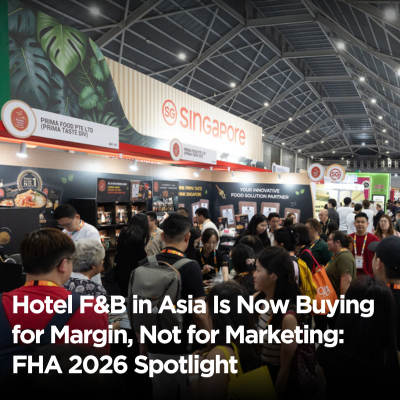
Food Hotel Asia (FHA 2026), convened April 21–24 at the Singapore EXPO, drawing 2,750+ exhibitors from 110+ countries and 80,000+ industry attendees, framed in the run-up by the usual story: Asian consumers are getting more demanding, and operators have to keep up.
Functional ingredients, plant-based formats, sustainable sourcing, and zero-waste kitchen design were the most revealing conversations at Food Hotel Asia 2026. Operators in Asia are racing to meet a more discerning guest.
That shift says more about the future of the food industry behind the event coverage. By looking for patterns and contradictions among exhibitors, speakers, and buyers, these operational trends are not hype-fueled narratives, but strategic directions worth working on.
The Crack in it
Walk the procurement-heavy halls, Hall 6 in particular, where ingredient suppliers and hotel buyers do their actual negotiating, and the language was different. Buyers from Bangkok, Indonesia, and Singapore-based hotel groups were not asking suppliers about consumer trends. They were asking about cold-chain telemetry SLAs, baht-denominated contracts, and yield ratios on whole-fish purchasing. The conversations sounded less like 2019 and more like a CFO call. Procurement leads who in past editions opened with menu trends were opening with input-cost exposure.
The Thesis
FHA 2026 confirmed that the trends being adopted by Asian hotel F&B operators in 2026: functional ingredients, second-wave plant-based, cold-chain verification, hyper-local sourcing, and whole-product utilization, are being driven by margin pressures and supply-chain risk, not only by guest demand. Operators chasing the consumer narrative will misallocate menu R&D budget. F&B procurement teams will gain a structural cost advantage over the next 18 months.
The Evidence

Asia F&B industry trends 2026 are not the loudest, but patterns are repeated across booths, conversations, and discussions, regardless of category or geography.
1. Functional ingredients are being adopted because the price gap closed, not because guests asked
Adaptogenic herbs, prebiotic fibers, and low-glycemic sweeteners are finally edging off the menu of juice-bar SKUs into mainstream kitchens in Singapore, Kuala Lumpur, and Seoul, but the trigger is supplier pricing, not guest surveys.
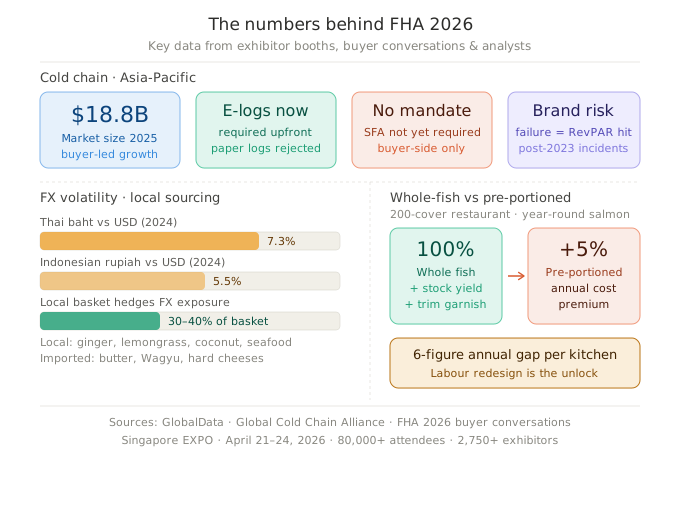
Allulose and stevia-blend sweeteners hit price parity with refined sugar in bulk foodservice formats over the past 18 months. At FHA, lion’s mane and ashwagandha extracts were quoted at roughly 30–40% lower price points than two years prior, making them viable for everyday menus, not just wellness-concept restaurants.
The functional foods market commands around 47% of the global market, but that figure aggregates Japan, Korea, China, and Southeast Asia into a single headline that masks genuinely different buying behaviour.
Japanese and Korean operators have been formulating with functional ingredients for decades. Southeast Asian hotel adoption is new, and it’s happening because the unit cost finally pencils out.
Consumer sentiment reinforces the case. “The commercial relevance of functional foodservice is reinforced by consumer sentiment,” notes Savitha Kruttiventi, Consumer Analyst at GlobalData.
But sentiment follows supply. Operators weren’t waiting for guests to ask, they moved when the margin made sense. Which raises the real operational question: not should we add ashwagandha to everything, but how do we do it in a way that complements the cuisine rather than feeling like medicine?
2. Plant-based abandoned the Western analogue, and that is the bullish read, not the bearish one
The first wave of plant-based in Asia was built on a Western premise: that Asian consumers would pay a premium for analogue meat in burger and sausage formats. They didn’t. Beyond Meat has scaled back parts of its Asia operations. The category didn’t break, the playbook did.
At FHA 2026, the plant-based booths that drew buyer crowds were not selling analogue meat. They were selling dumpling fillings, broth bases, and tofu-protein systems designed to drop into existing Asian menu formats.
Indonesian hotel groups are testing plant-based rendang for buffet service, where the dish has to sit in a chafing dish for three hours without separating, a constraint. Beyond burgers were never engineered for.
Japanese hotel restaurants are using plant-based chawanmushi to handle mixed-diet group bookings without splitting the menu into a vegan annex. The flexitarian diet framing matters here: the guest isn’t asking for a vegan option, they’re part of a mixed table that the kitchen needs to serve from one menu.
“It means there is room for growth, and addressing food diversity brings nothing but possibilities and opportunities.” — Chef Kusumoto Katsumi, SAIDO, Tokyo.
The point is whether the new wave of plant-based in Asia solves real kitchen problem (serving a flexitarian group from one menu) rather than a values problem (offering a vegan option). That is a procurement win, not a marketing win.
The lesson: food industry trends in Asia are not monolithic.
3. Cold-chain verification is now a gating question, not a closing question
Two FHA editions ago, hotel procurement teams asked about cold-chain handling at the contract stage. At FHA 2026, they were asking about it at the first meeting.
Also, several Singapore and Bangkok hotel groups confirmed they now require electronic temperature logs, not signed paper logs, not photographed thermometer readings, as a prerequisite to quoting on protein and dairy contracts. Suppliers without telemetry are being disqualified before price is discussed.
The driver is risk pricing, not regulation. The Singapore Food Agency has not mandated electronic logging; the ASEAN cold-chain logistics market is sized at around USD 18.8 billion in 2025, with growth into 2026 driven by buyer-side investment, not regulator-side enforcement. Singapore’s SFA food regulation framework sets the floor; hotel groups are now well above it on their own initiative.
What changed is the post-incident liability calculus: after several high-visibility contamination events in Singapore and Thailand between 2023 and 2025, hotel groups have internalised that a cold-chain failure is no longer an ops headache; it is a brand event with measurable RevPAR consequences.
That marks a structural shift in cold chain food sourcing in Asia. And the macro pressure is clear.
“Across the Asia-Pacific region, demand for investment in temperature-controlled logistics and storage continues to accelerate,” says Adam Thocher, Senior Vice President, Global Cold Chain Alliance.
For hotel operators sourcing ingredients from 187 countries, that acceleration is not abstract; it is the infrastructure their procurement decisions now depend on.
4. Hyper-local sourcing in Thailand, Vietnam, and Indonesia is FX hedging dressed as a sustainability story
The cleanest signal at FHA 2026 came from Thai, Vietnamese, and Indonesian procurement teams talking about local sourcing in the language of treasury management.
Thai baht volatility against the US dollar hit roughly 7.3% in 2024, materially above the Indonesian rupiah at around 5.5%. Hotel groups buying imported butter, beef, and dairy in USD-denominated contracts were absorbing two-digit input-cost swings on items they could not reprice without disturbing the rate card.
The response is a hybrid model, not the all-local sustainability fantasy that gets written about in consumer media. Bangkok hotel groups are localising the items where Thai supply is mature and scaled (ginger, lemongrass, coconut, certain seafoods) while continuing to import the items where local supply is unreliable in volume or grade (Austrian butter, Wagyu, hard cheeses). The case for local and seasonal ingredients in Asian hotel kitchens is now being made by the finance team, not the sustainability team.
The locally-sourced items are paid for in baht, hedging FX exposure on roughly 30–40% of the procurement basket. The marketing department gets the story; the CFO gets the variance reduction.
5. Whole-product utilisation is the food-cost play, but it is gated by knife skills
Suppliers at FHA 2026 were actively pitching whole fish, primal cuts, and untrimmed produce to hotel buyers, and the buyers were listening, because the math has shifted.
Hotel groups that have run the analysis are finding that pre-portioned salmon increases annual fish cost by approximately 5% versus whole-fish purchasing, even before accounting for stock and garnish yield from bones, heads, and trim. For a 200-cover hotel restaurant running salmon as a year-round menu item, that is a six-figure annual delta. How to control your restaurant’s food cost has a useful framework for modelling exactly this kind of make-vs-buy decision at the protein level.
The gating constraint is labour, and it connects to the structural hotel labor shortage across Singapore, Hong Kong, and Tokyo that operators have been describing as cyclical for five years, and which is in fact permanent.
The trade-off is labour skill. Breaking down a whole tuna is a 90-minute skill that culinary schools across the region are producing fewer graduates capable of doing each year.
Hotel groups that have solved for it, through dedicated butchery stations, cross-training programmes, or off-site primary processing, are treating it as a competitive moat. The economics work, but only for operators who invest in the labour redesign first.
The Counter-Argument
The strongest case against the margin-first reading is not that Gen Z surveys are influencing menus, that is the easy version, and it dies on contact with transaction data. Gen Z food trends do shape what ends up on menus eventually, but the causal chain runs through the P&L, not through the focus group.
The harder version is this: in premium urban Asian markets, Singapore, Hong Kong, Tokyo, Seoul, guest expectation is a margin lever. A five-star hotel restaurant that does not offer credible plant-based, functional, or hyper-local options gets discounted on TripAdvisor and Google Reviews, which feeds RevPAR through booking conversion, which is the metric the GM is actually compensated on.
In that world, “procurement is leading” and “consumers are driving” collapse into the same decision: the consumer signal arrives via the P&L rather than via a survey.
That is a fair partial concession. The thesis holds most cleanly for mid-tier hotel groups, urban casual concepts, and hotel groups operating outside the top three or four ratings tiers in tier-one cities.
For top-end Singapore and Hong Kong properties, the procurement and guest-expectation arrows point the same way, and the question of which is upstream is academic. The piece is most useful for the operators where the two diverge, and that is most of the FHA buyer base.
The Implications for Hotel F&B Procurement Leads
 Hotel F&B procurement leads should take these signals as actionable priorities:
Move cold-chain telemetry into supplier qualification, not contract negotiation
Add electronic temperature logging as a prerequisite for RFP participation in the protein, dairy, and ready-to-eat categories. Suppliers that cannot meet this within 90 days are not going to meet it in 12 months. The investment cycle on telemetry is long enough that you can read the signal now.
Build the local-supplier pipeline 18 months before you need it
In Thailand, Vietnam, and Indonesia, local sourcing partnerships for produce, fresh seafood, and selected proteins take two to three sourcing cycles to stabilise on volume and grade. Start now, even if only one menu item moves locally in the first cycle; the FX hedge does not work as an emergency measure.
Pilot whole-product utilisation on one menu section, not the whole kitchen
Pick the highest-volume protein on your menu, move it to whole-product purchasing for 60 days, and measure food and beverage costs percentage against a comparable pre-portioned section. The labour redesign question becomes answerable with data rather than instinct, and the ROI argument for cross-training stops being theoretical.
Forward Look
Three signals will tell us whether the margin-first reading of FHA 2026 holds up by FHA 2027.
First, watch the next two earnings cycles from Minor International, Mandarin Oriental, and Café de Coral for explicit language linking F&B procurement to margin protection or FX hedging, if that language appears in the prepared remarks rather than the Q&A, hyper-local has moved from operator initiative to investor-grade strategy.
Second, watch whether the Singapore Food Agency or Malaysia’s MOH moves toward mandatory electronic cold-chain logging for institutional foodservice; buyer-side adoption is already there, regulator-side adoption would close the loop.
Third, watch the FutureFWD startup cohort. If a meaningful share of the 2026 tech exhibitors are not at FHA 2027, the over-build-under-adopt read of hospitality technology trends (which sits behind several of these procurement shifts) will have its first measurable confirmation.
The broader pattern is one we will keep tracking from the vantage point that 80,000 buyers and 2,750 brands give us: in Asian hotel F&B, the consumer story is downstream of the procurement story, and the publications that get this backwards will keep writing recap pieces that age badly.