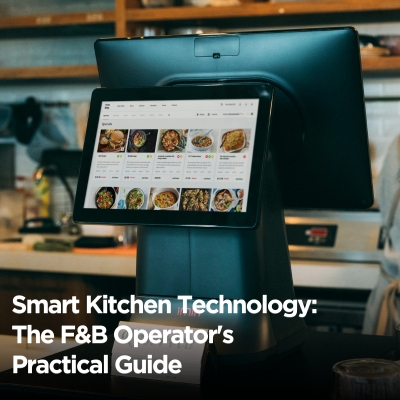
Asia’s food and beverage industry is under mounting operational pressure. Labour costs are climbing across markets from Singapore to South Korea. Qualified kitchen staff are increasingly difficult to recruit and retain. Food prices remain volatile. Energy bills are rising.
And customers, shaped by on-demand digital experiences, now expect fast, accurate, consistent service whether they are dining in, ordering delivery, or grabbing a quick meal.
These pressures are forcing operators to rethink how their kitchens function.
As a result, smart kitchen technology is not a futuristic concept reserved for large chains with deep pockets. It is a collection of connected equipment, automation tools, software platforms, sensors, and data systems that work together to improve how commercial kitchens perform, right now, with proven results.
This smart kitchen technology guide for Asia is designed to help F&B operators, from independent restaurants and hotel kitchens to cloud kitchens and multi-unit groups, understand the practical tools available, evaluate which investments deliver the strongest returns, and build a clear path toward smarter, more efficient operations.
What Is Smart Kitchen Technology?
Smart kitchen technology in a commercial foodservice refers to the integration of connected devices, software platforms, IoT sensors, and automation systems that communicate with each other to improve kitchen performance.
Unlike consumer smart kitchens that focus on convenience, commercial systems are designed for durability, scalability, and regulatory compliance. Key building blocks include:
- Internet of Things (IoT) sensors embedded in ovens, refrigerators, fryers, dishwashers, and other appliances that send data on temperature, usage patterns, and maintenance needs to cloud platforms.
- Kitchen management software that integrates with point‑of‑sale (POS) systems, inventory platforms, and scheduling tools to provide a single source of truth for orders, production status, and performance metrics.
- Automation and robotics, such as automatic fryers, smart combination ovens, portioning dispensers, and robotic arms that handle repetitive or hazardous tasks.
- Artificial intelligence and predictive analytics that analyse historical sales, weather patterns, and events to forecast demand, optimise labour scheduling, and minimise food waste.
In a connected kitchen ecosystem, data flows seamlessly between equipment, sensors, and software.
For example, a smart oven automatically adjusts cooking parameters based on recipe settings and monitors internal temperature, sending alerts to a kitchen display system when food is ready. Such real‑time visibility reduces guesswork and enables managers to make data‑driven decisions.
Why Smart Kitchen Technology Is Becoming Essential for F&B Operators
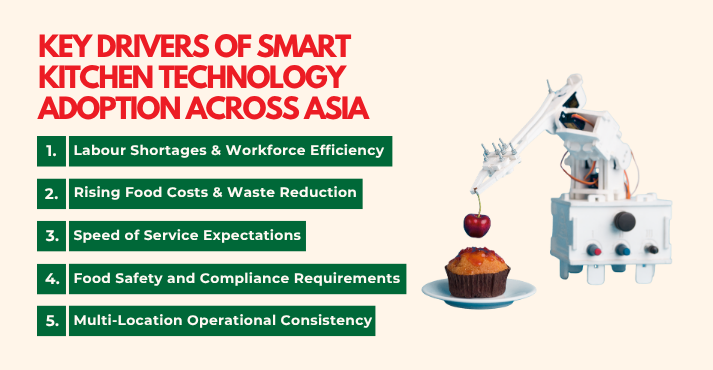
Smart kitchen systems for restaurants are no longer optional; they address critical industry challenges ranging from labour shortages to food waste and the need for speed.
Key drivers of smart kitchen technology adoption across F&B operators in Asia are:
Labour Shortages and Workforce Efficiency
Staffing challenges are acute across Asia’s hospitality and foodservice sectors. High turnover, rising wages, and a shrinking pool of experienced kitchen workers are making it harder for operators to maintain service quality. Despite this, F&B operators believe that technology will augment rather than replace human labour.
Restaurant kitchen automation tools address this by handling repetitive, time-intensive tasks, precise temperature control, cooking cycle monitoring, and inventory counts, allowing a leaner team to manage higher production volumes without sacrificing consistency.
Rising Food Costs and Waste Reduction
Food costs across the region have increased significantly in recent years, making waste reduction a direct profitability lever. Smart kitchen systems give operators real-time inventory visibility, automated expiration tracking, and data-driven forecasting that reduces over-purchasing.
For example, portion control systems ensure ingredients are used efficiently, while AI-powered restaurant kitchens can analyze consumption patterns to sharpen purchasing decisions and reduce spoilage.
Speed of Service Expectations
Consumer expectations for speed have accelerated. Whether ordering through a delivery app or walking into a quick-service restaurant, customers expect meals to arrive quickly and correctly.
In response, automation improves order flow, reduces production delays, and ensures the kitchen keeps pace with demand, directly supporting customer satisfaction and repeat business.
Food Safety and Compliance Requirements
Temperature monitoring, HACCP compliance, and audit-ready record keeping are non-negotiable for commercial kitchens. Smart refrigeration systems and connected cooking equipment automate data logging, generate compliance reports, and trigger alerts when parameters fall outside acceptable ranges, replacing manual checks that are time-consuming and prone to human error.
For F&B operators navigating Singapore’s SFA requirements, Hong Kong’s FEHD standards, or any other regional food safety framework, automated compliance tracking reduces risk and administrative burden.
Multi-Location Operational Consistency
As restaurant groups expand across cities or countries, maintaining consistent food quality and operational standards becomes a significant challenge.
As a result, centralized kitchen management software allows operators to push standardized recipes, monitor performance across all locations, and identify underperforming sites from a single dashboard.
Core Components of a Smart Commercial Kitchen

Smart kitchens combine several technology categories, such as:
Smart Cooking Equipment
Modern commercial kitchen IoT solutions include smart ovens, combination ovens, connected fryers, and automated grills that can be monitored and controlled remotely.
These units store and execute programmed recipes with precision, generate predictive maintenance alerts before equipment failures occur, and optimize energy consumption based on production schedules.
| Technology | Key Features | Primary Benefit | Business Outcome |
| Smart Ovens | Recipe automation, remote monitoring | Cooking consistency | Reduced waste, faster production |
| Combination Ovens | Multi-mode cooking, energy management | Versatility and efficiency | Lower energy costs |
| Connected Fryers | Temperature precision, oil management | Quality control | Less oil waste, compliance |
| Automated Grills | Programmable cycles, alerts | Labour reduction | Consistent output with fewer staff |
Kitchen Display Systems (KDS)
Kitchen display systems replace paper tickets with real-time digital order management. Orders flow directly from the POS or delivery platforms to screens positioned at each production station.
This eliminates miscommunication between front-of-house and kitchen, reduces production delays, improves ticket accuracy, and gives kitchen managers live visibility into order status and timing.
For high-volume operations, KDS is often the fastest-payback investment in the smart kitchen category.
Smart Refrigeration Systems
Connected refrigeration units monitor temperature continuously, generate compliance-ready logs, and send real-time alerts when temperatures drift outside safe ranges.
Beyond food safety, these systems track equipment health and flag early signs of mechanical issues, supporting preventive maintenance schedules that reduce costly emergency repairs and equipment downtime.
Inventory Management Platforms
Automated inventory tracking platforms connect purchasing, receiving, and production data to give operators a live view of stock levels, ingredient usage, and waste.
Forecasting tools use historical sales data to predict future demand, reducing over-ordering and the food waste that follows.
For operators managing tight food cost margins, particularly relevant across competitive Asian markets, inventory management software is a core profitability tool.
Restaurant POS Integration
A smart kitchen ecosystem depends on clean data integration between the POS, ordering platforms, delivery apps, and back-of-house systems.
When these platforms share data in real time, operators gain accurate demand signals, synchronized inventory records, and reporting that reflects true operational performance rather than siloed snapshots.
Workforce Management and Labour Optimisation Tools
Labour scheduling software uses sales forecasting data to build optimized shift schedules that align staffing levels with anticipated demand. Productivity tracking tools identify inefficiencies, while performance reporting helps operators make informed staffing decisions. These tools directly support margin improvement.
AI and Predictive Analytics
AI is transforming the hospitality industry, as the F&B operators integrate machine learning to improve demand forecasting, optimize menu mix, predict inventory needs, and schedule preventive equipment maintenance.
These are not speculative capabilities as they are available today through a growing range of kitchen management software platforms and are increasingly accessible to mid-market operators.
The Business Benefits of Smart Kitchen Technology
Adopting connected kitchen technology produces measurable outcomes across the operation.
- Improved Kitchen Efficiency: Automation eliminates manual bottlenecks, streamlines production workflows, and keeps the kitchen running at consistent throughput during peak service periods.
- Reduced Labour Costs: Task automation and optimized scheduling allow operators to deploy staff more effectively, doing more with the same team, rather than simply cutting headcount.
- Better Order Accuracy: Digital workflows and standardized production processes reduce the communication errors that lead to remakes, wasted food, and frustrated customers.
- Lower Food Waste: Inventory visibility, consumption forecasting, portion controls, and expiration tracking work together to reduce waste across the supply chain, a meaningful cost saving in any operation.
- Stronger Food Safety Compliance: Automated monitoring and digital record keeping replace error-prone manual logs, making audits faster and compliance management more reliable.
- Energy Savings and Sustainability: Smart appliances optimize energy consumption based on actual usage patterns. Combined with better demand forecasting that reduces unnecessary equipment runtime, operators can meaningfully lower their energy expenditure and improve their sustainability profile.
Which Smart Kitchen Technologies Deliver the Highest ROI?
Operators often ask which tools deliver the greatest return on investment. The table below compares core technologies by benefit, impact area, and implementation complexity:
| Technology | Primary benefit | Typical impact area | Implementation complexity |
| Kitchen Display Systems (KDS) | Eliminates paper tickets, improves order accuracy, and speeds up production | Service speed, order accuracy | Low: Requires integration with existing POS; training is simple |
| Inventory management software | Provides real‑time stock visibility and demand forecasting; reduces over‑ordering and waste | Food cost, waste reduction | Low to moderate: Depends on data integration and staff training |
| Smart refrigeration | Continuous temperature monitoring, real‑time alerts, compliance reporting | Food safety, spoilage reduction | Moderate: Requires IoT sensors and network connectivity |
| Smart ovens and cooking equipment | Recipe automation, remote monitoring, energy efficiency | Food quality, energy savings | Moderate to high: Involves capital expenditure and staff training |
| AI forecasting tools | Predicts demand, optimises inventory and labour, and reduces waste | Sales forecasting, labour scheduling | High: Requires data integration and analytics expertise |
| Labour management software | Automates scheduling and time tracking, improves productivity | Labour cost, employee satisfaction | Low: Cloud‑based solutions are easy to deploy |
Here’s what to consider as an F&B operator in Asia to achieve a higher ROI:
Fastest ROI: KDS systems and inventory management platforms typically deliver measurable returns within months of deployment. Both are relatively straightforward to implement and address high-cost operational problems directly.
Long-term strategic investments: Smart cooking equipment and AI forecasting tools require higher upfront investment but deliver compounding operational gains as data accumulates and systems become better calibrated to the operation.
Low-cost starting points: Labour management software and smart refrigeration monitoring are accessible entry points for operators who want to begin building a connected kitchen without committing to a full infrastructure overhaul.
Smart Kitchen Technology Costs: What Operators Should Expect
Investing in connected kitchen technology involves both upfront and ongoing costs. These vary widely based on business size, number of locations, existing infrastructure, and the sophistication of the chosen solutions.
Consider the following cost factors:
- Equipment upgrades: Smart ovens, combination ovens, connected fryers, and energy‑efficient refrigeration units involve significant capital expenditure. Costs depend on capacity, brand, and features.
- Software subscriptions: Kitchen management software, inventory platforms, labour scheduling tools, and AI analytics are often cloud‑based, charged as monthly or annual subscriptions per location or per user.
- Integration requirements: Connecting new systems to existing POS, property‑management, and accounting platforms may require custom development or middleware.
- Installation and training: Hardware installation, configuration, and staff training carry costs. Operators should budget for hands‑on onboarding and ongoing support.
- Maintenance and service: IoT sensors, appliances, and software require regular updates and servicing. Predictive maintenance can reduce unplanned downtime, but need a service plan.
- Scale considerations: Multi‑unit operators may receive volume discounts but also face higher implementation complexity across diverse sites.
How to Prioritize Smart Kitchen Investments
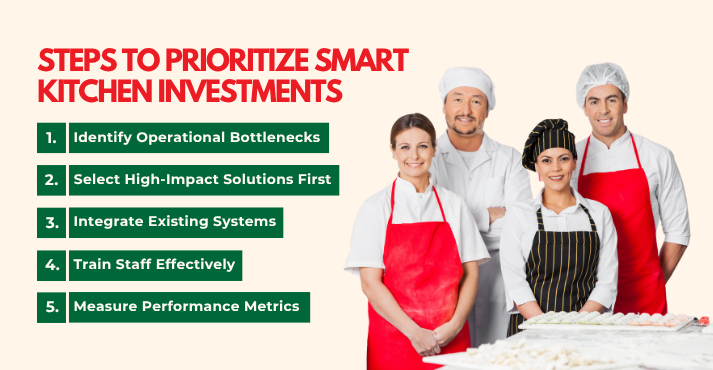
Implementing smart kitchen technology should follow a clear roadmap rather than a scattergun approach. Consider the following steps:
Step 1: Identify Operational Bottlenecks
Start by auditing your kitchen’s pain points:
- Are labour shortages causing slow service?
- Are food costs rising due to spoilage or over‑production?
- Do compliance records consume too much staff time?
Collect data on ticket times, waste levels, and equipment downtime to identify bottlenecks.
Step 2: Select High‑Impact Solutions First
Prioritise technologies that address your most pressing challenges and provide measurable outcomes.
For example, if order accuracy is an issue, implement a KDS. If waste is high, deploy inventory software and portion control systems. Consider the ROI table above when choosing where to invest.
Step 3: Integrate Existing Systems
Ensure that new technology works seamlessly with your current POS, property‑management system, and reporting platforms.
Avoid siloed solutions that create duplicate data entry or conflicting reports. Many vendors offer open APIs or integration partnerships; verify compatibility before purchasing.
Step 4: Train Staff Effectively
Technology adoption fails when staff are not properly prepared. Invest in structured training, designate internal champions who support their colleagues through the transition, and build realistic timelines that account for the learning curve.
Step 5: Measure Performance Metrics
Establish key performance indicators (KPIs) to track the impact of new technologies. Metrics might include ticket times, labour costs, food waste, energy usage, customer satisfaction scores, and equipment uptime. Regularly review data and adjust workflows or settings to optimise results.
Smart Kitchen Technology for Different Types of F&B Businesses
Different segments of the F&B industry have distinct needs.
Quick-Service Restaurants
Speed and throughput are the defining operational priorities. KDS systems, automated cooking equipment, and integrated ordering platforms work together to maximize service velocity while maintaining order accuracy across high transaction volumes.
Full-Service Restaurants
Workflow coordination between multiple kitchen stations, front-of-house communication, and labour management are the primary challenges. Smart kitchen systems support consistent production timing across complex menus and help operators manage labour costs without compromising the guest experience.
Hotel Kitchens
Large-scale production for multiple outlets, banquet operations, and room service demands tight coordination. Connected kitchen systems give hotel F&B teams centralized visibility across all production areas, supporting the future of hospitality operations and the consistency standards that branded hotel properties require.
Cloud Kitchens
Multi-brand operations running from a single kitchen depend on seamless digital integration between ordering platforms, production management, and delivery logistics.
Smart kitchen technology enables cloud kitchen operators to manage multiple brands efficiently, optimize production sequencing, and track performance by brand without dedicated staff for each.
Multi-Unit Restaurant Groups
Centralized oversight, performance benchmarking across locations, and standardized recipe execution are the core requirements.
Hotel industry trends show that multi-site reporting gives group operators the visibility needed to identify outliers, enforce standards, and scale successful practices, critical capabilities as brands expand across Asia.
Common Mistakes Operators Make When Implementing Smart Kitchen Technology
While smart kitchen technology can deliver significant operational benefits, many implementations fail to achieve their full potential due to poor planning and unrealistic expectations.
Buying Technology Without a Clear Business Goal
Technology should solve a defined operational problem, not signal modernity. Operators who invest in smart kitchen systems without identifying the specific outcomes they need to achieve often end up with underused tools and poor ROI.
Ignoring Integration Requirements
Purchasing equipment or software that cannot communicate with existing systems creates fragmentation rather than visibility. Integration compatibility must be verified before any purchasing decision is made.
Underestimating Staff Training
Even well-designed technology fails if the people using it lack confidence. Change management, structured onboarding, and ongoing support are as important as the technology itself.
Trying to Automate Everything at Once
A phased implementation approach, starting with the highest-impact, lowest-complexity technologies, builds organizational capability and generates early wins that build internal momentum for broader adoption.
Failing to Measure Results
Without established KPIs and consistent tracking, operators cannot evaluate whether a technology investment is performing as expected, identify what needs adjustment, or make a data-driven case for scaling the solution.
Future Trends Shaping Smart Commercial Kitchens
Several realistic trends are poised to shape smart commercial kitchens over the next few years:
1. AI-Assisted Kitchen Operations
AI applications in demand forecasting, menu optimization, and labour scheduling are becoming more accessible to mid-market operators, not just large chains. This is part of a broader shift in food service technology trends reshaping the industry.
2. Predictive Maintenance
Equipment sensors that flag early signs of mechanical issues before they cause failures are reducing unplanned downtime and emergency repair costs across commercial kitchen environments.
3. Computer Vision Technology
Vision systems that monitor production quality, portion sizes, and kitchen hygiene are beginning to enter commercial kitchens, with practical applications in quality control and compliance.
4. Robotics in Food Preparation
Automated preparation tools for repetitive tasks, chopping, portioning, and frying, are advancing quickly, with realistic near-term adoption in high-volume QSR and cloud kitchen environments.
5. Sustainability-Focused Automation
Energy management systems, waste tracking platforms, and water usage monitoring are becoming priorities as operators face regulatory pressure and consumer expectations around sustainability, an area of growing importance in food innovation trends across Asia.
6. Real-Time Operational Intelligence
The integration of AI, IoT, and cloud analytics is moving toward systems that can surface actionable operational recommendations in real time, reducing the gap between data collection and decision-making.
Smart Kitchen Technology Implementation Checklist
Use this checklist to guide your smart kitchen rollout:
- Define business goals: Identify whether you want to reduce waste, improve speed of service, strengthen safety compliance, or support a new business model.
- Audit existing systems: Map out your current equipment, software, and workflows. Note any legacy hardware or proprietary systems that could complicate integration.
- Identify operational challenges: Gather data on labour shortages, waste levels, ticket times, energy usage, and compliance issues. Prioritise the problems with the greatest impact on profitability.
- Prioritize highest ROI technologies: Use the comparison table above to choose tools that address your top challenges with quick paybacks.
- Verify integration requirements: Confirm that new systems can communicate with your POS, property‑management, and accounting platforms. Look for APIs or middleware if required.
- Develop implementation timeline: Plan phases for installation, testing, training, and rollout. Avoid overwhelming staff by spacing deployments.
- Train staff: Provide hands‑on training, documentation, and ongoing support. Encourage feedback and adjust workflows based on real‑world use.
- Establish KPIs: Define metrics for success (e.g., labour cost per hour, waste weight, ticket time, energy usage, customer satisfaction) and baseline them before implementation.
- Monitor results: Review metrics regularly and adjust processes or system settings as needed.
- Scale successful solutions: After piloting and measuring performance, roll out proven technologies to additional locations or concepts.
Conclusion
Smart kitchen technology gives F&B operators a practical path to improved efficiency, reduced waste, stronger compliance, better labour management, and healthier margins.
But the technology is only as effective as the operational strategy behind it. Successful implementation begins with a clear understanding of where the kitchen is losing time, money, and consistency, and a disciplined commitment to solving those problems first.
This smart kitchen technology guide for Asia is a starting point. The operators who will gain the most from connected kitchen systems are those who approach technology as a tool for solving real operational problems, not as an end in itself.
For this, evaluate your current workflows honestly, identify the highest-impact opportunities, and build a roadmap that prioritizes measurable outcomes.
As data-driven restaurant operations become the competitive standard across Asia, the gap between operators who have built connected kitchen infrastructure and those who have not will continue to widen. The time to start building is now.
FAQs
What is smart kitchen technology in restaurants?
Smart kitchen technology refers to connected equipment, IoT sensors, software platforms, and automation systems that work together to improve commercial kitchen efficiency, food safety, inventory management, and operational consistency.
Which smart kitchen technologies provide the fastest ROI?
Kitchen display systems and inventory management software typically deliver the fastest measurable returns, often within months of deployment, by directly reducing order errors, food waste, and over-purchasing.
How does smart kitchen technology reduce food waste?
Smart kitchen technology reduces food waste through real-time inventory tracking, temperature monitoring, and data analytics. These tools help operators prevent spoilage, manage stock more effectively, reduce overproduction, and identify waste patterns, resulting in lower food costs and more efficient kitchen operations.
Can smart kitchen technology help with labour shortages?
Yes. Automation handles repetitive tasks, scheduling software optimizes shift coverage, and connected equipment allows smaller teams to manage higher production volumes, directly addressing the impact of staffing shortfalls.
How much does it cost to implement a smart commercial kitchen?
Costs vary significantly based on business size, number of locations, existing infrastructure, and integration requirements. Operators should evaluate costs against the specific operational problems being solved, and model expected savings rather than focusing on upfront investment alone.
What integrations should operators consider before implementation?
Before the implementation of the smart kitchen, key integrations F&B operators should consider are:
- POS systems
- Delivery ordering platforms
- Inventory management tools
- Existing kitchen equipment
- Workforce management software
- Accounting and ERP systems
Is smart kitchen technology suitable for small restaurants?
Yes. Entry-level solutions such as KDS systems, smart refrigeration monitoring, and labour scheduling software are accessible to independent operators and deliver meaningful operational improvements without requiring large capital investment.
What metrics should operators track after implementation?
Key metrics F&B operators must track to monitor outcomes are:
- Ticket times
- Labour cost percentage
- Food waste volume
- Energy consumption
- Equipment uptime
- Order accuracy rates
- Customer satisfaction scores