FHA Food & Beverage 2026 was more than a trade exhibition. It served as a real-time indicator of where procurement in foodservice, hospitality, retail, and distribution is heading.
The numbers make that case clearly: 71,273 attendees, 2,750 exhibitors spanning 63 countries, 107 nations represented, 800 hosted buyers, and 19,000 business meetings conducted across the show floor. Together, they reflect an industry actively recalibrating how it sources, evaluates suppliers, and plans for the future.
Distinct signals emerged across several dimensions: a sharper focus on wellness-led products, accelerating interest in regional sourcing, rising sustainability expectations, technology adoption at scale, and a broader transformation of procurement itself.
This FHA 2026 post-show report is not an event recap. It is a post-show intelligence brief focused on the FHA 2026 buyer trends that will shape how the F&B industry sources, selects suppliers, and partners through 2027 and beyond.
FHA 2026 by the Numbers: What the Scale of the Event Reveals About Market Direction
As one of Asia’s leading food trade show insights platforms, FHA 2026 provided meaningful early signals for market forecasting, particularly through its hosted buyer program.
| Metric | FHA 2026 Results |
| Attendees | 71,273 |
| Countries/Regions | 107 |
| Exhibitors | 2,750 |
| Exhibitor Countries | 63 |
| Hosted Buyers | 800 |
| Hosted Buyer Countries | 23 |
| Business Meetings | 19,000 |
| Speakers | 170 |
| Sessions | 57 |
| Exhibition Space | 100,000 sqm |
| Group Pavilions | 78 |
With 800 buyers conducting 19,000 meetings across 23 countries, the event functioned as a live procurement intelligence platform, revealing where buyers are actively looking and what supply challenges they are trying to solve.
The European Union was designated Region of Honour, reflecting strong demand for premium, sustainable, and traceable products. This level of cross-border participation confirms that global sourcing diversification is not a future trend, it is already reshaping procurement decisions.
The Biggest Buyer Priorities Observed at FHA 2026
Understanding FHA Food & Beverage Asia insights starts with understanding what procurement teams came to solve. Cost inflation, supply chain disruption, labor shortages, and shifting consumer expectations were the core challenges driving sourcing decisions throughout the event.
| Buyer Priority | Why It Matters | Supplier Opportunity |
| Supply Reliability | Reduce disruptions | Multi-country sourcing |
| Price Stability | Budget forecasting | Long-term contracts |
| Sustainability | ESG goals | Traceable sourcing |
| Innovation | Market differentiation | New product development |
| Health & Wellness | Consumer demand | Functional ingredients |
| Operational Efficiency | Labor challenges | Convenience solutions |
Foodservice procurement trends in Asia increasingly reflect a business resilience mindset, where reliability, compliance, and long-term partnership matter as much as unit price.
Lowest-cost purchasing alone is no longer a viable procurement strategy for most mid-to-large buying organizations.
Trend #1 — Functional and Health-Focused Products Continue to Lead
Health, nutrition, and personalised wellness emerged as strategic themes at FHA 2026. Dedicated seminar sessions covering functional foods, healthy ageing, and preventive nutrition were not fringe programming, they drew consistent buyer attendance, reflecting genuine procurement intent behind the interest.
Ageing populations across Asia, rising consumer willingness to pay for functional benefits, and a structural shift toward preventive health are all accelerating demand in this category. Consumer food trends in Asia confirm that wellness is no longer a niche segment, it is entering mainstream procurement planning across foodservice, retail, and hospitality channels.
Functional beverages remain a standout, as probiotic drinks, botanical beverages, high-protein hydration products, and adaptogen-infused formats all drew strong buyer engagement on the show floor.
Supplier Action: Improve ingredient transparency, back health claims with scientific evidence, develop clean-label offerings, and ensure packaging communicates functional benefits clearly at the point of purchase.
Trend #2 — Regional and Localized Sourcing Strategies Are Expanding
The F&B sourcing trends 2026 reflect a decisive move toward near-regional supply networks. ASEAN suppliers, South Asian manufacturers, and regional production hubs are gaining procurement attention as buyers look to reduce geopolitical exposure, shorten lead times, and manage currency risk.
Singapore’s gateway role for cross-border procurement remains significant. Emerging food markets across Southeast Asia are attracting growing interest from European, Middle Eastern, and global buyers. Strong Asian buyer representation at FHA 2026 reinforced ASEAN’s standing as both a preferred sourcing hub and an expansion destination
Geographic diversification has shifted from a cost optimization tactic to a risk management imperative. Local product relevance also matters: buyers are increasingly seeking product formats adapted to regional tastes and country-specific consumer preferences, rather than generic global offerings.
Trend #3 — Convenience and Ready-to-Use Solutions Are Winning Attention
Operational efficiency is a defining challenge driving hospitality buying behavior in 2026.
Staffing shortages, consistency requirements, and margin pressure are pushing hotels, restaurants, and foodservice operators toward ready-to-cook formats, ready-to-serve solutions, and portion-controlled ingredients.
Labor-saving innovations that maintain quality are attracting serious procurement interest. Suppliers who can deliver convenience formats without compromising taste, nutrition, or brand positioning are well-placed to win purchasing contracts in this environment.
That said, convenience is no longer a positioning shortcut, it is an operational requirement for many buyers.
Trend #4 — Sustainability and Traceability Are Becoming Competitive Advantages
The FHA 2026 Sustainability Summit delivered one clear message: sustainability conversations have shifted from compliance to commercial strategy.
Sessions covering climate-smart agriculture, alternative proteins, and supply chain resilience positioned sustainable sourcing as a revenue driver, not just a regulatory obligation.
Food supply chain innovation is now directly linked to sustainability outcomes across procurement functions. Wholesale food sourcing trends reflect rising buyer expectations around recyclable and compostable packaging, plastic reduction commitments, and supplier-level ESG reporting.
Traceability is becoming a procurement standard rather than a differentiator. Farm-to-fork visibility, third-party certifications, and supply chain transparency are now evaluation criteria during supplier selection.
Waste reduction thinking, including upcycled ingredients and waste-to-value innovation, is also entering mainstream sourcing discussions.
Trend #5 — Innovation Must Deliver Commercial Value
Buyers at FHA 2026 were consistent on one point: they want practical innovation, not novelty.
Scalability, ease of implementation, and market readiness are the filters through which new products are assessed before a procurement conversation begins.
Food and beverage innovation trends with strong purchasing momentum include functional beverages, alternative proteins, specialty ingredients, smart packaging, and premium convenience foods.
Food innovation trends confirm that commercial viability is the threshold every product must clear before buyers will commit to a supplier relationship.
How Technology and AI Are Influencing Procurement Decisions
Technology emerged as one of the most consistent cross-cutting themes at FHA 2026, moving well beyond equipment demonstrations into strategic procurement and operational planning conversations.
Technology Was One of the Strongest Cross-Industry Themes at FHA 2026
FutureFWD, which made its debut at FHA 2026, brought technology firmly into the center of F&B sourcing discussions.
Sessions explored how hospitality technology is redefining guest experience and back-of-house operations, how foodservice technology is enabling faster and more consistent meal delivery, and how retail technology is transforming inventory management and supplier integration.
Food industry trends in 2026 confirm that digital transformation across all three sectors is no longer aspirational, it is operational. Buyers are actively evaluating suppliers on their ability to support, not resist, digital procurement workflows.
AI-Assisted Supplier Evaluation
AI is fundamentally changing how procurement teams assess and monitor their supply base. Supplier benchmarking that once required manual research across multiple data sources can now be completed at scale and with greater consistency.
Risk monitoring tools flag supply disruptions, compliance gaps, and geopolitical exposure in real time. Demand forecasting powered by AI is enabling procurement teams to make more accurate purchasing decisions, reducing both overstock and stockout risk across complex supply chains.
Smarter Procurement Planning
Beyond supplier evaluation, AI-driven tools are making procurement planning significantly more precise. Inventory optimization systems are reducing waste and improving turnover across foodservice and retail operations.
Cost forecasting tools give procurement leaders earlier visibility into price movements before they impact budgets. Procurement analytics dashboards surface actionable insights from purchasing data.
As a result, helping teams identify savings opportunities, consolidate supplier relationships, and negotiate from a stronger, evidence-based position.
Digital Supply Chain Visibility
Real-time tracking across the supply chain is rapidly becoming a baseline expectation rather than a premium capability.
Buyers at FHA 2026 expressed clear demand for supplier transparency, the ability to see order status, batch provenance, and delivery timelines without relying on manual updates or fragmented communication.
Given this, procurement dashboards that consolidate supplier data, compliance documentation, and performance metrics in a single interface are accelerating decision-making and reducing administrative burden across purchasing teams.
Which Product Categories Generated the Most Interest at FHA 2026?
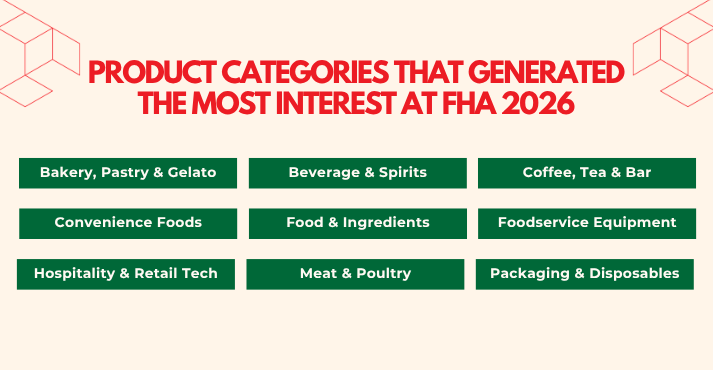
Here’s a quick snapshot of the top product categories from FHA 2026:
| Category | What It Signals |
| Bakery, Pastry & Gelato | Premium experiences |
| Beverage & Spirits | Innovation and premiumisation |
| Coffee, Tea & Bar | Specialty demand |
| Convenience Foods | Labor efficiency |
| Food & Ingredients | Product innovation |
| Foodservice Equipment | Operational productivity |
| Hospitality & Retail Technology | Digital transformation |
| Meat & Poultry | Stable demand |
| Packaging & Disposables | Sustainability focus |
What Hosted Buyer Activity Reveals About Future Procurement Trends
The scale of hosted buyer participation at FHA 2026 provides valuable insight into how procurement priorities are evolving across the foodservice and hospitality industries.
Why 19,000 Buyer Meetings Matter
The 19,000 business meetings held during FHA 2026 highlight active procurement activity across the foodservice and hospitality sectors.
Buyers attended to identify new suppliers, evaluate emerging product categories, explore market-entry opportunities, and build future sourcing partnerships.
The volume of meetings reflects strong purchasing intent and ongoing investment in supply chain development.
Procurement Teams Are Looking Beyond Products
Modern procurement decisions extend beyond price and product quality. Buyers increasingly assess supplier reliability, regulatory compliance, sustainability practices, scalability, and innovation capabilities.
Hosted buyer discussions at FHA 2026 demonstrated growing demand for partners that can support long-term business objectives while adapting to changing market requirements.
Procurement Is Becoming More Strategic
Procurement now plays a critical role in driving business performance. Purchasing decisions influence revenue growth, risk management, supply resilience, and competitive positioning.
Supplier partnerships are becoming strategic assets that help organizations respond faster to market changes and customer expectations.
Five Strategic Signals Suppliers Should Take Away from FHA 2026
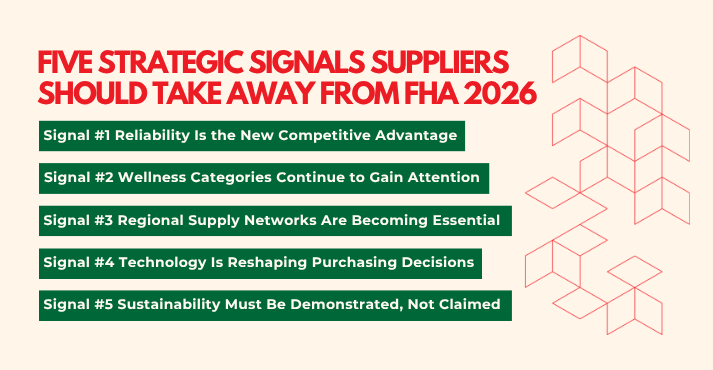
FHA 2026 highlighted several procurement trends that suppliers should monitor as buyer expectations continue to evolve.
Signal #1 — Reliability Is the New Competitive Advantage
Supply disruptions have made consistent delivery performance a top procurement priority. Suppliers that can demonstrate reliability are increasingly favored over those competing primarily on price.
Signal #2 — Wellness Categories Continue to Gain Attention
Health-focused and functional products are moving further into mainstream procurement pipelines. Ingredient transparency and credible product claims are becoming key differentiators.
Signal #3 — Regional Supply Networks Are Becoming Essential
Buyers are prioritizing shorter, more resilient supply chains. Strong regional operations or distribution partnerships can significantly improve supplier competitiveness.
Signal #4 — Technology Is Reshaping Purchasing Decisions
Procurement teams are adopting digital tools at scale. Suppliers that support system integration, inventory visibility, and data-driven purchasing processes will be better positioned for growth.
Signal #5 — Sustainability Must Be Demonstrated, Not Claimed
Sustainability is now a procurement requirement rather than a marketing advantage. Buyers increasingly expect certifications, traceability, and measurable environmental commitments.
Buyer Outlook for 2027 and Beyond
The food and beverage industry outlook for 2026 and into 2027 points toward continued acceleration across several interconnected areas.
AI-enabled procurement will expand well beyond early adopters. Functional nutrition will deepen its position in mainstream category management. Sustainable sourcing standards will become more formalized and more frequently audited by procurement teams.
Food industry trends in Asia suggest that regional sourcing expansion will intensify as buyers prioritize supply resilience over global consolidation. The future of the food industry will increasingly be shaped by procurement functions that operate as strategic growth enablers, not cost centers.
Key Takeaways from FHA 2026
The FHA 2026 buyer trends documented throughout this report point to one overarching conclusion: procurement is becoming more strategic, more technology-driven, and more value-focused than ever before.
- Reliability has overtaken lowest cost as the primary criterion in supplier evaluation
- Wellness and functional food categories are gaining sustained momentum across procurement pipelines
- Sustainability now influences supplier selection — not just brand positioning
- AI and digital tools are transforming procurement planning, forecasting, and supplier evaluation
- ASEAN remains a preferred and expanding sourcing hub for global buyers
- Convenience and ready-to-use solutions are growing across foodservice and hospitality channels
- Innovation must demonstrate commercial ROI to convert buyer interest into contracts
- Regional supply networks are expanding as supply resilience becomes a core procurement priority
Frequently Asked Questions
What were the biggest buyer trends at FHA 2026?
The FHA 2026 event highlighted several procurement priorities shaping future purchasing decisions:
- Supply reliability
- Wellness and functional products
- Sustainability requirements
- Technology adoption and digital procurement
Which food categories attracted the most interest?
The following categories drew strong and consistent buyer attention throughout the event:
- Functional beverages
- Convenience foods
- Specialty coffee and tea
- Bakery products
- Sustainable packaging solutions
How are sourcing strategies changing in the F&B industry?
Buyers are adopting more resilient and flexible sourcing approaches, including:
- Diversifying supplier networks geographically
- Prioritizing regional suppliers
- Reducing dependence on single-source procurement
- Strengthening supply chain resilience
- Building contingency sourcing strategies
Why is sustainability becoming more important in procurement decisions?
Sustainability is becoming central to procurement because companies must meet stricter ESG reporting standards, respond to rising consumer demand for ethical and eco-friendly products, and comply with tightening regulations. As a result, procurement teams now evaluate suppliers based on measurable environmental impact, making sustainability a mandatory selection criterion rather than a competitive advantage.
How is AI affecting food and beverage sourcing?
AI is transforming food and beverage sourcing by improving supplier evaluation, enhancing demand forecasting accuracy, and enabling real-time risk monitoring. It also strengthens procurement analytics, helping organizations identify cost efficiencies and supply gaps. As a result, mid-to-large buyers can make faster, data-driven decisions and build more resilient, responsive supply chains.
What did hosted buyer activity reveal about procurement priorities?
Key procurement priorities revealed through hosted buyer activity include:
- New supplier discovery and diversification
- Long-term strategic partnerships
- Category expansion across F&B segments
- Risk reduction through supply chain resilience
- Increased focus on value beyond pricing
Why is ASEAN becoming more important for food sourcing?
ASEAN is gaining importance in food sourcing due to its strategic location, strong production capabilities, and improving logistics networks. These advantages help buyers reduce reliance on single regions, shorten supply chains, and improve resilience, making ASEAN a key hub for diversified and stable global food procurement strategies.
What sourcing trends are expected to shape the F&B industry through 2027?
Key sourcing trends shaping the F&B industry through 2027 include:
- AI-driven procurement and analytics
- Growth in functional and health-focused nutrition
- Standardized sustainability and ESG compliance
- Expansion of alternative protein categories
- Strengthening of regional and localized supply networks