The trade show model everyone knows is already the wrong frame.
We have covered food innovation trends across Asia long enough to know the script: trade shows are where suppliers pitch, buyers walk, and deals happen over dinner. Walk in, collect your tote bag, scan the hall, take a meeting. The model has been stable enough that most exhibitors could plan their booth strategy on a napkin.
FHA 2026 made that model look dated. The first signal came not from the keynote stage but from the floor plan itself: 37% of the 2,750-plus exhibitors at Singapore EXPO were new to the show, the highest new-entry rate in a decade. is a platform under active reconstruction, and the direction it is moving is not toward scale for its own sake.
Our read going into FHA 2026 was that the food trade show in Asia 2026 was entering a differentiation phase, that shows would have to justify themselves as something more than buyer-supplier matching. Understanding the future of the food industry requires understanding which trade platforms are genuinely driving it. FHA’s April edition confirmed that it read faster than we expected.
Argument 1: Three Simultaneous Debuts are a Strategy, Not an Addition

One new format at a trade show is an experiment. Three new formats in one edition, each targeting a different operator function, is a strategy. FHA 2026 debuted three distinct formats:
1. FHA FutureFWD Singapore 2026
FHA FutureFWD Singapore 2026 was not a seminar track with an exhibit hall attached. It was a four-day technology deployment zone, 50-plus expert speakers, named commercial exhibitors including RestoSuite, Rolo Robotics, Koomi, Singtel Stack-EZ, OpenTable, and Razer Fintech, where Singapore-based and ASEAN-market operators could evaluate and begin qualifying technology they might actually procure.
The distinction matters: a showcase function displays what exists; an innovation lab function enables operators to begin a qualification process. FutureFWD was the latter.
“FHA 2026 is not just an event, it is a celebration of the creativity, resilience, and vision that define our industry. Let us make the most of this incredible platform to shape the future of food and hospitality.” Said Ian Roberts, Senior Vice President – Asia, Informa Markets.
2. FHA Young Chefs Grand Prix innovation
The Young Chefs Grand Prix put 300-plus competitors from more than 10 countries, Australia, UAE, South Korea, Malaysia, Singapore, Sri Lanka, Taiwan, Thailand, and the USA on the Singapore EXPO floor, sourcing ingredients from live exhibitors and cooking with them in real time.
That is not a competition staged at a trade show. That is a competition designed to use the trade show floor as a testing laboratory. Buyers watching from the hall were simultaneously evaluating raw ingredient quality and live culinary application.
The FHA Young Chefs Grand Prix innovation function, live ingredient validation under competitive conditions, does not exist anywhere else on the Asian trade show calendar in that format.
3. IndusFood Asia FHA 2026 debut
India’s Ministry of Commerce and Industry did not build a standalone India food show in Southeast Asia. It did not run a bilateral India-Singapore event.
It chose FHA as the international launch infrastructure for Indian F&B brands targeting ASEAN, specifically Singapore, Malaysia, Indonesia, Thailand, and Vietnam, because FHA’s Hall 9 at Singapore EXPO is a more efficient multi-market entry point than any alternative.
The IndusFood Asia FHA 2026 debut is a sovereign trade strategy, not a pavilion booking. When a national ministry selects a platform as its preferred commercialisation infrastructure, it is making a statement about which show it believes has the right buyer composition.
Three formats. Three different operator functions. One aim: the trade show floor is no longer where you go to see what exists. It is where you go to test what works.
Argument 2: FHA’s innovation function is different from SIAL’s and THAIFEX’s — not better, different
The SIAL Shanghai vs FHA food trade show comparison is one that exhibitors evaluating Asia F&B innovation commercialisation 2026 are now actively making, and the right framing is not which show is larger. It is which show validates for which market function. The food trade show in Asia 2026 comparison breaks cleanly into three distinct market orientations.
| FHA 2026 | SIAL Shanghai 2026 | THAIFEX 2026 | |
| City | Singapore | Shanghai, China | Bangkok, Thailand |
| Dates | Apr 21–24 | May 18–20 | May 26–30 |
| Exhibitors | 2,750+ | 5,000+ | 3,590 |
| Countries | 115 | 75+ | 56 |
| Visitors | 70,000 | 180,000+ | 100,000+ |
| New exhibitor rate | 37% new to show | Not disclosed | Not disclosed |
| Innovation mechanism | FutureFWD zone + 3 debut formats | 10,000 new product launches (record) | tasteInnovation: 10 winners, 50 finalists |
| Market orientation | Asia-out (multi-market ASEAN) | China-in | Southeast Asia via Thailand |
| Govt backing | Singapore MTI + Enterprise SG | Chinese ministry pavilions | Thailand DITP + Ministry of Commerce |
SIAL Shanghai 2026
SIAL Shanghai 2026 (Shanghai, May 18–20) recorded 10,000 new product launches, a show record, across more than 5,000 exhibitors from 75-plus countries. SIAL Shanghai is the world’s most efficient platform for launching into the Chinese consumer and retail market.
That is its power and its limit. It validates for one regulatory and consumer context. If your global food trends strategy centres on China, there is no more efficient stage.
THAIFEX-Anuga Asia 2026
THAIFEX-Anuga Asia 2026 (Bangkok, May 26–30) ran its tasteInnovation Show with 10 winners and 50 finalists selected by independent judges for commercial viability, edible packaging, fermented products, and next-generation proteins.
THAIFEX 2026 food innovation technology is strongest in commodity categories and Thai-origin products. It is Southeast Asia’s most direct export platform for brands entering food retail through Thailand, and its annual cadence lets it absorb and reflect fast-moving category shifts in real time.
For brands routing into ASEAN via a Thai distributor relationship, it remains the more efficient entry point.
FHA 2026
FHA 2026 is doing something structurally different. All evidence of a show designed for Asia-out commercialisation: validating whether a product, ingredient, or platform works across 10-plus regulatory and consumer contexts simultaneously: Singapore, Malaysia, Indonesia, Thailand, Vietnam, the Philippines, and beyond.
Understanding food supply chain innovation across that geography, halal certification frameworks, cold-chain maturity differentials, and import duty structures makes multi-market validation the more demanding and more valuable test.
The SIAL Shanghai vs FHA 2026 distinction is not a ranking. It is a routing question: which regulatory and consumer context does your product need validated in? For China: SIAL Shanghai. For Thai-gateway ASEAN: THAIFEX. For multi-market ASEAN simultaneously: FHA.
Argument 3: Singapore’s Structural Position Makes this Lead Difficult to Close
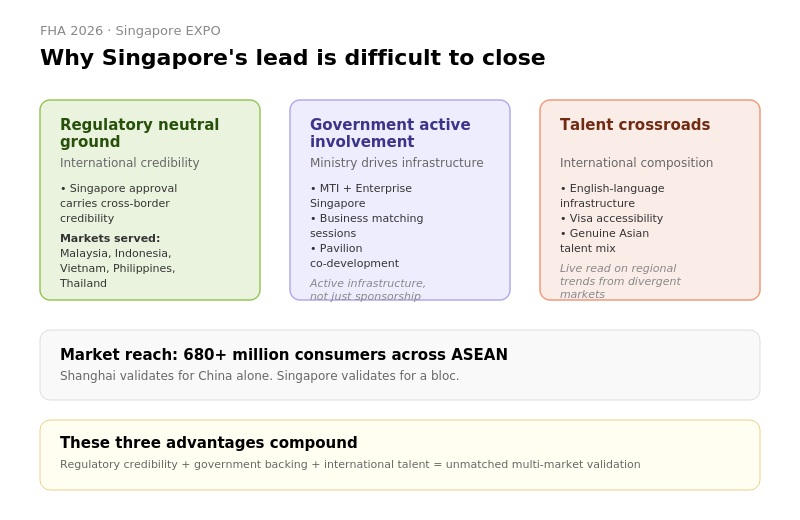
Singapore’s role in the food trade show innovation lab model is not accidental, and understanding why matters for any operator or brand evaluating which Asian show earns the travel and exhibit budget.
Three structural advantages compound here, and each one names the specific markets it actually affects.
Regulatory Neutral Ground
Singapore’s food safety standards are internationally recognised in a way that creates a credible certification pathway into ASEAN markets without full country-by-country re-certification cycles. Specifically affecting Malaysia, Indonesia, Vietnam, the Philippines, and Thailand.
A product validated in Singapore’s regulatory environment carries cross-border credibility that a Bangkok or Shanghai approval does not replicate at the same scale. Shanghai validates for China. Bangkok validates for Thailand and its immediate ASEAN trading relationships.
Singapore validates for a bloc of more than 680 million consumers. That structural fact makes FHA the natural multi-market launch infrastructure.
Government as Active Market-maker
Senior Minister of State Low Yen Ling opened FHA 2026. Enterprise Singapore ran business-matching sessions and co-developed the Singapore Pavilion with the Singapore Food Manufacturers Association.
“The SAFE framework offers a more effective way to assess food safety performance. By recognising food establishments which consistently maintain high standards, we strengthen food safety across the industry while empowering consumers to make informed choices.” Dr Tan Lee Kim – SFA’s Director-General of Food Administration and Deputy CEO of Food Safety.
Singapore’s Ministry of Trade and Industry is not sponsoring a trade show, it is using a trade show as active economic infrastructure to support Singapore-based exporters and international brands seeking ASEAN market entry.
That is a different posture than the ministry booth present at every Asian show, and it has a measurable consequence: the government relationship accelerates buyer qualification in Singapore in a way that is not replicated at THAIFEX or SIAL Shanghai.
Talent Crossroads
The Young Chefs Grand Prix drew competitors from Australia, the UAE, and the USA alongside Singapore, Malaysia, Thailand, South Korea, Sri Lanka, and Taiwan.
Singapore’s English-language infrastructure and visa accessibility remove the friction that prevents genuine international convergence at Bangkok or Shanghai. The result for exhibitors and buyers watching on the floor is a live read on where food industry trends in Asia are heading, assembled from culinary talent representing genuinely divergent Asian markets.
That is not international branding. That is international composition.
The Strongest Case Against Our Own Read
The strongest challenge to our read is not that FHA is smaller than SIAL Shanghai, that dissolves on contact with the routing argument above. The harder version has two parts.
First, scale does carry real weight for certain commercialisation objectives. SIAL Shanghai’s 10,000 new product launches, 180,000-plus attendees, and 200,000 sqm put it in a category where sheer buyer density makes product exposure faster than any other single show in Asia. If a brand’s priority is maximum reach to retail and distribution buyers in the shortest time, the scale differential is not irrelevant.
Second, and more genuinely: FHA runs biennially. THAIFEX and SIAL Shanghai run annually. A food trade show innovation lab model that operates every two years has a structural pipeline gap that no number of debut formats fully closes. Brands that need to iterate, pivot, and relaunch cannot do so on a two-year cycle.
The biennial cycle is the single most actionable structural opportunity for FHA’s innovation-lab positioning, and it is the one we cannot argue away. Our concession: the multi-market validation argument holds.
Our Read — And the One Thing that Should Change About How You Attend
Trade show ROI in food and beverage Asia is typically calculated on the number of contacts made and the leads moved to pipeline. That metric is not wrong. It is just undersized for what the food trade show innovation lab model actually offers.
The question to ask before your next FHA is not what you will find on the floor. It is what you need to validate, and whether 19,000 buyer-supplier meetings across Singapore, Malaysia, Indonesia, Thailand, and Vietnam can give you that answer faster and more cheaply than any alternative.
For most operators and brands with multi-market Asia ambitions, and across the F&B innovation categories FHA covers, from ingredient sourcing to foodservice technology to bakery and pastry supply chains, the answer in 2026 is yes.
Watch IndusFood Asia’s Year 2 format at FHA 2027. If India’s Ministry of Commerce expands its hall allocation and ASEAN government trade bodies co-invest in the zone, the innovation-lab model will have been externally validated by national trade strategy, not by editorial coverage.
That is the leading indicator that what we are reading in FHA 2026 is not a single-edition experiment. It is a structural repositioning of what Asia’s most significant food trade show is actually for.