Asia remains one of the fastest-growing food and beverage regions in the world, and international brands looking for their next phase of expansion are increasingly turning their attention here.
With rising incomes, evolving consumer tastes, and a rapidly modernizing retail landscape, the region offers enormous upside for companies ready to scale beyond their home markets.
This is exactly why food trade show Asia events have become such an important part of global growth strategies for food and beverage businesses.
FHA Food & Beverage has positioned itself as one of the region’s leading B2B food trade events, connecting global suppliers with buyers, distributors, retailers, importers, and foodservice operators from across Asia.
For many international brands, FHA isn’t just an exhibition to showcase products; it functions as a full market-entry platform. Companies use it to build distribution networks, validate demand, study consumer trends, and generate the kind of qualified leads that are difficult to secure through any other channel.
In this article, we’ll break down the main reasons why exhibit at the food trade show Asia, FHA, including access to Asian buyers, distribution partnerships, market validation, trend discovery, and broader regional expansion opportunities.
Understanding FHA Food & Beverage and Its Role in Asian Market Expansion
FHA Food & Beverage is one of Asia’s largest food and hospitality trade exhibitions, bringing together thousands of exhibitors and trade visitors under one roof.
Held in Singapore, the event has built a reputation as a launchpad for companies entering Asian markets for the first time, as well as a strategic touchpoint for established exporters looking to deepen their regional presence.
Singapore’s role as host is not incidental. As a neutral, highly connected business hub, it allows the event to draw participants from across Southeast Asia, East Asia, South Asia, Oceania, and Middle Eastern markets with strong trade ties to Asia. This geographic spread is part of what makes FHA function as a true food exhibition Singapore event with regional, rather than purely local, relevance.
The diversity of attendees is one of FHA’s defining strengths. On the show floor, brands typically encounter:
- International exhibitors representing dozens of countries
- Importers seeking new product lines
- Distributors evaluating exclusive or regional partnerships
- Retail chains scouting for shelf-ready products
- Foodservice operators sourcing for restaurants and catering
- Hotel procurement teams managing large-volume purchasing
- E-commerce buyers building out online grocery assortments
This mix is precisely why FHA is often described as a gateway event for companies entering Asian markets rather than simply another exhibition on the trade show calendar.
Why Asia Remains a High-Priority Growth Market for Global Food Brands
There’s a reason so many international food brands keep circling back to Asia when planning expansion. The fundamentals behind consumer demand here remain strong, and they show no signs of slowing.
Rising Consumer Spending Across Asia
Asia’s expanding middle class continues to drive higher disposable incomes across most major economies in the region.
As household budgets grow, so does demand for premium food categories and imported products that were once considered niche or unavailable.
This shift creates real openings for international food brands Asia-wide, particularly in categories like specialty snacks, gourmet ingredients, and premium beverages.
Rapid Growth of Modern Retail and E-Commerce
Retail infrastructure across Asia has modernized at a remarkable pace. Supermarkets, hypermarkets, and convenience store chains have expanded aggressively, while online grocery platforms and cross-border e-commerce have opened entirely new routes to market.
Brands no longer need a physical footprint in every country to reach consumers, a well-structured online distribution strategy can now complement, or in some cases substitute for, traditional retail presence.
Demand for International and Innovative Food Products
Asian consumers are increasingly drawn to health-focused foods, functional ingredients, sustainable products, premium imports, and convenience-oriented offerings.
This appetite for innovation aligns closely with the food industry trends in Asia that continue to shape sourcing decisions at every level of the supply chain.
Singapore’s Strategic Position as Asia’s Business Gateway
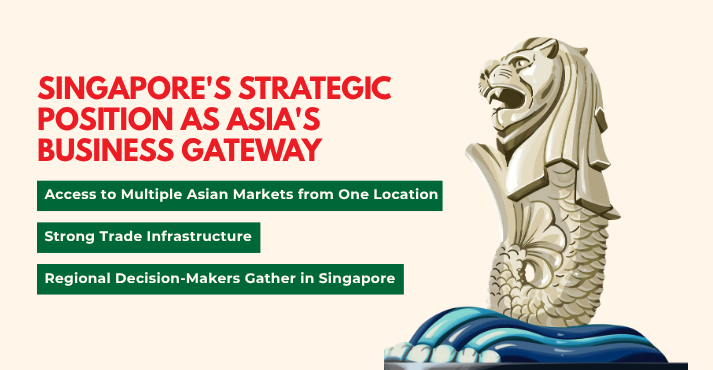
Much of FHA’s value depends on where it’s held. Singapore plays an outsized role in regional market-entry strategies, and understanding why helps explain the broader appeal of the event itself.
Access to Multiple Asian Markets from One Location
From a single trip to Singapore, brands can realistically begin building relationships that extend into Malaysia, Indonesia, Thailand, Vietnam, the Philippines, China, and South Korea.
Few other cities offer this level of regional reach in one location, which is a major part of why a food and beverage trade show Singapore event carries so much strategic weight for companies mapping out Asian expansion.
Strong Trade Infrastructure
Singapore’s logistics connectivity, world-class port facilities, regulatory transparency, and business-friendly environment make it far easier for international companies to operate confidently.
These factors reduce friction for brands taking their first steps into ASEAN food market entry, where unfamiliar regulations and logistics challenges can otherwise slow momentum significantly.
Regional Decision-Makers Gather in Singapore
Many multinational food and beverage companies base their regional headquarters in Singapore, meaning purchasing and sourcing decisions for large swaths of Asia are often influenced, or made outright, by teams located in the city.
Exhibiting at FHA puts brands directly in front of these decision-makers, often without the need for separate visits to each individual market.
Direct Access to Importers, Distributors, and Retail Buyers
Buyer access is, for many exhibitors, the single biggest reason to attend FHA. Few channels offer this level of concentrated, face-to-face exposure to the people who actually make purchasing decisions.
Meeting Qualified Distribution Partners
FHA gives brands a practical way to identify local food distributors Asia-wide, evaluate potential market-entry partners, discuss territory expansion, and explore exclusive distribution agreements, all within a compressed timeframe that would otherwise require months of separate outreach and travel.
Connecting with Retail Buyers
The event also draws retail buyers Asia companies rely on to fill shelves across supermarkets, specialty retailers, gourmet stores, and convenience chains. These conversations often move faster in person, where buyers can sample products and ask direct questions on the spot.
Building Foodservice Relationships
For brands targeting the hospitality sector, FHA opens doors to hotels, restaurants, catering companies, and institutional buyers, making it a valuable venue for any company hoping to grow its presence among foodservice buyers Asia-wide.
FHA as a Market Validation Platform Before Large-Scale Expansion
Before committing significant capital to a new market, many brands use FHA to test the waters first.
Testing Product-Market Fit
Direct buyer and consumer interaction at the event allows brands to gather real-time feedback on taste preferences, packaging design, product positioning, and pricing expectations, insights that are far more reliable than assumptions made from a distance.
Understanding Regional Differences
Asia is not a single, uniform market. Preferences and purchasing behavior can vary significantly between Southeast Asia, East Asia, and emerging ASEAN markets.
FHA gives brands a chance to observe these differences firsthand, which is essential reading alongside resources on emerging food markets across the region.
Identifying Market Entry Challenges Early
Exhibitors often use the event to surface regulatory barriers, import requirements, certification expectations, and consumer behavior differences before they become costly surprises later in the expansion process.
Combined with broader research into food import export trends, this early intelligence can meaningfully de-risk a market entry plan.
Discovering Consumer and Industry Trends Shaping Asian Food Markets

Trend intelligence is another major draw for companies attending FHA, particularly for brands trying to stay ahead of shifting consumer expectations.
Health and Wellness Trends
Functional foods, clean-label products, reduced-sugar formulations, and high-protein offerings continue to gain ground across the region as health-conscious consumers reshape category demand.
Plant-Based and Alternative Proteins
Interest in plant-based products is growing steadily, with regional adaptation creating fresh innovation opportunities for brands willing to localize flavor profiles and formats for Asian palates.
Sustainability and Responsible Sourcing
Buyers are showing increasing interest in sustainable ingredients, traceability, ESG initiatives, and responsible production practices, factors that are becoming harder to ignore in supplier evaluations.
Convenience and Ready-to-Eat Solutions
Urban consumers, foodservice operators, and modern retail channels are all driving demand for convenience and ready-to-eat solutions, a trend closely tied to the consumer food trends in Asia shaping product development across the industry.
How FHA Helps Brands Generate High-Quality B2B Leads
Despite the rise of digital marketing, trade exhibitions remain remarkably effective for B2B food exhibition Asia lead generation, and FHA is no exception.
Face-to-Face Relationship Building
Trust plays an outsized role in Asian business culture, and in-person meetings continue to carry weight that digital outreach simply can’t replicate.
Accelerating Sales Conversations
On the show floor, brands can demonstrate products, conduct tastings, address buyer concerns directly, and move prospects through the sales cycle far faster than they could through email or video calls alone.
Building Long-Term Regional Networks
The relationships formed at FHA frequently extend well beyond the event itself, forming the backbone of a food industry networking event Asia companies can return to year after year as their regional presence grows.
FHA Compared with Other Major Food Trade Shows in Asia
FHA isn’t the only major food trade event in the region, and brands often weigh it against other established shows when planning their exhibition calendar.
| Event | Primary Region | Buyer Reach | Market Entry Focus | International Presence |
| FHA Food & Beverage | Southeast Asia, broader Asia-Pacific | Wide regional reach via Singapore hub | Strong, especially for ASEAN entry | High |
| THAIFEX | Thailand, Southeast Asia | Strong within Thailand and neighboring markets | Moderate to strong | High |
| Foodex Japan | Japan, East Asia | Concentrated on the Japanese market | Strong for Japan-specific entry | Moderate to high |
Each event has its own strengths. THAIFEX offers deep access to the Thai market, while Foodex Japan is a natural fit for brands prioritizing entry into Japan specifically.
FHA’s particular advantage lies in its ASEAN access and Singapore’s regional positioning, which together create cross-market networking opportunities that are harder to replicate at more single-market-focused events.
The right choice ultimately depends on which markets a brand is prioritizing first.
Common Outcomes International Brands Seek from FHA Participation
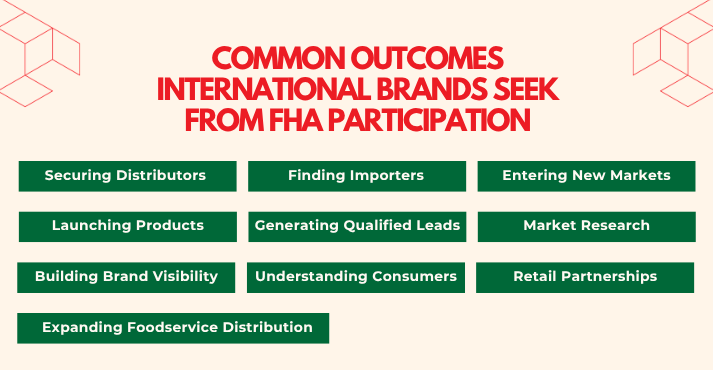
Companies attend FHA with a range of goals in mind, though several objectives come up consistently:
- Securing distributors: Finding partners capable of managing in-market logistics and sales
- Finding importers: Connecting with food operators in Asia that can bring products across borders compliantly
- Entering new Asian markets: Using the event as a structured first step into unfamiliar territory
- Launching products: Introducing new SKUs to a concentrated, relevant buyer audience
- Generating qualified leads: Building a pipeline of serious, vetted business contacts
- Conducting market research: Gathering direct feedback before committing to full-scale entry
- Building brand visibility: Raising awareness among regional trade audiences
- Understanding local consumer preferences: Refining products for specific market tastes
- Developing retail partnerships: Opening conversations with supermarket and specialty retail buyers
- Expanding foodservice distribution: Growing reach into hotels, restaurants, and catering channels
A Typical Market-Entry Journey Using FHA
For brands new to the process, it helps to understand how FHA participation typically fits into a broader expansion timeline.
Before the Event
Preparation usually involves market research, identifying and targeting priority buyers, scheduling meetings in advance, and localizing marketing materials or packaging where needed.
During the Event
This is where most of the activity happens, product demonstrations, active networking, scheduled buyer meetings, and on-the-spot lead qualification to separate serious prospects from casual interest.
After the Event
Post-show follow-up is often where deals are actually closed. This phase typically includes structured follow-up outreach, evaluating distributor candidates more closely, running pilot launches in select markets, and building out a longer-term expansion plan based on what was learned.
Is FHA the Right Event for Your Food Brand?
FHA tends to deliver strong value across a wide range of company types, including emerging brands testing international waters for the first time, established exporters looking to deepen regional partnerships, ingredient suppliers targeting B2B buyers, beverage manufacturers, functional food brands, plant-based food companies, and specialty food producers.
The event tends to deliver the strongest results for brands that arrive with a clear sense of their target markets and buyer types, rather than treating the show as a generic marketing exercise.
Companies that combine FHA participation with ongoing research, such as tracking the future of the food industry, tend to get more strategic value from each conversation they have on the show floor.
Conclusion
International food brands continue to choose FHA for a consistent set of reasons: access to Asia’s fast-growing markets, direct connections with buyers and distributors, opportunities for market validation, valuable trend intelligence, strong lead generation potential, and strategic positioning through Singapore’s role as a regional business hub.
Successful market entry rarely comes down to a single trade show appearance. It depends on building the right partnerships and developing a genuine understanding of regional market dynamics, both of which FHA is specifically designed to support for brands serious about long-term growth in Asia.
FAQs
What is FHA Food & Beverage?
FHA Food & Beverage is one of Asia’s leading B2B food trade exhibitions, held in Singapore, connecting international suppliers with buyers, distributors, retailers, and foodservice operators from across the region.
Why is Singapore considered a gateway to Asian food markets?
Singapore offers strong trade infrastructure, regulatory transparency, and central access to multiple Asian markets, while also hosting many regional headquarters that influence purchasing decisions across the continent.
What types of buyers attend FHA?
FHA attracts qualified buyers from every stage of the food and hospitality supply chain, creating opportunities across retail, foodservice, distribution, and hospitality, including:
- Importers
- Distributors and wholesalers
- Supermarkets and retail chains
- Foodservice operators
- Hotel and resort procurement teams
- Restaurant groups
- Catering companies
- E-commerce and online grocery buyers
- Hospitality purchasing managers
- Institutional and government buyers
How can food brands find distributors through FHA?
Brands can meet potential distribution partners directly on the show floor, evaluate their market coverage and capabilities, and discuss territory or exclusivity terms in person.
Is FHA suitable for small and emerging food brands?
Yes. FHA accommodates a wide range of company sizes, and emerging brands often use it specifically to validate demand and build initial buyer relationships before committing to larger investments.
What Asian markets can companies access through FHA?
Companies can access the following Asian markets through FHA:
- Singapore
- Malaysia
- Indonesia
- Thailand
- Vietnam
- Philippines
- China
- South Korea
- India
- Hong Kong
- Taiwan
- Other ASEAN and Asia-Pacific markets
How does FHA compare with THAIFEX and Foodex Japan?
FHA provides one of the broadest gateways to Southeast Asia and the wider Asia-Pacific region through Singapore’s role as an international trade hub. While THAIFEX has a stronger emphasis on the Thai market and neighboring countries, and Foodex Japan is primarily focused on Japan’s domestic and import sectors, FHA attracts a highly international audience, making it particularly valuable for companies seeking multi-market expansion through a single event.
What food trends can brands discover at FHA?
Food trends that brands can discover at FHA include:
- Health and wellness foods
- Plant-based and alternative proteins
- Sustainable and responsibly sourced products
- Ready-to-eat and convenience foods
- Functional foods and beverages
- Clean-label and natural ingredients
- Premium and specialty foods
- Food technology and smart manufacturing
- Sustainable packaging solutions
How can exhibitors maximize ROI from FHA participation?
Successful exhibitors begin planning well before the exhibition by identifying priority buyers, scheduling meetings in advance, and aligning their products with regional market demand. During the event, engaging product demonstrations, targeted networking, and lead qualification help generate stronger opportunities. Consistent post-event follow-up, timely quotations, and ongoing relationship building are essential to converting conversations into long-term business and maximizing return on investment.
What should companies prepare before attending FHA?
Brands should complete market research, identify priority buyer segments, localize packaging or materials as needed, and schedule key meetings in advance of the event.