Restaurants across Southeast Asia are under more pressure than ever.
Labor shortages, rising wages, and higher operating costs are pushing F&B operators to find ways to keep service fast, consistent, and profitable. At the same time, diners now expect quicker table service, shorter wait times, and smoother experiences.
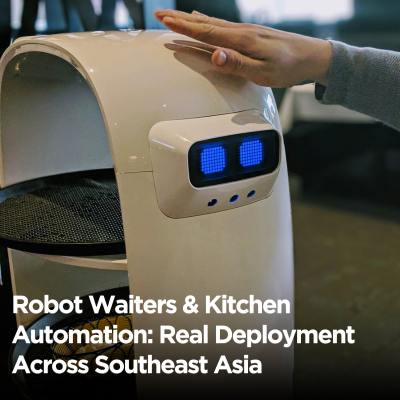
That is why robot waiters in Southeast Asia have become one of the clearest signs of how quickly AI and robotics are entering hospitality.
From robots delivering meals in dining rooms to kitchen automation restaurants using smart systems to prep, cook, and manage orders, automation is no longer a futuristic idea.
This article explains why adoption is accelerating, describes current technologies, and examines real deployments across Singapore, Thailand, Vietnam, Malaysia, and Indonesia. It also reviews business outcomes, limitations, and future trends.
Why Southeast Asia Is Becoming a Hotspot for Restaurant Automation
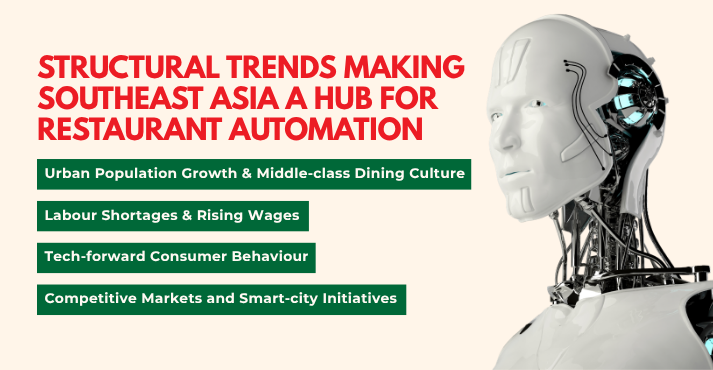
Several structural trends explain why hotel management systems and automation are gaining traction in Southeast Asia:
Urban Population Growth and Middle‑class Dining Culture
Major cities such as Singapore, Bangkok, Ho Chi Minh and Jakarta have dense urban populations and a burgeoning middle class that dines out frequently. Restaurants face constant pressure to serve more customers without increasing staff.
Labour Shortages and Rising Wages
COVID‑19 travel restrictions drained the migrant labour pool in many countries, leaving restaurants short-staffed. During the pandemic, many restaurants lost workers because employees couldn’t return to the city, so operators turned to robots to plug the gap.
Tech‑forward Consumer Behaviour
Southeast Asia’s young, connected population embraces digital services and enjoys novelty, reflecting broader hospitality technology trends across the region. Robots become a “wow” factor that drives social‑media buzz and younger demographics into restaurants.
Competitive Markets and Smart‑city Initiatives
Governments promote smart‑city and tourism projects, and local start‑ups import or distribute robots. For example, Thailand’s robot‑supplier landscape includes Ideotech, Sun Robotics & AI, Ras Paul and Fortune Mechanic, while Singapore’s Hotel Industry Transformation Map (ITM) encourages hotels to adopt facial‑recognition‑enabled self‑check‑in systems.
Automation is therefore framed as a labour solution (relieving staff shortages), an efficiency solution (faster service and higher throughput) and a branding strategy (creating memorable experiences).
What Restaurant Automation Actually Includes Today
Robot Waiters & Autonomous Food Runners
Robotic service staff is now common in hotpot chains, buffets, cafés and quick‑service restaurants. Key features include:
Tray-carrying Robots that Ferry Dishes from the Kitchen to Tables
Thai hotpot chain MK uses 530 robots called Nong Sukjai and Nong Phakard across 355 branches. These robots use LiDAR to map the restaurant, detect obstacles, and plan routes. They can even collect empty dishes during downtime.
Autonomous Navigation and Obstacle Avoidance
Delivery robots rely on simultaneous localisation and mapping (SLAM) and laser sensors. These robots create digital maps, detect obstacles with sensors, and compute optimal routes, which allows them to carry multiple orders during peak periods.
Customer Interaction Features
Robots are programmed with cheerful personalities and can sing while working. Some models have screens to display promotions or to accept orders.
Chinese manufacturers dominate the restaurant robot market. Thai importers supply robots from Pudu Robotics, OrionStar, SIASUN and others.
Vendors like Keenon Robotics and Bear Robotics also supply dining, reception and cleaning robots; at Restaurant Asia 2024 in Singapore, they demonstrated service robots with tray‑carrying, cleaning and room‑delivery capabilities.
Kitchen Automation Systems
Back‑of‑house automation uses robotic appliances to augment chefs rather than replace them. Examples include:
Robotic Fry Station
Bowl & Bowl Singapore has integrated a fully automated fried rice concept run by six robots that can prepare a bowl of fried rice in 1 minute 55 seconds. It ensures consistency while allowing staff to focus on other tasks.
Noodle & Beverage Robots
Singapore caterer Orange Clove deployed a robotic laksa station that automates noodle blanching and broth dispensing, producing up to 80 bowls per hour. The system was introduced to improve consistency and reduce labor requirements during large-scale catering events.
Robotic Arms and Smart Inventory Systems
Automated kitchen systems integrate AI‑powered cameras and sensors that monitor cooking status and inventory, reducing waste and ensuring consistent portions.
Partially Automated Kitchens
Most deployments are hybrid; robots handle repetitive tasks such as frying or beverage preparation, while human chefs manage plating, seasoning, and customer interaction. For example, Malaysia’s BBQ Plaza uses robotic food delivery to transport food from the kitchen to customer tables, reducing the need for staff to perform repetitive running tasks.
AI‑powered Restaurant Operations
Robots are only one piece of the puzzle. AI software platforms optimise ordering, forecasting and labour scheduling:
AI Order Management and Predictive Demand Forecasting
AI forecasting reduces uncertainty by generating dynamic demand signals based on sales patterns and current inputs. It integrates with inventory and supplier data to produce order recommendations, reducing over‑ordering and waste.
Smart Scheduling and POS Integration
AI platforms can create optimal staff rosters based on predicted demand and integrate with digital ordering systems. Also, AI in the hospitality industry helps forecast busy periods, adjust staffing, and even act as virtual call‑centre agents that take phone orders and upsell menu items.
Complementarity with Robots
Predictive analytics ensures that kitchen robots operate efficiently, while delivery robots provide data for continuous improvement. Importantly, AI solutions are meant to enhance, not eliminate, human interaction.
Real Restaurant Deployments Across Southeast Asia
Across Southeast Asia, restaurants, cafés, and hotels are deploying robots and AI systems to improve efficiency, address labor shortages, and enhance customer experiences.
Here are some real-world examples:
Singapore — Smart Restaurants & Labor Efficiency
Singapore has become Southeast Asia’s leading testing ground for hospitality robotics, driven by high labor costs, strong government support for digitalization, and a consumer base comfortable with new technology.
Restaurants such as Haidilao, Shin Minori, Swee Choon, and Ananda Bhavan use robot food runners, intelligent kitchen systems, QR-code ordering, and self-service kiosks to streamline operations while allowing staff to focus on customer service. Automation has also expanded into hotels, where delivery robots handle routine guest requests and support contactless technology initiatives.
Thailand — Robot Servers in High-Traffic Dining Chains
Thailand has embraced robot servers in high-volume dining environments, particularly hotpot chains and buffet concepts. MK Restaurant has deployed hundreds of robots across its outlets to deliver food, guide guests, and assist with table clearing.
Beyond operational efficiency, robots have become part of the dining experience, attracting customer attention through interactive features, entertainment value, and social-media-friendly experiences while helping restaurants maintain faster service during peak periods.
Vietnam — Automation Emerging in Urban Restaurant Markets
Vietnam’s growing urban middle class and tech-savvy younger consumers are encouraging experimentation with restaurant automation. Modern cafés such as Twitter Bean Coffee combine delivery robots, robot baristas, and interactive service features to create unique customer experiences.
Malaysia — Balancing Hospitality with Automation
Malaysia has largely adopted a hybrid service model with AI kitchen assistants rather than replacing staff. Restaurants such as NALE Nasi Lemak Co. use delivery robots to transport food to tables, helping operators address manpower shortages while maintaining a strong hospitality focus.
Adoption is particularly common among mid-sized operators seeking efficiency gains without the significant investment required for fully automated systems.
Indonesia — Automation in Large-Scale Foodservice Operations
Indonesia’s restaurant automation efforts are concentrated in shopping malls, chain restaurants, and other high-volume foodservice environments.
Operators are exploring service robots, AI-powered customer engagement tools, and digital ordering systems to improve operational consistency, reduce queues, and support scalable growth.
Early deployments suggest that customer experience, innovation, and convenience may be just as important as labor savings in driving adoption.
Business Benefits of Robot Waiters & Kitchen Automation
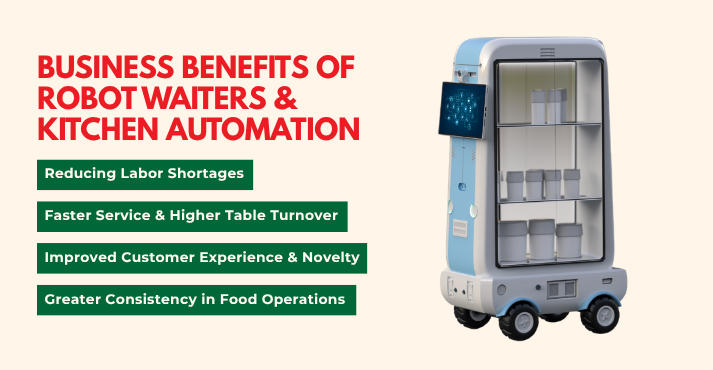
Restaurant automation is gaining traction because it delivers measurable business benefits. From addressing workforce challenges to improving service consistency, robots and AI systems help operators run more efficient and scalable foodservice operations.
Reducing Labor Shortages
Robotics helps restaurants manage staffing pressures by taking over repetitive, physically demanding, or time-consuming tasks.
Food delivery robots, automated cooking systems, and AI-powered scheduling tools allow teams to operate more efficiently while enabling staff to focus on customer service and higher-value responsibilities.
Faster Service & Higher Table Turnover
Automation can accelerate food delivery, reduce waiting times, and improve kitchen throughput. By streamlining repetitive tasks and coordinating workflows, restaurants can serve more customers during peak periods and maximize table utilization.
Improved Customer Experience & Novelty
Robot-assisted service creates a unique dining experience that attracts customer attention and supports tech-forward brand positioning. Interactive features, contactless service, and faster delivery can enhance convenience while generating social media engagement.
Greater Consistency in Food Operations
Automated systems follow standardized processes, helping restaurants maintain consistent food quality, portion control, and service accuracy. AI-powered forecasting and inventory tools can also reduce waste and support better operational planning.
Challenges & Limitations Restaurants Still Face
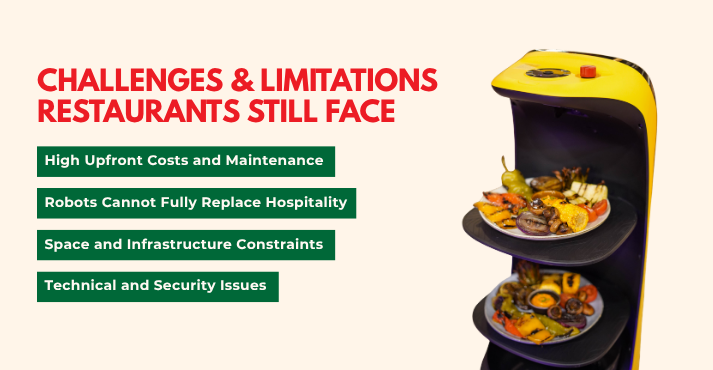
Despite the benefits, automation has limitations:
1. High Upfront Costs and Maintenance
Robots, AI software, and kitchen equipment require significant capital. Some restaurants rent robots, and return on investment may take months.
2. Robots Cannot Fully Replace Hospitality
Robots can’t place dishes on tables, verify orders, or offer empathy. F&B operators note that robots lack a “service mind” and still need human supervision, and emphasize that robots are there to assist, not replace, staff.
3. Space and Infrastructure Constraints
Narrow aisles, stairs, or complex layouts challenge robot navigation. Robot suppliers advise evaluating walkway width and testing robots before deployment.
4. Technical and Security Issues
Automated hotels may face equipment malfunctions or security concerns. Even the Singapore Tourism Board promotes the EVA system but notes the need for strong support systems and security measures.
Which Restaurant Types Benefit Most from Automation?
| Restaurant Type | Best Automation Type | Main Benefit |
| Hotpot chains | Robot waiters | High‑volume delivery and entertainment |
| Quick‑service restaurants (QSRs) | Kitchen automation systems | Speed, consistency and reduced staffing |
| Cafés | Beverage automation & AI baristas | Labour reduction and precision brewing |
| Buffet restaurants | Delivery robots | Efficient replenishment and contactless service |
| Food courts | AI ordering systems & autonomous food delivery robots | Queue reduction and improved throughput |
Leading Restaurant Robotics Companies Expanding in Asia
The leading restaurant robotics companies include:
Pudu Robotics
A leading restaurant robotics company whose BellaBot and HolaBot delivery robots use 3D sensors and modular chassis for safe navigation. BellaBot’s large trays can carry twice as much as a human server and perform up to 400 deliveries per day.
The company also offers FlashBot robots that ride elevators to deliver items in hotels, highlighting cross‑sector reach.
Keenon Robotics
Keenon and partner Truly Robotics displayed robots such as T5, T9, T10, and T8 along with cleaning units, demonstrating broad applications from dining rooms to malls. Their expansion in Asia underscores growing demand for service robots.
Bear Robotics
This California‑based firm develops robot servers such as Servi and Servi+ that use AI navigation and can carry multiple trays. They are deployed in restaurants and casinos across Asia and integrate with point‑of‑sale systems for seamless operation.
SoftBank Robotics
Known for the humanoid robot Pepper, SoftBank provides robots for reception and customer engagement in hotels and restaurants. Pepper’s ability to converse and recognise faces makes it a popular choice for front‑of‑house automation.
These companies offer robots as equipment purchases or “robotics‑as‑a‑service” subscriptions, lowering the barrier for smaller operators.
The Future of AI Restaurant Automation in Southeast Asia
Looking ahead at the future of the hospitality industry, restaurant automation in Southeast Asia will continue evolving from simple robotics into more connected AI-driven systems.
To begin with, AI-powered kitchens will combine vision systems, robotic arms, and inventory analytics to handle more cooking tasks, while chefs focus on creativity and quality.
At the same time, predictive restaurant operations will become more common as AI forecasts demand, optimizes menus, and adjusts decisions in real time for better efficiency.
In addition, voice AI ordering will make customer interaction more seamless by enabling orders through smart devices or conversational systems without physical menus. Alongside this, delivery platform integration will strengthen, linking in-store automation with last-mile logistics and creating smoother order-to-delivery workflows.
Also, robotics-as-a-service (RaaS) will lower costs and make automation more accessible to mid-sized operators, accelerating wider adoption across the region.
As these systems scale, Southeast Asia will likely see a shift toward broader, more practical use of automation beyond large chains. However, despite this growth, the long-term model will remain a human–AI hybrid, where robots manage repetitive tasks while staff focus on hospitality and customer experience.
The goal is not replacement, but improved efficiency, better service, and stronger guest satisfaction.
FAQ
How do robot waiters work in restaurants?
Service robots are autonomous mobile platforms equipped with shelves, LiDAR, and sensors. Staff load food and select the destination; the robot navigates using SLAM mapping, avoids obstacles, and stops at the assigned table. Some robots guide customers to tables and collect empty dishes.
Are robot waiters replacing human staff?
No. F&B operators stress that robots are designed to assist staff and lighten workloads, not replace workers. Robots cannot plate food or offer empathy, so human servers remain essential.
Which Southeast Asian countries use restaurant robots the most?
Singapore and Thailand lead adoption due to high labour costs and tech‑savvy consumers. Singaporean chains like Haidilao, Shin Minori and Swee Choon, and Thai chains like MK and Yayoi, have deployed fleets of robots. Vietnam, Malaysia and Indonesia are also experimenting with robots.
How much do restaurant robots cost?
Prices vary across the region and countries. Thai companies rent delivery robots for tens of thousands of baht (roughly US$1–2 k). Purchasing units from manufacturers like Pudu or Bear may cost more but can be structured as RaaS subscriptions.
What are the benefits of kitchen automation?
Kitchen automation helps restaurants improve efficiency, reduce costs, and maintain consistent food quality while easing pressure on staff. Key benefits include:
- Reduces labor dependency and staffing pressure
- Speeds up food preparation and service times
- Improves consistency in taste, portioning, and quality
- Lowers food waste through better forecasting and control
- Enhances kitchen efficiency during peak hours
- Supports safer, more hygienic food handling
- Allows staff to focus on higher-value tasks like customer service
Which restaurants benefit most from robot servers?
High‑volume restaurants (hotpot and buffet), QSRs and cafés benefit because robots handle repetitive delivery tasks and allow staff to focus on service. Food courts also gain from AI ordering systems and autonomous food delivery robots.
What companies make restaurant service robots?
Leading restaurant service robot manufacturers include Pudu Robotics, Keenon Robotics, Bear Robotics, OrionStar, SIASUN and SoftBank Robotics. Local distributors in Thailand, Singapore and Malaysia import and maintain these robots.
Are robotic restaurants profitable?
Robotic restaurants can be profitable as it helps with labor cost reduction, table turnover rate, and order throughput, especially in high-volume formats like QSRs and buffets. In Southeast Asia, operators like MK, NALE, and Swee Choon report shorter queues and happier customers, but high upfront costs and maintenance mean careful planning is required.