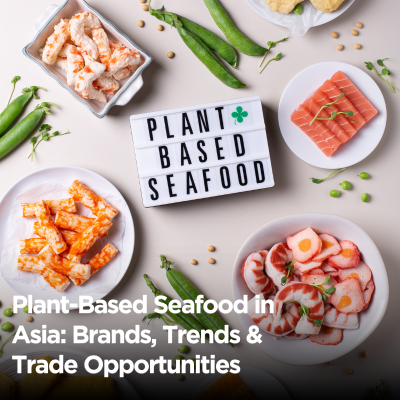
Plant-based seafood in Asia is transitioning from niche curiosity to a commercially meaningful segment within one of the world’s most dynamic food regions.
Despite Asia’s deeply rooted seafood culture, a powerful convergence of sustainability concerns, overfishing pressures, food security priorities, supply chain vulnerabilities, and alternative protein innovation is creating genuine momentum for seafood alternatives.
Retail shelves and foodservice menus across the region are increasingly featuring these products.
This guide covers the market size, leading brands, consumer trends, country-level opportunities, and trade potential, defining the landscape today.
What Is Plant-Based Seafood?
Plant-based seafood refers to food products designed to replicate the taste, texture, and nutritional profile of conventional seafood using entirely plant-derived ingredients.
Manufacturers commonly use soy protein, pea protein, wheat gluten, seaweed, algae, konjac, legumes, and vegetable oils to recreate the flakiness, chewiness, and umami depth associated with traditional seafood.
These products are distinct from cultivated (cell-cultured) seafood, which is grown from actual animal cells in bioreactors, and from conventional wild-caught or farmed seafood. Plant-based seafood contains no animal-derived inputs, making it fully vegan and accessible to a broad consumer base.
Most Common Product Categories
- Plant-based shrimp: Mimics the texture and sweetness of conventional shrimp using konjac and soy protein
- Plant-based tuna: Often made from soy or legume protein, used in sushi and ready meals
- Vegan salmon: Typically featuring algae-derived omega-3s for nutritional authenticity
- Fish-free fillets: Designed for mainstream cooking applications and family meal occasions
- Vegan crab products: Popular in Asian cuisines where crab features prominently
- Plant-based fish sticks: Appealing to younger consumers and families
- Fish-free seafood snacks: Positioned for convenience and on-the-go eating
- Ready-to-cook seafood alternatives: Targeting busy urban households seeking quick meal solutions
Asia’s Plant-Based Seafood Market at a Glance
The alternative seafood market in Asia-Pacific is growing at a faster rate than its counterparts in North America and Europe, driven by both supply-side innovation and shifting consumer demand.
The Asia Pacific Plant-based Seafood Market would witness market growth of 9.0% CAGR during the forecast period (2025-2032), with seafood alternatives attracting increasing investor attention given the region’s enormous consumption base.
Asia accounts for over 70% of global seafood consumption, making it the world’s largest market by volume. Rapid urbanisation, an expanding middle class, and growing environmental awareness among younger demographics are combining to create genuine demand for alternatives.
Governments across the region are incorporating alternative proteins into national food security strategies, while modern retail channels, supermarkets, e-commerce platforms, and convenience chains are expanding access and visibility for plant-based products.
Key Drivers Behind Plant-Based Seafood Growth in Asia
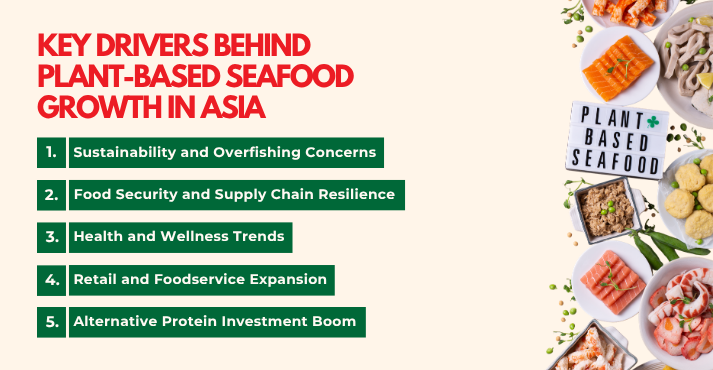
Several interconnected economic, environmental, and consumer-driven factors are accelerating the adoption of plant-based seafood products across Asian markets, creating new opportunities for manufacturers, retailers, and foodservice operators.
Sustainability and Overfishing Concerns
Declining wild fish stocks and escalating pressure on marine ecosystems are prompting both consumers and corporations to reassess conventional seafood sourcing.
ESG commitments from food companies and major retailers are accelerating the adoption of sustainable seafood alternatives that reduce environmental impact across the supply chain.
Consumer awareness of ocean depletion is particularly pronounced in coastal communities and highly urbanised markets.
Food Security and Supply Chain Resilience
Many Asian economies depend heavily on seafood imports, leaving them exposed to supply disruptions, climate-driven stock declines, and geopolitical trade risks.
Plant-based alternatives offer a domestically producible protein source that reduces dependence on volatile and import-heavy seafood supply chains, a compelling proposition for regional governments and food security planners alike.
Health and Wellness Trends
Flexitarian consumers across the region are increasingly seeking products that support reduced animal protein intake without sacrificing nutrition or satisfaction.
The plant-based fish market is benefiting from rising interest in cleaner-label ingredients and functional nutrition, particularly among urban millennials and Gen Z consumers in Singapore, Japan, and South Korea.
Retail and Foodservice Expansion
Supermarkets, quick-service restaurants, hotels, cafes, and food delivery platforms are all expanding their plant-based offerings in response to consumer demand.
Seafood alternatives for foodservice represent one of the fastest-growing commercial opportunities, particularly in hotel dining, institutional catering, and QSR chains seeking to diversify protein options across their menus.
Alternative Protein Investment Boom
Venture capital activity in the alternative protein seafood sector continues to attract significant capital, with FoodTech startups across Asia securing funding rounds to accelerate product development and market entry.
Corporate partnerships between established food manufacturers and innovative startups are shortening commercialisation timelines considerably.
Leading Plant-Based Seafood Brands in Asia
The competition among global brands with established Asian distribution and homegrown startups developing locally adapted products.
OmniFoods
Founded in Hong Kong, OmniFoods is one of the most recognised vegan seafood brands Asia has produced to date. Its OmniSeafood range includes plant-based tuna, shrimp, and crab products, with distribution spanning Asia-Pacific, Europe, and North America.
Products are specifically formulated to suit Asian culinary traditions, giving the brand a strong fit across both retail and foodservice channels.
Good Catch
Good Catch is a US-based brand with a growing footprint across Asian retail channels. Its portfolio centres on fish-free tuna and crab made from a six-legume protein blend.
Positioned as a premium plant-based seafood option, Good Catch has gained traction in health-focused supermarkets and specialty stores across the region.
Revo Foods
Austria-based Revo Foods uses 3D food printing technology to produce whole-cut plant-based salmon. While primarily a European innovator, its technology is directly relevant to Asian manufacturing partnerships and the premium retail segment, where whole-cut formats command higher price points.
Hooked Foods
Sweden’s Hooked Foods differentiates its fish-free fillets through a clean-label formulation built on oats and pea protein. Its simple ingredient list resonates in markets where consumers are increasingly scrutinising product labels for transparency and minimal processing.
Plantish
Plantish is an Israeli startup developing whole-cut vegan salmon through proprietary extrusion technology. Its whole-cut format holds significant commercial potential in Asian premium dining and upscale retail channels as the technology scales toward commercial production volumes.
Current Foods
Current Foods focuses on the foodservice segment with plant-based tuna and salmon designed for institutional and restaurant use. Its approach aligns with growing demand for cost-effective, scalable seafood alternatives among foodservice operators prioritising menu diversification.
Emerging Asian Startups
| Company | Country | Key Product | Target Market | Strength |
| Avant Meats | Hong Kong | Cell-based grouper | Premium foodservice | Deep tech R&D capability |
| Karana | Singapore | Jackfruit-based seafood | Foodservice and retail | Whole-cut texture innovation |
| New Wave Foods | USA/Asia distribution | Plant-based shrimp | Foodservice operators | Clean-label formulation |
| Umami Meats | Singapore | Cell-based grouper | Fine dining | Sustainable aquaculture focus |
Which Plant-Based Seafood Categories Are Growing Fastest?
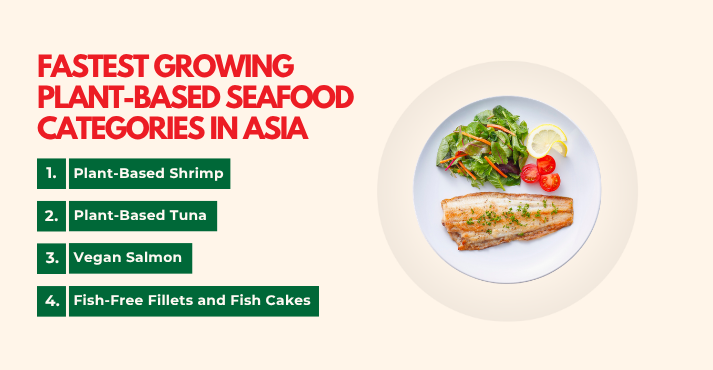
Not all categories scale equally. Proximity to familiar flavour profiles, ease of texture replication, and culinary versatility determine which formats gain commercial traction fastest.
Plant-Based Shrimp
Plant-based shrimp products are among the fastest-scaling categories, driven by the ubiquity of shrimp across Asian cuisines and the relative ease of replicating their texture using konjac and soy protein blends.
Foodservice demand is particularly strong in Thailand, Vietnam, and China, where shrimp appear in virtually every regional cuisine.
Plant-Based Tuna
Vegan tuna alternatives are gaining traction through integration into sushi menus and the expanding ready-meal segment. Their versatility across both Asian and Western applications makes them commercially accessible across a wider range of retail and foodservice formats.
Vegan Salmon
Vegan salmon occupies a premium market position, with strong retail potential in Japan, South Korea, and Singapore.
The inclusion of algae-derived omega-3s allows brands to make meaningful nutritional claims that resonate with health-driven consumers willing to pay a premium.
Fish-Free Fillets and Fish Cakes
Fish cakes and fillets carry strong mainstream adoption potential, particularly in family-oriented markets where these formats are already deeply embedded in daily cooking traditions. Their accessible price point and versatile preparation methods support broad retail uptake.
A Quick Snapshot of Fastest-Growing Plant-Based Seafood Categories
| Category | Consumer Demand | Foodservice Potential | Retail Potential | Growth Outlook |
| Plant-based shrimp | High | Very High | High | Strong |
| Plant-based tuna | Medium–High | High | Medium–High | Strong |
| Vegan salmon | Medium | Medium | High | Moderate–Strong |
| Fish-free fillets | High | Medium | Very High | Strong |
| Vegan crab | Medium | High | Medium | Moderate |
Country-by-Country Analysis of Plant-Based Seafood Opportunities in Asia
Asia’s plant-based seafood market is not developing uniformly. Each country presents a unique combination of consumer demand, regulatory support, manufacturing capabilities, and investment activity.
Singapore
Singapore functions as the region’s most advanced alternative protein innovation hub. Government-backed initiatives, a transparent regulatory environment, and a startup ecosystem have made it the leading market for early-stage commercialisation.
The Singapore Plant-based Seafood Market, worth USD 2.07 Million in 2025, is forecasted to achieve USD 4.5 Million by 2034. The Singapore market is anticipated to grow at a CAGR of 9.03% during the period 2026–2034.
Moreover, Singapore’s food safety authority has approved novel food products, including plant-based and cell-based proteins, at a pace well ahead of most regional counterparts.
China
China’s market scale makes it the single most significant volume opportunity in Asia, with a market value of $90.7 million by 2032. Domestic manufacturing capacity is substantial, and plant-based food trends are gaining ground in tier-1 and tier-2 cities.
Local brands are adapting products to familiar Chinese seafood formats, including fish tofu, crab paste, and seafood dumplings.
Japan
The food innovation trends emerging from Japan increasingly intersect with alternative seafood development. It is emerging as a promising market for plant-based seafood, driven by growing concerns around sustainability, overfishing, and food security.
As one of the world’s largest seafood consumers, the country presents significant opportunities for alternative seafood producers.
The market was valued at USD 8.0 million in 2025 and is projected to reach USD 79.1 million by 2034, expanding at a CAGR of 28.91%. Growth is being supported by advances in food technology, increasing adoption of alternative proteins, and rising consumer interest in sustainable dietary choices.
South Korea
The South Korea plant-based seafood market generated a revenue of USD 8.7 million in 2024 and is expected to reach USD 13.6 million by 2030. Further, the market is expected to grow at a CAGR of 8.1% from 2025 to 2030.
The global reach of Korean food culture also creates meaningful cross-border commercial opportunities for plant-based seafood products formulated around Korean culinary applications.
Thailand
Thailand is one of the world’s leading seafood processing and export centers, providing the infrastructure needed to scale alternative seafood production.
Thai food technology researchers developed the plant-based seafood brand “Ve-Sea,” highlighting growing domestic innovation in seafood alternatives.
Moreover, Thai seafood giant Thai Union Group has expanded investments in plant-based seafood analogs and alternative protein R&D, signalling increasing commercial interest in the category.
Malaysia
Malaysia offers a distinct competitive advantage through its halal certification ecosystem. The Malaysian plant-based seafood market is projected to reach USD 980 million by 2031, registering a CAGR of 27.1% during the forecast period.
Also, halal-compliant plant-based seafood products manufactured in Malaysia can access a substantial and underserved global Muslim consumer market. Its geographic position within Southeast Asia also supports efficient regional distribution.
Indonesia
With a population exceeding 270 million and a rapidly expanding modern retail sector, Indonesia represents a large and largely underpenetrated consumer opportunity.
As emerging food markets across Southeast Asia mature, Indonesia is widely regarded as a priority expansion market by both regional and global plant-based brands.
| Country | Market Potential | Consumer Awareness | Manufacturing Strength | Investment Activity |
| Singapore | High | High | Medium | Very High |
| China | Very High | Medium | Very High | High |
| Japan | High | Medium | High | Medium |
| South Korea | High | Medium–High | High | High |
| Thailand | Medium–High | Medium | Very High | Medium |
| Malaysia | Medium | Medium | High | Medium |
| Indonesia | Very High | Low–Medium | Medium | Medium |
Plant-Based Seafood vs Cultivated Seafood
Plant-based seafood and cultivated seafood are often grouped within the alternative seafood sector, but they represent fundamentally different technologies and commercial pathways.
| Factor | Plant-Based Seafood | Cultivated Seafood |
| Production method | Plant ingredients, extrusion, and texturisation | Cell cultivation in controlled bioreactors |
| Regulatory readiness | Approved in most markets | Limited approvals globally |
| Scalability | High due to established manufacturing infrastructure | Low — early commercial stage |
| Cost structure | Declining, near parity in select categories | Very high, cost reduction ongoing |
| Consumer acceptance | Growing steadily | Experimental, limited exposure |
| Sustainability profile | Strong, lower land and water footprint | Promising but energy-intensive |
| Commercialisation timeline | Available now | 5–10 years for meaningful scale |
Key Takeaway: Plant-based seafood currently holds a clear commercialisation advantage. Approved ingredients, scalable manufacturing, and established retail infrastructure give it immediate market relevance. Cultivated seafood holds significant long-term promise but remains early-stage across Asia in terms of both regulation and commercial viability.
Trade Opportunities Across the Plant-Based Seafood Value Chain
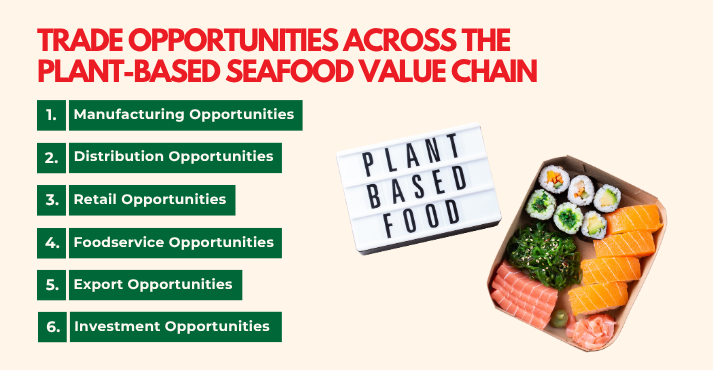
Understanding the food import and export trends shaping Asia is essential for brands and investors to identify where commercial opportunities lie across the value chain.
Manufacturing Opportunities
Private label production, ingredient sourcing partnerships, and export-oriented contract manufacturing are all viable entry points, particularly in Thailand, Malaysia, and China, where food processing infrastructure is well established and cost-competitive.
Distribution Opportunities
Importers, wholesalers, and regional distributors with existing cold chain capabilities are well-positioned to capture first-mover advantage as cross-border trade in plant-based seafood accelerates across Southeast and Northeast Asia.
Retail Opportunities
Supermarkets, specialty health stores, and e-commerce platforms offer scalable retail access. Online channels have proven particularly effective for reaching younger, health-conscious urban demographics across the region.
Foodservice Opportunities
Restaurants, hotel chains, institutional caterers, and airline catering operations represent high-volume foodservice channels. The food industry trends in Asia consistently point toward increasing menu diversification and plant-based protein integration across all service tiers.
Export Opportunities
High-growth import markets, including the Middle East, Australia, and Western Europe, are actively sourcing plant-based seafood from Asian manufacturers. Halal certification, competitive production costs, and existing seafood processing expertise give Asian exporters a meaningful structural advantage in cross-border trade.
Investment Opportunities
Startups developing ingredient technologies, whole-cut alternative seafood formats, and scalable manufacturing infrastructure are attracting both venture and corporate capital. Alternative protein funds active in Asia are expanding their seafood-specific investment mandates in response to growing commercial evidence.
Challenges Facing the Plant-Based Seafood Industry in Asia
Despite strong growth potential, several commercial, consumer, and regulatory challenges continue to influence the pace of plant-based seafood adoption across Asia.
- Price Competitiveness: Plant-based seafood products often cost more than conventional seafood, limiting adoption in price-sensitive markets. Greater production scale and supply chain efficiencies are needed to improve affordability.
- Consumer Education: Consumer awareness remains relatively low outside major urban centres. Brands must invest in education and marketing to build familiarity and trust.
- Taste and Texture Expectations: Replicating the taste, texture, and eating experience of traditional seafood remains a key challenge, particularly for premium and whole-cut products.
- Distribution and Market Access: Limited distribution networks and intense retail competition can restrict market reach, while cost concerns may slow foodservice adoption.
- Regulatory and Labeling Considerations: Differences in regulations, labeling requirements, and ingredient approvals across Asian markets add complexity to regional expansion strategies.
Future Outlook for Plant-Based Seafood in Asia
The future of food industry innovation in Asia points toward continued advances across ingredients, processing technologies, and distribution models.
AI-assisted food formulation, improved extrusion and 3D printing technologies, and next-generation protein isolates are expected to substantially close the taste and texture gap over the next five years.
Pea-based ingredients are expected to gain market share, while whole-cut seafood alternatives, algae-enhanced formulations, and AI-optimised product development become increasingly common. Retail availability is likely to expand significantly, and foodservice adoption should become more widespread across major urban centres.
The greatest volume increases are anticipated in China, Indonesia, and India, while Singapore and Japan are expected to sustain leadership in product innovation and premium positioning. Investor activity is projected to intensify as leading companies reach commercial scale and demonstrate clear paths to profitability.
Key Takeaways for Brands, Buyers, and Investors
The plant-based seafood sector is transitioning from an emerging niche to a strategically important segment within Asia’s broader alternative protein industry, creating significant opportunities for brands, manufacturers, distributors, retailers, and investors.
- Asia-Pacific is rapidly emerging as a high-growth region for plant-based seafood, underpinned by sustainability pressures, food security priorities, and rising consumer demand.
- Plant-based shrimp, tuna, and fish-free fillets represent the fastest-growing and most commercially accessible product categories.
- Singapore, China, Japan, South Korea, and Thailand are the leading markets for both innovation and commercial adoption.
- OmniFoods, Good Catch, and an expanding cohort of Asian startups are defining the competitive landscape.
- Trade opportunities span the full value chain, from manufacturing and ingredient sourcing to distribution, retail, foodservice, and export.
- Investment appetite is strong across all segments, from early-stage ingredient technology to branded consumer products.
- Price competitiveness and consumer education remain the two most significant barriers to accelerated market growth.
- Brands entering the region should prioritise halal certification, local culinary adaptation, and cold chain distribution capabilities.
Frequently Asked Questions
What is plant-based seafood?
Plant-based seafood refers to food products made entirely from plant-derived ingredients, including soy protein, pea protein, seaweed, algae, and konjac, formulated to replicate the taste, texture, and nutritional profile of conventional seafood. These products contain no animal-derived inputs and are suited to vegan, vegetarian, and flexitarian consumers.
Why is plant-based seafood growing in Asia?
Plant-based seafood growth is being driven by a convergence of factors: sustainability concerns around overfishing and marine ecosystem degradation, rising consumer interest in health-oriented diets, food security priorities at both government and corporate levels, and the increasing availability of these products through retail and foodservice channels across the region.
Which countries lead plant-based seafood innovation in Asia?
Countries leading plant-based seafood innovation in Asia include:
- Singapore: Government-backed innovation hub and regulatory frontrunner
- China: Manufacturing scale and rapidly growing domestic demand
- Japan: Functional food integration and premium product innovation
- South Korea: Strong retail adoption and active FoodTech investment
- Thailand: Processing expertise and export-oriented manufacturing
What are the most popular plant-based seafood products?
The most commercially active categories are plant-based shrimp, vegan tuna, fish-free fillets, and vegan crab products. These formats align closely with existing Asian culinary traditions and are gaining traction across both retail and foodservice channels.
Who are the leading vegan seafood brands in Asia?
OmniFoods (Hong Kong), Good Catch (US-based with growing Asian distribution), and a growing number of Singapore-based startups, including Karana, are among the most active. The competitive landscape is evolving rapidly as both established global brands and regional newcomers deepen their commitment to Asian markets.
How does plant-based seafood compare with cultivated seafood?
Plant-based seafood is commercially available now, relies on approved plant-derived ingredients, and can be manufactured using existing food processing infrastructure. Cultivated seafood is grown from animal cells in bioreactors and holds considerable long-term potential, but currently faces high production costs, limited regulatory approvals in Asia, and minimal commercial scale. Plant-based seafood offers the clearer near-term opportunity; cultivated seafood is a longer-horizon investment.
Where can distributors source plant-based seafood products?
The distributors can source plant-based seafood products:
- Established global brands with Asian distribution arms (e.g., OmniFoods, Good Catch)
- Southeast Asian contract manufacturers offering private label production
- B2B trade platforms and alternative protein industry events, such as Food & Hotel Asia
- Direct engagement with FoodTech startups at the commercialisation stage across Singapore, Hong Kong, and South Korea
What opportunities exist for investors in alternative seafood?
Key opportunities exist for investors in the alternative seafood market in the Asia-Pacific, including:
- Early-stage startups developing ingredient technology and novel processing methods
- Contract manufacturers scaling plant-based seafood production for regional and export markets
- Distribution infrastructure serving underpenetrated Southeast Asian markets
- Alternative protein venture funds expanding their seafood-specific mandates
- Strategic co-investment opportunities with major food and beverage corporations
Is plant-based seafood more sustainable than conventional seafood?
Plant-based seafood generally carries a significantly lower environmental footprint than both wild-caught and farmed conventional seafood, requiring less water, less land, and generating lower carbon emissions per kilogram of protein. It eliminates bycatch and reduces direct pressure on overfished marine stocks. Brands are also progressively improving their supply chain sustainability credentials through renewable energy adoption and responsible ingredient sourcing.
What challenges could slow market growth?
The challenges that could slow the market growth of plant-based protein in Asia include:
- Premium pricing relative to conventional seafood limits mass-market uptake
- Limited consumer awareness outside major urban centres
- Ongoing product development hurdles in replicating authentic seafood texture
- Complex and fragmented regulatory environments across different Asian markets
- The distribution infrastructure investment required to reach secondary and tertiary cities at a commercial scale