Restaurants today face rising food costs, shaky supply chains, and growing pressure to show they’re sustainable.
That makes local and seasonal ingredients more than a feel-good trend. It is a strategic move that protects quality and the bottom line.
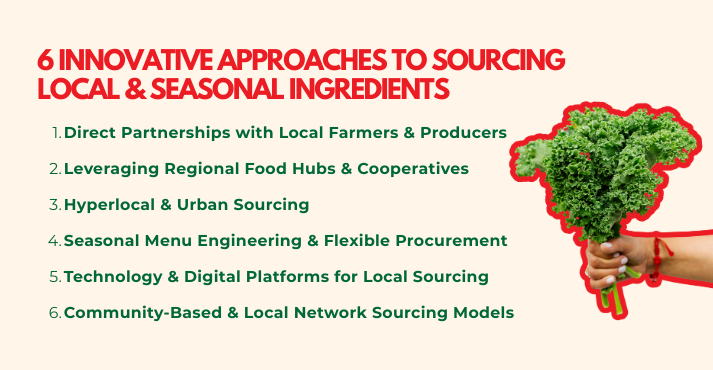
Innovative local sourcing goes well beyond farmers’ markets.
From food hubs and shared-buy programs to season-extension partnerships and supplier subscriptions, there are many ways restaurants can rethink procurement.
And the goal is the same: proving that sustainable, eco-friendly practices can deliver exceptional flavor without compromising it.
In this post, you’ll see how sourcing seasonal ingredients with tactics that minimize waste and make menus more reliable. These creative farm-to-table supply chain ideas help kitchens keep costs down while delivering fresher plates that diners notice.
Approach #1: Direct Partnerships with Local Farmers & Producers
Direct partnerships with local farmers and producers mean a restaurant buys ingredients directly from the source rather than through multiple distributors.
Chefs and buyers communicate directly with farmers, fishers, or makers to plan around seasons, agree on volumes, and set quality standards in advance.
Menus are built using crop calendars and harvest windows, which leads to more consistent quality, clearer pricing, and stronger trust on both sides.
For example, the Michelin-starred restaurant led by Chef LG Han works closely with local farmers, especially urban growers like Edible Garden City, to source herbs, vegetables, and other produce for its menus.
Chef Han makes frequent visits to his network of suppliers and shapes dishes around what’s in season locally, with about 90% of the ingredients coming from farms around Singapore.
Here’s how to approach local farmers and producers:
1. Find Farmers
Visit local farmers’ markets, join producer cooperatives, or contact agricultural extension offices. Word‑of‑mouth referrals from other chefs can also uncover growers who welcome restaurant clients.
2. Approach Them
Ask about crop calendars, growing practices, and willingness to enter custom agreements. Be clear about your volume needs and flexibility around seasonal availability.
3. Negotiate
Discuss minimum purchase volumes, pricing models, and delivery cadence. Consider pre‑harvest contracts that guarantee the farmer a market in exchange for priority access to specific crops.
Pros & Cons
Direct partnerships offer greater transparency and traceability, giving restaurants a clear view of where ingredients come from and how they are produced.
Over time, buying straight from farmers can also lead to lower costs and consistently fresher produce, while strengthening the restaurant’s brand through authentic community connections.
However, this approach does require an upfront investment of time to build relationships, visit farms, and coordinate supply.
Moreover, it can also be harder to scale quickly for high-volume needs, and seasonal gaps may still require backup suppliers to maintain menu consistency.
Approach #2: Leveraging Regional Food Hubs & Cooperatives
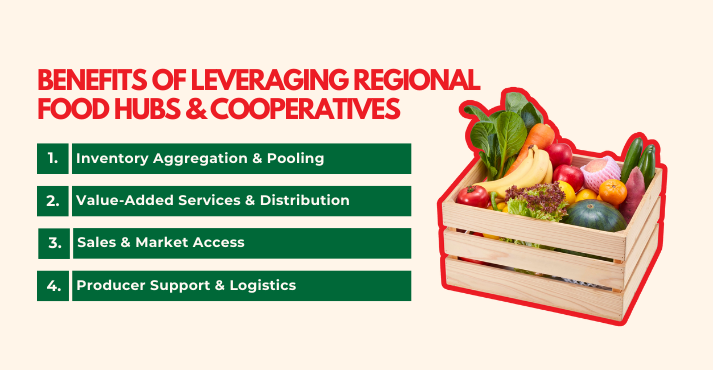
Regional food hubs and producer cooperatives serve as central aggregation points that connect many small- and mid-sized farmers and producers with larger buyers such as restaurants, institutions, and retailers.
Instead of juggling separate orders from dozens of farms, a food hub brings everything together, all while preserving traceability back to the original farms.
Here’s how they help:
- Inventory Aggregation and Pooling: Aggregate products from multiple farms into a single inventory pool.
- Value-Added Services and Distribution: Distribute, store, and sometimes process produce so it’s ready for wholesale buyers.
- Sales andMarket Access: Market and sell local products to a range of customers, including foodservice and retail.
- Producer Support and Logistics: Provide services like packaging, logistics support, and connections to technical assistance for producers.
This simplifies access to locally sourced produce for restaurants by leveraging regional food hubs and producer cooperatives.
For example, many are choosing coffee that’s ethically sourced, which is prompting more businesses to consider sustainability from farm to shelf.
Comparison: Direct Farm Sourcing vs Food Hubs
| Aspect | Direct Farm Sourcing | Regional Food Hub |
| Supplier management | Multiple relationships to manage | A single point of contact aggregates many farms |
| Customization | High and can request specific crops | Moderate and product selection depend on hub inventory |
| Best for | Independent restaurants or small groups that value bespoke supply | Mid‑sized or multi‑location operators that need scale and reliability |
This is best for:
- Small, Single-Location Restaurants: Useful when you want local sourcing without hiring multiple buyer contacts, food hubs give you variety with fewer suppliers.
- Multi-Location Operators and Growing Kitchens: Great for operations that need scale and reliability while still maintaining a local identity, because hubs help meet greater, more consistent demand.
- Chefs Who Want Local Without the Admin: Hubs streamline logistics without losing that regional ingredient story.
Leveraging food hubs and cooperatives can bridge the gap between artisanal producers and commercial kitchens, especially for restaurants that find direct relationships with every farm too time-intensive or complex.
Approach #3: Hyperlocal & Urban Sourcing (On-Site, Rooftop, Community)
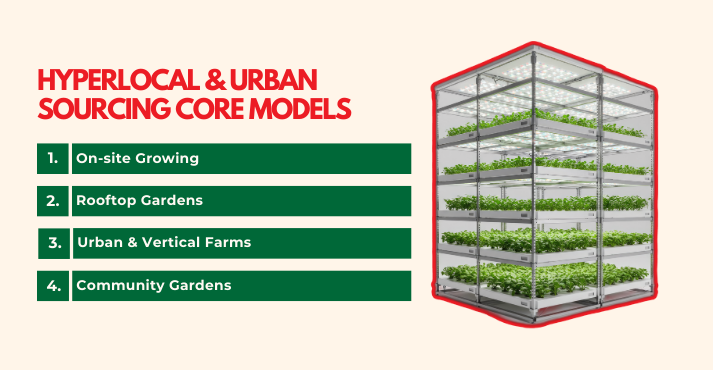
Hyperlocal and urban sourcing means growing or sourcing produce very close to the restaurant, on a rooftop, in planters on-site, from a nearby vertical farm, or via community garden partnerships.
In real kitchens, this often looks like window-box herbs for daily garnishes, a rooftop bed for salad greens, a contract with a vertical-farm operator for consistent microgreens, or a community plot that supplies seasonal veg.
The result is ingredients harvested at peak freshness, stronger stories for your menu, and visual proof of sustainability that guests can see and share.
To implement these local food sourcing strategies, consider these models:
- On-site Growing: Planters, window boxes, indoor hydroponics
- Rooftop Gardens: Raised beds for greens, herbs, and small crops
- Urban & Vertical Farms: Commercial partners supplying consistent harvests
- Community Gardens: Shared plots or neighborhood grower collaborations
Together, these models support an urban farm-to-table approach that fits city-based restaurants.
For example, Na Oh, a modern Korean restaurant, is a direct farm-to-table experience, sourcing its fresh produce from a two-story, fully automated robotic vertical farm located within the same facility.
This advanced farm, described as “the first of its kind,” utilizes automation and robotics to produce over 30 kilograms of fresh greens daily.
What Ingredients Make Sense
Not everything can be grown this way. Hyperlocal sourcing works best for:
- Herbs (basil, cilantro, thyme, mint)
- Salad greens and baby lettuces
- Microgreens and edible flowers
- Garnish items (lemongrass, chives)
- Small vine crops in containers (cherry tomatoes, peppers)
- Indoor mushrooms (oyster, shiitake) via small kits
These items deliver high flavor impact and strong visual appeal without requiring much space.
Scalability and Limit
Hyperlocal sourcing brings freshness and great marketing, but it rarely replaces full supply needs. Yields are limited by space, season, and climate.
Rooftops and vertical systems can scale with investment, but they need capital, ongoing labor, and sometimes technical know-how.
Brand Impact: Strengthen Your Restaurant Identity
Hyperlocal sourcing turns sustainability into something guests can see, feel, and talk about.
Here’s how
- Menu Atorytelling: “Grown on our rooftop” or “harvested today” elevates menu language
- Marketing & Social Media: Visual growing spaces and harvest moments drive engagement
- Sustainability Credibility: Guests see real, tangible eco-friendly practices
- Differentiation: Creates a unique identity that competitors can’t easily copy
Pros & Cons
Hyperlocal sourcing offers ultra-fresh ingredients, strong brand storytelling, and visible sustainability, but is limited in scale, requires setup and upkeep, and is vulnerable to seasonal or weather challenges.
Approach #4: Seasonal Menu Engineering & Flexible Procurement
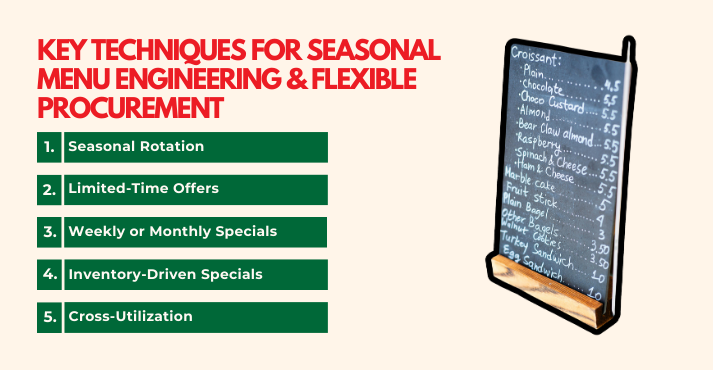
Designing menus around what’s locally available, rather than insisting on the same dishes year‑round, reduces waste and improves margins.
That means rotating mains and sides with the seasons, running limited-time offers when a crop peaks, and using shorter ordering windows so purchases match actual harvests.
Here are the key techniques for seasonal ingredient procurement:
- Seasonal Rotation: Swap core dishes by quarter or season.
- Limited-Time Offers: Spotlight peak produce to move volume quickly.
- Weekly or Monthly Specials: Respond to last-minute harvest opportunities.
- Inventory-Driven Specials: Build dishes around surplus items to cut waste.
- Cross-Utilization: Create components that work in multiple dishes to increase flexibility.4
A strong example is North Miznon Singapore, which adapts its menu around locally sourced seasonal produce, working closely with farmers so dishes reflect what’s at its peak.
As a result, the guests taste the authentic, unadulterated flavours of the region, crafted into memorable dishes that speak of place and season.
Smart Implementation Tips for Seasonal Menu Engineering
Effectively using seasonal menus requires coordination between the kitchen, front-of-house, and procurement teams. Here are some tips you can follow:
- Train staff: Educate servers and cooks about new dishes and ingredients so they can confidently explain menu changes.
- Communicate with guests: Use menus, chalkboards, and websites to highlight seasonal specials and the stories behind them.
- Work backwards from harvest cycles: Plan limited-time offers and weekly specials based on farmers’ crop calendars. Feature bumper crops prominently and pivot to preserved items when supplies run low.
- Preserve and ferment: Pickling, fermenting, and dehydrating extend the life of seasonal produce while adding unique flavors to the menu.
Pros & Cons
Seasonal menu engineering lowers waste, delivers fresher dishes, enables creative storytelling, and allows cost control through bulk purchasing during peak harvests.
On the flip side, it requires flexible recipe development, more frequent menu updates, and may occasionally confuse guests who expect consistent offerings.
Approach #5: Technology & Digital Platforms for Local Sourcing
Digital sourcing tools and online marketplaces connect restaurants to networks of regional producers, food hubs, and specialty suppliers in one searchable place.
Instead of phone lists and spreadsheets, kitchens can check real-time availability, compare prices across suppliers, place and track orders, and pull traceability or sustainability data for menu claims.
These platforms turn manual procurement into a repeatable, auditable workflow, freeing buyers to focus on menu strategy.
When Technology Truly Pays Off for Local Sourcing
These tools make sense for operations that want to reduce administrative burden, track availability in real time, and strengthen sustainability claims.
- Large or Multi-Unit Operations: Streamlined ordering and centralized inventory visibility make managing multiple locations far easier.
- Diverse Supplier Base: When sourcing from many small farms, platforms reduce administrative overhead and minimize order errors.
- Traceability and Sustainability Reporting: Digital records make it easy to track carbon footprints and certifications, and to communicate sourcing stories to guests.
- Remote or Time-Pressed Buyers: Users can search, compare, and place orders from anywhere, keeping local supply chains running smoothly even when on the go.
Practical Steps to Adopt Digital Sourcing
Adopting digital sourcing platforms works best when your kitchen needs efficiency, consistency, and better visibility into suppliers. Here’s how:
- Audit Your Needs: List SKUs, order frequency, and pain points (e.g., too many invoices, inconsistent availability).
- Start Small: Pilot a platform for a subset of items (e.g., herbs, microgreens, or specialty proteins) before a full migration.
- Standardize SKUs: Create clear product names and pack sizes to avoid mismatches when multiple suppliers list similar items.
- Train Staff: Show purchasing staff how to search, set availability alerts, and reconcile invoices.
- Integrate Workflows: Feed order data into your inventory system or accounting system to reduce duplicate entries.
- Use Traceability Data: Capture supplier origin and certifications to support menu copy and sustainability claims.
Novotel Dubai World Trade Centre has adopted a cloud‑based procurement system that gives its purchasing team real‑time access to supplier data, inventory levels, and order status, improving transparency and agility in managing complex supply chains.
Approach #6: Community-Based & Local Network Sourcing Models
While direct sustainable ingredient sourcing creates a single link between buyer and grower, community-based models weave a multi-stakeholder network that shares risk, rewards, and responsibility.
This approach moves beyond transactional relationships to build a collaborative local food ecosystem in which restaurants, producers, and, sometimes, even consumers are interdependent partners in sustainability.
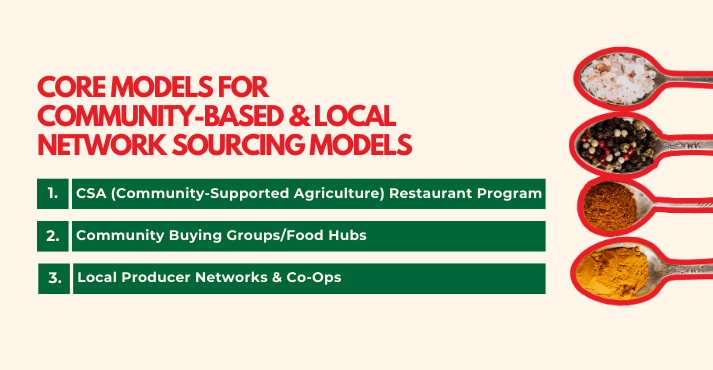
Core Models & How They Work
Practical partnership structures that help restaurants source locally, share risk, and build resilient supply chains.
1. CSA (Community-Supported Agriculture) Restaurant Programs
Partner with a farm or a farmer network to purchase a “share” of the harvest. You commit upfront, providing farmers with crucial early-season capital, and in return receive a regular, seasonal supply.
2. Community Buying Groups/Food Hubs
Collaborate with other local restaurants, cafés, or institutions to aggregate purchasing power.
These groups often work through a local food hub that coordinates aggregation, distribution, and sometimes processing from multiple small-scale producers, making local sourcing efficient and scalable.
3. Local Producer Networks & Co-Ops
Establish partnerships with formalized networks of farmers, fishers, and ranchers.
These entities operate on principles of long-term partnerships and ethical sourcing, ensuring fair prices and stable demand for their members.
These models work especially well for:
- Independent restaurants
- Mission-driven brands
- Local-first food businesses
- Operators prioritizing sustainability, storytelling, and community impact
How This Strengthens Local Food Systems
This approach creates a virtuous cycle:
- Stabilizes farmer Income with predictable demand and upfront capital.
- Increases regional food security by keeping more food production and distribution within the community.
- Builds infrastructure by supporting the food hubs and networks that make local sourcing viable.
- Fosters Innovation through close collaboration on crop planning, heirloom varieties, and value-added products.
- Deepens community goodwill by visibly investing in the local economic and agricultural fabric.
For example, Native Kitchen (certified under Singapore’s Farm-to-Table Recognition Programme) actively promotes farm-to-table/locally sourced produce, highlighting its commitment to sustainable, locally centered supply chains.
Comparison Table: Approaches vs Benefits
Here’s a quick comparison of all the approaches:
| Approach | Best for | Key benefits | Challenges |
| Direct partnerships with farmers | Independent restaurants; chefs seeking unique flavours | Transparency, bespoke crops, strong storytelling, predictable quality | Managing many small suppliers; limited product range; crop failures |
| Regional food hubs & cooperatives | Mid‑sized restaurants, institutions, and multi‑unit operators | Simplified ordering, broad product variety, stable supply | Less direct connection to growers; possible mark‑ups |
| Hyperlocal & urban sourcing | Hotels, resorts, urban eateries, and brands seeking differentiation | Ultra‑fresh ingredients, guest engagement, and marketing value | High initial costs, limited production capacity, and maintenance |
| Seasonal menu engineering | Concept‑driven restaurants, modern bistros | Reduced waste, higher margins, culinary creativity | Frequent menu updates, training needs, and possible guest confusion |
| Technology & digital platforms | Multi‑location restaurants, buyers with a diverse supplier base | Efficiency, real‑time availability, transparency, traceability | Subscription fees, training requirements, reliance on tech |
| Community‑based & network models | Independent restaurants, mission‑driven brands | Shared risk, strong community ties, support for local farmers | Limited scalability, inconsistent box contents, and planning complexity |
FAQ’s
How do restaurants find reliable local suppliers?
Restaurants usually find reliable local suppliers through a mix of networking and vetting. They ask other chefs for recommendations, visit farmers markets and food hubs, attend trade shows, and search local producer directories. Before committing, they sample products, check certifications and references, and start with small trial orders to test consistency, quality, and delivery reliability.
What are the risks of sourcing locally?
Sourcing ingredients locally offers freshness and community benefits, but introduces key risks, including:
- Potential food safety gaps from smaller or less-regulated producers
- Inconsistent supply and quality due to seasonality and weather
- Higher product and logistics costs
- Limited volume or variety
- Added operational complexity in managing multiple vendors
- Local sourcing isn’t automatically more environmentally sustainable
Is local sourcing more expensive?
Yes, locally sourced ingredients have higher unit prices than large-scale or imported alternatives because smaller producers have higher production and labor costs, and less buying scale. However, overall costs aren’t always higher once you factor in reduced transportation, spoilage, and logistics savings, and sometimes local items can be similarly priced or even cheaper in certain cases.
How can small restaurants source seasonal ingredients?
Small restaurants can source seasonal ingredients by building local partnerships and designing flexible, produce-driven menus that adapt to what’s fresh and available. Here’s how:
- Build relationships with nearby farmers and producers
- Shop farmers’ markets or join local food hubs/co-ops
- Use regional distributors that specialize in seasonal products
- Plan rotating menus and daily/weekly specials around availability
- Stay updated with seasonal calendars and crop forecasts
- Work with multiple suppliers to avoid gaps in supply
Can large food businesses source locally at scale?
Yes, large food businesses can source locally at scale by coordinating with regional food hubs or aggregators that combine products from multiple small farms, contracting several suppliers to meet volume and consistency needs, standardizing food safety and quality requirements, planning menus around seasonal availability, and investing in strong logistics and forecasting to keep supply reliable year-round.
Conclusion: Building a Smarter Local Sourcing Strategy
Today, sourcing local and seasonal ingredients is no longer just about swapping a few imported items for farmers’ market produce.
Instead, thanks to innovations in supply chains, technology, and community collaboration, locavore ideals have evolved into practical, scalable business strategies.
By thoughtfully mixing approaches, for example, combining direct farmer partnerships with digital sourcing platforms, or pairing a rooftop garden with a regional food hub, operators can create resilient supply chains tailored to their size, goals, and mission.
As a result, the benefits extend beyond fresher, tastier dishes; restaurants can also better control costs, reduce environmental impact, and clearly differentiate their brand.
Lastly, as consumer demand for transparency and sustainability continues to grow, these creative farm-to-table sourcing methods will increasingly shape the future of dining.