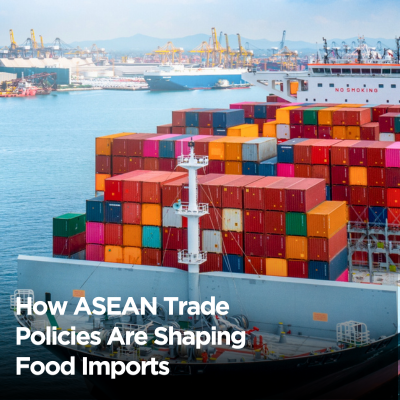
Southeast Asia’s booming population and urbanization are driving surging food demand.
Many ASEAN countries already rely heavily on food imports. For example, Singapore sources over 90% of its food through trade. At the same time, global shocks (COVID lockdowns, geopolitical conflicts) have exposed vulnerabilities in food supply chains.
ASEAN (Association of Southeast Asian Nations), a 10-member bloc with 700 million people and 7.4% of global GDP, has responded by coordinating trade policies and regulations, cutting tariffs within its Free Trade Area, harmonizing standards, and negotiating major trade pacts.
ASEAN food import policies are directly shaping how products move across the region through tariffs, free trade agreements, and sanitary rules
This article examines how ASEAN trade rules affect food imports. Also, we explain tariff cuts and food market and trade facilitation that lower costs, as well as non-tariff measures (SPS, licensing) that raise compliance burdens.
Overview of ASEAN Trade Policies for Food Imports

ASEAN’s trade framework plays a central role in shaping the region’s food market and trade.
Through agreements such as the ASEAN Trade in Goods Agreement (ATIGA), most customs duties within the region have been removed, enabling the smoother movement of goods.
What Are ASEAN Trade Policies?
ASEAN trade policies are coordinated efforts led by the ASEAN Secretariat to promote economic integration and reduce trade barriers among member states. While each country maintains its own regulations, ASEAN provides a shared framework that aligns key trade practices.
These policies rely on several key components:
- Tariffs: Taxes on imported goods, many of which have been reduced or eliminated within ASEAN
- Quotas: Limits on the quantity of certain food imports
- SPS Standards: Food safety and health regulations to protect consumers
- Import Licensing: Approval systems are required before certain goods can enter a country
This combination ensures that trade flows efficiently while maintaining safety and regulatory control.
Key Agreements Shaping Food Trade
Two key agreements that shape the food trade in the ASEAN region are:
1. ASEAN Free Trade Area (AFTA)
AFTA binds all 10 ASEAN states to eliminate intra-regional tariffs on virtually all goods. Under ATIGA, items in sensitive lists (rice, sugar, dairy, etc.) saw phased tariff cuts.
For example, the Philippines reduced tariffs on key staples such as rice and sugar significantly over the years, making imports more affordable.
2. Regional Comprehensive Economic Partnership (RCEP)
The Regional Comprehensive Economic Partnership (RCEP) further enlarges the free-trade zone to include China, Japan, South Korea, Australia, and New Zealand. This means food exports from Japan or China to ASEAN can enter with much lower duties than before.
Both AFTA and RCEP are designed to lower import costs and expand sources of food. These agreements support ASEAN food import regulations by making them more predictable and transparent for businesses.
Key benefits include:
- Lower import costs due to reduced tariffs
- Expanded sourcing options for food products
- Faster customs clearance through streamlined procedures
- Greater transparency via tools like the ASEAN Trade Repository
At the same time, ASEAN continues to enforce inspection and certification standards to ensure food safety. Risk-based SPS measures and shared guidelines help maintain quality while supporting trade growth.
How Tariffs and Trade Agreements Impact Food Imports
Understanding the agricultural import policy of Southeast Asia requires a close look at both tariff and non-tariff measures. These policies are directly shaping emerging food markets like Vietnam and Indonesia, where consumer demand is exploding.
Tariff Reductions and Import Costs
Food trade policies have successfully reduced average tariffs on agricultural goods in many ASEAN nations. As a result, reduced tariffs make imported staples like rice, wheat, and dairy more affordable for local consumers.
Lower duties also cut costs for downstream users: for example, cheaper sugar and grains reduce costs for confectioners and livestock farmers.
Trade pacts like RCEP further extend these gains. Within RCEP, major exporters like Japan, China, and South Korea will gradually remove most food tariffs on ASEAN imports.
For example, RCEP’s tariff schedules often grant low tariffs on staple foods (wheat, dairy, fruits) from partner countries. This means a Thai food processor can import wheat flour from Australia or milk powder from New Zealand at minimal duty.
Trade Facilitation and Supply Chain Efficiency
Beyond tariffs, ASEAN nations are simplifying customs and logistics to speed up food imports. The ASEAN Single Window (ASW) initiative links national electronic customs platforms, so importers submit documents only once.
When fully implemented, ASW dramatically cuts clearance times. Moreover, WTO-led programs like Authorized Economic Operator (AEO) schemes give trusted traders expedited clearance. Also, AEO-certified imports clear faster at ports than non-certified shipments.
Applying such measures in ASEAN means perishable foods (seafood, fruits, dairy) move faster through borders, improving freshness and reliability.
Case Insight
Under AFTA, Malaysia substantially reduced tariffs on imports from ASEAN partners, so those suppliers gained a clear price advantage in the Malaysian market.
In food terms, Malaysia also sources about 41.6% of its rice from ASEAN member countries, which makes it a practical example of how tariff preferences support intra-ASEAN food imports. Also, lower tariffs give consumers more spending power and a wider product choice.
Role of Non-Tariff Measures (NTMs)
Even as tariffs fall, non-tariff measures (NTMs) increasingly govern food imports. NTMs are policy measures beyond customs duties that affect trade, chiefly regulatory requirements.
So, data shows that when we compare tariff and non-tariff barriers in ASEAN, the number of reported ASEAN agri-food NTMs quadrupled between 2000 and 2019.
Sanitary and Phytosanitary (SPS) Standards
Food safety rules are the most prominent NTMs. Every ASEAN country sets its own SPS standards (residue limits, allowed additives, microbial criteria) and inspection regimes. These include mandates like pre-export health certificates, laboratory tests, and maximum residue thresholds.
While aiming to protect consumers, SPS requirements can be complex for exporters. Differing standards mean exporters must often tailor products for each market. For example, a dairy product may need distinct labeling and testing in Malaysia versus in the Philippines.
Import Licensing and Regulatory Barriers
Each ASEAN country maintains its own import licensing regime, creating a fragmented system for the food supply chain. Regulations differ widely on transparency, with some nations requiring detailed nutritional panels while others focus on allergen warnings.
According to industry surveys, most ASEAN countries (except Malaysia and Singapore) require official registration of food products before sale.
Companies may face frequent inspections, mandatory ingredient disclosures, and evolving standards (e.g., new Halal laws in Indonesia).
Transparency in food labeling is another key area: ASEAN states have different language requirements, nutrition labeling norms, and even rules on traceability.
Impact on Import Volumes
The net effect of stringent NTMs is that they dampen import volumes, even in a low-tariff environment. Higher compliance costs tend to reduce demand for imported foods relative to what tariff cuts alone would suggest.
For example, despite ASEAN’s FTA, countries with more rigorous SPS and licensing regimes still import comparatively less food than they might, given their consumption needs. In contrast, markets with fewer NTMs, such as Malaysia or Singapore, are easier for exporters to penetrate.
Country-Level Comparison
Here’s a detailed country-level comparison:
| Country | Tariffs | Ease of Import (Key) | Key Regulations | Food Import Demand |
| Thailand | Low. | Relatively easy intra-ASEAN | Strict SPS controls on fruit and seeds, mandatory quality checks for seafood, halal labeling optional. | Major exporter of rice/oil; imports corn (for feed), wheat, food ingredients. Medium-high food import volume. |
| Vietnam | Moderate. | Improving (customs reforms underway; still bureaucracy for registrations). | Rigorous SPS/labelling: many technical rules, product registration. | Exports rice/pork; imports wheat, corn, soy, dairy; growing demand with incomes. |
| Indonesia | Moderate. | Challenging, high documentation costs, licensing (e.g., import permits, halal certification). | Complex import licensing, strict new Halal law, and testing labs are required for many goods. | Largest ASEAN market: heavy imports of feed grains, sugar, vegetable oils, processed foods. Demand is growing fast. |
| Malaysia | Low. | Easy (favorable customs environment). | Focus on Halal certification (mandatory for many products); labeling in Malay/English; relatively transparent system. | Moderate importer: Rice is imported, plus fruits and meat. Steady demand as incomes rise. |
| Philippines | Medium-High. | Moderate (high process times; import permits needed via NFA for grains). | Quotas on rice; licensing by NFA (rice) and PCA (poultry); SPS tests (e.g., aflatoxin screening); labeling in English. | Heavy importer: Big imports of corn, meat, dairy; rice imports are limited. Fresh fruit and sugar are also imported. |
The country-level table highlights that the easiest markets (Malaysia, Thailand) have simple regimes and lower tariffs, whereas the highest-demand markets (Indonesia, Philippines, Vietnam) pair strong import needs with more regulatory friction.
Trends in ASEAN Food Imports

Current policies are responding to several powerful trends reshaping consumption. Southeast Asia trade agreements will continue to adapt as these trends accelerate.
Growing Demand for Imported Food
Population growth, rapid urbanization, and shifting dietary preferences toward protein-rich diets are driving import needs. Local production cannot keep pace with rising middle-class expectations for variety and quality.
Shift Toward Processed and High-Value Foods
The rising middle class is demanding more convenience foods, ready-to-eat meals, and premium imported ingredients. Processed foods, dairy products, and specialty items are seeing the fastest growth in import volumes.
Supply Chain Resilience and Diversification
Global disruptions from pandemics and geopolitical conflicts have pushed ASEAN to diversify its supply sources. Regional trade policies now actively encourage sourcing from multiple partners to avoid over-reliance on any single nation.
Purchases on E-commerce and Digital Platforms
Consumers increasingly buy food online, and businesses use digital traceability. ASEAN is pushing digital transformation: guidelines and workshops encourage blockchain and data-sharing to strengthen the regional food supply chain.
Digital certificates, e-payments, and traceability apps are gradually being adopted, which should lower costs and enhance transparency.
Impact of Trade Policies on Food Prices and Availability
Southeast Asia trade agreements in the food sector experience a dual effect from current policies. On the positive side, tariff cuts generally lower consumer prices for imported foods.
Eliminating duties on commodities like vegetable oils, wheat flour, or dairy inputs makes end products cheaper. Consumers enjoy more choice and can shift consumption toward imported varieties when local prices rise.
Also, the lower tariffs in ASEAN have kept staple prices more stable than in markets that remain heavily protected.
However, the regulatory side can push in the opposite direction. Strict SPS and licensing can raise effective costs. Thus, even with low tariffs, consumers may face higher prices if items incur heavy compliance costs or delays.
Availability is similarly nuanced. FTAs and trade facilitation generally expand availability by inviting more suppliers into the market. A broader supplier base usually means fewer shortages. Indeed, AFTA’s tariff cuts have prompted increased intra-ASEAN trade flows.
RCEP will likely have a similar effect with extra-regional partners. However, unpredictable NTMs or sudden export bans can still cause gluts or scarcities: the 2022 Russian–Ukrainian war saw Malaysia ban chicken exports, causing regional supply stresses.
Therefore, policymakers must balance these trade-offs: liberalization generally improves long-term availability and choice, while safeguards and licensing can short-term limit availability to protect local interests.
Opportunities for Exporters and Businesses

ASEAN’s integrated market offers many opportunities for exporters who navigate it wisely.
Private label co-manufacturing in APAC is a growing opportunity as local retailers seek to develop their own branded food products. Thus, ASEAN trade regulations can work in favor of prepared, shelf-stable, and frozen food categories.
Market Entry Opportunities
The fastest-growing ASEAN food markets include Indonesia and the Philippines (urbanizing quickly). These large countries have rising disposable incomes, and they import vast quantities of feed grains, meat, dairy, and packaged foods.
For example, Indonesia’s retail F&B sector has grown 7–9% annually, and survey data show Indonesians now spend 82% of their household budgets on food. Product categories in demand include animal feed (corn, soy), frozen meats (chicken, beef), dairy powder, processed snacks, and halal-certified foods.
How to Navigate ASEAN Regulations
Success in ASEAN requires mastering SPS and labeling standards.
Here are some tips to remember:
- Understand SPS Standards: Research each market’s permitted additives, contaminant limits, and required certificates. For example, check Malaysia’s Food Act and Thailand’s FTB.
- Engage Local Partners: Distributors or importers can handle registration and respond to regulators. In Indonesia and Vietnam, having a locally registered importer is often mandatory.
- Monitor Policy Changes: Regulators in ASEAN can update rules suddenly (e.g., listing a new banned ingredient). Use trade alerts from agencies like USDA/FAS or ASEAN’s trade repository.
- Use Certifications: International certifications (ISO, HACCP, Halal from recognized bodies) can ease market entry across the bloc.
Leveraging Trade Agreements
Exporters should capitalize on ASEAN’s FTAs. Ensure products qualify under the rules of origin to claim tariff concessions.
For example, Chinese food firms can now export starches or fruits to ASEAN tariff-free under RCEP if they meet origin criteria. Similarly, exporters from ASEAN can ship to Japan or Korea duty-free via RCEP.
Challenges and Risks
The outlook is positive, but significant risks remain.
- Regulatory Fragmentation: Each of the ten ASEAN members maintains unique food safety and labeling rules. This fragmentation makes it difficult for exporters to apply a single strategy across the region, often requiring country-specific adjustments.
- Compliance Complexity: Small exporters struggle to meet diverse SPS and halal certification requirements simultaneously. Even minor errors in paperwork or labeling can lead to shipment delays or rejections, increasing administrative workload and costs.
- Political and economic risks: Sudden import bans, currency fluctuations, or protectionist measures can disrupt supply chains overnight.
Future Outlook: Where ASEAN Food Trade Is Heading
The regional food supply chain in ASEAN is likely to become more integrated and transparent over the next few years.
Policy Harmonization and Sustainability
Initiatives like the ASEAN Food Safety Network aim to unify testing methods. Future efforts (e.g., under the ASEAN Strategic Plan for Agriculture) include promoting sustainable farming, reducing food waste, and climate-smart practices across the region.
Climate policies may lead to rules on deforestation (affecting palm oil) or emissions in agriculture. Importers might see new requirements for traceability (e.g., proof of sustainable sourcing) in the coming years.
Digital Trade and Logistics
The use of technology will accelerate. Plans are underway to link ASEAN’s customs digital platforms further and to pilot blockchain traceability for agri-foods. Digital payment and e-commerce agreements (like those in RCEP chapters) will reduce friction for online food trade.
We expect smarter cold-chain logistics (monitored via IoT) and broader use of electronic phytosanitary certificates, further speeding cross-border trade and reducing losses.
Consumer Transparency
Finally, consumers in ASEAN are increasingly demanding information on ingredient origins and ethical standards. Trends like “farm-to-table” and “traceable origin” may drive regulatory emphasis on labeling the origin of key ingredients, production methods (e.g., antibiotic-free meat), and sustainability scores.
Looking ahead, we anticipate ASEAN trade policy will lean toward deeper integration, modernization, and a push for greener, more resilient food supply chains.
FAQ
What are ASEAN trade policies for food imports?
ASEAN’s trade policies aim to liberalize intra-regional trade and harmonize standards. Through agreements like AFTA/ATIGA, tariffs on most food products between member states have been cut to zero. ASEAN also works on common food safety principles (e.g., ASEAN SPS frameworks) to ease inspections. Additionally, ASEAN has FTAs with external partners (e.g., RCEP), expanding free trade for food beyond the region.
How do tariffs differ across ASEAN countries?
Tariffs vary by product and country. Most staple foods are duty-free under ATIGA, but sensitive items retain higher rates. For example, the Philippines maintains 35% import duty on rice and 5% on sugar, while Vietnam’s agriculture tariffs averaged around 8–12%. Thailand and Malaysia generally have low average agri tariffs, and Singapore imposes virtually none. Under RCEP and other FTAs, many extra-ASEAN tariffs have also been reduced.
What is the impact of RCEP on food trade?
RCEP expands market access for ASEAN food imports by reducing tariffs with China, Japan, South Korea, Australia, and New Zealand, simplifying origin rules. It is expected to boost food flows by lowering costs and harmonizing regulations among member countries.
Which ASEAN countries import the most food?
Indonesia, Vietnam, and the Philippines are the largest food importers in ASEAN, driven by large populations and rising consumer spending.
What regulations affect food exporters to Southeast Asia?
Exporters must comply with each country’s food safety and import rules. Major regulatory areas include:
- Sanitary standards: Pathogen testing, residue limits, and contaminant levels.
- Import licensing: Permits or registrations required for specific food categories.
- Health certificates: Mandatory for products of animal origin in most ASEAN nations.
- Ingredient restrictions: Banned additives or limits on certain preservatives.
- Halal certification: Required for meat and processed foods in Indonesia and Malaysia.
- Labeling laws: Language (e.g., Bahasa Indonesia, Thai), nutrition info, and allergen warnings vary by country.
How do SPS standards impact imports?
SPS standards protect health but can slow imports through required inspections, documentation, and product testing, increasing time and costs. Exporters must satisfy importing countries’ food safety requirements, which vary widely. Non-scientific or overly tight SPS rules can even act as trade barriers.
Conclusion
ASEAN trade policies have drastically lowered tariff barriers for food imports across Southeast Asia, creating a large, mostly duty-free market. At the same time, regulatory requirements (SPS rules, import licensing) have grown more complex.
Given this, food imports into ASEAN have become cheaper and more diversified, but compliance has become a critical concern. For businesses and policymakers alike, the message is clear: seize the opportunities of a more open market, while investing in compliance and risk management.
Going forward, ASEAN will likely deepen integration, further harmonizing standards and embracing digital trade, which could smooth some of today’s hurdles.
Staying informed and proactive is key: exporters should leverage FTAs and partner networks, and governments should continue to align rules.
In an era of supply-chain shocks and rising demand, the ASEAN trade policy and food imports will only grow more important. And the future belongs to those who can adapt quickly.