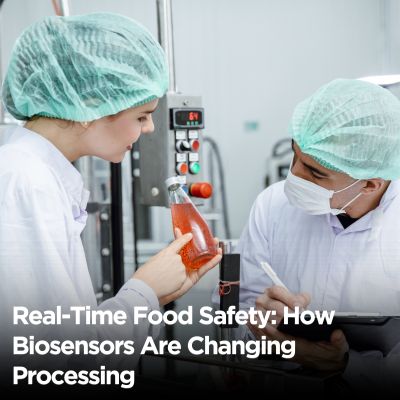
Each year, nearly 600 million people worldwide fall ill after consuming contaminated food, leading to approximately 420,000 deaths. These numbers highlight the importance of implementing effective food safety measures in the food processing industry.
Traditional food safety protocols often rely on periodic laboratory testing, which can be slow and may miss contamination events that occur between sampling points.
With regulatory standards becoming stricter and consumer expectations rising, manufacturers face increasing pressure to maintain consistent product quality and safety.
Real-time food safety solutions, such as biosensors, provide a practical approach. By providing continuous or near-continuous monitoring on the production floor, these sensors can detect contaminants as they appear, allowing for immediate corrective actions.
This article explains how real-time biosensors are used in food safety, their function, and how they fit into processing workflows.
It also covers benefits compared with traditional testing methods, steps for implementation, common challenges, and emerging trends.
What Are Biosensors in Food Safety?
Biosensors are devices that detect specific substances in food by combining a biorecognition element, such as an enzyme, antibody, DNA sequence, or aptamer, with a transducer.
The biorecognition element interacts with the target, and the transducer converts this interaction into a measurable signal, such as an electrical or optical response.
Unlike traditional laboratory tests, which take hours or days, and rapid test strips, which provide only spot-checks, biosensors can deliver continuous or frequent measurements directly on the production line.
This allows manufacturers to respond quickly and maintain consistent food safety standards.
The main types of biosensors include electrochemical sensors, which measure changes in conductance or current; optical sensors, which detect changes in light such as fluorescence or chemiluminescence; and nano- or paper-based sensors, which are portable, low-cost, and can serve as smart labels or on-site testing tools.
By providing fast, real-time monitoring, biosensors help improve detection of contaminants, reduce the risk of product holds or recalls, and support overall food safety management throughout the processing operation.
How Real-Time Detection Works on the Line
In modern processing plants, biosensors are installed at critical points where risks are most likely to occur. They may be mounted in wash water systems, on production lines, within air handling units, or even integrated into packaging.
Data from these sensors is collected and transmitted to operators or a central monitoring platform, where it can trigger alerts, automatically stop production lines, or integrate with a digital food safety system.
This flow of information allows faster decision-making and reduces the time between detection and corrective action.
In 2024, hospitalizations caused by foodborne illnesses more than doubled, from 230 to 487, highlighting the urgent need for near-instant monitoring.
1. Raw Receiving & Pre-Processing
At the point of raw material intake, sensors can screen for common pathogens such as E. coli, Salmonella, and Listeria, as well as toxins like aflatoxins.
By monitoring incoming product and wash water, biosensors help identify potential food contamination before it reaches the processing stage.
Results can be tied to automated accept-or-reject logic or quarantine protocols, thereby reducing the risk of unsafe ingredients progressing in production.
2. In-Process & Sanitation
During active production, biosensors can monitor water loops, cleaning-in-place (CIP) systems, and sanitation cycles to verify hygiene standards. They are also useful for detecting allergen carryover between product runs and for environmental checks on air or surfaces.
These applications provide an added layer of protection that traditional testing might miss, identifying intermittent risks.
3. Packaging & Post-Pack
Once products are sealed, biosensors can be integrated into smart indicators that track freshness and spoilage over time. They can also support cold-chain monitoring by verifying the integrity of the temperature during storage and transport.
When connected to traceability systems using QR codes or RFID, this final layer of monitoring ensures that food leaves the plant with clear, verifiable safety data attached.
Business Outcomes (Speed, Cost, Compliance)
Biosensors help safeguard consumers while cutting losses that affect profitability. By detecting hazards earlier and providing reliable data during operations, they support decisions that reduce product waste and operational risk.
Globally, approximately 30% of the food produced for human consumption is lost or wasted at some point along the food supply chain. This makes prevention at the processing stage even more critical.
1. Speed
Traditional microbiological testing can take anywhere from several hours to multiple days before results are available. Biosensors provide results within minutes, allowing faster product release and minimizing time spent holding inventory.
This speed also reduces the risk of widespread recalls since potential hazards can be addressed immediately.
2. Coverage
Because biosensors operate continuously, they provide a more complete view of what is happening on the line.
Instead of relying on spot checks or batch sampling, real-time HACCP monitoring ensures ongoing visibility into contamination risks. This reduces blind spots and helps detect problems that intermittent testing might miss.
3. Cost
Holding inventory for extended testing times, retesting batches, and discarding suspect products all add up quickly. With biosensors, fewer retests and faster release cycles significantly lower these costs.
In addition, fixing labor shortage challenges becomes more feasible when routine testing is automated, freeing up staff for higher-value tasks in quality assurance and production oversight.
4. Compliance
For regulatory frameworks such as HACCP and FSMA, biosensors strengthen verification records by providing timestamped, audit-ready logs.
These digital records simplify reporting and confirm that preventive controls are continuously in place, giving both regulators and customers greater confidence in food safety systems.
Biosensors vs. Traditional Lab Testing — A Comparison
Biosensors and traditional laboratory testing serve different purposes in food safety management. Biosensors allow continuous food safety monitoring directly on the production line, providing rapid results that help limit risks before they escalate.
Laboratory testing remains essential for confirmatory analysis, regulatory reporting, and handling complex matrices.
Here’s a side-by-side look at how they compare:
Side-by-Side Comparison
| Dimension | Biosensors (Real-Time) | Traditional Lab Testing |
| Detection speed | Seconds to minutes | Hours to days |
| Coverage/frequency | Continuous, at-line | Periodic, spot checks |
| Sensitivity/LoD | High, matrix-dependent; improving | High, validated methods |
| Operator skill | Line-friendly once deployed | Trained laboratory personnel |
| Total cost of ownership (TCO) | Capital investment with low per-read costs; reduced hold times | Lower initial costs; higher per-test expenses and holding costs |
| Compliance role | Effective for monitoring and verification | Critical for confirmatory testing |
| Best use | On-line risk reduction | Formal confirmation and complex analyses |
Biosensors give processors immediate insights during production, while traditional methods provide the checks needed for compliance and detailed analysis. Used together, they strengthen food safety.
Who Is Driving Adoption?
Adoption of biosensors is led by processors, vendors, regulators, and retailers. Processors aim to reduce hold times and minimize losses, while vendors provide the technology and tools for data integration.
Regulators and retailers enforce stricter standards, bringing live CCP monitoring into daily operations.
On the plant floor, poultry plants are trialing inline pathogen sensors in wash water, dairies are using at-line allergen kits in processing rooms, and beverage plants apply biosensors in QA labs to detect spoilage.
Notable examples include bioMérieux for intake testing, Neogen for allergen detection, and Unisensor for spoilage detection.
1. Ecosystem & Go-To-Market
The supplier base comprises established diagnostic firms that are extending their platforms and startups creating purpose-built biosensors. Both rely on systems integrators to connect results with LIMS, MES, and ERP systems.
Typical services offered alongside sensor deployment include installation, calibration, training for operators and QA staff, and ongoing technical support. This ensures plant-floor teams can manage equipment while data flows seamlessly into compliance systems.
2. Regulatory & Retailer Drivers
Food safety laws, such as HACCP and FSMA, require verification steps that biosensors can streamline. At the same time, retailers use specifications and brand scorecards to demand more substantial proof of compliance.
With biosensors, plants can automatically generate monitoring logs, flag exceptions, and record corrective actions, making audit preparation far less time-consuming.
3. Fast-Adopting Sectors
In the meat and poultry industry, inline wash water sensors are being adopted to reduce the risk of Salmonella and Campylobacter contamination. Dairy plants are using at-line allergen kits and spoilage monitoring systems to lower contamination incidents.
Produce and ready-to-eat foods are using inline biosensors in wash water for E. coli detection, seafood processors are running lab-based sensors for histamine and spoilage checks, and beverage plants are applying at-line spoilage tests before release.
Implementation Playbook (Step-by-Step)
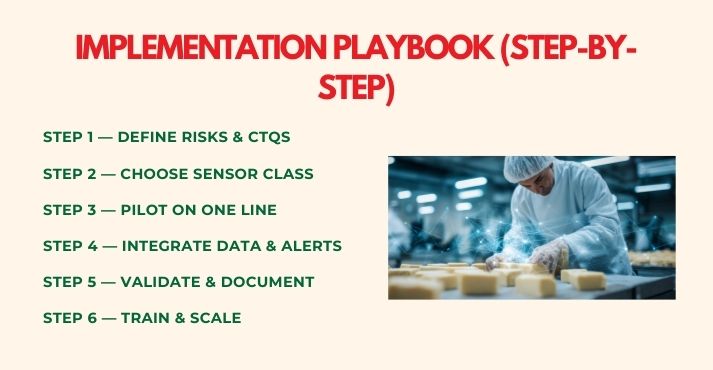
Rolling out biosensors is most effective when planned as a structured project rather than a quick add-on. Plants that follow a precise sequence can reduce downtime, control costs, and build confidence in results.
This step-by-step playbook brings together lessons from food technology and production system integration to help teams get started.
Step 1 — Define Risks & CTQs
The first step is identifying the critical targets. Plants should determine which analytes to monitor, the product types or water sources at risk, and the required response time.
Sensitivity levels and throughput requirements must be defined early, as they determine the appropriate equipment for the process.
Step 2 — Choose Sensor Class
Different biosensors suit different conditions. Electrochemical sensors work well in wet systems, optical sensors excel in precise detection of specific markers, and nano- or paper-based sensors support portable checks.
Teams also need to confirm compatibility with cleaning agents, sanitation cycles, and temperature ranges.
Step 3 — Pilot on One Line
Introducing sensors on a single line allows testing without disrupting the whole plant. Operators can compare results with existing QA checks while tracking performance criteria such as false positives, false negatives, time-to-alert, and system uptime.
Step 4 — Integrate Data & Alerts
The next step is to connect biosensors with dashboards, HMIs, and communication channels, such as SMS or email. Data should also feed into LIMS, MES, or ERP systems to support retention policies.
A digital twin in manufacturing can be used to simulate how alerts and responses would function in real-world operations before being scaled across multiple lines.
Step 5 — Validate & Document
Validation ensures reliability. Plants must establish a calibration schedule, run drift checks, and set up control samples. All results and procedures should be documented in SOPs that align with HACCP requirements.
Step 6 — Train & Scale
Operator training ensures daily use and maintenance routines are handled effectively. Plants should plan for spare parts and technical support before expanding biosensors to additional lines, products, or facilities.
Challenges & Considerations
Implementing biosensors comes with technical and operational challenges that plants must anticipate.
Matrix effects and biofouling can affect sensor accuracy, requiring pretreatment steps or protective housings. Regular calibration and drift checks are essential to maintain reliable readings.
False positives or negatives can occur, so thresholds should be defined carefully, and critical alerts confirmed in the lab. Environmental conditions such as temperature, humidity, and cleaning cycles may also limit sensor performance.
Data governance is another major consideration. Plants must define ownership, retention periods, and access controls, which is where a cloud food safety platform can simplify monitoring, reporting, and compliance management.
Economic factors must also be evaluated. While the initial capital expenditure may be significant, the potential savings from reduced line holds, recalls, and improved operational efficiency often justify the investment, especially for processors expanding into emerging food markets.
Future of Real-Time Food Safety
Advances in nanobiosensors are making them more sensitive and affordable, allowing plants to detect contaminants earlier and reduce product loss. These sensors can be integrated directly into production lines, so teams can respond quickly when issues arise.
Smart packaging is also becoming more common for real-time monitoring throughout the supply chain. Compostable and biodegradable packaging with embedded sensors can track temperature, humidity, and freshness, helping maintain quality from production to retail.
The global smart food packaging market is projected to grow from $26.42 billion in 2024 to $35.69 billion by 2029, reflecting a 6.2% CAGR.
Standardized interfaces and APIs are simplifying the integration of sensors into existing plant systems, reducing setup time and ensuring consistent monitoring and reporting across lines and facilities.
Together, these developments point to a future where real-time food safety management is more proactive, connected, and reliable than ever before.
FAQs
What are biosensors in food processing?
Biosensors are devices that detect biological or chemical targets in food. They combine a recognition element, such as an enzyme, antibody, DNA, or aptamer, with a transducer that converts the biological interaction into a measurable signal. They provide rapid detection without the need for extensive lab testing.
How do biosensors detect pathogens in real time?
Biosensors detect pathogens by binding specific molecules from bacteria, viruses, or toxins, which triggers an electrical, optical, or chemical signal.
Inline or at-line placement allows continuous monitoring of wash water, production surfaces, or product samples, giving immediate feedback to operators.
Which industries use biosensors for food safety?
Biosensors are used in meat and poultry, dairy, seafood, produce, ready-to-eat foods, and beverage processing. Each sector applies sensors where contamination risks are highest, including wash water and fermentation tanks, as well as packaging lines.
What regulations govern biosensor use (HACCP/FSMA/EFSA)?
Biosensors support compliance with HACCP and FSMA verification steps, providing audit-ready logs of monitoring, exceptions, and corrective actions. In Europe, EFSA guidelines influence validation and reporting requirements for food safety technologies.
Which types (electrochemical/optical/nano) fit which problems?
Electrochemical sensors excel in wet systems and rapid microbial detection. Optical sensors are preferred for precise pathogen identification or toxin measurement. Nano- and paper-based sensors are often portable, low-cost, or integrated into smart packaging.
Can smart packaging sensors replace in-plant sensors?
Smart packaging sensors complement but do not replace in-plant sensors. They provide end-to-end monitoring during storage and distribution, while in-plant sensors catch contamination risks during production and processing.
What are typical detection limits/response times (ranges)?
Detection limits vary by sensor type and target analyte, ranging from a few cells per milliliter for pathogens to parts per billion for toxins. Response times are typically seconds to minutes for real-time biosensors, compared with hours or days for traditional lab tests.
How is sensor data stored and used in audits?
Data is recorded digitally, often in centralized systems or cloud food safety platforms. Records include time-stamped measurements, exceptions, and corrective actions, providing evidence for audits, regulatory reporting, and verification of HACCP preventive controls.
Conclusion
Real-time biosensors are changing how food processors manage safety. By delivering immediate insights, they enable rapid detection of pathogens, toxins, and allergens, helping reduce product holds and minimize waste.
These sensors also support compliance by generating audit-ready records and facilitating verification under HACCP, FSMA, and other standards.
When integrated with packaging and digital systems, they improve traceability across the supply chain, allowing teams to act quickly when issues arise.
While biosensors provide fast, real-time monitoring, they complement rather than replace laboratory testing, which remains essential for confirmation and complex analyses. Together, these approaches provide a more reliable and efficient food safety management system.