Asia has become the world’s most influential food and beverage (F&B) powerhouse.
Home to over half of the planet’s population and some of its fastest‑growing economies, the region commands enormous purchasing power and cultural influence.
The dual character of Asia’s food scene, deeply rooted culinary traditions alongside a rapidly evolving food‑tech ecosystem, creates a unique marketplace where traditional street food vendors coexist with AI‑enabled cloud kitchens.
Global brands, investors, and innovators regard Asia as non‑negotiable due to its scale, diversity, and momentum.
This guide examines the forces shaping Asia’s food and beverage industry, from the digital revolution in food delivery to the growing demand for health-focused and sustainable products. It offers a roadmap to the opportunities and challenges in the world’s most dynamic food market.
Overview of Asia’s Food & Beverage Market
The Asia-Pacific region is the largest food and beverage market by both value and volume. In 2025, the region is projected to hold about 40.88% of the global food and beverage market.
The size and growth are driven by China, India, Japan, and Southeast Asian countries, which together account for most of the world’s population and have rapidly expanding middle classes.
Key reasons for Asia’s dominance include:
- Demographic Scale: Emerging economies such as China and India contribute billions of consumers and underpin a mass‑market base, while mature markets like Japan and South Korea drive premium segments.
- Culinary Diversity: The region encompasses myriad culinary traditions, including dumplings in China, biryani in South Asia, sushi in Japan, and satay in Southeast Asia, enabling brands to localise products and create fusion offerings.
- Vibrant Food Culture: Eating out is central to social life, and street food remains a culinary institution. This makes the foodservice sector particularly dynamic.
- Innovation Ecosystem: Rapid digital adoption has led to the rise of super‑apps, food-delivery platforms, and cloud kitchens, enabling low‑cost expansion and data‑driven personalization.
Market Size, Revenue, and Growth Projections
Globally, the F&B market is projected to grow from US$9.79 trillion in 2026 to US$11.78 trillion by 2031; Asia‑Pacific accounts for the largest share at 40.88%.
In Asia, Southeast Asia’s F&B industry alone was valued at US$667 billion in 2023 and is forecast to reach US$900 billion by 2028.
Moreover, the foodservice segment is growing even faster, from US$192.43 billion in 2024 to US$349.05 billion by 2029. These figures emphasise that Asia is both a mass‑consumption market and a high‑value opportunity.
Digital platforms are reshaping consumption, as Asia‑Pacific consumers use more grocery channels than any other region, averaging four shopping channels and favouring on‑demand delivery services.
This omnichannel behaviour, augmented by mobile payments and super‑apps, has created an ecosystem of cloud kitchens, food‑delivery couriers, and AI‑enabled menu platforms, accelerating Asia food market growth and enabling new entrants to scale quickly.
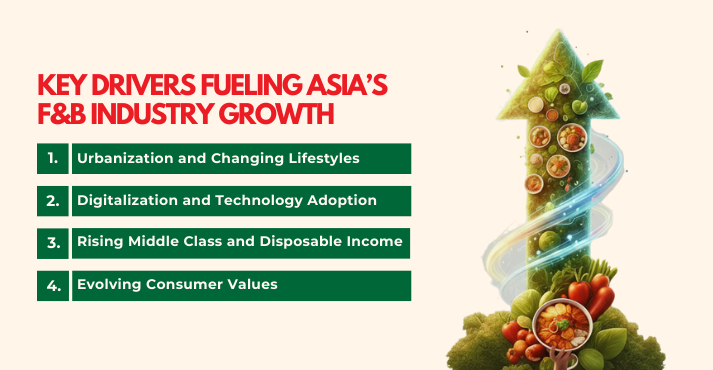
Key Drivers Fueling Asia’s F&B Industry Growth
The engine of the Asia Pacific food and beverage market growth is powered by several interconnected macro-forces:
Urbanization and Changing Lifestyles
Population growth and rapid urbanization are remaking Asian food habits. Food companies are navigating growing and urbanising populations while supply chains are being rewired amid geopolitical change.
As people move to cities and work longer hours, demand for convenient and ready‑to‑eat meals rises. The Asia‑Pacific frozen food sector is expected to reach US$109.88 billion by 2033 (5.76% CAGR).
Digitalization and Technology Adoption
According to PwC’s survey, Asia‑Pacific consumers are among the most open in the world to adopting new technology, including artificial intelligence, in their shopping and food experiences.
Nearly 80% use at least one health app or wearable device, and more than half are comfortable allowing generative AI to plan meals or assist with nutrition decisions.
That said, digital integration goes beyond consumer interfaces: cloud kitchens, AI‑powered demand forecasting, blockchain‑based traceability, and smart‑kitchen appliances allow businesses to optimise operations, reduce waste, and respond quickly to market trends.
In addition, partnerships between food companies and delivery platforms such as Meituan, GrabFood, and Gojek enable data sharing that continuously improves the consumer experience.
Rising Middle Class and Disposable Income
The growth of Asia’s middle class is driving demand for premium and experiential dining.
Countries such as Vietnam, Thailand, and Indonesia are becoming key investment destinations due to rising disposable incomes and growing demand for branded, high‑quality products.
Also, premiumisation leads consumers to trade up for branded snacks, specialty beverages, and experiential dining.
Evolving Consumer Values
Consumers in Asia are becoming more health‑conscious, environmentally aware, and value-driven.
PwC’s survey shows that 54% of Asia‑Pacific consumers expect food companies to help them lead healthier lives.
Whereas two‑thirds worry about ultra‑processed foods, pesticides, and food safety. Sustainability matters as well, as about 65% of Southeast Asian consumers prefer brands that demonstrate environmental transparency.
These values are prompting demand for clean‑label products, ethical sourcing, reduced sugar, functional foods, and transparent labelling.
Consumer Trends Shaping Asia’s Food & Beverage Industry
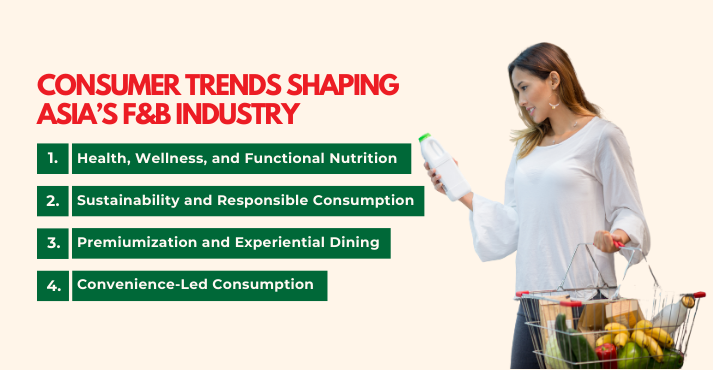
Contemporary consumer preferences are emerging around four dominant themes:
1. Health, Wellness, and Functional Nutrition
Health has moved from optional to non‑negotiable. Consumers are scrutinising their diets to prevent chronic diseases and support immunity.
Fresh produce and protein‑rich products are in high demand: 63% of respondents intend to increase their consumption of fresh produce, and Asia’s protein market is projected to grow from US$8 billion today to nearly US$11 billion by 2030.
Functional nutrition, foods fortified with probiotics, vitamins, or adaptogens, is booming, reflected in the rapid growth of fortified dairy products and immunity‑boosting beverages.
2. Sustainability and Responsible Consumption
Environmental awareness is shaping purchasing decisions. In Southeast Asia, consumers prefer brands that demonstrate environmental transparency and ethical practices. This has spurred innovation in eco‑friendly and recyclable packaging.
The food cans market demonstrates this trend: the Asia‑Pacific food cans sector, worth US$6.63 billion in 2025, is projected to reach US$7.95 billion by 2030.
Demand for aluminium cans is growing because they are infinitely recyclable and help preserve flavour, and consumers favour small‑size and multi‑pack formats.
Given this, sustainable sourcing, carbon footprint reduction, and waste‑reduction initiatives are becoming mainstream expectations.
3. Premiumization and Experiential Dining
With rising incomes, consumers are trading up to gourmet, artisanal, and specialty products. Asia’s specialty cheese market is projected to reach US$4.75 billion by 2030.
Premium dairy, craft beverages, and fusion cuisines are gaining favour. Experiential dining, in which the story, ambience, and cultural narrative are as important as taste, is thriving in cities such as Bangkok, Tokyo, and Singapore.
4. Convenience-Led Consumption
Convenience remains paramount, as consumers shop across multiple channels and are more likely than their global peers to use on‑demand grocery delivery, meal‑kit services, and subscription boxes.
Moreover, the projected 5.76% CAGR in the frozen food market and the growth in ready meals indicate strong demand for convenient formats. Single‑serve, microwaveable, and long‑shelf‑life products cater to busy urban lifestyles.
Major Food Movements Transforming Asia’s F&B Market
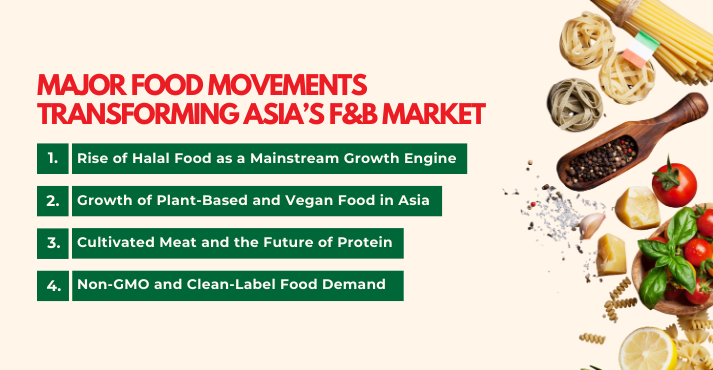
Beyond broad consumer trends, the food and beverage market in Asia is being fundamentally reshaped by several interconnected, large-scale food movements.
The key movements that are actively transforming the industry’s landscape include:
Rise of Halal Food as a Mainstream Growth Engine
Halal food is transitioning from a niche religious requirement to a mainstream lifestyle choice.
The Asia‑Pacific halal food and beverage market is projected to grow from US$524.38 billion in 2026 to US$815.52 billion by 2031. Indonesia commands 36.54% of regional revenue, and Malaysia is forecast to be the fastest‑growing market.
Halal certification appeals to non‑Muslim consumers because it signals safety, hygiene, and ethical production. Also, convenience formats such as halal‑certified ready meals and packaged snacks are expanding rapidly.
Growth of Plant-Based and Vegan Food in Asia
Demand is driven by lactose intolerance, animal‑welfare concerns, and sustainability; oat, almond, coconut, and pea milks are gaining traction.
The Asia-Pacific plant-based meat market is projected to reach US$ 8,085.58 million by 2033. For example, Singapore has emerged as a leading market for the adoption of plant‑based and cell‑cultured foods.
Similarly, in Indonesia, interest in plant-based foods is increasing rapidly. Indonesia ranked 16th among the 20 vegetarian-friendly countries.
Cultivated Meat and the Future of Protein
Cultivated meat, grown from animal cells without raising animals, offers a sustainable solution to protein demand.
For example, China opened its first alternative‑protein innovation facility and approved mycoprotein while building the world’s first large‑scale cultivated pork facility. Australia issued its first approval for cultivated meat, and Malaysia ruled that cultivated meat can be halal.
Given this, cultivated meat promises environmental and animal‑welfare benefits and could reduce reliance on livestock, but high costs, scaling challenges, and regulatory approvals remain hurdles.
Non-GMO and Clean-Label Food Demand
Rising label literacy is fuelling demand for non‑GMO and clean‑label ingredients. The Asia‑Pacific clean ingredients market is forecast to grow from US$11.07 billion in 2025 to US$12.71 billion by 2031, with a 2.33% CAGR.
Consumers seek natural flavours, colours, preservatives, and sweeteners, and demand transparency around sourcing and manufacturing.
Also, non‑GMO certification is increasingly seen as part of ethical consumption and premiumisation, although it differs from organic certification. Trust and transparency are important drivers of purchase.
Deep Dive: High-Growth Food & Beverage Segments in Asia
To identify where the most significant opportunities lie, we must examine the specific product categories experiencing accelerated growth.
Dairy Industry Trends in Asia
The dairy sector remains an important area of nutrition in the Asia region. The Asia‑Pacific dairy market is projected to reach US$268.37 billion by 2031.
India accounts for more than 52.76% of the regional value due to its large cattle population and rising per‑capita consumption.
Importantly, growth is shifting from commoditised milk to value‑added products such as drinkable yoghurt, probiotic beverages, and lactose‑free ultra‑high‑temperature (UHT) milk.
Moreover, urban consumers are trading up to fortified and protein‑enhanced dairy, while supply‑side improvements (cold chain expansion and dairy cooperatives) support market expansion.
Dairy Alternatives and Plant-Based Innovation
Dairy alternatives are no longer niche. The dairy alternatives market in the Asia-Pacific will reach US$17.02 billion by 2030.
Plant‑based milks such as soy, oat, almond, and coconut offer options for lactose‑intolerant consumers and those seeking lower‑carbon footprints. Innovation focuses on new ingredients (e.g., cashew, hemp, and pea) and on improved sensory attributes.
Cheese Market Evolution in Asia
The cheese market in Asia has evolved from a relatively niche, imported commodity to a rapidly expanding category driven by rising urbanization, growing disposable incomes, and increasing adoption of Western-style diets that include pizzas, burgers, sandwiches, and other cheese-rich foods.
In 2025, the Asian cheese market was valued at approximately US$7.55 billion, and it’s projected to grow to around US$12.55 billion by 2034. This growth reflects both increased use of ingredients in foodservice and broader household adoption across major markets.
Frozen Food Market Growth
The frozen-food market across Asia has shifted from a niche convenience item to a mass retail staple.
China is a major growth engine, increasing from approximately US$32 billion in 2024 to roughly US$72 billion by 2033, reflecting rapid retail expansion and product innovation.
India is another fast-growing market, valued at about INR 191 billion in 2024, with forecasts indicating it will reach INR ~593 billion by 2033 as ready-to-eat meals and frozen meat/seafood gain traction in urban centres.
These regional gains sit alongside a growing global frozen-food sector (hundreds of billions USD) and reflect a broader shift.
Canned Food Market Opportunities
Asia’s canned-food sector is at an inflection point: rising urbanization, a growing middle class, busy lifestyles, and increased demand for affordable protein.
Urban shoppers prefer smaller packs and multi-packs for trialability and affordability.
The Asia-Pacific canned food market is a growing segment of the regional food sector, valued at US$21.9 billion in 2024 and projected to reach US$31.9 billion by 2033.
Regional and Cultural Influence on Asian Food Consumption
Asian cuisines continue to win global palates.
Dishes like sushi, ramen, biryani, and pho have moved from ethnic specialties to mainstream global staples, often ranking among the most popular items on food delivery platforms worldwide.
This demand extends beyond restaurants to premium packaged foods, meal kits, and sauces that allow consumers to recreate authentic experiences at home.
Furthermore, the fusion of these deep flavors with other culinary traditions, such as Korean tacos or sushi burritos, continues to drive innovation and attract adventurous eaters globally.
Regional Spotlight: Singapore as Asia’s F&B Innovation Hub
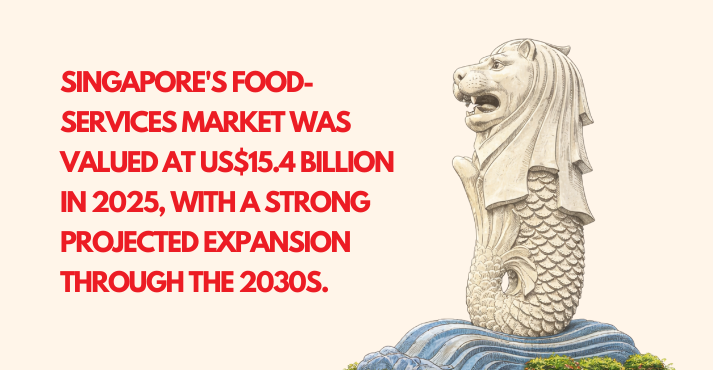
Singapore’s food-services market was valued at US$15.4 billion in 2025, with a strong projected expansion through the 2030s.
Its advanced digital and logistical infrastructure has fostered a cutting-edge foodtech ecosystem, making it a global leader in areas such as cultivated meat regulation, where it was the first to grant commercial approval.
The government’s strong sustainability regulations, such as mandatory nutrition labelling and sugar taxes, encourage manufacturers to reformulate products and adopt clean‑label ingredients.
Singapore also leads in alternative proteins: it was the first country to approve cultivated meat and continues to host pilot production facilities.
That said, Singapore is the testbed for scalable Asian F&B trends.
Due to its compact geography, advanced logistics and payments, high smartphone penetration, a top-ranked startup ecosystem, and a regulator that consults industry, the country pilots fast and transferable.
Technology, Digitalization, and Innovation in Asia’s F&B Industry
Technology is now central to the production, transport, and sale of food across Asia
Here’s how different technologies are playing a role in reshaping Asia’s F&B industry:
Food Delivery Apps and Super-app Ecosystems
These platforms integrate ordering, payments, and logistics, providing F&B brands with instant market access, higher order volumes, and real-time consumer data to improve demand planning and customer retention.
Cloud Kitchens and Asset-light Expansion
Delivery-only kitchens reduce real estate and staffing costs, allowing brands to test menus quickly and scale across cities with lower capital investment.
AI, Blockchain, and Supply Chain Transparency
AI improves demand forecasting, inventory control, and waste reduction, while blockchain enables end-to-end traceability, faster recall,s and stronger trust in food safety and sustainability claims.
E-commerce and Cross-border Food Trade
Digital marketplaces and social commerce platforms enable packaged-food brands to sell directly across Asian markets, thereby simplifying cross-border payments, logistics, and market entry.
Challenges Facing Asia’s Food & Beverage Industry
Asia’s Food and Beverage industry is growing fast but faces several obstacles that can slow expansion and raise costs.
Key challenges faced by the F&B industry in Asia include:
- Rising Operational And Labor Costs: Higher wages, energy, and raw material prices squeeze margins and force firms to raise prices or cut costs.
- Supply Chain Disruptions: Weather events, trade restrictions, and logistics bottlenecks cause delays, shortages, and unpredictable input costs.
- Regulatory Complexity And Food Safety Standards: Different rules across countries and frequent regulatory updates make compliance costly and slow time to market.
- Certification Challenges (Halal, Non-GMO, Clean Label): Securing and maintaining multiple certifications imposes time costs and documentation burdens on exporters and retailers.
- Competitive Intensity And Market Saturation: A crowded field of local and international brands increases price pressure and shortens product life cycles.
Opportunities and Strategic Outlook for F&B Businesses in Asia
Despite challenges, opportunities abound for businesses that align with evolving consumer preferences and regulatory landscapes:
- Health and Functional Foods: Reformulate products to reduce sugar, salt, and unhealthy fats; invest in protein‑rich, fortified, and functional foods that support immunity and wellbeing.
- Halal and Plant‑based Expansion: Capture growth by offering halal‑certified, vegan, and plant‑based products. Halal certification appeals beyond Muslim consumers because of hygiene and ethical standards, and plant‑based meat and dairy alternatives are growing at double‑digit rates.
- Sustainable Packaging and Waste Reduction: Adopt recyclable and compostable packaging and invest in circular‑economy models. Educate consumers about recycling and support initiatives to reduce food waste.
- Food‑tech and Automation: Integrate AI, IoT, and blockchain to optimise supply chains and personalise consumer experiences. Explore cloud kitchens, smart‑kitchen appliances, and predictive ordering systems.
- Cross‑border Expansion with Localisation: Expand into neighbouring markets by tailoring flavours, formats, and marketing to local cultures. Leverage free‑trade agreements and digital platforms to reach new consumers.
Future Forecast: Where Asia’s F&B Industry is Headed
Asia’s food and beverage industry will continue to expand across multiple categories.
Consumption growth is driven by demographic momentum and rising incomes, while innovation will be shaped by three converging themes: sustainability and convenience.
Moreover, consumers will demand products that are both nutritious and indulgent, packaged responsibly, and delivered seamlessly.
The region will remain the global testing ground for food innovation, from cultivated proteins and vertical farming to smart kitchens and AI‑enabled menu planning.
Also, collaboration between tradition and technology, combining centuries‑old culinary practices with cutting‑edge tech, will define the next decade.
Businesses that invest in data‑driven insights, sustainable operations, and personalised experiences will be best positioned to capitalise on Asia’s multi‑category CAGR growth trajectory.
Conclusion: Winning in Asia’s Food & Beverage Market
Asia’s unmatched scale, cultural diversity, and innovation capacity make it the most exciting and essential growth market for food and beverage companies.
To succeed, businesses must adopt data‑driven, consumer‑centric strategies that anticipate evolving health, convenience, and sustainability demands. They should embrace local flavours and cultural narratives while leveraging technology to deliver personalised experiences.
Navigating regulatory complexity and supply‑chain challenges requires robust compliance frameworks and resilient logistics.
Thus, companies that commit to sustainable practices, invest in innovation, and remain adaptable will thrive in Asia’s food and beverage industry.