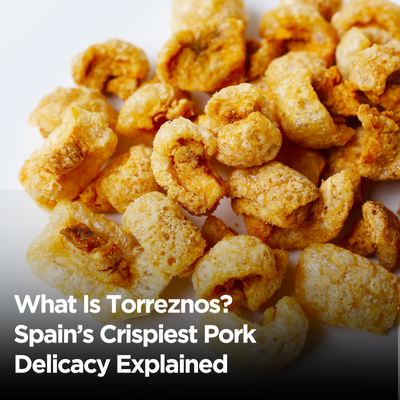
That first bite is mostly sound: a brittle sheet of blistered pork skin snaps and crackles, then gives way to a rich, juicy layer of pork belly that feels almost buttery from the rendered fat.
In Spain, torreznos are best understood in plain language as crispy fried pork belly with the skin on, a classic bar snack prized for a crunchy crackling top and tender, savory meat underneath.
If you’ve ever typed what is torreznos into a search bar, the simplest answer is: a crispy Spanish pork belly snack that’s served hot as a tapa or aperitivo, delivering crunch + juiciness in the same bite.
It’s also worth thinking of it as a torreznos pork belly snack rather than a “bag of pork rinds”: torreznos are built around real layers of belly (skin, fat, meat), which is why they feel substantial, more like a tapas bite than a dried nibble.
In this post, we will explore everything from their origins and cultural significance to how you can make them at home and where to find the best examples.
What Exactly Are Torreznos?

In the Real Academia Española dictionary, torrezno is defined broadly as a “piece of fried (or to-be-fried) pork fat,” which captures the idea but doesn’t fully convey what makes great torreznos special.
Torreznos are made from pork belly with skin, typically salted (and often seasoned), then lightly cured or dried, and finally fried so the skin blisters into crackling while the interior stays juicy.
This salted-and-cured step is central in protected Soria-style production, where the official product specification lists fresh pork belly and edible salt as core ingredients, with sweet paprika (pimentón) and other seasonings as optional additions.
To understand torreznos meaning in everyday food talk, the word implies a very specific eating experience: not just “cracklings,” but a deliberate stack of textures created by the belly cut and the method of frying.
The signature texture is easiest to understand as a three-layer bite:
- Crispy skin (the crackling “shell”)
- Fat layer (renders and keeps the bite succulent)
- Tender pork meat (stays juicy if cooked patiently)
Pork belly matters here because it naturally contains alternating fat and lean layers; the official Soria specification explicitly describes a layered structure designed to be well-suited to frying.
Typical ingredients:
- Pork belly with skin
- Salt
- Olive oil or pork fat
- Optional paprika (for color and subtle smokiness)
This combination sets torreznos apart from simpler fried pork snacks. They are a traditional Spanish torreznos delicacy where the meat-to-crunch ratio is carefully balanced.
The Origins of Torreznos in Spain
Torreznos appear in multiple parts of Spain, but their strongest regional identity is tied to Soria, a province in Castile and León.
The official protected specification for “Torrezno de Soria” defines the geographic production zone as the entire province of Soria and emphasizes that the product is made there under controlled conditions.
Soria’s torreznos also moved beyond local recognition into formal protection pathways: regional authorities in Castile and León have described the evolution from the certification mark toward an EU-style protected geographical indication as a major commercial lever.
Culturally, torreznos are strongly linked to taverns, tapas bars, and communal “aperitivo time.”
The official specification frames their reputation as rooted in local custom and highlights long-running food events and public contests that build social ritual around the snack.
In the simplest lived tradition, they’re often eaten with bread, wine, or beer, a pairing echoed in Spanish food writing and in coverage of award-winning torrezno culture.
Why Torreznos Are So Famous in Spain

Torreznos became iconic for a reason that’s easy to taste: the dish hits a hard-to-fake balance of crunchy crackling + juicy interior, using basic ingredients but a precise technique.
They also plug directly into tapas culture: small portions served as snacks, often alongside a drink, and frequently shared. Tapas references consistently describe them as bite-sized plates or snacks that can be combined into a casual meal.
That’s why Torrezno functions simultaneously as:
- A bar snack you order with a drink
- A tapas staple that can anchor a shared spread
- A comfort food marker of rural interiors
For many visitors, these Spanish torreznos are memorable because they feel rustic: simple on paper, but demanding in execution.
What Are Torreznos Made Of?
Here’s a breakdown of exactly what torreznos made of:
| Ingredient | Role |
| Pork belly | Main cut provides the fat + meat layers that stay juicy while crisping |
| Pork skin | Creates the crackling when fried and blistered |
| Salt | Seasons and supports the curing/drying step that firms and concentrates flavor |
| Olive oil or pork fat | Heat-transfer medium for frying and blistering the skin |
Pork belly is non-negotiable because its fat layers render slowly, basting the meat from within while the skin dehydrates and puffs. You can’t make real torreznos with lean cuts; you’d lose the juicy interior.
How Torreznos Are Traditionally Made
Torreznos is a traditional Spanish pork dish, especially popular in regions like Soria. The Spanish torreznos recipe is simple but very technique-sensitive.
First, strips of pork belly (with skin on) are salted and sometimes left to dry slightly. This helps firm up the skin and improves the final texture.
Next, the pork is cooked slowly in oil over low heat. At this stage, the goal isn’t browning—it’s gently rendering the fat and cooking the meat evenly without toughening it.
Once the pork is cooked through, the heat is increased. This is the critical moment: the skin begins to puff up and blister, transforming into a crispy, airy crust while the meat stays juicy underneath.
The finished torreznos are deep golden, with a crunchy top layer and tender interior.
The hardest part of the process is getting that skin to puff and crisp properly. Timing, temperature control, and moisture levels all matter, too much heat too soon or too much moisture in the skin can prevent that signature crunchy texture from forming.
How to Cook Torreznos at Home
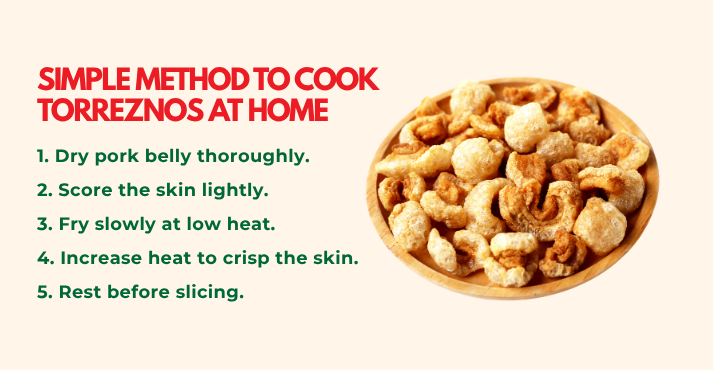
Here’s how to cook torreznos at home:
- Dry the pork belly thoroughly (especially the skin).
- Lightly score the skin to help it blister rather than tighten.
- Fry slowly over low heat to render fat and cook the belly evenly.
- Increase the heat near the end so the skin puffs and crisps into crackling.
- Rest briefly before slicing; the crust sets, and the juices redistribute.
If you’re learning how to make torreznos, the “hard part” is almost always the same: getting the skin to blister beautifully without burning it or drying the belly out.
Here are some cooking tips you must follow:
- Dry skin = crispy skin. Any moisture left will steam, not crackle.
- Slow frying prevents tough meat. Don’t rush the first stage.
- Final high heat creates the crackling. Watch closely, it can burn in seconds.
Torreznos vs Pork Cracklings vs Chicharrones
Torreznos are sometimes casually described as Spanish pork crackling, but that shorthand can blur important differences, especially when people compare them to cracklings or chicharrones.
Torreznos vs chicharrones: both involve fried pork and a crisp exterior, but the cut, thickness, and cultural default “shape” can differ a lot by region.
Here’s a practical comparison:
| Dish | Origin | Main Difference |
| Torreznos | Spain | Thick belly cut designed to keep meat + fat layers under crisp skin |
| Chicharrones | Latin America + Spain (varies) | Can mean anything from fried skin to fried pork belly chunks, depending on the country/region |
| Pork cracklings | Various (term differs) | Usually, the crisp residue/bits from rendered pork fat/skin are often smaller and drier than belly strips |
Given this, why torreznos feel unique is the thickness: the Soria-style specification describes a layered belly structure intended for frying, which helps explain why torreznos keep a substantial interior instead of becoming only skin chips.
Meanwhile, chicharrones are a wide universe: some versions are skin-only, while others are explicitly “meaty chunks of pork with skin and fat still attached,” depending on the country and style.
Torreznos in Spanish Tapas Culture
In Spain, tapas are a lifestyle. Torreznos fit perfectly into this world of shared plates and casual bar-hopping.
- How they’re eaten: Often served as a tapa (small portion) alongside other classics like patatas bravas, jamón, or olives.
- Typical pairings: A cold beer (lager or amber ale), a glass of Rioja or Ribera del Duero red wine, or even a crisp cider.
- Social ritual: Friends order a ración (larger shareable plate) of torreznos, tear them apart with their hands, and debate which bar makes them best.
Torreznos are also a staple at ferias (festivals) and verbenas (street parties), where vendors fry them fresh in massive copper cauldrons. The smell alone draws crowds.
Where You Can Find Torreznos Today
Torreznos are no longer a hidden secret. You can find them:
- In Spain: Virtually any traditional tapas bar, especially in Castile and León, Madrid, and Aragon. Look for “Torreznos de Soria” on the menu, that’s the gold standard.
- Outside Spain: Spanish tapas restaurants worldwide, from New York to Tokyo. Also available in gourmet Spanish food stores and online retailers.
- Exports: Torreznos de Soria are now vacuum-packed and shipped globally. Some specialty butchers in the UK, US, and Australia also produce their own versions.
As trends in asia’s food and beverage industry show rising demand for authentic international snacks, torreznos are appearing in Asian food halls and Spanish-themed gastrobars, especially in cities like Singapore, Hong Kong, and Tokyo.
Why Food Lovers Are Rediscovering Torreznos
As continental food goes, torreznos fit a timeless pattern: rich fried textures plus social drinking culture. With a global revival of traditional, regional foods, torreznos are riding that wave.
Here’s why:
- Authenticity: In an age of processed snacks, torreznos are real food: pork, salt, fat. No additives.
- Gastropub appeal: Modern chefs are elevating torreznos with smoked paprika honey, aïoli, pickled peppers, or craft beer pairings.
- Social media friendly: That first crunch on camera is irresistible. Torreznos videos regularly go viral.
This rediscovery is also part of larger trends in the meat sector, consumers are moving away from mass-produced, flavorless meats toward heritage cuts and traditional charcuterie.
The pork meat market has seen a resurgence in artisanal pork snacks, with torreznos leading the Spanish charge.
Even conversations about eating less meat for the environment have paradoxically boosted quality-focused meat products: people want to eat better meat, less often, and Torreznos delivers an intensely satisfying experience in small portions.
FAQ
What are torreznos made of?
Torreznos are made from pork belly with the skin left on, which gives them their signature crispy top. The meat is simply seasoned with salt and fried in oil until the skin becomes crunchy and the inside stays tender.
Are torreznos the same as pork cracklings?
No, torreznos are not the same as pork cracklings. Torreznos are made from thick cuts of pork belly that include meat, fat, and skin, giving them a crispy exterior and juicy interior, while pork cracklings are typically just fried pork skin with little to no meat, making them lighter and fully crunchy.
Where do torreznos come from?
Torreznos come from Spain, particularly the region of Castilla y León, with the province of Soria being especially famous for them. They are a traditional Spanish dish often enjoyed as a tapa or snack.
How do you make torreznos crispy?
To make torreznos crispy, you cook them in stages, first slowly at low heat to render the fat and dry out the skin, then finish with high heat so the skin puffs and crisps. The key is keeping the skin dry and controlling the temperature carefully, since the final crisping step is the most delicate part.
What do torreznos taste like?
Torreznos have a rich, savory pork flavor with a perfect contrast in texture. The meat inside is juicy and tender, while the top layer is crispy and airy, giving a satisfying crunch with each bite.
Conclusion
So, what is Torreznos? They are one of Spain’s most beloved pork dishes, thick cuts of pork belly transformed into a perfect balance of crispy, golden skin and juicy, flavorful meat.
Known for their signature crunch and rich taste, torreznos have earned their place as a staple of Spanish tapas culture, especially in regions like Soria.
Whether you’re discovering them for the first time or recreating them at home, torreznos offer a deeply satisfying, sensory experience, from the crackling bite of the skin to the tender melt of the meat. If you love bold, comforting flavors, they’re well worth exploring.