Every year, commercial food services, including restaurants, hotels, caterers, and cloud kitchens, account for a huge slice of global food waste.
According to UNEP, 19% of food available to consumers is wasted at the retail, food service, and household level, on top of another 13% lost earlier in the global supply chain.
Therefore, cutting that waste is one of the fastest ways to cut food waste costs and protect margins.
This is where AI food waste management is changing the game.
AI-powered food waste reduction tools enable smart waste management by using data, computer vision, and predictive analytics to track waste in real time, forecast demand accurately, and optimize purchasing and menu planning at scale.
The rapid adoption of AI in foodservice reflects its growing impact, as the AI in Food and Beverages market is projected to reach USD 18.34 billion in 2026.
In this post ahead, we’ll break down 7 AI-driven tools that enhance food waste reduction in commercial kitchens, explaining how each works, the benefits they deliver, and the outcomes they are already achieving.
How AI Reduces Food Waste in Commercial Kitchens
Traditional food waste management depends on manual logging and staff estimates. This approach fails because it is:
- Time-consuming: Busy kitchen staff skip or rush waste logs.
- Inconsistent: Data quality varies by shift, location, and employee.
- Reactive: Reports show what went wrong after the food is already thrown away.
Without reliable, real-time food data, kitchens are forced to rely on intuition rather than evidence.
That’s why AI in commercial kitchens brings practical, automated intelligence to everyday work. These AI systems rely on three core technologies:
- Computer vision uses cameras to identify food items, portion sizes, and waste in real time.
- Machine learning analyzes patterns across sales, prep, and disposal data to uncover where and why waste occurs.
- Predictive analytics forecasts demand, spoilage risk, and optimal ordering levels before losses happen.
AI-driven solutions reduce food waste across the entire kitchen workflow, not just at the bin. This lifecycle-wide intelligence is exactly what modern AI food waste management systems are designed to deliver.
The 7 AI-Driven Tools Enhancing Waste Reduction in Commercial Kitchens
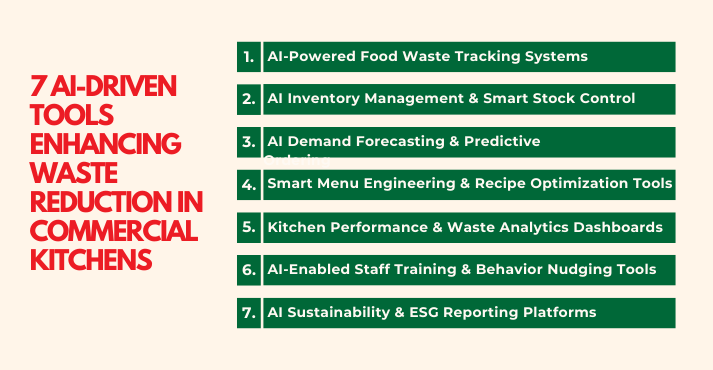
Commercial kitchen AI-driven solutions go beyond simple tracking by automating waste detection, predicting demand, optimizing preparation, and revealing exactly where losses occur.
Here are 7 AI tools for commercial kitchens that deliver measurable benefits in real-world operations.
Tool #1: AI-Powered Food Waste Tracking Systems
AI-powered automated food waste-tracking software uses computer vision and smart weighing scales to identify and measure food waste as it is discarded automatically.
When food is thrown away, the system captures an image, records the weight, and logs key details, including food type, time, and the reason for disposal. This data is sent to a dashboard in real time, giving kitchens a precise view of where waste is occurring without manual logging.
Unlike traditional waste sheets, this technology helps commercial kitchens with:
- Immediate Waste Visibility: Managers see what’s being wasted, when, and where, daily, not weeks later.
- Reduced Staff Friction: Automated tracking removes the need for manual waste logs.
- Behavioral Change Through Awareness: Clear data drives smarter portioning, prep adjustments, and menu decisions.
- Data-backed Waste Reduction: Commercial kitchens commonly report 30–70% reductions in food waste after implementation.
- Lower Food Costs: Better insights lead directly to improved purchasing and production control.
These systems are a core category of modern restaurant food waste software and among the most widely adopted AI food waste-tracking tools in large-scale kitchens.
For example, Hilton Tokyo Bay was the first hotel in Japan to implement an AI-powered food waste-tracking system powered by Winnow Vision. Within the first four weeks, the kitchen reduced food waste by 30%, saving over 17,000 meals and approximately ¥3.3 million (US$31,000) annually.
Tool #2: AI Inventory Management & Smart Stock Control
AI inventory management systems give kitchens real-time visibility of every ingredient, from dry goods to chilled produce, so teams stop guessing what’s on hand.
These solutions pair software intelligence with sensors, barcode/RFID scanners, and connected commercial equipment (smart fridges, pallet scales, IoT probes) to automatically monitor stock levels and condition.
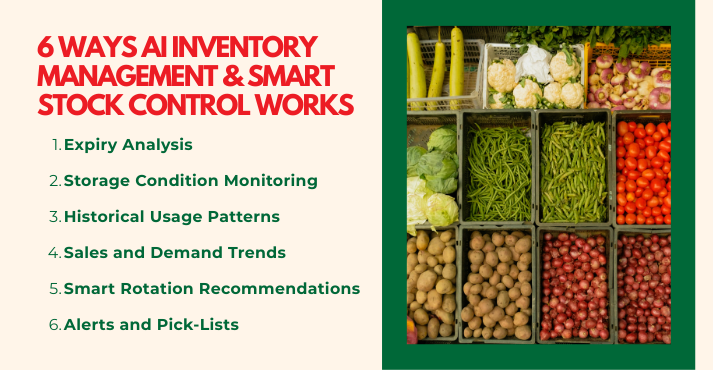
Here’s how systems predict expiration risk and recommend stock rotation:
- Expiry Analysis: AI monitors product expiry dates and flags items approaching their use-by or best-before dates.
- Storage Condition Monitoring: Sensors track temperature, humidity, and other conditions to detect items at risk of spoilage.
- Historical Usage Patterns: Past consumption data helps forecast how quickly items are likely to be used.
- Sales and Demand Trends: POS data and seasonal trends guide which items should be prioritized in rotation.
- Smart Rotation Recommendations: The system suggests FIFO picks, highlights at-risk stock for immediate use, and can propose recipes or specials to prevent waste.
- Alerts and Pick-Lists: Dashboards provide actionable alerts and structured lists to help staff rotate stock efficiently.
This connected, predictive approach results in clear, measurable benefits:
- Reduced spoilage
- Better FIFO compliance
- Lower inventory holding costs
- Improved purchasing accuracy
- Tighter operational control
This tool ties inventory health directly to purchasing, prep, and menu choices, so kitchens buy smarter, store better, and use ingredients before they go bad.
Tool #3: AI Demand Forecasting & Predictive Ordering
AI predictive analytics for food inventory helps kitchens anticipate what customers will order before it happens, rather than guessing or reacting after the fact.
Instead of ordering ingredients based on gut instinct or simple spreadsheets, AI systems ingest large amounts of data and spot patterns that humans might miss.
AI analyzes multiple signals to build these forecasts, including:
- Historical Sales: What sold well (or didn’t) on similar days and times in the past.
- Seasonality: Predictable changes in demand based on day of week, month, or season.
- Weather: Local conditions that influence appetite, like hot days boosting cold drink orders.
- Events and Trends: Local festivals, holidays, sports games, and delivery demand spikes that shift ordering patterns.
Because the forecasts are tied to actual sales drivers, kitchens can cut orders for slow‑moving ingredients and bring in more of what’s likely to sell, smoothing production and reducing waste.
This approach leads to measurable outcomes across operations:
- Fewer excess ingredients, reducing spoilage by aligning stock with true demand
- Smarter supplier ordering reflects forecasted need, not manual guesswork
- Improved profit margins with less waste and fewer emergency purchases
For example, Grab developed an internal AI tool called Spyce to streamline forecasting across its operations. Spyce helps restaurants and Grab’s fulfilment teams anticipate order volumes, optimise supply, and adjust inventory or prep schedules, effectively preventing over-ordering and spoilage while improving operational efficiency.
Tool #4: Smart Menu Engineering & Recipe Optimization Tools
The smart kitchen technology for waste reduction uses AI to help kitchens reduce prep waste and identify low-performing menu items.
Instead of relying on intuition or static reports, these tools analyze sales data, ingredient usage, and customer preferences to determine which dishes drive profit, which create unnecessary waste, and how ingredients can be used more efficiently across multiple recipes.
AI analyzes multiple factors to generate actionable insights:
- Dish Profitability: Evaluates which menu items bring the highest margins relative to cost.
- Plate Waste: Tracks which dishes generate leftover food from customer portions or prep.
- Ingredient Overlap: Identifies common ingredients across dishes to streamline purchasing and reduce spoilage.
This leads to measurable benefits:
- Smaller plate waste, as portions and recipes are optimized to reduce leftovers.
- Streamlined ingredient lists with fewer unique items in stock, reducing spoilage.
- Data-driven menu decisions based on real consumption patterns and profitability.
These AI-driven solutions reduce restaurant food waste and leverage commercial kitchen analytics to help operators make smarter, more sustainable decisions.
Tool #5: Kitchen Performance & Waste Analytics Dashboards
Kitchen performance refers to the ongoing evaluation of commercial kitchen equipment and day-to-day workflows to improve efficiency, reduce operating costs, and consistently maintain food quality.
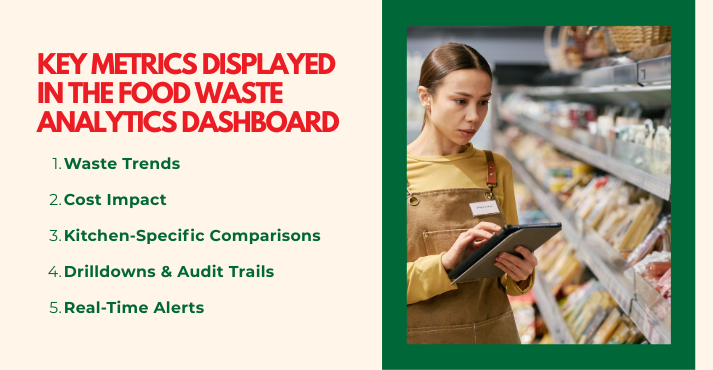
To support this, AI-powered dashboards turn raw waste and operational data into actionable insights that help kitchens see trends, measure cost impact, and compare performance across areas or time periods.
Within data-driven kitchen efficiency tools, dashboards display:
- Waste Trends: Daily/weekly/monthly waste by ingredient, station, shift, and menu item.
- Cost Impact: Waste converted into dollars (or local currency) so managers see the P&L effect.
- Kitchen-Specific Comparisons: Side-by-side performance for stations, shifts, or locations to find outliers and best practices.
- KPIs & Benchmarks: Waste per cover, waste per revenue, target vs. actual, plus customizable thresholds.
- Drilldowns & Audit Trails: Photos, timestamps, and reasons linked to each waste event for root-cause analysis.
- Real-Time Alerts: Notifications when waste spikes or when an item’s spoilage risk crosses a threshold.
Rather than waiting for end-of-month reports, these dashboards deliver real-time alerts and benchmarks so teams can correct course on the fly.
Tool #6: AI-Enabled Staff Training & Behavior Nudging Tools
AI-enabled training and nudging tools focus on changing the daily habits that create avoidable waste.
They don’t replace chefs; they make good practice the easy default by surfacing the exact moments and behaviours that cause losses, then delivering targeted, timely guidance to fix them.
What these tools spot (how AI highlights problems):
- Prep Inefficiencies: Identifies when yields are low, trimming is excessive, or standard recipes aren’t followed.
- Overproduction Patterns: Flags times, dishes, or shifts that consistently produce too much food.
- Repeat Human Errors: Finds recurring mistakes (wrong portioning, wrong cut sizes, missed FIFO) tied to specific staff, stations, or shifts.
- Peak-Time Bottlenecks: Detects when rush-period workflows lead to rushed prep, resulting in increased waste.
Moreover, machine learning in commercial kitchens quietly runs in the background, learning from daily operations to spot patterns humans often miss.
Over time, the system learns which dishes are frequently overproduced, which shifts generate the most waste, and where small workflow gaps lead to repeated losses.
From here, these insights are used for targeted training and nudges.
- Micro-Training: Short, focused training modules pushed to staff after the system detects an issue (e.g., a 60-second video on portioning).
- Real-Time Nudges: On-screen prompts or mobile alerts during service (e.g., “Reduce batch size for Caesar salad, last 3 runs undersold”).
- Shift Summaries & Coaching Cues: end-shift reports highlight what went well and one action to improve tomorrow.
- Gamified Goals & Leaderboards: Positive incentives that reward shifts with the lowest waste per cover.
- Manager Alerts for Focused Coaching: When a pattern repeats, managers get an evidence-backed cue to run a short coaching session.
Tool #7: Sustainability & ESG Reporting Platforms Powered by AI
AI-powered sustainable restaurant technology solutions sit at the final, strategic layer of food waste management, turning operational actions into measurable accountability.
Instead of scattered spreadsheets, AI standardizes waste data across locations and time periods, enabling it to be used confidently for environmental reporting and audits.
Using AI, waste data is automatically transformed into:
- Sustainability reports that track food waste reduction, landfill diversion, and environmental impact over time.
- ESG metrics such as waste intensity, carbon footprint contributions, and operational efficiency improvements.
- Compliance documentation aligned with regulatory requirements and recognized sustainability frameworks.
In doing so, AI helps organizations move beyond intent and demonstrate real, trackable impact in support of long-term zero-waste and sustainability goals.
For example, Mandarin Oriental Hotel Group has integrated AI-enabled food waste management technology across its properties, including Mandarin Oriental Hong Kong, as part of its broader sustainability strategy.
The group’s sustainability reporting highlights the use of AI-driven waste data to optimise menus, reduce food waste, and inform environmental goals tied to its ESG commitments.
Comparing AI Food Waste Tools: What to Look For
When choosing the best AI food waste tools for restaurants, hotels, and catering kitchens, it helps to see how key solutions stack up across core criteria like accuracy, ease of implementation, integrations, ROI timeframes, and best-fit kitchen types.
Here is a key factor table to help you evaluate options at a glance:
| Factor | Why it matters | What to check/how to measure |
| Accuracy & data fidelity | Decisions are only as good as the data. | Sample classification accuracy, false-positive rates, and calibration process. |
| Integration capability | Must fit your tech stack (POS, inventory, suppliers). | Available APIs, out-of-the-box connectors, and middleware support. |
| Implementation complexity & time | Affects disruption and speed to value. | Hardware install needs, IT resources, and typical deployment timeline. |
| Hardware requirements | Some solutions need cameras/scales/sensors. | List of required devices, installation footprint, maintenance needs. |
| Scalability & multi-site support | Important for growing or multi-location operators. | Centralised management, roll-out templates, per-site configs. |
| Real-time functionality & alerts | Enables immediate corrective actions. | Alert latency, mobile/onscreen delivery, custom thresholds. |
| Reporting & analytics (incl. ESG) | Shows ROI and supports compliance. | Available reports, export formats, and ESG metric support. |
| Usability & staff adoption | Determines whether features will actually be used. | UI simplicity, training needs, language/localization. |
| Customization & configurability | Fit to your workflows increases impact. | Ability to add categories, reasons, recipes, and KPIs. |
| Vendor support & training | Ongoing help speeds maturity and ROI. | SLA, onboarding program, and local support presence. |
| Cost structure & ROI timeframe | Total cost vs. expected savings. | Upfront vs. recurring fees, hardware costs, vendor ROI benchmarks. |
| Security, compliance & data ownership | Protects customer data and corporate risk. | Data storage location, access controls, ownership/portability. |
ROI of AI-Driven Waste Reduction in Commercial Kitchens
For most commercial kitchens, food waste isn’t a sustainability problem; it’s a cost problem. The good thing is that AI-driven waste reduction tools address both.
While exact results vary by operation size and starting waste levels, most kitchens see results within predictable ranges:
- Food Waste Reduction: 20–50% overall is common, with some kitchens achieving 30–70% reductions in high-waste areas like prep and overproduction.
- Food Cost Savings: 2–8% of total food spend, driven by smarter purchasing, tighter inventory control, and reduced discard.
- Payback Period: 3–12 months for most restaurants, hotels, and catering kitchens.
This means kitchens can realistically aim to cut food waste by X% and lower food costs while meeting ESG goals, without waiting years to see value.
How to Calculate ROI
ROI becomes clear when savings are tied directly to food spend. Here’s how to calculate:
Step 1: Estimate annual savings: Annual food spend × expected % reduction = annual savings
Step 2: Calculate payback period: Implementation cost ÷ annual savings = payback (in years)
For example: Mid-size restaurant
- Annual food spend: $1,000,000
- Conservative waste-related savings: 3%
- Annual savings: $30,000
- AI implementation cost: $20,000
- Payback period: ~8 months
For example: Small café
- Annual food spend: $200,000
- Savings: 5%
- Annual savings: $10,000
- Implementation cost: $5,000
- Payback period: ~6 months
These calculations show why AI waste tools are often approved as cost-reduction investments rather than experimental tech.
Why ROI Improves Over Time
Initial savings usually come from obvious fixes, overproduction, expired stock, and portion control. Over time, ROI increases as AI insights influence:
- Purchasing and supplier orders
- Menu design and prep planning
- Staff training and daily kitchen behavior
- Forecast accuracy across seasons and events
The longer the system runs, the smarter and more profitable the decisions become.
Financial ROI + Sustainability ROI
Beyond cost savings, AI tools provide verifiable sustainability outcomes, including:
- Reduced landfill waste
- Lower carbon footprint from food disposal
- Data-backed ESG and sustainability reporting
This allows kitchens to prove impact, not just claim it, supporting brand trust, regulatory compliance, and investor expectations.
Implementation Considerations: Getting Started with AI in the Kitchen
When kitchens consider implementing AI food waste tools, it’s natural to have concerns around setup, staff adoption, hardware, and cost.
Common concerns include:
1. Setup Complexity
AI solutions generally fall into two categories: software-first, which integrates with POS and inventory systems, and hardware+vision, which requires cameras, scales, or sensors.
Software-only tools are usually faster to deploy, while hardware solutions need some site preparation.
2. Staff Adoption
Technology only works if people use it. Success depends on clear, simple workflows, short micro-training sessions, and visible KPIs that staff can act on immediately.
Thus, the goal is to make AI a helpful assistant, not an extra task.
3. Hardware Requirements
Camera+scale systems need a stable mount, power, and a bin/station; sensors need network access. Low-tech pilots can start with manual scans or mobile logging.
4. Cost
Expect a mix of one-time hardware costs, onboarding costs, and recurring SaaS fees. Compare total first-year cost vs. projected annual food savings to justify ROI.
How AI Implementation Works in Commercial Kitchens

Most successful kitchens follow a phased approach that combines piloting, staff training, hardware setup, and gradual expansion.
Here’s how it usually works in detail:
1. Select a Pilot Location or Station
Choose a single outlet, prep station, or high-waste area (e.g., buffet line, prep counter, or banquet service). Assign an operations sponsor or manager to oversee the project and act as the point of accountability.
2. Baseline: Measure Current Waste (7–30 Days)
Before implementing AI, track the kitchen’s existing waste patterns. Measure the weight, type, and cost of discarded food over a week or month. This baseline serves as a reference point for evaluating the AI solution’s effectiveness.
3. Choose Solution Type (software vs. vision + scale)
Decide whether a software-only solution (integrating with POS and inventory systems) or a hardware-enabled solution (cameras, scales, sensors) is best.
Software-only is faster and less disruptive, while hardware+vision provides more precise, real-time tracking of discarded food.
4. Install Minimal Hardware if Needed
For hardware solutions, set up cameras, scales, or sensors at the pilot station. Connect the system to POS, inventory, and supplier portals. This ensures accurate, real-time data collection and seamless integration with existing kitchen operations.
5. Run Pilot, Monitor Dashboard, and Act on First Insights
Start the pilot and track data daily through the AI dashboard. Identify overproduction, expired items, or mismanaged stock. Take immediate corrective actions, such as adjusting batch sizes, rotating ingredients, or repurposing unused items.
6. Iterate Workflows, Train Staff With Micro-Learning, and Set KPIs
Use short, focused training sessions (60–90 seconds) to teach staff how to use the system and respond to alerts.
Define simple KPIs, such as waste per dish or cost per discard. Refine workflows and habits based on insights gathered during the pilot.
7. Roll Out Gradually to Other Shifts/Sites
After a successful pilot, expand the AI system to additional shifts, stations, or outlets. Apply lessons learned to streamline installation, training, and adoption.
Thus, maintain consistent KPI tracking and dashboard monitoring to ensure ongoing improvements and measurable results.
Future of AI in Sustainable Commercial Kitchens
The next wave of AI in commercial kitchens goes beyond reducing waste and cutting costs; it’s reshaping how food is ordered, prepared, and managed, with efficiency, sustainability, and automation at the core.
Fully Autonomous Ordering and Procurement
AI is pushing foodservice technology toward automated decision‑making that can reorder stock and manage procurement with minimal human input.
By 2030, platforms that automatically detect low inventory, trigger smart reorders with preferred vendors, and schedule deliveries by usage patterns are becoming mainstream, reducing over‑ordering and spoilage far more effectively than manual systems.
Thus, innovations in food waste management move kitchens closer to fully autonomous ordering, where the AI evaluates inventory needs and places orders without constant human intervention, helping kitchens stay optimised and aligned with sustainable purchasing practices.
Cross‑Location Optimization
Digital technology is enabling a new level of connected kitchen operations.
As systems aggregate real‑time data from multiple locations, operators can compare performance, inventory usage, and waste patterns across an entire estate, creating a virtual “digital twin” of operations.
With such a model, operators can simulate menu changes, share best practices across outlets, and forecast needs by location based on localized demand trends.
AI‑Driven Zero‑Waste Kitchens
Zero‑waste kitchens are no longer a distant aspiration; they’re becoming a tangible goal driven by smarter forecasting, waste intelligence, and integrated analytics.
Tools that flag expiry risks ahead of time, model plate waste, and track ingredient flow help chefs make precise decisions that maximise yield from every ingredient.
Moreover, this aligns with growing expectations from regulators, customers, and investors for transparent, data‑backed sustainability performance.
Conclusion
AI turns kitchen waste from a cost center into a strategic data opportunity.
With real-time waste events, predictive demand modeling, and smarter purchasing, AI food waste management shifts decisions from guesswork to evidence.
The result: measurable reductions in wasted food, lower operating costs, and clearer sustainability performance you can report to stakeholders.
Beyond immediate savings, these systems create continuous improvement loops, feeding insights into menu engineering, inventory control, and changes in staff behaviour, so gains compound over time.
For operators, this means fewer expired goods, smaller plate waste, and tighter margins without extra staff burden.
Lastly, for sustainability leads, it means verifiable impact, reduced landfill waste, lower carbon intensity, and credible ESG metrics.