Online ordering has moved from “nice-to-have” to default behavior in many markets.
Off-premises dining (delivery, takeout, drive-thru) now represents a structurally larger share of restaurant demand than it did pre-pandemic, particularly for younger consumers.
At the same time, operators in the restaurant industry face a tougher cost equation: labor remains a large share of sales, and broader input-cost inflation (including labor, food, and operating costs) keeps pressure on margins that were already thin.
Against this backdrop, cloud kitchens, also called ghost kitchens, dark kitchens, or virtual kitchens, have emerged as a disruptive operating model built for delivery-first demand.
They matter because they change the “shape” of a restaurant business: where fixed costs sit, how fast a concept can be launched, and how efficiently it can scale across delivery zones.
Given this, cloud kitchens are transforming cost structures, scalability, and delivery-first strategies, and forcing the food service industry to rethink what a “restaurant location” even means.
In this post, we will explore everything you need to know about cloud kitchens, how they work, their business models, key benefits and challenges, key players, the role of tech, and future outlook.
What is a Cloud Kitchen?
A cloud kitchen is a delivery-first food operation that prepares meals in a commercial kitchen without a dine-in dining room (and often without a customer-facing storefront). Customers discover the brand digitally and place orders online; the kitchen produces and packs food for delivery.
That said, “restaurants built for the app,” where demand is captured through food online ordering instead of foot traffic.
So, how do cloud kitchens work? Here’s how:
Orders arrive via delivery marketplaces or ordering channels, are routed to a kitchen workflow system, cooked and packaged in a centralized production space, and then handed off to a delivery courier network.
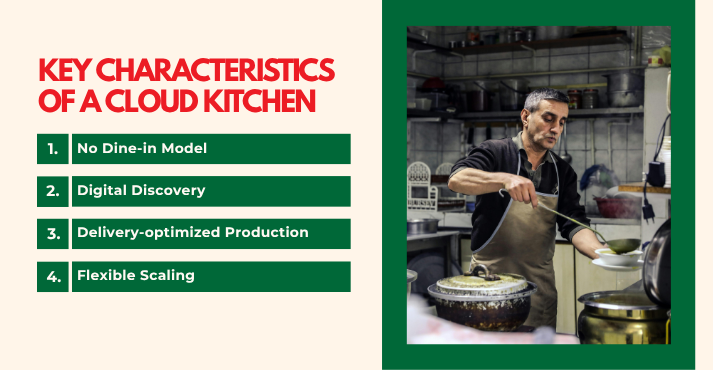
Key characteristics of a cloud kitchen:
- No dine-in model: Minimal or no front-of-house footprint and staffing.
- Digital discovery: The brand “lives” on apps, websites, and marketplaces.
- Delivery-optimized production: Menus, packaging, and prep flow designed for travel time.
- Flexible scaling: Add delivery zones, brands, or shifts without expanding dining space.
This is the core cloud kitchen concept: reallocate resources away from dining-room experience and toward throughput, consistency, and delivery economics.
Why Cloud Kitchens Are Rising
Cloud kitchens are rising because they align with what consumers already do—and because they offer operators a way to compete when traditional cost structures become harder to carry.
A major demand driver is that off-premises behavior is not a temporary spike; it’s a durable channel shift. For example, an industry report shows that 35% of customer traffic in the full-service segment is off-premises, increasing from 2019 to 2025 across segments, reinforcing that delivery and takeout are now “everyday” behaviors.
They’re also riding a large and still-growing online food delivery market. Estimates show the market is expected to reach USD 728.83 billion by 2034, expanding at a 9.58% CAGR during the forecast period 2026-2034.
On the supply side, operators care because the economics of a dine-in footprint have gotten tighter. Industry analysis shows labor commonly taking roughly one-third (or more) of sales in many restaurant formats, while broader cost inflation makes it difficult to hold historical margin benchmarks without price increases.
Outcome-driven reasons brands adopt cloud kitchens include:
- Launch a restaurant with lower investment by skipping dining-room buildout and front-of-house labor requirements.
- Scale without expensive real estate by expanding delivery coverage through additional kitchen nodes rather than premium storefronts.
- Meet urban convenience demand where time-saving and app-based ordering are strong predictors of usage in delivery research.
- Plug into tech-enabled operations (integrations, analytics, automation) that increasingly shape the technology in the restaurant industry.
A useful stat-style way to frame it: the cloud kitchen market itself is often estimated in the tens of billions of dollars today, with forecasts projecting continued growth into 2030.
Cloud Kitchen Business Models
A cloud kitchen business model can vary from “one brand, one kitchen” to multi-tenant facilities and even platform-backed kitchen networks.
The key differences are:
- Who owns the kitchen real estate and operations?
- How many brands run inside the kitchen?
- How is demand generated?
| Model | Who operates the kitchen? | What typically runs inside | Primary advantage | Primary trade-off |
| Single-brand cloud kitchen | One operator/brand | One menu/brand | Operational simplicity; high focus on one concept | Less risk diversification; fewer cross-selling options |
| Multi-brand kitchen | One operator (or one tenant running multiple concepts) | Multiple virtual brands from one kitchen | Better asset utilization; test and iterate multiple concepts | More complexity (menu ops, quality control, brand clarity) |
| Aggregator-
owned kitchens |
Delivery platform or aggregator partners | Multiple partnered restaurants or platform-driven concepts | Built-in demand signals, data, and logistics reach | Greater dependency on the platform relationship and economics |
| Kitchen-as-a-
service/shared kitchens |
Facility operator rents stations to brands | Multiple tenants share infrastructure | Lower commitment; faster setup; flexible capacity | Less control over shared environment; scheduling constraints |
Scalability and flexibility tend to increase as operators move from single-brand toward multi-brand and shared-facility approaches, because the “unit of scale” becomes kitchen capacity and delivery radius, not dining-room seats.
Cloud Kitchens vs Traditional Restaurants
Cloud kitchens and traditional restaurants solve different jobs: one optimizes for production + delivery, the other for experience + place.
Here’s a quick comparison that clarifies why cloud kitchens are disruptive:
| Factor | Cloud Kitchen | Traditional Restaurant |
| Cost structure | Lower front-of-house footprint; more spend on packaging, delivery operations, and digital acquisition | Higher occupancy and front-of-house costs; in-store experience investment |
| Customer experience | Convenience-first; limited “hospitality” touchpoints without dine-in | Full hospitality, ambiance, and in-person service |
| Reach | Expands via delivery zones; less tied to foot traffic | Strong local presence; reach depends on location and dine-in draw |
| Scalability | Add kitchens/brands to scale; “copy/paste” processes across nodes | Scale often means new leased sites, long buildouts, and staffing |
| Profit margins | Potentially higher if utilization is high and platform costs are managed; sensitive to marketplace fees | Historically thin net margins; sensitive to labor/food inflation and occupancy costs |
The takeaway: cloud kitchens can improve unit economics, but they also shift risk toward platform dependence and digital competition.
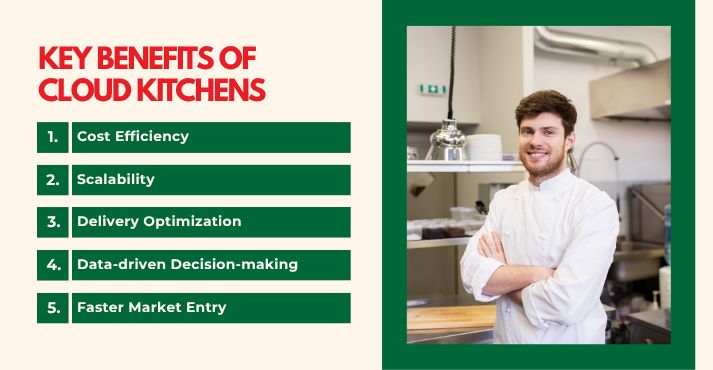
Key Benefits of Cloud Kitchens
Cloud kitchens create value when they convert fixed costs into variable, scalable capacity and when they match production to delivery-driven demand.
Cost Efficiency (lower rent and staff complexity)
By stripping out dine-in requirements, many operators reduce front-of-house staffing needs and avoid investing in high-visibility dining locations, redirecting spend toward kitchen throughput and delivery packaging.
Scalability (multiple brands and locations)
Running multiple concepts from a single production footprint can increase utilization across dayparts and allow operators to target different customer segments without opening multiple storefronts.
Delivery Optimization
Delivery-first kitchens can design menus and prep sequences for speed, predictable holding time, and consistency across courier handoffs, key drivers of repeat ordering in app-based ecosystems.
Data-driven Decision-making
Because orders are captured digitally, operators can analyze dish performance, daypart demand, and delivery-zone patterns and iterate faster than physical-menu cycles typically allow.
Faster Market Entry
A delivery-only node can be a lower-risk way to test neighborhoods or cuisines before committing to a full dine-in rollout, particularly when off-premises demand is already proven.
Challenges & Limitations
The cloud kitchen model is not “better,” it’s a set of trade-offs. Understanding them is essential for realistic planning and for evaluating whether cloud kitchens are profitable in a given market.
No Dine-in Experience (weaker experiential differentiation)
Without a dining room, brands rely on food quality, packaging, and digital reputation, making “experience” more fragile and review-dependent.
Heavy Reliance on Delivery Platforms
Platforms commonly monetize through restaurant commissions and related fees, which can materially affect margins, especially for smaller operators.
Brand Visibility Challenges
Because customers shop in crowded marketplaces, discovery can become a paid game (ads, promotions) and a performance game (ratings, prep-time, cancellations).
Quality Control Across Locations
As networks scale across multiple kitchens, standardization becomes harder; recipes, prep discipline, packaging, and courier handoffs can vary by site.
Regulatory and Community Friction (in some cities)
Dark kitchens can raise planning, visibility, and oversight challenges for local authorities, especially when clustered near residential zones.
A practical way to read these limits: cloud kitchens trade place-based differentiation for network-based efficiency.
Role of Technology in Cloud Kitchens

Cloud kitchens don’t work at scale without software. Operational excellence depends on connecting ordering channels, production, dispatch, and feedback loops into one measurable system.
Core technology components include:
- Order management systems (OMS): Consolidate tickets from multiple channels and push updates to kitchen workflows.
- Delivery integrations: Middleware that connects delivery marketplaces to POS/KDS so orders don’t require manual re-entry.
- Data analytics: Performance dashboards that reveal which dishes win, where demand is strongest, and where cancellations spike.
- Restaurant inventory management: Better forecasting and ingredient tracking because delivery demand can swing with promos, weather, and time of day; inventory discipline becomes a margin lever rather than admin work.
- Automation (AI/robotics, selectively): Emerging use for repetitive tasks (fry stations, prep assistance) and forecasting, aimed at reducing labor dependency and improving consistency.
A key insight is that tech doesn’t just “add efficiency,” it changes what can be scaled. Once food online ordering, kitchen production, and courier handoffs are instrumented, operators can manage multiple brands and locations with a playbook closer to e-commerce than classic hospitality.
Key Players & Industry Examples
Here are notable entities shaping the space:
- Rebel Food: Multi-brand “internet restaurant” operator known for scaling multiple delivery-first brands from shared production infrastructure.
- CloudKitchens: A large operator focused on delivery-first kitchen real estate and operator enablement; often positioned as infrastructure for delivery commerce.
- Kitchen United: A multi-tenant kitchen and “restaurant hub” operator that has raised significant funding to build facilities and enable multi-brand ordering.
- Uber Eats, Deliveroo, and DoorDash: Delivery platforms that shape demand and unit economics through marketplace access, logistics, and fee structures, and in some cases through kitchen initiatives/partnerships.
- Travis Kalanick: A prominent figure associated with scaling a major ghost-kitchen operator; widely covered in funding and expansion reporting.
| Category | Example | Core role in the ecosystem |
| Multi-brand operator | Rebel Foods | Builds portfolios of digital brands and scales via standardized operations |
| Infrastructure operator | CloudKitchens | Supplies delivery-only kitchen capacity + enabling tech, betting on network scale |
| Multi-tenant kitchen hub | Kitchen United | Aggregates multiple restaurant concepts into shared production and pickup/delivery flows |
| Demand + logistics | Uber Eats, Deliveroo, DoorDash | Customer acquisition, delivery dispatch, marketplace ranking, and fee economics |
Cloud Kitchens Valuation and Why Investors Care
The sector’s visibility also comes from large private-market bets. For example, reporting on CloudKitchens’ funding described a valuation of roughly $15B associated with a late-2021 funding round, highlighting how investors have treated cloud kitchens as logistics, real estate, and software infrastructure, not just another restaurant category.
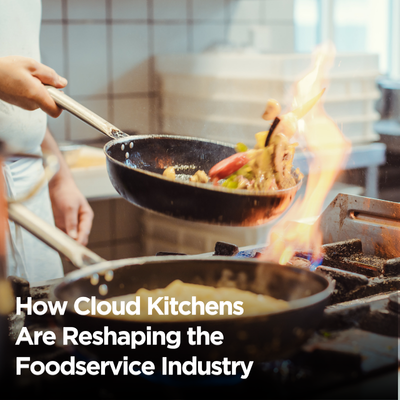
How Cloud Kitchens Are Reshaping the Foodservice Industry
Cloud kitchens reshape the food service industry by changing three fundamentals at once:
- The channel
- The cost bases
- The competitive set
Channel Shift: From dine-in to delivery-first as a default
Off-premises traffic is rising materially versus pre-pandemic baselines, reinforcing that delivery and takeout behavior is now embedded in routines, not reserved for special occasions.
Cost-structure Shift: Less dependence on premium storefronts
A cloud kitchen can operate in locations optimized for logistics rather than foot traffic, which is consistent with research showing that ghost kitchens cluster in less “visible” commercial locations while maintaining strong digital visibility.
Competitive Shift: Digital-first brands compete like consumer apps
Because discovery happens on marketplaces and apps, competition becomes more elastic: a new brand can appear quickly, test pricing, iterate menus, and target a micro-market, raising the rate of innovation and intensifying competition for ranking, reviews, and repeat purchase.
Future outlook
The future is likely to be hybrid rather than purely “cloud” or purely “dine-in.” A realistic forward view includes:
- Continued expansion of the delivery economy, with off-premises remaining a large share of traffic, and as online food delivery continues to grow.
- Hybrid models, where established restaurants add delivery-only production lines or separate kitchen nodes to extend reach.
- AI-driven kitchens and selective robotics for repetitive tasks, especially where labor constraints persist.
- Global expansion and localization as operators build networks tuned to city-level demand patterns and regulation.
Cloud kitchens will keep growing where they solve a clear unit-economics problem, dense delivery demand, high occupancy pressure, or underserved cuisines, but the winners will be those who treat delivery not as a side-channel, but as a system.
FAQs
What is a cloud kitchen and how does it work?
A cloud kitchen is a delivery-only (or delivery-first) food operation with little to no dine-in space. Orders come through digital channels, are produced in a commercial kitchen, packaged, and handed to couriers for delivery.
Are cloud kitchens profitable?
Yes, cloud kitchens can be profitable when kitchen utilization is high, and delivery costs/commissions are managed, because the model can reduce certain fixed costs tied to dine-in operations. Profitability is not guaranteed, however, because marketplace commission fees can be significant and the category is highly competitive.
What are the disadvantages of cloud kitchens?
Common disadvantages of cloud kitchens include:
- No dine-in experience and fewer hospitality touchpoints
- Dependence on delivery platforms and their commission structures
- Discoverability challenges in crowded marketplaces
- Quality-control complexity across multiple sites or brands
How are cloud kitchens different from restaurants?
Traditional restaurants typically compete through location and dine-in experience, while cloud kitchens compete through delivery speed, consistency, digital merchandising, and operational efficiency across delivery zones.
What is the future of cloud kitchens?
The likely future is a blending of formats: delivery-first kitchens continue expanding, while many established brands adopt hybrid strategies (dine-in plus delivery-only capacity). Technology and automation will increasingly determine who scales profitably.
Conclusion
Cloud kitchens are reshaping the foodservice landscape by shifting growth from storefront-dependent expansion to delivery-network expansion, compressing launch cycles, and enabling digital-first brand portfolios that can scale across cities with standardized operations.
They matter because they change what restaurants optimize for: not seats and foot traffic, but throughput, data, integration, and delivery economics, while also introducing new trade-offs around platform dependence and brand visibility.
Adapt your restaurant for the delivery-first future.