The global food industry is under growing pressure to do more with less.
Climate uncertainty, rising costs, supply chain disruptions, and changing consumer expectations are forcing the sector to rethink how food is produced, processed, and delivered.
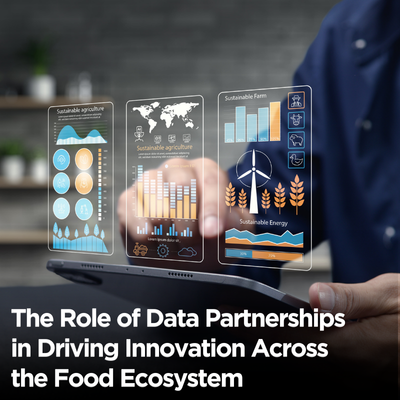
In response, data-driven food innovation is emerging as a powerful catalyst for change, with data partnerships at its center.
Across farms, processors, distributors, retailers, and technology providers, vast amounts of data are generated every day. Yet when this data remains siloed, its potential impact is limited.
Data partnerships in agriculture and across the wider value chain enable the integration of disconnected insights, creating a clearer, more actionable view of the entire food system.
This collaboration is accelerating the digital transformation in the food industry, enabling smarter decisions, faster innovation, and more resilient supply chains.
More importantly, shared data is helping unlock innovation in the food ecosystemthat balances commercial performance with sustainability goals.
This blog explores how these collaborations work, why they matter now, and how they are shaping the future of food.
Understanding the Digital Transformation of the Food Ecosystem
The food ecosystem is shifting from manual, siloed workflows to connected, data-rich systems, a change that’s often called the agri-food digital transformation.
Across the value chain, from input suppliers and growers to processors, distributors, and retailers, stakeholders are adopting sensors, cloud platforms, and analytics to turn raw telemetry into actionable decisions.
That shift is already visible in places investing heavily in agri-food tech. For example, Singapore is pushing a high-tech agri-food cluster that includes large indoor vertical farms using AI, robotics, and automation to boost production.
The Digital Shift in Agriculture and Food Industries
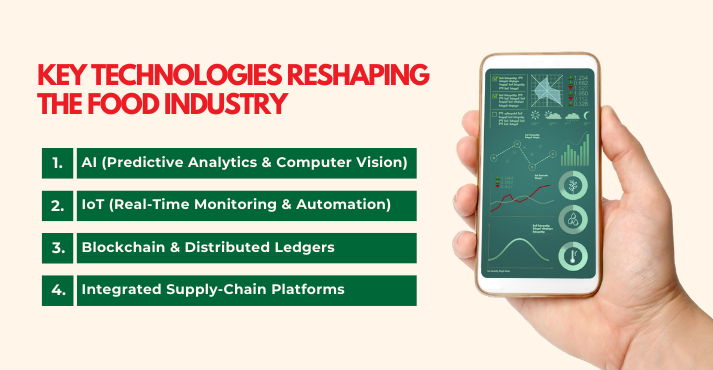
Digital technologies, especially AI in agriculture, blockchain, and the Internet of Things (IoT), are driving practical change across farms and factories.
Here are the key ways these technologies are reshaping the food industry:
AI (Predictive Analytics & Computer Vision)
The Asia-Pacific region is emerging as one of the fastest-growing markets for AI in agriculture, driven by rapid digital adoption, rising investment in agri-tech, and a strong regional focus on food security.
Market research projects that the Asia-Pacific AI in agriculture market will reach US$2,403.08 million by 2031, highlighting how quickly AI-enabled farming is moving from pilot projects to large-scale adoption.
At the farm level, AI models integrate weather forecasts, soil data, satellite imagery, and real-time sensor inputs to predict crop yields, identify early signs of disease or pest outbreaks, and optimise irrigation and fertiliser application.
Given this, AI could increase global food productivity by up to 67 per cent and cut food prices by nearly 50 per cent by 2050.
For example, Singapore’s Marine Aquaculture Centre uses AI-controlled environments to optimise fish farming conditions. This capability shifts agriculture from reactive decision-making to predictive, data-led management, helping farmers increase yields while using fewer resources.
IoT (Real-Time Monitoring & Automation)
The Internet of Things (IoT) is turning the food value chain into a live, responsive system.
Small, inexpensive sensors now stream temperature, humidity, vibration, and location data from fields, greenhouses, trucks, cold rooms, and processing lines.
When those feeds are combined with analytics and AI models, they provide real-time visibility into product condition, logistics performance, and equipment health.
Asia is an especially active tech market for this change. Data show heavy public and private investment in IoT infrastructure across the Asia-Pacific, with the IoT devices market expected to reach US$63,047.9 million in revenue by 2030.
Here’s how IoT drives transformation:
- Cold-chain monitoring: Real-time temperature and location telemetry on pallets and trucks reduces spoilage, speeds recalls, and supports shelf-life optimisation.
- Controlled-environment & vertical farms: Use dense sensor networks and automation to tightly control light, water, and nutrients, improving yields per square metre while shortening supply chains.
- Smart logistics & traceability: Integrating IoT with cloud platforms and distributed ledgers enables end-to-end tracking and data sharing among producers, packers, and retailers, essential for trust and transparency.
However, there are also constraints: heterogeneous device standards, connectivity gaps in rural areas, and recurring barriers to data interoperability and governance in deployments.
Blockchain & Distributed Ledgers (Traceability & Trust)
Blockchain and distributed ledger technologies (DLTs) operate on a shared ledger. These tamper-resistant records track food products as they move through the supply chain, from farm inputs and harvesting to processing, transport, and retail.
Unlike traditional databases owned by a single organisation, blockchain enables multiple stakeholders across the food ecosystem (farmers, processors, logistics providers, certifiers, and retailers) to write and verify data on a shared ledger.
Here are several measurable impacts of blockchain adoption in agri-food systems:
- Improved traceability and recall speed: Studies show blockchain-enabled traceability can reduce food recall times from days to minutes by enabling rapid identification of affected batches.
- Fraud and contamination reduction: Research in food safety and supply-chain journals finds blockchain effective in reducing data manipulation and food fraud by making records auditable across partners.
- Consumer trust and sustainability verification: Blockchain supports verification of organic, fair-trade, and sustainability claims, addressing growing consumer demand for transparency.
Integrated Supply-Chain Platforms (Optimisation & Collaboration)
Instead of each player working from isolated systems, integrated supply-chain platforms bring together production data, inventory levels, transportation status, demand forecasts, and quality metrics in real time.
These platforms typically combine cloud infrastructure with AI, IoT, and advanced analytics.
Here are several benefits of integrated supply-chain platforms in the food industry:
- Reduced food loss and waste: Real-time visibility and demand-driven planning can significantly cut spoilage by improving inventory rotation and cold-chain management.
- Improved operational efficiency: With integrated planning, you can achieve lower logistics costs, faster order fulfilment, and fewer stockouts compared to siloed systems.
- Greater resilience to disruption: Digitally integrated supply chains recover faster because partners can share data and adjust plans collaboratively.
Given the benefits, regional initiatives led by APEC and the World Economic Forum (WEF) are actively promoting the digitalisation of food supply chains through public–private collaboration.
Taken together, these technologies are not just point solutions; they enable food tech innovation by enabling multiple stakeholders to collaborate on a shared data foundation.
Data Partnerships: The Catalyst for Innovation
Data partnerships are the missing link between isolated tech pilots and industry-wide change.
They enable food innovation through data partnerships by creating shared measurement, governance, and commercial models that benefit farmers, tech firms, and food companies.
How Data Partnerships Are Shaping the Future of the Food Ecosystem
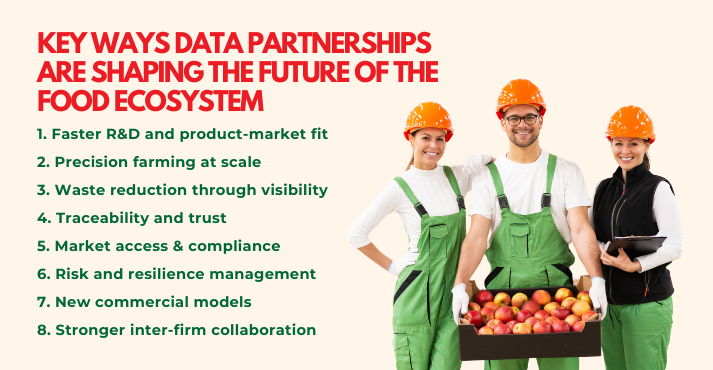
Data-driven agriculture partnerships help convert raw telemetry into coordinated action, from optimizing field inputs to balancing inventory across retail networks.
Key ways these partnerships are reshaping the food ecosystem:
- Faster R&D and product-market fit: Linking retail sales, sensory lab data, and farm records enables R&D teams to iterate on recipes, packaging, and shelf life with real-world feedback.
- Precision farming at scale: Shared weather, soil, and sensor feeds improve model accuracy for irrigation, pest control, and nutrient management, raising yields while lowering inputs.
- Waste reduction through visibility: Cross-partner access to inventory and cold-chain telemetry enables dynamic routing, redistribution, and markdowns that cut spoilage.
- Traceability and trust: Joint data registries shorten recall times and prove sustainability claims to regulators and consumers.
- Market access & compliance: Aggregated quality and logistics data make it easier for producers to meet export standards and new buyer requirements.
- Risk and resilience management: Shared early-warning systems (weather, pests, demand shocks) enable partners to coordinate contingency plans more quickly.
- New commercial models: Data-backed services (eg, yield-as-a-service, dynamic pricing) create recurring revenue and align incentives across the chain.
- Stronger inter-firm collaboration: Practical governance frameworks and shared KPIs break down information hoarding and foster long-term collaboration in the food sector.
When those pieces are in place, food industry data collaboration becomes a multiplier: better products, fewer losses, stronger export prospects, and a faster path to sustainable, data-led growth.
Optimizing Data Use for Sustainability and Innovation
Making data useful, not just collected, is the key to turning technical potential into real-world impact.
Optimising data flows means turning raw telemetry into clear, measurable actions: smarter input schedules for farmers, dynamic routing for distributors, and product-level insights for retailers.
Leveraging Data for a More Sustainable Food Ecosystem
Data partnerships let stakeholders move from one-off fixes to systemic change by sharing the signals each actor needs to act earlier and more precisely.
This shift is central to modern data-driven sustainability efforts: it links farm management with logistics, retail, and waste management systems so that every decision can account for environmental impact and resource efficiency.
How data partnerships enable sustainability and innovation:
- Smarter resource management: Shared soil, weather, and irrigation data enable precision application of water, fertiliser, and energy, reducing inputs while maintaining or increasing yields.
- Reduced post-harvest losses: Combining harvest estimates, transport telemetry, and demand forecasts enables earlier reallocation, dynamic pricing, and targeted distribution, resulting in measurable reductions in food waste.
- Lower carbon footprint: Route optimisation, modal shifts, and load consolidation, informed by real-time logistics data, reduce miles and emissions; lifecycle data also helps prioritise lower-impact sourcing.
- Optimising packaging and shelf life: Sensor and lab data linked to sales signals reveal true shelf life, enabling brands to redesign packaging and cold-chain settings to extend shelf life and reduce waste.
- Circular value streams: Shared data uncovers opportunities to valorise byproducts (e.g., food for animal feed, composting), enabling closed-loop business models that reduce landfill and create new revenue.
- Transparency and sustainable claims: Verified, shared records make sustainability claims auditable, improving consumer trust and easing regulatory reporting compliance.
- Informed policy and incentives: Aggregated, anonymised datasets help governments and NGOs design targeted incentives where they will have the highest impact.
When these mechanisms are combined across partners, the result is a more resilient, innovative, and efficient food system.
Understanding the Diversity of Intent in Data Partnerships
Not all data partnerships are built for the same purpose. Different organisations come to the table with distinct goals, time horizons, and risk tolerances.
Recognising this diversity of data sharing in the food industry up front makes it easier to design agreements, select technologies, and set KPIs that deliver value.
Different Needs Behind Data Partnerships in the Food Sector
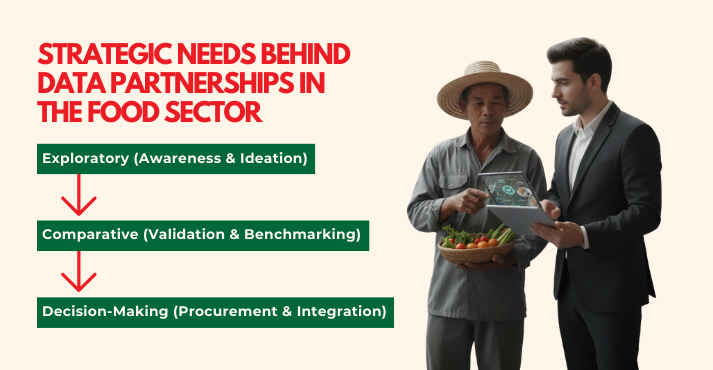
Data partnerships can serve very different strategic needs. Here are the common categories that show how the goal shapes the partnership design:
Exploratory (Awareness & Ideation)
At this stage, organisations focus on possibilities rather than outcomes. These partnerships are research-led and designed to surface new insights across the supply chain.
A common example is piloting AI in agriculture, such as using computer vision to detect early crop diseases or applying predictive models to assess yield risk under climate stress.
The result is typically a proof of concept rather than a production-ready solution.
Comparative (Validation & Benchmarking)
Here, the intent shifts from discovery to evaluation. Organisations compare tools or approaches to understand relative performance.
For example, two IoT sensor solutions can be tested side by side to assess the accuracy of detecting cold-chain breaches for food safety.
These partnerships rely on standardised datasets and controlled testing to enable fair, data-driven comparisons.
Decision-Making (Procurement & Integration)
At the most mature level, data partnerships support high-impact business decisions. The focus is on selecting technologies and integrating them into core operations.
For example, a global food manufacturer may work with an analytics partner to model scenarios and select the best data tools to optimise its supply chain.
The outputs directly guide procurement, investment priorities, and long-term digital strategy.
The Role of Key Entities in Data Partnerships
Data partnerships don’t happen in a vacuum; they’re driven by a mix of technology vendors, commercial food players, startups, investors, governments, and research institutions.
Key Players in Data Partnerships Across the Food Ecosystem
Data partnerships in the food ecosystem are shaped by a small number of key player groups, each contributing a specific type of value.
When these groups work together, data can move beyond silos and drive practical innovation at scale. Here’s how:
1. Technology Companies (The Enablers)
Global technology companies build the digital foundation for data partnerships.
Platforms such as IBM Watson and Google AI provide cloud infrastructure, analytics, machine learning, and automation tools that allow food companies to process large volumes of data and generate insights across the supply chain.
2. Food Giants (The Asset Holders)
Food giants and retail chains play a central role because they control scale.
Their access to supplier networks, logistics data, and consumer demand signals makes them natural anchors for multi-partner initiatives focused on traceability, waste reduction, and supply-chain optimisation.
3. Agri-Food Tech Startups & SMEs (The Disruptors)
Startups bring speed and specialization. These companies focus on specific problems such as crop monitoring, precision irrigation, food safety sensors, or demand forecasting.
Their technologies often integrate with larger platforms, helping partnerships move from ideation to real-world deployment.
4. Governments & Research Institutions (The Architects)
Public agencies enable data collaboration by funding pilot projects, setting regulatory frameworks, and supporting shared standards.
In many regions, government-backed initiatives help reduce risk and encourage collaboration between private-sector players.
Each of these groups is essential. Together, they form the backbone of leading data partnerships, enabling food-sector innovation through data collaboration that no single organization could achieve alone.
Case Studies: Successful Data Partnerships in the Food Industry
Across Asia, real-world data partnerships are moving beyond theory and delivering measurable improvements in productivity, sustainability, and food safety.
Real-World Case Studies of Data Partnerships Driving Innovation
Here are some food innovation success stories that reinforce why data partnerships are becoming central to food system transformation.
Case Study 1: Blockchain-Verified, Deforestation-Free Soy – CP Group (Thailand) & Bunge (Brazil)
In a leading example of food tech partnerships for sustainability, Bangkok Produce Merchandising (BKP), the procurement arm of Thailand’s CP Group, partnered with global agribusiness Bunge to deliver end-to-end traceability across the soy supply chain serving Southeast Asia’s livestock sector.
The Challenge: CP Group sources millions of tons of Brazilian soy each year for animal feed. Ensuring that this volume was deforestation-free and socially compliant required reliable, verifiable data spanning thousands of farms, traders, and logistics providers.
The Partnership: After feasibility testing in 2023, Bunge and BKP piloted a blockchain-based traceability platform developed by Justoken (a Bunge Ventures portfolio company). The pilot tracked 375,000 metric tons of soybean meal, leading to the signing of a commercial-scale MoU in 2025.
The outcomes:
- End-to-end digital traceability from Brazilian farms to CP feed mills in Thailand
- 100% deforestation-free verification, aligned with CP Group’s 2025 commitment
- Carbon and emissions visibility, supporting CP Group’s net-zero by 2050 target
This case highlights how collaboration between a food giant and a food tech innovator can turn transparency into a long-term competitive advantage.
Case Study 2: Data-Driven Rice Transformation – Mars Food & 1,400 Thai Farmers
When a severe drought in 2018 destroyed 58% of Thailand’s aromatic rice second harvest, Mars Food & Nutrition recognized that traditional flood-irrigated rice farming was unsustainable.
The company initiated the Sustainable Aromatic Rice Initiative in partnership with a German development agency and engaged farmers in two Thai provinces.
The Challenge: Farmers were risk-averse; adopting Alternate Wetting and Drying (AWD) required trust that yields would not drop and that water savings were real.
The Partnership: Mars used on-farm data collection to demonstrate the measurable benefits of new practices. Real crop data became the persuasion tool. “Brave farmers” who piloted the methods became advocates, sharing their verifiable results with neighbors.
Quantified Outcomes (six-year results):
- Yield increase: 58–60% (depending on region)
- Water use reduction: 50%
- Methane elimination: AWD prevents methanation associated with continuous flooding
- Scale: Program now includes 1,400 farms; 70% are female-led
This case study remains a template for food supply chain innovation in smallholder-dominated Asian agriculture.
Case Study 3: Smart Farming & ERP Integration – Nafoods & FPT (Vietnam)
In January 2026, Vietnam’s Nafoods Group, a processor exporting to 70 countries, signed a comprehensive digital transformation partnership with FPT Group, Vietnam’s leading technology corporation.
The Challenge: Nafoods manages tens of thousands of hectares of raw material areas and a complex export supply chain. It faced urgent traceability requirements from markets such as China and Australia.
The Partnership: FPT is deploying SAP S/4HANA Public Cloud as the enterprise backbone, integrated with FPT Smart Farm, an IoT and data platform that captures real-time growing conditions, yield forecasts, and quality metrics from contracted farms.
Outcomes (in progress):
- Unified real-time governance of farming, logistics, processing, and sales
- Traceability transparency from seedling to export container
- Yield/demand forecasting to stabilize raw material supply
- Greenhouse gas emission monitoring embedded in analytics
This is the first large-scale Vietnamese example of closing the loop between field-level agronomic data and global ERP-class financial and supply chain planning.
Case Study 4: QR Code Traceability for Premium Produce – Plantner (Korea) & FoodMap Asia (Vietnam)
South Korean eco-fertilizer startup Plantner signed an MOU with Vietnam’s digital agriculture platform FoodMap Asia in mid-2025. The partnership aims to transform fragmented smallholder data into consumer-facing traceability assets.
The Challenge: Vietnamese organic farmers lack systems to capture and verify production data; consumers lack trust in premium claims.
The Partnership: Plantner supplies its certified slow-release fertilizers to Vietnamese farms and deploys a digital crop growth data management system based on international agricultural standards. This data (soil health, fertilization history, harvest dates) links directly to FoodMap Asia’s QR code history management system.
The outcomes (targeted):
- Transparent production history for end consumers
- Premium price realization for compliant farmers
- Data-driven productivity improvement
This case shows how food innovation success stories can emerge from cross-border SME collaboration without major multinational involvement.
Navigating the Complexities of Data Partnerships in Food Systems: Challenges and Opportunities
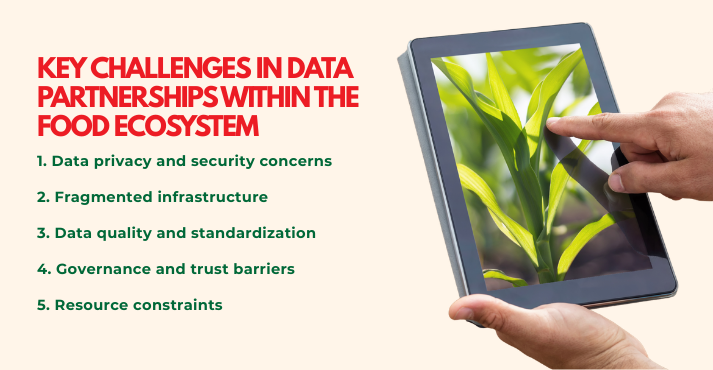
While the potential of food supply chain innovation through data collaboration is immense, the path from intent to impact is fraught with friction.
Organizations entering food technology partnerships for sustainability frequently encounter entrenched silos, misaligned incentives, and legacy infrastructure that was never designed for interoperability.
The most common obstacles in the food sector include:
- Data privacy and security concerns: Sharing farm, supplier, or consumer data can create risks if governance and encryption are weak.
- Fragmented infrastructure: Many supply chains rely on outdated systems or incompatible software, making seamless data integration difficult.
- Data quality and standardization: Inconsistent or incomplete datasets reduce model accuracy and undermine trust among partners.
- Governance and trust barriers: Organisations may hesitate to share sensitive information when there are no clear rules, incentives, or legal frameworks in place.
- Resource constraints: Smaller farms or startups may lack the technical capacity or funding to participate fully in data partnerships.
Despite those obstacles, the very gaps they expose point to the highest-impact opportunities. When farmers, tech vendors, retailers, and regulators agree on clear governance, common data formats, and shared KPIs, pilots become repeatable, data quality improves, and integration costs fall.
Here are actionable solutions to help turn these opportunities into reality.
- Invest in secure, scalable platforms: Cloud-based solutions with encryption, access control, and blockchain capabilities can protect sensitive information while enabling secure sharing.
- Promote transparency and governance: Establish clear roles, data ownership, and shared KPIs to build trust across partners.
- Adopt standardised data formats: Standardization reduces friction and ensures datasets are compatible for analysis.
- Start small with pilots: Test partnerships with limited datasets or geographies before scaling to full supply chains.
- Provide training and capacity building: Equip farmers, suppliers, and staff with the skills to participate in digital ecosystems.
- Leverage public-private collaboration: Government incentives, industry consortia, and multilateral frameworks can support adoption, reduce risk, and establish shared standards.
The Future of Data Partnerships in the Food Ecosystem
The future of food innovation is built on transparency: next-gen data partnerships will connect farmers, processors, retailers, and regulators in new collaborative networks that drive sustainability and resilience.
So, what’s next for data-driven innovation in food? Here’s what you need to know:
1. Blockchain for Traceability
Distributed ledgers will enable immutable records of every step in the food supply chain. This transparency helps prevent fraud and contamination by allowing stakeholders to verify the origins and handling of food products.
When combined with AI, blockchain can also help ensure data accuracy, making supply chains more accountable and increasing consumer trust.
2. AI in Food Ecosystems
Machine learning and advanced analytics will mine vast food datasets (from crop genetics to consumer trends) to guide decision-making.
In AI in food ecosystems, these insights enable smarter farming and processing, driving efficiency and innovation across the value chain.
3. IoT in the Food Industry
Connected sensors and devices will monitor everything from soil moisture to cold-chain temperatures in real time.
By continuously streaming environmental and operational data, IoT in the food industry enables real-time detection of issues (e.g., contamination or spoilage) and process adjustments.
4. Next-Gen Data Partnerships
Future collaborations will link disparate data sources through shared platforms and standards. Industry consortia and cloud networks will enable farms, suppliers, brands, and governments to securely pool information.
For example, some platforms already connect brands, manufacturers, and suppliers in a collaborative ecosystem that shares critical data, dramatically expanding the insights available to all participants.
Conclusion: The Power of Data Partnerships for Future Food Innovation
Data partnerships are the multiplier for the food ecosystem.
By connecting farms, processors, logistics providers, retailers, and policymakers through shared, trustworthy data and by combining IoT, AI, and ledger technologies, organisations can unlock faster innovation, cut waste, meet sustainability targets, and build more resilient supply chains.
While the technical tools are already in place, the real work now lies in establishing trusted governance, shared standards, and fair commercial models so that value flows across the ecosystem, especially to farmers and small suppliers.
Without this foundation, even the most advanced technologies struggle to scale.
The key takeaway is to start practical and scale with intent. Test small pilots, agree on measurable KPIs, invest in secure platforms, and use public–private forums to align standards.
Whether you’re a food company, tech provider, investor, or policymaker, exploring data-driven innovation partnerships today is the fastest route to a more efficient, sustainable, and resilient food future.