A guest arrives at a hotel in Singapore speaking very little English. The front desk staff need to provide a warm welcome, explain hotel services, and manage check-in efficiently.
Hotels today serve guests from a diverse range of countries, each with its own unique languages and cultural expectations. This diversity creates challenges in ensuring clear communication and maintaining high standards of guest experience.
Language barriers can lead to misunderstandings, delays, and frustration, affecting both guests and staff. Traditional methods, such as printed guides or relying on staff with language skills, often fail to meet the expectations of an increasingly international clientele.
AI-powered translation provides a solution to bridge these communication gaps in real-time. It allows hotel teams to interact seamlessly with guests, delivering information accurately while maintaining a personalized and welcoming experience.
This blog will explore AI-powered translation, its benefits for hotels, practical use cases, how it compares with human interpreters, tips for smooth integration, and answers to common questions.
What is AI-Powered Translation in Hospitality?
AI-powered translation in hospitality refers to platforms and systems that instantly translate voice or text, allowing hotel staff to communicate effectively with guests who speak different languages.
These multilingual communication solutions provide automated language support, helping hotels overcome language barriers and ensuring clear interactions at every touchpoint.
Compared with traditional translation methods, which often rely on human interpreters or printed materials, these platforms are faster, scalable, and more cost-efficient.
They allow hotels to respond to multiple guests in different languages simultaneously without delays, improving both operational efficiency and guest satisfaction.
Key features include real-time text translation, speech-to-text functionality for face-to-face conversations, and chatbots that can handle multilingual inquiries.
For the hotel industry, these systems are a practical way to eliminate language obstacles and provide a seamless, consistent experience for international guests.
Why Breaking Language Barriers Matters in Guest Communication
Hospitality is fundamentally a people-first industry, where the quality of communication has a direct impact on the guest experience.
Language differences can lead to misunderstandings during check-in, incorrect room service orders, or unfulfilled guest requests, all of which can negatively impact guest satisfaction.
These communication challenges can also lead to delays in responding to inquiries and impact the overall efficiency of hotel operations.
Guests who face communication difficulties are more likely to leave negative reviews, which can impact a hotel’s reputation and influence future bookings.
A recent study found that 73% of consumers believe that effective communication, including overcoming language barriers, significantly improves the customer experience in the hospitality industry.
In the Asia-Pacific region, seamless communication has become a competitive differentiator. Hilton Singapore Orchard, for example, offers multilingual staff and services to ensure guests can communicate clearly and comfortably during their stay.
This approach has helped the hotel maintain high satisfaction levels and positive guest feedback in a multicultural environment.
However, while Hilton relies on multilingual staff, AI-powered translation now offers hotels a scalable way to achieve the same level of inclusivity at lower cost.
By embedding translation into front desk systems, guest apps, and in-room services, hotels of all sizes can provide the same clarity and comfort, without relying solely on human resources.
How AI Translation Works for Hotels and Resorts

AI-powered multilingual communication systems enhance guest satisfaction and improve operational efficiency across hotel services. The following examples show how these solutions are applied in practice:
1. Front Desk & Concierge
AI-powered multilingual communication systems allow front desk staff to interact with guests in their preferred languages, minimizing miscommunication during check-in and concierge requests.
These systems streamline workflows, support personalized service, and reduce delays during peak hours.
By ensuring clear communication from the very first touchpoint, hotels can boost guest satisfaction, build a stronger brand reputation, and maintain consistency easily.
2. In-Room Services
In-room multilingual voice assistants or chatbots can handle service requests, provide information about amenities, and offer local recommendations in the guest’s preferred language.
This reduces the need for staff intervention, especially during peak hours, with AI-powered assistants ensuring guests feel attended to at all times.
3. Restaurants & Menus
AI-powered translation in digital menus allows guests to view dishes in their preferred language, improving clarity and confidence when ordering.
This not only prevents mistakes and order errors but also enhances satisfaction by making dining experiences more personalized and enjoyable.
4. Guest Messaging Platforms
AI-powered translation in mobile apps and messaging platforms allows hotels to communicate with guests seamlessly before, during, and after their stay.
By centralizing communication across all channels, hotels deliver consistent and efficient service across a range of properties — from boutique hotels to large international resorts.
For example, RedDoorz, a budget hotel chain in Southeast Asia, uses a multilingual AI chatbot to interact with guests across its website, mobile app, and messaging platforms like WhatsApp and Facebook Messenger.
This ensures guests receive timely responses and support in their preferred language, creating smoother communication and a better overall experience.
5. Emergency Communication
Multilingual communication tools ensure that safety instructions and emergency alerts are clearly understood by all guests — a critical requirement for both guest safety and regulatory compliance.
By providing information in multiple languages, hotels reduce confusion during urgent situations and allow staff to respond quickly and effectively.
This capability is especially vital in international hotels and resorts that serve a diverse audience, reinforcing trust and safeguarding the guest experience.
AI Translation vs. Human Interpreters
Bridging language gaps is a critical challenge in the hospitality industry, especially as hotels and resorts welcome guests from diverse linguistic backgrounds.
Both translation systems and human interpreters have unique strengths, and understanding their advantages can help businesses deploy the right solution for each scenario.
AI Translation Advantages
Automated translation platforms provide speed and scalability, allowing staff to communicate with multiple guests simultaneously.
They are available 24/7, reducing dependency on scheduling and providing consistent support across various channels, from messaging apps to in-room devices.
These systems can also reduce operational costs, particularly in large properties or chains that handle high volumes of guest interactions daily.
The market for these technologies is expanding rapidly, with AI solutions expected to reach approximately $244 billion in 2025 and grow to over $800 billion by 2030, reflecting increasing adoption across various industries, including hospitality.
Human Interpreter Advantages
Human interpreters provide accuracy, cultural sensitivity, and context-aware understanding. They are essential for high-stakes or sensitive interactions, such as resolving complaints or handling complex guest requests.
While more resource-intensive, human interpreters ensure clear communication and help maintain service quality in situations that require a detailed understanding.
Suggested Hybrid Approach
For most hotels, a hybrid approach is the most effective. Automated translation can handle routine, day-to-day communication efficiently, while human interpreters are better suited for complex or sensitive interactions.
This combination improves operational efficiency while maintaining high-quality guest interactions.
Quick Comparison
| Feature | Translation Platforms | Human Interpreters |
| Speed | Immediate, real-time | Dependent on availability |
| Scalability | High, supports multiple interactions simultaneously | Limited to one-on-one sessions |
| Cost | Lower operational cost | Higher cost per interaction |
| Accuracy | Good for routine communication | High, especially for complex or sensitive interactions |
| Cultural Sensitivity | Limited | Strong, context-aware |
| Availability | 24/7 across platforms | Scheduled or on-demand |
Strategically integrating both solutions helps hotels bridge language gaps, improve guest satisfaction, and optimize staff workflows. It also enables the efficient adoption of modern hospitality technology solutions.
Benefits of AI-Powered Translation in Guest Experience

Integrating advanced translation solutions into hotel operations enhances both guest interactions and internal workflows. These solutions offer various advantages that can improve service quality, operational efficiency, and overall guest satisfaction.
1. Guest Satisfaction
Providing personalized experiences in guests’ preferred languages creates comfort and builds trust from the moment they arrive. Guests are more likely to engage with hotel services, participate in activities, and make additional purchases when information is easy to understand.
This approach also helps prevent misunderstandings before they escalate, improving overall satisfaction. By addressing individual language needs, hotels strengthen loyalty and support a long-term guest retention strategy.
For example, Marriott International has implemented multilingual communication solutions, such as the EVA virtual agent and multilingual mobile app, to facilitate real-time communication across various languages.
These initiatives aim to enhance guest satisfaction and operational efficiency.
2. Operational Efficiency
Automated translation solutions allow staff to focus on higher-value tasks instead of manual language support. This reduces response times for guest requests, lowers the risk of miscommunication, and streamlines daily operations.
By integrating AI-powered translation, hotels can coordinate services more effectively across departments, especially during peak occupancy.
A recent industry survey shows that 39% of hoteliers believe that improving operational efficiency is technology’s most important value proposition, highlighting how staff-focused innovations can enhance productivity.
3. Cost Savings
Investing in multilingual communication solutions can reduce the need for full-time multilingual staff, especially in properties serving international markets. By minimizing staffing constraints, hotels can manage labor costs more effectively while maintaining service quality.
Additionally, digital systems reduce errors in bookings, in-room requests, and dining orders, saving money on operational mistakes. Automated communication also scales easily across multiple locations without a proportional increase in staffing costs.
4. Global Reach
With AI-powered multilingual translation, hotels can confidently host international guests by supporting cross-language communication throughout the guest journey.
Multilingual solutions expand market reach and make it easier to attract travelers from diverse regions.
This approach helps hotels maintain consistent service standards across global locations, ensuring a seamless experience and reinforcing brand integrity.
5. Brand Perception
Implementing multilingual solutions shows a commitment to modern, guest-centric service. Hotels communicate that they value inclusivity, accessibility, and technological innovation.
Guests often associate effective communication with professionalism, which in turn strengthens a brand’s reputation and differentiates hotels from their competitors.
Integration with Hotel Tech Stacks
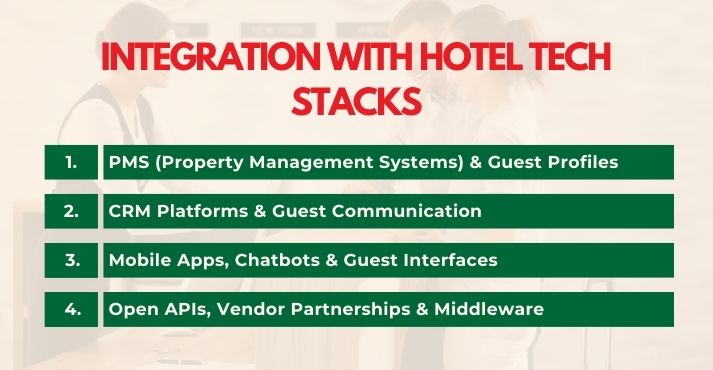
To make translation capabilities operational (not just theoretical), they must integrate tightly with a hotel’s existing systems. Below are key areas and best practices for their implementation in full-service hotels and other properties.
1. PMS (Property Management Systems) & Guest Profiles
The PMS should serve as the single source of truth for guest preferences, including language.
When a guest’s profile indicates a preferred language, translation tools can automatically display prompts, forms, and notifications in that language, ensuring clear communication from the first point of contact.
This helps front desk staff provide personalized service efficiently and prevents miscommunication during check-in or other interactions.
2. CRM Platforms & Guest Communication
Translation-aware CRMs allow hotels to personalize emails, SMS, and push notifications based on each guest’s language preference.
By segmenting guests by language, hotels can send messages that are relevant and easy to understand, avoiding confusion and enhancing engagement.
This ensures marketing, upsells, and post-stay outreach are meaningful and accessible to all guests.
3. Mobile Apps, Chatbots & Guest Interfaces
Embedding translation into guest-facing apps, in-room tablets, kiosks, or web chat ensures content is always presented in the guest’s preferred language.
Messages from staff or automated systems can be translated in real-time, maintaining smooth communication for service requests such as room service or spa bookings.
Flexible systems allow hotels to manage multiple channels consistently without interrupting workflows.
4. Open APIs, Vendor Partnerships & Middleware
Translation platforms that integrate seamlessly with PMS, CRM, and chat systems help hotels centralize multilingual communication. These integrations reduce delays, prevent miscommunication, and ensure that hotel-specific terminology is always accurate.
When selecting vendors, hotels should prioritize platforms that support easy integration, reliable updates, and consistent translation quality to enhance guest satisfaction.
Hoteliers often evaluate these capabilities at trade shows featuring hospitality technology, where integration readiness and seamless multilingual communication have become top buying criteria.
Challenges and Considerations
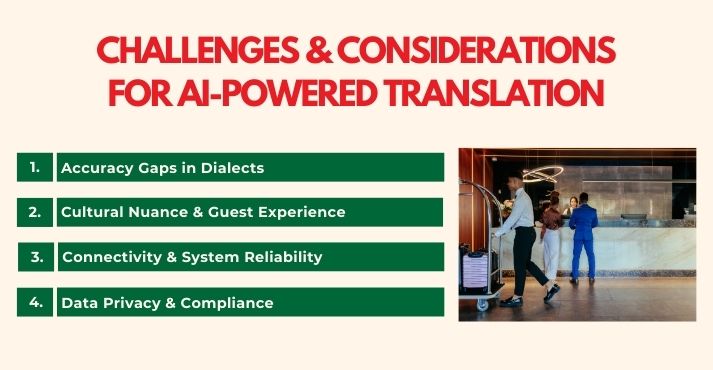
Even with strong integration, certain risks and limitations must be carefully managed. Before deploying translation tools, hotels should assess the trade-offs and ensure controls are in place.
1. Accuracy Gaps in Dialects
Translation quality is not uniform across all languages. Dialects or regional phrasing can result in errors that confuse guests or lead to mistakes in service delivery.
Hotels should test translation systems with the languages most commonly spoken by their guests and maintain fallback glossaries for key terms, such as room types or amenities. Partnering with vendors that support continuous updates helps reduce inaccuracies over time.
2. Cultural Nuance and Guest Experience
Direct translation may overlook tone, etiquette, or cultural context. For example, a phrase acceptable in one market may sound abrupt or impolite in another. Training staff to complement translation systems with cultural awareness ensures that hospitality standards remain intact.
Some operators run workshops or roleplay sessions where teams practice handling culturally sensitive situations.
3. Connectivity and System Reliability
Translation platforms depend on stable internet access. In remote resorts or regions with variable coverage, connectivity issues can disrupt guest interactions.
Hotels can mitigate this by using offline translation modules for critical functions such as emergency alerts and by building redundancy into their network design.
Connecting translation to existing hotel automation systems, such as service request routing, can also prevent communication breakdowns when bandwidth is limited.
4. Data Privacy and Compliance
Handling multilingual guest data requires strict adherence to data protection laws, such as the GDPR in Europe or the PDPA in Singapore. Hoteliers should confirm that vendors provide end-to-end encryption, regional data storage options, and audit trails.
According to a 2025 Hotel Management survey, 49% of hoteliers struggle to access the data needed for revenue and operational decision-making, citing disconnected systems and fragmented integrations as significant barriers.
This shows the importance of selecting translation platforms that integrate seamlessly with existing tech stacks while ensuring compliance.
Practical Solutions for Operators
- Schedule regular updates of translation datasets to improve accuracy.
- Train staff in cultural sensitivity and in using translation tools effectively.
- Establish escalation protocols to route sensitive or complex guest issues to human staff.
- Audit vendor SLAs for uptime, accuracy, and data handling to ensure long-term reliability.
Best AI Translation Tools for Hotels
Several leading platforms are widely adopted in the hospitality industry to support multilingual communication, streamline guest interactions, and enhance digital transformation initiatives.
Key Platforms & Specialized Tools
| Platform | Strengths for Hospitality Use |
| Google Cloud Translate | Supports many language pairs, reliable latency, strong global infrastructure; good for integrating into PMS or messaging channels. |
| Microsoft Translator | Offers speech-to-text and text translation; integrates well with Microsoft Azure services and Microsoft’s cloud ecosystem. |
| DeepL | Known for fluent, natural-sounding translations; especially strong for European languages and guest-facing content like marketing, signage, menus. |
| Unbabel | Combines automated translation with human editing for higher quality in sensitive or branded content; offers APIs for integration. |
| Specialized hospitality tools | Chatbots trained for hotel Q&A, smart kiosks in lobbies that can communicate in multiple languages, in-room interfaces that display language based on guest profile. |
Hospitality Use Cases
- Accor Hotels adopted Unbabel to build a custom translation API, allowing app content and promotions to flow directly into the translation workflow. This minimized manual updates and ensured consistency across multiple languages.
- iNPLASS, a hotel management tool, introduced real-time multilingual support for both guests and staff across 12 major languages. Guests can set their preferred language, and all communications adjust automatically to match.
What to Look for in Vendors
- Scalability: Can the platform handle multiple properties, spike in usage (e.g., peak season), and new languages or locales without needing major re-engineering?
- Integration: Support for APIs / REST endpoints, ability to hook into PMS, CRM, mobile apps, kiosks, chat systems. Also, check the ability to integrate with vendor glossaries or allow customization of terminology.
- Support & Maintenance: How well the vendor manages updates (language models, dialects), handles errors, provides fallback/human review options, and ensures reliability.
- Security & Privacy: Compliance with regional data protection laws (GDPR, PDPA, etc.), encryption, and regional hosting when necessary.
FAQs
What is AI-powered translation in hotels?
It involves the use of translation platforms integrated into hotel systems to provide guests with real-time multilingual support, from booking to check-in and in-stay services.
Can AI replace human interpreters?
Not entirely. While translation tools handle routine communication at scale, human interpreters are still needed for sensitive, complex, or culturally nuanced interactions.
How does AI improve guest satisfaction?
By removing communication barriers, hotels can respond more quickly, personalize services in the guest’s preferred language, and minimize misunderstandings during their stay.
What are the top AI translation tools for hospitality?
Common platforms include Google Cloud Translate, Microsoft Translator, DeepL, and Unbabel, as well as specialized hospitality tools such as multilingual chatbots and kiosks.
How secure is AI guest communication data?
Leading vendors use encryption, compliance frameworks like GDPR, and regional hosting to ensure guest data is protected and processed responsibly.
Conclusion
Multilingual translation tools are no longer optional for hotels competing in today’s global market. They help properties overcome language barriers, enhance guest satisfaction, and streamline operations across departments.
In Singapore and other APAC regions, where guests speak diverse languages, effective communication is crucial for delivering high-quality service.
A phased approach works best: start with pilot programs at the front desk, in mobile apps, or kiosks, then measure guest feedback and operational impact before scaling.
By investing early, hoteliers can strengthen their brand reputation, future-proof their guest experience, and lead in delivering seamless and inclusive hospitality.