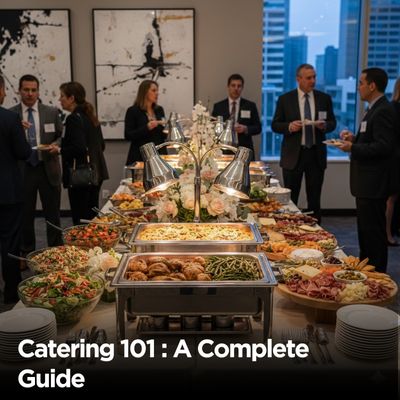
Imagine the clink of glasses at a glamorous wedding, the focused energy of a corporate meeting perfectly timed around a lunch break, or the simple joy of a family reunion where no one has to cook.
Behind these seamless experiences lies the world of catering services, far more than just delivering food.
Catering is both an art and a science, combining culinary creativity with precise logistics to bring hospitality directly to you, wherever you are.
This industry has grown, and the numbers are striking: the global foodservice market, which includes catering, was valued at $5.1 trillion in 2025 and is projected to surpass $7.2 trillion by 2035.
Growth is not limited to Western markets; the Asia-Pacific region accounted for approximately $893 billion in 2025, with urbanization and rising incomes driving rapid expansion.
So, whether you’re a food entrepreneur, an event planner, or simply curious about the business behind the buffet, understanding catering is an important part of how we connect, celebrate, and do business today.
In this guide, you will learn what catering services are, why they matter, the different types of catering, current trends shaping the industry, and practical tips on how to start and market your own catering business.
What Is a Catering Service?
At its simplest, catering is mobile hospitality: preparing food and providing service at a location other than a restaurant, usually for a special event or function. While a restaurant waits for guests to arrive, a caterer brings the whole dining experience to the client.
A full-service catering package usually includes:
- Menu planning: Designing a menu that fits the event’s theme, the client’s tastes, and their budget.
- Food preparation: Cooking and finishing dishes in a licensed kitchen (often a commercial commissary).
- Delivery & setup: Transporting food, equipment (tables, linens, china), and staff to the venue and arranging everything.
- On-site service: Running plated meals, buffets, bars, and stations, servers, bartenders, and specialists handle service.
- Cleanup: Clearing plates, packing equipment, and returning the venue to its original condition.
It’s important to distinguish catering from similar services. Restaurants are a fixed location you visit for a meal, whereas catering comes to you. Meal delivery services (like takeout) drop off pre-ordered food for immediate individual consumption, but they rarely provide the staffing, equipment setup, and full-service event management that defines the catering experience.
Why Catering Is Important for Events
Food is more than fuel; it’s memory and meaning.
People remember a dish long after the décor is packed away because flavor, smell, and presentation trigger emotion, conversation, and connection.
That emotional weight is a core part of a caterer’s value: when food is done right, it becomes the thread that ties an event together and leaves guests with a lasting impression.
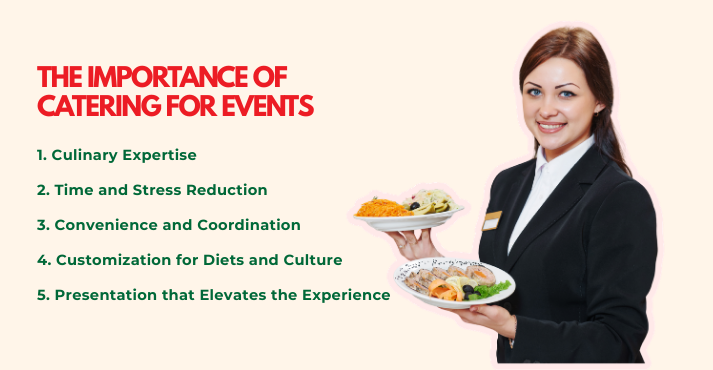
Culinary Expertise
Caterers bring professional culinary skills that raise quality and reduce risk. That means consistent cooking and plating, smart menu planning for flow and timing, and the ability to scale dishes so every guest gets the same great experience.
Crucially, experienced teams can handle dietary restrictions and cross-contamination protocols, so guests with allergies or special diets are safe and satisfied.
Time and Stress Reduction
Hiring a caterer frees the host to focus on the people and purpose of the event.
Instead of juggling food prep, timing, and serving, the host can welcome guests, manage the schedule, or run the program.
That stress reduction often makes the difference between a chaotic day and one the host actually enjoys.
Convenience and Coordination
A full-service caterer offers an end-to-end, “handled for you” promise: from menu creation and sourcing, to delivery, setup, service, and cleanup.
The caterer coordinates logistics (timing, equipment, staff) and manages on-the-ground problems so the client doesn’t have to. For busy planners, that single point of responsibility is priceless.
Customization for Diets and Culture
Modern event catering services offer options: vegetarian and vegan dishes, halal and kosher menus, gluten-free choices, and careful allergy accommodation.
Caterers can design culturally appropriate menus and label items clearly so every guest feels respected and included. Customization builds trust and avoids uncomfortable moments during service.
Presentation that Elevates the Experience
How food looks and is served changes how guests perceive the whole event.
Thoughtful plating, attractive buffet layouts, eye-catching live stations, and professional beverage service turn meals into theatre.
Moreover, presentation signals care and value; it makes the food feel like part of the event’s story, not just something to eat.
Example: Wedding vs Office Training Day
At a wedding, food often carries heavy emotional and symbolic weight: custom dishes, family recipes, elegant plating, and personalized service help create memorable moments and photos.
For an office training day, the priority shifts to timing, simplicity, and function: boxed lunches or plated buffet stations that are easy to eat between sessions, delivered on schedule, with clear labels for dietary needs.
Both events benefit from catering, but the value looks different; one focuses on emotion and ceremony, the other on efficiency, and a smooth program flo
Who Uses Catering Services? Two Main Customer Categories
The catering industry serves a wide range of clients, ranging from corporations running back-to-back meetings to families celebrating life’s milestones.
Understanding who uses catering helps caterers design the right packages, staffing, and service style for each market.
Here are the two main customer categories and what they typically need:
Business-to-Business Catering (B2B)
B2B clients include companies, institutions, and event organizers that require food and service for professional events. Typical B2B needs include:
- Meetings, trainings, and workshops
- Conferences and product launches
- Staff events and team-building activities
- Recurring orders (weekly lunches, monthly town-halls)
- Large-scale logistics (multiple breaks, simultaneous room service, AV-friendly meal timing)
Key priorities for B2B: punctual delivery, streamlined service, easy billing (invoices or purchase orders), and consistent quality across repeated events.
Consumer Catering (B2C)
B2C customers are individuals and families planning personal or social events. Typical B2C events include:
- Weddings, anniversaries, and birthdays
- Funerals and memorial services
- Family reunions and private parties
Key priorities for B2C: customization, emotional impact, presentation, menu personalization, seasonal planning, and one-off special touches such as tastings, plated service, or dessert stations.
Packages & Pricing: How B2B and B2C Differ
Here’s the difference in approach:
| Feature/Aspect | B2B Catering | B2C Catering |
| Pricing structure | Per-head rates, bundled recurring contracts | Package-driven, variable per event |
| Payment terms | Net payment, invoicing, and purchase orders | Deposits, event-specific add-ons |
| Focus | Consistency, scalability, reliability | Customization, presentation, one-off services |
| Typical add-ons | Minimal, mainly logistical adjustments for scale | Tastings, cake cutting, late-night staffing, and décor coordination |
| Best suited for | Recurring corporate events, conferences, and staff functions | Weddings, birthdays, reunions, private parties |
A Brief History of Catering
While the modern catering company with branded vans and online ordering is a recent invention, the fundamental concept of catering, preparing, and serving food away from home for a gathering is as old as civilization itself.
The history of catering is a story of how we have celebrated, conducted business, and cared for one another through food across the ages.
Ancient Origins
The earliest roots of catering lie in ancient hospitality and power. In civilizations like Egypt, Greece, and Rome, wealthy elites would host lavish feasts for hundreds of guests, employing armies of cooks, bakers, and servers to prepare and present elaborate meals.
These events were statements of status and generosity, requiring the same core elements of modern catering: planning, specialized labor, and off-site food preparation.
Medieval Period
During the medieval era, inns and taverns began providing meals to travelers, while trade routes introduced new ingredients and spices. Feasts became larger and more elaborate, reflecting growing social complexity.
Catered events often marked celebrations, weddings, and public ceremonies, combining nourishment with spectacle.
Renaissance refinement
By the Renaissance, catering began to professionalize. Cooking began to be viewed as a craft worthy of study and documentation, with the publication of some of the first professional cookbooks.
Caterers were no longer just providers; they were culinary artisans, tasked with delighting both the palate and the eye.
Catering Industry Snapshot and Market Direction
Catering is a large, resilient industry that’s growing in most regions.
As of 2025, the global catering services market is valued at approximately US$175.45 billion and is projected to grow at a robust compound annual growth rate (CAGR) of 6.60% through 2035, potentially reaching US$332.45 billion.
This expansion is fueled by consistent demand from corporate clients, a resurgence in social and wedding events, and the increasing reliance on outsourced food services by institutions worldwide.
The Asia-Pacific region, in particular, is emerging as a powerful engine of this growth. This surge is driven by rapid urbanization, an expanding middle class with rising disposable incomes, and a profound shift toward convenience and premium dining experiences.
Within this, the contract catering segment alone in Asia Pacific was valued at US$13.66 billion in 2024 and is set to grow at a CAGR of 6.23% through 2033, with countries like India and China leading the charge at projected CAGRs of 8.1% and 7.3%, respectively.
This growth, however, unfolds within a highly competitive landscape. For any caterer, from a startup to an established firm, this environment makes differentiation not just an advantage, but a necessity.
Catering Industry Trends Shaping the Future
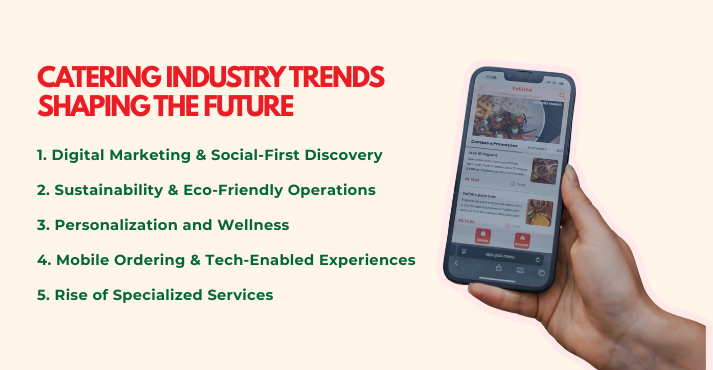
The future of catering is being written now, driven by technology, changing values, and a new generation of consumers.
These trends are not fleeting; they are fundamental shifts that should inform every modern catering operation and marketing decision.
Here are the major catering industry trends you must know to plan what to do next:
Digital Marketing and Social-First Discovery
Gone are the days when word-of-mouth and a yellow pages listing were enough.
Today, customers discover caterers visually, through Instagram feeds, TikTok videos, and targeted Google searches. A potential client’s first impression is likely a photo of a beautifully styled grazing table or a behind-the-scenes video of a live cooking station.
What a caterer should do:
- Invest in high-quality, professional photography and video of your events
- Share content consistently on social media platforms that your target clients use
- Make it easy for potential clients to envision your services at their event
Sustainability and Eco-Friendly Operations
Sustainability has moved from a “nice-to-have” to a core expectation.
Consumers and corporate clients alike are demanding eco-friendly practices, from eliminating single-use plastics and using compostable or recyclable packaging to sourcing ingredients locally and implementing rigorous food waste reduction programs.
This “green intelligence” is now a mark of a responsible and forward-thinking business.
What a caterer should do:
- Audit operations to identify areas of waste
- Switch to sustainable packaging and local sourcing
- Highlight eco-friendly practices in marketing and client communication
Changing Consumer Preferences: Personalization and Wellness
The era of one-size-fits-all catering is over. Clients now expect highly personalized experiences that cater to a diverse range of dietary needs and lifestyle choices.
This includes everything from plant-based, keto, and gluten-free options to culturally specific menus (halal, kosher) and “functional eating” that supports health and wellness goals.
Health is no longer a luxury; it is a daily priority for many.
What a caterer should do:
- Understand a wide range of dietary requirements
- Create versatile menu items that can be adapted
- Clearly label offerings to help guests make informed choices
Mobile Ordering and Tech-Enabled Experiences
Technology is streamlining the entire catering journey. Clients now expect the convenience of online ordering, real-time tracking, and seamless digital payments.
On the operational side, caterers are using AI-powered tools for demand forecasting to reduce food waste and integrated order management systems to ensure flawless execution.
Even the experience itself is becoming tech-enabled, with interactive ordering kiosks or apps at large events.
What a caterer should do:
- Offer a user-friendly online ordering and payment system
- Use software to manage logistics, inventory, and client communication
- Explore tech-enabled experiences for large events
Rise of Specialized Services
To stand out in a crowded market, many caterers are finding success by focusing on a specific niche.
Rather than trying to be everything to everyone, they are becoming the go-to expert for a particular segment, such as high-end corporate wellness programs, exclusive vegan wedding catering, or authentic regional Italian cuisine for private dinners.
This specialization allows for targeted marketing and the development of deep expertise.
What a caterer should do:
- Identify a niche in your local market or a cuisine/service you’re passionate about
- Build your brand and menu around that specialty
- Position yourself as the go-to expert for your niche
Types of Catering Services
Not all catering is created equal. The way food is prepared, where it is cooked, and how it reaches the guest defines the type of catering service being offered.
Understanding these categories helps both clients choose the right fit for their event and aspiring caterers decide which business model to pursue.
Here are two primary types of catering: on-premise and off-premise catering.
On-Premise Catering
On-premise catering means the food is prepared and served at the same venue. This approach is common at:
- Hotels, restaurants, and banquet halls
- Resorts and private clubs
- Country clubs and cruise lines
- Religious or community centers
When it works best: Large events where built-in kitchen staff, full-service dining, and extensive setup are available. On-premise catering offers seamless coordination, consistent service, and often the ability to handle high guest volumes with less logistical hassle.
Off-Premise Catering
Off-premise catering involves preparing food elsewhere (a commercial kitchen or commissary) and delivering it to the event location. Key variations include:
- Mobile catering: Food trucks, portable kitchens, or pop-up stations
- Specialized dietary catering: Kosher, halal, vegan, gluten-free, or allergy-friendly menus
The success of off-premise catering relies entirely on trust and logistics.
Unlike on-premise operations where the kitchen is steps away, off-premise caterers must master the art of timing, temperature control, safe transport, and rapid on-site setup.
Food must leave the kitchen at precisely the right moment, travel in specialized equipment to maintain safety and quality, and be reheated or plated upon arrival without compromising the dining experience.
This is because a single delay in transit or a breakdown in temperature management can undo hours of preparation.
Which Should You Choose?
Deciding between on-premise and off-premise catering depends on your event priorities and the type of catering business you want to build.
| Consideration | On-Premise Catering | Off-Premise Catering |
| Best for | Events where simplicity and a single venue contract are preferred | Events at venues without catering or requiring specialized menus |
| Facilities & Staff | Built-in kitchen, staff, and equipment | Caterers must bring their own kitchen setup, staff, and equipment |
| Menu Flexibility | Limited to what the venue can support | Highly flexible; can accommodate specialized dietary or niche menus (e.g., kosher, vegan) |
| Predictability | All-in-one, predictable service; the caterer knows the space intimately | Requires careful planning, timing, and transport to maintain quality |
| For Aspiring Caterers | Need venue partnerships or own space | Greater flexibility to serve multiple clients/locations, but demands strong logistics and reliable transport |
Building Your Identity: Niche + Signature Style
In a crowded and competitive industry, trying to be everything to everyone is a recipe for burnout and mediocrity.
The most successful catering businesses have one thing in common: they know exactly who they are and who they serve.
When you pick a lane, you stop competing on price and start competing on expertise.
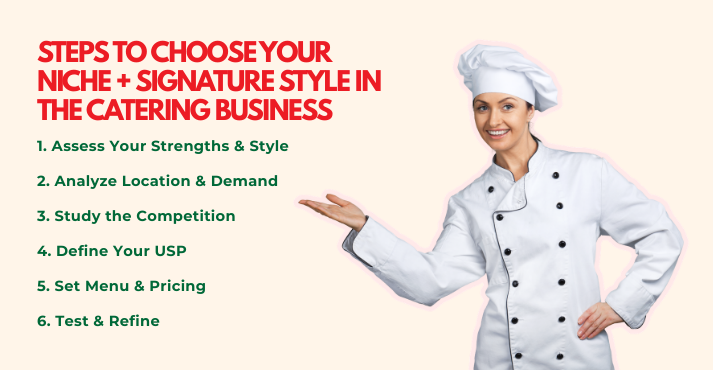
How to Choose a Niche (Practical Checklist)
Finding your niche is a process of self-discovery and market research.
Work through this practical checklist to identify the sweet spot where your passions, skills, and market demand intersect:
- Assess Your Strengths & Style: Identify what you do best, cuisine, cooking technique, or service style, and make it the foundation of your brand.
- Analyze Location & Demand: Match your skills to common local events (weddings, corporate functions, cultural gatherings).
- Study the Competition: Find gaps in the market, special diets, niche cuisines, or unique service offerings.
- Define Your USP: Clearly state what sets you apart, e.g., cultural authenticity, interactive stations, or efficiency for large events.
- Set Menu & Pricing: Build a menu that showcases your USP and choose a price point (premium, mid-range, or high-volume) that’s sustainable.
- Test & Refine: Run a small event, gather client feedback, and adjust your menu, service, and positioning before scaling.
Customizing Services as a Competitive Advantage
Once your niche is defined, customization becomes your superpower.
Acaterer who truly understands their specialty can offer tailored menus, thematic service styles, and event-specific experiences that a generalist cannot replicate.
For example, a caterer specializing in Mediterranean cuisine doesn’t just offer “chicken”; they offer a choice between Lebanese-style garlic chicken, Greek lemon oregano chicken, or Moroccan-spiced chicken tagine, each with appropriate sides and service ware.
This deep specialization builds trust. When a client needs a kosher wedding, they don’t want a caterer who “can probably figure it out.” They want the expert who does it every weekend.
That trust translates directly into referrals. Clients become advocates because they know you will deliver an authentic, flawless experience that meets the specific needs of their guests.
In catering, a strong reputation within a niche is the most effective marketing tool you can own.
Examples of Niche Catering Concepts
Here are two examples of focused catering concepts that have found success by owning a specific lane:
- Plant-based/vegan catering: Focus on flavour-forward, satisfying plant proteins and showy presentation that disproves the “boring” vegan myth.
- Cultural or theme-driven experiences: Offer deeply authentic menus for specific celebrations (e.g., regional Italian feasts or South Asian wedding banquets) with matching service rituals.
How to Start a Catering Business
Turning a passion for food into a catering business is an exciting journey, but it requires more than just great recipes.
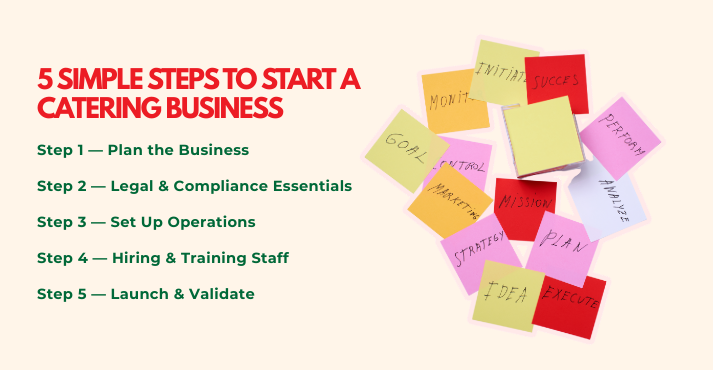
Follow these steps and use the launch checklist at the end to keep things on track:
Step 1 — Plan the Business (Your Roadmap)
A clear plan saves time and money. Your business plan should cover:
- Executive summary: One-page snapshot of what you do and your target customers.
- Market: Who are your clients (B2B, B2C, niches), local demand, and competitor gaps?
- Operations: Service types (drop-off, full-service, mobile, corporate contracts), kitchen model, staffing model, and logistics.
- Marketing: Brand positioning, pricing tiers, sales channels (events, sites, social, corporate outreach).
- Budget & projections: Startup costs, fixed/variable costs, break-even, and 12–24 month revenue forecast.
Be explicit about the services you will offer from day one (e.g., drop-off lunches only, full-service weddings, or recurring corporate catering). That clarity guides pricing, equipment, and staffing.
Step 2 — Legal and Compliance Essentials
Keep this general, but thorough; legal issues can stop your business fast if neglected. Key items:
- Business registration & structure: Choose a legal form that fits your risk tolerance and growth plans.
- Permits & licensing: Food service permits, local health department approvals, and any venue-specific permissions.
- Food safety & storage laws: Safe handling, temperature control, labelling, and allergen rules; follow local health codes.
- Insurance basics: General liability, commercial auto (if delivering), and workers’ comp where required.
- Contracts & agreements: Service contracts, deposit/refund terms, cancellation policy, and vendor agreements.
Step 3 — Set Up Operations (Kitchen, Equipment, Suppliers)
With the paperwork in order, it is time to build the physical infrastructure of your business.
This step is often the most stressful but also the most exciting, as your vision starts to take tangible form.
Kitchen Setup Paths
You have options depending on your budget and local regulations. Some caterers start in home-based kitchens where zoning laws permit, though this often limits the scale of events you can handle.
The most common path is renting space in a shared commercial kitchen or commissary, which provides the licensed, inspected facility you need without the massive upfront investment of building your own.
- Equipment Checklist: Your equipment needs will vary based on your niche, but a standard catering operation requires:
- Cooking: Ovens, ranges, tilt skillets, fryers, large stockpots, sauté pans.
- Refrigeration: Walk-in coolers or commercial reach-in units, freezers, portable coolers for transport.
- Prep: Commercial mixers, food processors, cutting boards, chef’s knives, mixing bowls.
- Storage: Shelving units, food-grade storage containers, dry goods bins.
- Serviceware: Chafing dishes, serving platters, utensils, linens, tables, chairs (if offering full-service).
- Safety: Thermocouples/probe thermometers, first-aid kits, fire extinguishers, and sanitizing supplies.
- Point of Sale (POS): A system for processing payments and managing invoices.
Ingredient Sourcing and Supplier Diversification
Build relationships with multiple suppliers, wholesale distributors, local farms, butchers, and fishmongers. Diversification protects you if one supplier has a shortage.
Also, establish clear quality control standards for inspecting all incoming ingredients.
Inventory Basics
Implement a simple system for tracking inventory, whether a spreadsheet or software. This helps control food costs, reduces waste, and ensures you never run out of key items before a big event.
Step 4 — Hiring and Training Staff
You cannot cater an event alone. Building a reliable team is essential for growth and for delivering consistent quality.
Even if you start as a solo operator, you will eventually need cooks, servers, bartenders, and drivers.
- Hiring Channels: Look for talent through your professional network, partner with local culinary schools, post on industry job boards, or build a roster of reliable on-call staff who work events as needed.
- Training Areas: Do not assume staff will know how you want things done. Comprehensive training should cover:
- Food Safety: Reinforcing proper handling, temperature monitoring, and sanitation.
- Service Standards: Plating techniques, how to interact with guests, and timing of courses.
- Communication: How to handle client requests on-site and coordinate with the rest of the team.
- Role Clarity: Everyone should know their specific responsibilities for each event.
- Cross-Training: Train staff to handle multiple roles. A server who can also help in the prep kitchen or a driver who knows basic plating is invaluable.
Investing in training reduces costly mistakes, ensures a consistent guest experience, and builds a team that takes pride in its work.
Remember, consistency is what turns first-time clients into repeat customers.
Step 5 — Launch and Validate
Your business is registered, your kitchen is ready, and your team is trained.
Now it is time to launch, but start smart. The goal of your initial phase is validation: proving that your concept works and refining it based on real-world feedback.
Begin by catering to smaller, lower-risk events. Offer your services to friends and family at a reduced rate, or partner with a local non-profit for a fundraising event.
These early gigs are invaluable for:
- Testing your menu under pressure.
- Practicing your setup and service flow.
- Building a portfolio of professional-quality photos.
- Collecting genuine testimonials.
Use this feedback to refine your menu, adjust your pricing, and identify any operational gaps.
Once you feel confident, establish standard packages with clear tiers (e.g., “Bronze,” “Silver,” “Gold”) and a list of add-ons. This makes it easy for potential clients to understand what you offer and makes quoting faster and more consistent.
Catering Business Launch Checklist
Use this quick checklist to track your progress as you move toward your first official booking:
- Business Plan: Completed market research, service definition, and financial projections.
- Legal Foundation: Business registered, licenses applied for, insurance secured.
- Contracts: Professional catering agreement template created.
- Kitchen: Commercial kitchen space secured and inspected (if required).
- Equipment: All essential cooking, transport, and service equipment purchased or rented.
- Suppliers: Wholesale and local sourcing relationships established.
- Menu: Core menu developed, priced, and tested.
- Branding: Business name registered, logo designed, website and social media profiles created.
- Pricing: Package tiers and add-on prices defined.
- Team: Initial staff hired and trained.
- Portfolio: First test event completed with professional photos.
- Marketing: Launch announcement ready to share with the network and online.
Marketing Your Catering Business (Proven Strategies)
A great catering business will struggle to survive without effective marketing. The goal is to make it easy for the right clients to find you, trust you, and choose you over the competition.
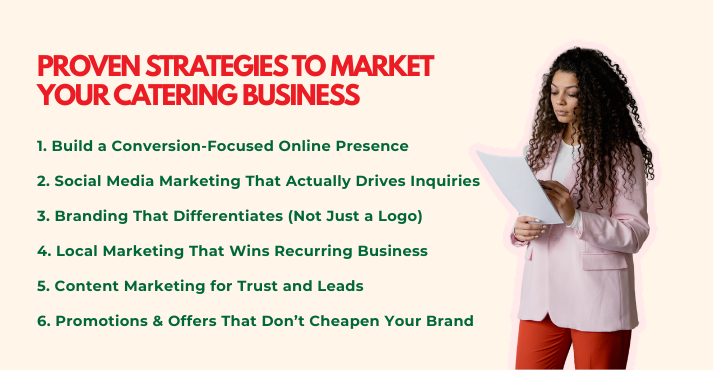
Here are the proven strategies that focus on building visibility, credibility, and a steady stream of inquiries.
Build a Conversion-Focused Online Presence
Your website is the hub for leads and bookings. Essentials include:
- Clear navigation and mobile optimization
- Menu/pricing (or “starting from”) and strong calls-to-action
- Photo/video galleries, client testimonials, and an inquiry/booking form
- SEO basics: local keywords and service pages by event type
Social Media Marketing That Actually Drives Inquiries
Social platforms help clients discover and trust you. Key points:
- Platform fit: Instagram (visual appeal), Facebook (local/community + ads), YouTube (credibility via behind-the-scenes & event highlights)
- Content pillars: Menus, events, BTS, staff/chef features, client stories
- Paid ads: Promote packages, seasonal deals, or lead forms strategically
Branding That Differentiates (Not Just a Logo)
Your brand should communicate purpose, values, and personality consistently:
- Purpose, values, voice/tone, visual identity, and brand story
- Consistency across website, social media, proposals, packaging, and uniforms
When every interaction feels cohesive, you build recognition and trust.
Local Marketing That Wins Recurring Business
Build connections that drive repeat bookings:
- Partnerships: Venues, planners, photographers, florists, and other local businesses
- Community events: Markets, fairs, tastings, pop-ups
- Sponsorships: Support causes aligned with your niche and showcase involvement
Content Marketing for Trust and Leads
High-quality content establishes expertise and keeps you top-of-mind:
- Blog topics: Seasonal menus, event planning tips, dietary guides, plating tips, case studies
- Visual content: Photos, videos, carousels, short clips, infographics
- Testimonials & case studies: Collect and repurpose across all channels
Promotions and Offers That Don’t Cheapen Your Brand
Strategic offers drive bookings without lowering perceived value:
- Seasonal or event-specific packages (e.g., summer BBQ, New Year early-bird)
- Loyalty programs, especially for corporate/repeat clients
- Referral programs with clear rewards for both referrer and new client
90-Day Marketing Launch Plan
Weeks 1-2: Setup
- Launch website with SEO basics, galleries, and inquiry form.
- Create social media profiles and post the first 3 pieces of content.
- Define brand voice and create proposal templates.
Weeks 3-6: Content + Partnerships
- Post consistently (3-4x weekly) across priority platforms.
- Reach out to 5 potential partners (venues, planners) for coffee meetings.
- Write 2 blog posts and repurpose them into social content.
Weeks 7-12: Ads + Events + Reviews
- Run a small targeted ad campaign promoting a seasonal package.
- Participate in one community event or tasting.
- Collect and showcase at least 3 client testimonials from initial events.
Factors Affecting the Catering Market
The catering market is shaped by evolving client expectations, labor trends, and technology.
Key strategic factors:
Demand for Healthy Options and Wellness Menus
Clients are increasingly prioritizing health and wellness, even at events. Corporate clients want nutritious lunches that boost productivity rather than induce food comas.
Wedding couples seek lighter, plant-forward options. Guests expect clear labeling of allergens and dietary accommodations.
To address this, develop adaptable menus that meet wellness trends without sacrificing flavor or presentation.
Gig Economy Impact on Staffing and Responsiveness
The rise of the gig economy has transformed catering staffing. Fewer workers seek traditional full-time employment, while many experienced hospitality professionals prefer flexible, on-call work.
This creates both opportunities and challenges in building a reliable team.
As a response, build a vetted pool of temporary staff, cross-train in multiple roles, and maintain clear communication systems.
Automation and Tech Tools Improving Operations
Technology is streamlining everything from client acquisition to post-event cleanup.
Online ordering systems, AI-powered inventory management, customer relationship management (CRM) software, and automated invoice tools are no longer luxuries but competitive necessities.
Therefore, invest in technology that reduces errors, speeds service, and allows clients to interact with your brand digitally.
Food Safety, Hygiene, and Standards in Catering
In catering, food safety is not just a regulatory requirement; it is the foundation of your reputation. Clients trust you to feed their guests safely, and a single incident can undo years of hard work.
The focus areas include:
The “4Cs” of Food Safety
The core principles of food safety can be summarized in four simple concepts:
- Cleaning: Maintain spotless kitchens, equipment, and service areas.
- Cooking: Cook food to the recommended internal temperatures.
- Cross-contamination: Use separate tools, prep surfaces, and storage for allergens and raw vs cooked foods.
- Chilling: Keep cold foods properly refrigerated and transport at safe temperatures.
Temperature Control and Safe Transport Basics
Off-premise catering makes temperature control particularly critical. Invest in insulated transport containers designed to hold hot foods hot and cold foods cold.
Use wireless temperature monitors for longer journeys. Pack foods in smaller batches rather than one large container to maintain consistent temperature.
Upon arrival, immediately transfer food to serving equipment and verify temperatures before service begins.
Staff Training and Certification Importance
Every person handling food should hold a current food safety certification, such as ServSafe or equivalent. Beyond certification, conduct regular in-house training sessions covering your specific protocols.
Emphasize that food safety is everyone’s responsibility, not just the head chef’s. When staff understand the “why” behind procedures, compliance becomes a point of pride rather than a chore.
Supplier Credibility and Traceability
Your food safety is only as strong as your suppliers’. Source ingredients from reputable, licensed vendors who follow their own safety protocols.
Maintain records of all deliveries, including dates, quantities, and supplier information. In the unlikely event of a foodborne illness inquiry, this traceability allows you to identify the source quickly and demonstrate due diligence.
Managing Events Smoothly and Scaling the Business
The final step in your journey is learning to manage events with precision and implementing strategies that allow your company to grow sustainably.
Efficient Event Management
Smooth events are built on planning and preparation:
- Planning: Confirm menus, guest counts, dietary needs, and timelines.
- Staffing: Assign clear roles, schedule backups, and cross-train team members.
- Logistics & Equipment Checks: Verify transport, temperature control, and all necessary tools are on-site.
- On-Site Setup Flow: Organize stations, service lines, and presentations for efficiency.
- Contingency Planning: Prepare for delays, equipment failure, or last-minute guest changes.
- Communication: Maintain clear lines between the kitchen, service staff, and client contacts.
Gathering and Using Feedback
Feedback helps refine offerings and strengthen client relationships:
- In-the-moment Feedback: Check satisfaction discreetly during service.
- Post-event Surveys: Ask clients for ratings on food, service, and overall experience.
- Review Requests: Encourage Google, Yelp, or social media reviews.
More importantly, compile feedback monthly and look for patterns. Are multiple clients requesting more vegetarian options? Is the same service issue appearing?
Use these insights to refine menus, adjust training, and continuously elevate your offering.
Scaling Strategies
Once operations are smooth, growth requires smart systems and partnerships:
- Online Booking Systems: Automate inquiries, confirmations, and payments.
- Strategic Partnerships: Work with venues, planners, or delivery services aligned with your brand.
- Inventory Upgrades: Increase storage, prep, and transport capacity.
- Menu Diversification: Introduce new cuisines, seasonal offerings, or dietary options.
- New Locations or Delivery Zones: Expand carefully to meet demand without overextending.
Key Performance Indicators (KPIs) to Track
Numbers tell the story of your catering business’s health. Track these plain-language metrics monthly:
- Inquiry-to-Booking Rate: What percentage of potential clients who contact you actually book? This measures your sales effectiveness and pricing accuracy.
- Repeat Rate: How many clients book you again? This is the ultimate measure of satisfaction and service quality.
- Average Order Value: What is the typical dollar amount per event? Increasing this through add-ons and upgrades directly boosts profitability.
- On-Time Delivery Rate: For drop-offs, what percentage arrive exactly when promised? This is a non-negotiable trust metric.
- Review Count and Rating: How many recent reviews do you have, and what is the average star rating? This directly influences new client decisions.
Final Thoughts
Catering services are far more than delivering food; it is the art of mobile hospitality, transforming gatherings into memorable experiences through culinary expertise, seamless service, and emotional connection.
From understanding the two main categories of on-premise and off-premise operations to recognizing the power of specialization, this guide has mapped the landscape of a dynamic industry poised for global growth.
Success in catering requires navigating emerging trends like sustainability and personalization while building a business on a foundation of solid planning, food safety, and strategic marketing.
Whether you are just starting or seeking to scale, the key takeaway is clear: differentiation through a defined niche and unwavering quality is what turns first-time clients into lifelong advocates.
Start with the niche. Build the systems. And then, go feed people.
FAQs
What does full-service catering include?
Full-service catering includes menu planning, food preparation, delivery, setup, staffing, service, and cleanup.
What does a catering service include?
A catering service typically includes far more than just the food itself, though the exact offerings depend on the package you select. Most full-service catering encompasses menu planning and consultation, food preparation in a licensed kitchen, delivery to your event location, on-site setup of food and equipment, service staff (such as servers, bartenders, or carvers), and complete cleanup and breakdown after the event. Higher-end packages may also provide rentals like tables, linens, china, and glassware, while drop-off catering focuses solely on food delivery without staffing or setup.
What’s the difference between on-premise and off-premise catering?
On-premise catering prepares and serves food at the same venue (hotels, banquet halls), offering built-in convenience and familiar facilities. Off-premise catering prepares food in a separate kitchen and transports it to your location, providing greater venue flexibility but requiring meticulous logistics for timing, temperature, and setup.
How far in advance should I book a caterer?
Most caterers recommend booking 6 to 12 months in advance for weddings and large celebrations, especially during peak seasons (spring and fall). For corporate events and smaller private parties, 4 to 8 weeks is typically sufficient. Popular caterers book quickly, so securing your date early ensures availability and allows ample time for menu planning and tastings.
How do caterers handle dietary restrictions and allergies?
Here’s how caterers handle dietary restrictions and allergies:
- During consultation, clients specify restrictions (gluten-free, nut allergies, halal, vegan) and caterers discuss cross-contamination risks.
- Separate prep areas, color-coded utensils, and dedicated equipment prevent cross-contact.
- Dishes are clearly labeled at buffets, and staff are trained to guide guests and answer questions about ingredients.
- Many caterers require signed waivers or recommend dedicated allergen-free vendors to ensure safety.
What licenses do I need to start a catering business? (keep general unless geo-specific)
While requirements vary by location, most caterers need:
- Business license: Register your business name and structure (LLC, sole proprietor).
- Food service permit: Health department approval to operate a commercial kitchen.
- Food handler certifications: Staff must complete accredited food safety training (e.g., ServSafe).
- Health department inspection: Your kitchen passes sanitation and safety standards.
- Insurance: General liability, commercial auto (for delivery), and workers’ compensation.
- Zoning/permit for home-based kitchens: If starting from home, verify local cottage food laws allow catering.
Always check with your local health department and Small Business Administration for specific requirements in your area.
How do I price catering menus? (high-level only)
To price catering menus, start by calculating your cost of goods sold (COGS), typically 25-35% of the menu price, then add labor, overhead, and desired profit margin. Research competitor pricing in your area to ensure market alignment, and consider value-based pricing for specialized niches (e.g., vegan, kosher). Most caterers structure pricing as per-person rates with package tiers, plus separate line items for rentals, staffing, and delivery. Always build in a buffer for unexpected costs and review pricing quarterly as ingredient costs fluctuate.
What marketing channel works best for caterers?
The marketing channels that work best for caterers include:
- Instagram: Highest ROI for visual storytelling, showcase food, events, and behind-the-scenes content to attract private clients.
- Local partnerships: Relationships with wedding venues, event planners, and corporate offices drive consistent referral business.
- Google Business Profile: Essential for local search visibility (“caterer near me”) and collecting reviews.
- Facebook: Effective for community building, event promotion, and targeted ads to local audiences.
- Website with SEO: Converts traffic into inquiries; service pages optimized for local keywords (e.g., “corporate lunch catering [city]”).
- Content marketing: Blog posts and case studies build trust and improve search rankings over time.