Regulatory oversight and consumer expectations around food safety are becoming more demanding than ever.
While HACCP systems and supplier audits are essential for maintaining compliance, many food businesses still rely on paper logs and spreadsheets. This process often leads to incomplete records, reporting delays, and last-minute stress during inspections.
Food safety digitization offers a modern, practical alternative. By adopting digital HACCP solutions and automated processes, companies can record data in real time, reduce manual errors, and maintain centralized compliance documentation.
This digital approach also strengthens supplier oversight by tracking certifications, quality metrics, and performance across the supply chain.
This blog explores how digital transformation simplifies HACCP management and supplier audits, helping food organizations save time, ensure compliance, and build greater transparency from production to distribution.
What is Digital HACCP and Why It Matters
Digital HACCP is a modern approach to managing food safety, built on connected systems that centralize and automate critical control processes.
Unlike traditional paper-based methods, it uses HACCP-compliant software to organize and verify safety records at every production stage.
Through cloud platforms and IoT-based digital monitoring, businesses can track temperature logs, cleaning schedules, and corrective actions in real time. This ensures that all data is securely stored and immediately retrievable during audits or inspections.
What makes this change significant is its alignment with global safety frameworks such as FSMA, ISO 22000, BRCGS, and GFSI.
Instead of simply digitizing forms, companies create a living system that continuously monitors performance and flags deviations before they become compliance issues.
By 2024, over 75% of food manufacturers in North America had integrated some form of digital food safety software, up from 62% in 2022, indicating steady progress toward stronger compliance and operational control.
How Digitization Transforms Food Safety Operations
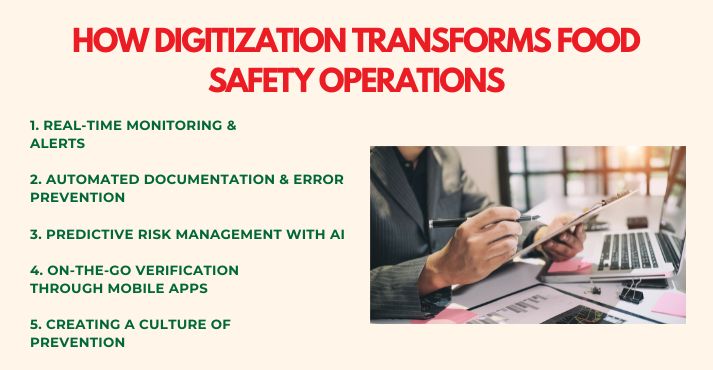
Food safety digitization helps companies move from manual recordkeeping to smarter, connected systems that simplify compliance and reduce risk.
Digital platforms make it easier for teams to monitor conditions, document processes, and stay prepared for inspections at all times.
1. Real-Time Monitoring and Alerts
IoT sensors and cloud systems continuously track key control points such as temperature and humidity. If readings fall outside the set range, alerts are sent instantly so corrective actions can begin right away.
Nearly 60% of US food and beverage manufacturers now use IoT systems to track and trace ingredients, showing the importance of connected monitoring in modern food safety.
This proactive approach helps prevent product loss and keeps records ready for digital food safety audits whenever needed.
2. Automated Documentation and Error Prevention
Digital forms and automated food safety compliance systems eliminate common issues like missed entries or misplaced paper logs.
Required fields and time-stamped records ensure accuracy, while centralized storage keeps information organized for faster reporting and audit preparation.
3. Predictive Risk Management with AI
AI-powered analytics identify early warning signs, such as recurring temperature fluctuations or delayed corrective actions. Detecting these patterns early helps prevent non-compliance and supports consistent food safety across operations.
4. On-the-Go Verification Through Mobile Apps
Mobile applications allow staff to complete safety checks on-site, upload photos, and submit records instantly. Managers can review updates immediately, ensuring checks are completed promptly and accurately.
5. Creating a Culture of Prevention
By bringing monitoring, reporting, and analytics into one system, digital food safety solutions help teams focus on prevention rather than reaction. Operations become more efficient, and compliance processes are easier to manage across facilities and supplier networks.
Digitizing Supplier Audits for Compliance and Safety
Supplier audits are essential for ensuring food safety, but managing them manually can be time-consuming and error-prone. Companies must assess multiple suppliers, meet varied compliance standards, and respond to strict regulatory and customer expectations.
Digitizing supplier audits makes the process more efficient and consistent. Supplier audit software enables quality teams to standardize evaluations, track performance, and receive alerts for missed deadlines or non-compliance, all from a single platform.
Common Pain Points in Supplier Audits
Manual audits often involve sifting through inconsistent paper files or spreadsheets. Reporting formats vary across suppliers, making comparisons difficult.
These gaps can lead to delayed identification of non-compliance or, in the worst cases, food safety breaches, which may result in regulatory fines or damage to brand reputation.
How Digital Tools Simplify Supplier Audits
Digital supplier audits consolidate information into a single platform. Performance scorecards, automated alerts, and compliance dashboards help teams quickly identify issues, track corrective actions, and maintain accurate inspection records.
Leading platforms in this space include FoodLogiQ, SafetyChain, and Safefood 360°, which provide these features without relying on paper processes.
Case Example
Hilton Food Group, a food manufacturer, moved from manual checklists to a centralized mobile auditing system.
Previously handling around 130 supplier audits per year, the company reduced administrative effort by 40% and increased the number of audits to over 240, improving efficiency and supplier oversight.
Compliance and Regulatory Alignment
Food safety regulations are becoming stricter, with frameworks such as FDA FSMA, BRCGS, GFSI, ISO 22000, and Singapore Food Agency (SFA) guidelines governing how risk and quality are managed in production facilities.
Digital HACCP solutions and automated food safety compliance systems simplify adherence by organizing records, standardizing processes, and making data readily accessible for inspections.
Every entry is time-stamped and securely stored, allowing auditors to review documentation efficiently while reducing administrative workload.
These systems also support long-term traceability, helping organizations maintain consistent compliance across multiple sites and regulatory frameworks without relying on manual recordkeeping.
KPIs to Measure Success in Digital Food Safety
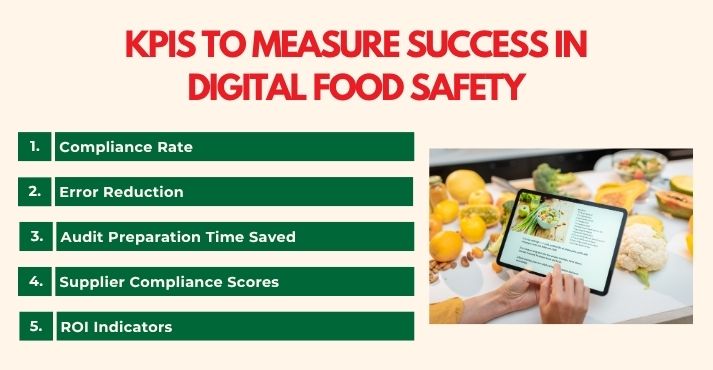
Measuring key performance indicators (KPIs) helps organizations understand how digital systems impact food safety and compliance. Tracking these metrics allows teams to identify areas that need attention and assess overall effectiveness.
- Compliance Rate: Track how consistently safety procedures are completed as required. Monitoring completion percentages provides insight into adherence to standards and accountability across operations.
- Error Reduction: Evaluate decreases in missed entries, incomplete records, or procedural mistakes. Fewer errors contribute to safer products and smoother audits, reducing risk across the supply chain.
- Audit Preparation Time: Measure the time saved in preparing for inspections compared to manual processes. This KPI highlights operational efficiency and the effectiveness of digital record management.
- Supplier Performance Scores: Assess supplier compliance and quality consistently using digital audits. Tracking these scores helps identify risks, prioritize corrective actions, and support ongoing improvement in supplier management.
- Return on Investment (ROI): Monitor business impact through outcomes such as fewer non-compliance incidents, improved operational efficiency, and enhanced customer trust. ROI indicators quantify the benefits of digitizing food safety processes.
Challenges in Digital HACCP Implementation
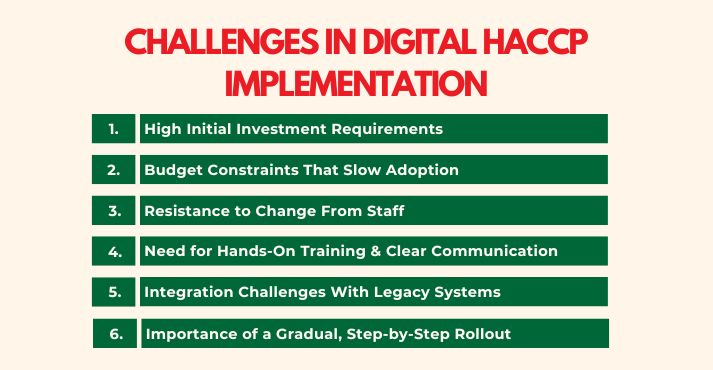
Adopting digital HACCP systems offers significant advantages, but the transition can still pose challenges. For many small and mid-sized food businesses, the initial investment in hardware, software, and ongoing support can be a concern.
While long-term savings from improved efficiency, compliance, and reduced waste often balance these costs, budget limitations may slow adoption.
Change management is another challenge. Teams used to manual recordkeeping may be hesitant to switch to new food technology, making hands-on training and clear communication about the benefits essential.
Integration can also be complex when connecting digital HACCP systems to older platforms, leading to data gaps or duplication.
A step-by-step rollout that begins with the most critical control points and expands over time helps organizations ease adoption and maintain continuity in daily operations.
FAQs on Digitizing HACCP & Food Safety
What is the difference between traditional HACCP and digital HACCP?
Traditional HACCP relies on paper logs and manual data entry, which are time-consuming and prone to human error. Digital HACCP uses software, mobile apps, and cloud platforms to automate monitoring, recordkeeping, and reporting, improving accuracy and efficiency.
How do IoT sensors support HACCP compliance?
IoT sensors continuously monitor critical control points, such as temperature, humidity, and contamination levels. They send instant alerts when limits are breached, allowing faster corrective actions and more reliable compliance records.
Can digital HACCP reduce audit preparation time?
Yes. By automating documentation and storing data centrally, digital HACCP systems simplify audits and significantly reduce the time and effort required to prepare for inspections.
What industries benefit most from digital HACCP?
Digital HACCP benefits all sectors within the food industry, including processing, dairy, meat, seafood, beverages, and ready-to-eat products. Any business that must meet stringent food safety standards can gain efficiency and consistency through digital systems.
Which regulations require HACCP digitization?
While not always mandatory, global frameworks such as FDA FSMA, BRCGS, GFSI, ISO 22000, and SFA guidelines encourage digital recordkeeping as a best practice to enhance traceability and audit readiness.
Conclusion
Digitizing food safety is essential for improving compliance, efficiency, and control. Moving from manual workflows reduces errors, speeds up audits, and allows real-time monitoring of critical control points.
Digital systems keep records organized and accessible, making inspections and regulatory alignment easier.
Adopting digital HACCP and supplier audit solutions helps businesses improve visibility across operations and maintain accountability within the supply chain.
Organizations that implement digital food safety today will be better prepared for future compliance needs and changing customer expectations, ensuring consistent quality across all stages of production.