Hotels that adopt advanced revenue management tools and ways of thinking can increase profits by as much as 30%.
That number isn’t magic; it comes from treating hotel revenue management as a strategic business discipline, not just a way to change room rates.
When done right, revenue management answers one critical question: how to sell the right room, at the right time, to the right guest, through the right channel, at the right price.
That question pulls in several interconnected pillars:
- Pricing: From BAR (Best Available Rate) to dynamic/open pricing across segments and lengths of stay.
- Forecasting: Predicting demand, occupancy, and average daily rate to enable proactive, not reactive, decisions.
- Distribution & Direct Bookings: Choosing channels, managing commissions, and making direct-booking offers that win guests and margins.
- Demand Controls: RFP management, blackout dates, minimum/maximum stay rules, and cancellation policies that protect revenue and reduce churn.
These pillars do not operate in isolation and require systems, data, and cross-departmental cooperation.
In this guide, you will learn how pricing models (from BAR to open pricing), forecasting, distribution, direct bookings, corporate contracts, blackout dates, cancellation policies, and new technologies fit together to create a sustainable hotel revenue engine.
By the end, you will know how to optimize RevPAR and profitability while delivering great guest experiences.
What Is Hotel Revenue Management?
Hotel revenue management is the practice of selling the right room to the right guest, at the right time, and at the right price through the right channel.
It blends data, analytics, forecasting, and pricing decisions to maximize a hotel’s total revenue. How modern revenue management differs from traditional pricing:
- Traditional Static Pricing: set rates by season or fixed calendars; few updates; decisions often based on intuition or past practice.
- Modern Data-driven Revenue Management: continuous, evidence-based decisions using analytics and forecasts; dynamically adapts to real-time demand and channel signals.
Moreover, effective revenue management extends beyond rooms, optimizing revenues from dining, spas, and other services to maximize total hotel revenue rather than just occupancy.
Why Revenue Management Is Critical in Today’s Hospitality Industry
Revenue management directly affects key financial metrics, including RevPAR (revenue per available room), ADR (average daily rate), and GOPPAR (gross operating profit per available room).
RevPAR measures a hotel’s ability to fill rooms at an average rate; it is calculated by multiplying ADR by occupancy or dividing total room revenue by available rooms.
However, RevPAR does not account for costs, so many hotels also track TRevPAR and GOPPAR to capture ancillary revenue and profitability.
Thus, an increase in RevPAR usually indicates improvement in occupancy or average rate, but managers must ensure expenses and distribution costs do not erode profits.
Moreover, a well-executed revenue strategy also improves the guest experience. Fair, data-driven pricing prevents extreme rate spikes during peak periods and creates attractive offers during low-demand and shoulder seasons, building trust and long-term loyalty.
Today, revenue management extends across the entire hotel ecosystem, turning it into a growth lever rather than a defensive tactic:
- Rooms: Optimizing pricing, availability, and demand mix
- Food & Beverage: Maximizing covers, spend per guest, and outlet utilization
- Spa & Wellness: Yielding appointment slots and pricing experiences dynamically
- Meetings & Events: Managing space, timing, and displacement decisions
- Packages & Experiences: Bundling services to increase total guest value
By managing all revenue streams in a single system, hotels improve overall profitability while delivering a more consistent, value-driven guest experience.
Core Components of Hotel Revenue Management
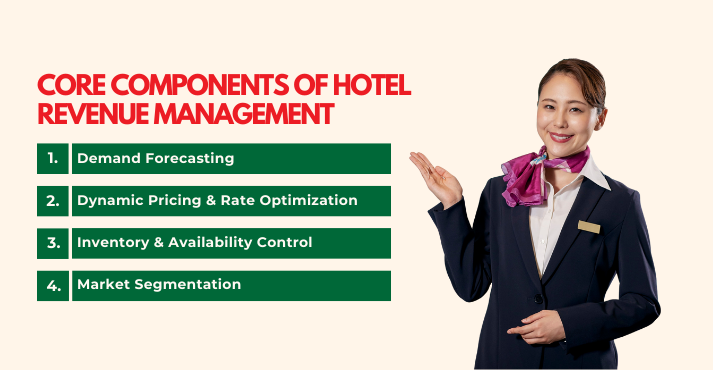
Revenue management is a system of linked components that turn data into disciplined commercial choices. Here are the four key components you’ll rely on to build reliable, repeatable revenue outcomes.
Demand Forecasting
Forecasting forms the foundation of all revenue decisions. Hotels analyze historical performance, seasonality, booking patterns, and market events to project future demand.
Demand forecasting models incorporate segmentation, competitor pricing, and external factors such as holidays or local events to anticipate peaks and troughs.
Without reliable forecasts, hotels may underprice during high demand or overbook and then face costly walk‑outs during sold‑out periods.
Dynamic Pricing & Rate Optimization
Dynamic pricing adjusts room rates in response to demand fluctuations, booking windows, market conditions, and guest behaviour.
Traditional BAR (Best Available Rate) pricing sets a base rate for a standard room and then applies fixed percentage adjustments for other room types or discounts. This method is simple but inflexible; all related rates remain tied to BAR.
In contrast, open pricing decouples other room types and segments from BAR, allowing revenue managers to set flexible discounts and independent prices based on demand, channel, or guest segment.
This enables granular price points and real‑time adaptation to market shifts. Open pricing often yields higher RevPAR, greater flexibility, and improved personalization, making it a hallmark of modern revenue management.
Inventory & Availability Control
Rooms are a perishable asset; once the night passes, unused inventory is lost forever.
Revenue managers implement inventory and availability controls such as length‑of‑stay restrictions, yield or stay‑through controls, and overbooking strategies to maximize revenue.
Also, channel management systems update room availability across all channels in real time to prevent double bookings, yet a controlled level of overbooking can be profitable.
Moreover, by selling slightly more inventory than is available, hotels offset no‑shows and cancellations; historical data helps determine the optimal overbooking level.
If cancellations do not occur, the hotel may transfer guests to partner properties or offer upgrades, which are less costly than leaving rooms empty.
Market Segmentation
Not every guest has the same willingness to pay or tolerance for cancellation; segmentation enables tailored pricing and packaging.
Core segments to consider:
- Business travelers (often short lead times, higher ADRs weekdays)
- Leisure travelers (longer lead times, weekend demand patterns)
- Groups & events (bulk inventory, negotiated rates, displacement risk)
- Corporate / negotiated accounts (contracted rates, channel mix)
- Loyalty members (repeat value, upsell opportunities)
Recognizing these differences allows revenue managers to apply distinct rate ladders and packages for each segment and to perform displacement analysis when groups or corporate accounts compete with high‑rate transient business.
Pricing Strategies in Modern Hotel Revenue Management
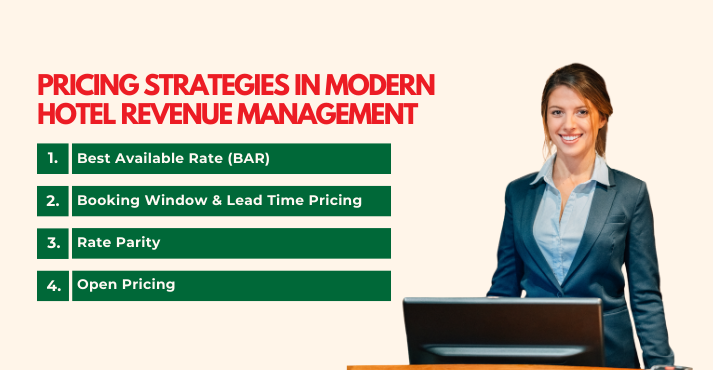
Effective pricing strategies are at the heart of modern hotel revenue management.
They balance transparency, guest trust, and revenue optimization while adapting to market dynamics, guest behavior, and inventory availability.
Best Available Rate (BAR): The Pricing Foundation
BAR is the baseline dynamic price for a standard room; other room types are priced using fixed percentage modifiers, and discounts are calculated as percentages off the BAR.
Remember, BAR fluctuates with demand, occupancy, and market conditions and serves as a reference price for guests.
While BAR promotes transparency and guest trust, it can limit flexibility because all derived rates remain linked to the base.
That said, BAR remains a useful starting point for corporate negotiated rates and loyalty discounts, but hotels should not rely on it exclusively.
Booking Window & Lead Time Pricing Strategy
The booking window, or lead time, is the period between a reservation and the guest’s arrival. Typical windows are:
- Short: 0–7 days
- Medium: 7–30 days
- Long: 30+ days
Understanding booking windows allows revenue managers to create early-bird discounts, last-minute premiums, and manage inventory across the booking cycle.
For example, holiday-season reservations often begin months in advance, allowing hotels to set higher early-bird rates and reserve inventory for high-yield guests.
Short lead times can signal volatile demand, as seen during the pandemic, when guests booked closer to arrival and required flexible cancellations, prompting frequent rate adjustments.
Rate Parity: Consistency Across Channels
Rate parity ensures consistent room pricing across all distribution channels, including OTAs and the hotel’s own website.
Also, parity agreements often prevent hotels from undercutting OTA rates, protecting brand trust and preventing revenue leakage.
However, parity should not be a constraint: some markets now allow narrow parity, letting hotels offer slightly lower rates on their own channels to encourage direct bookings while still honoring OTA agreements.
Open Pricing: The Evolution Beyond BAR
Open pricing allows hotels to set independent rates for each room type, channel, and guest segment. Unlike BAR, it frees revenue managers from having to link all rates to a single base.
This flexibility enables:
- Pricing suites higher than BAR percentages during peak demand
- Offering deeper discounts during slow periods
- Creating segment-based promotions, channel-specific offers, and personalized pricing
By adopting open pricing, hotels can achieve higher RevPAR, better direct booking performance, and greater flexibility to respond to market conditions and guest behavior.
Hotel Forecasting: Predicting Demand, Revenue & Resources
Hotel forecasting is the predictive process of estimating future demand, revenue, and resource needs. It helps hotels prepare for disruptions, correct mistakes, maximize profits, and inform pricing strategies.
Types of Hotel Forecasting
Forecasting covers several domains:
- Room demand forecasting estimates future occupancy levels and informs pricing, overbooking, staffing, and distribution decisions.
- Revenue forecasting projects total room revenue and other revenue streams, enabling budgeting and financial planning.
- Staffing forecasting uses occupancy projections to schedule labour efficiently, ensuring service quality without overspending.
- Inventory forecasting anticipates room availability and guides yield management decisions such as minimum stay requirements and close‑to‑arrival restrictions.
Each type supports smarter decisions and reduces operational risk.
Tools & Technology for Accurate Forecasting
Modern revenue forecasting relies on advanced technology and integrated systems to process data, anticipate demand, and optimize pricing.
Hotels increasingly use Revenue Management Systems (RMS), Property Management Systems (PMS), and AI-driven tools to transform raw data into actionable insights.
Key capabilities of modern forecasting tools:
- Real-time Data Analysis: AI-driven RMS processes historical booking data, current market trends, and event-driven demand shifts to predict peaks and low-demand periods.
- Dynamic Pricing Optimization: Systems evaluate competitor rates, channel inventory, and guest behavior to adjust room rates in real time, maximizing revenue during high-demand periods and protecting occupancy during slower periods.
- Integrated Data: Advanced RMS unifies data from multiple hotel systems, providing staff with personalized recommendations and automated pricing decisions.
- Automation: Routine tasks such as availability updates, reporting, and data entry are automated, freeing revenue teams to focus on strategic planning and decision-making.
- PMS-RMS Synchronization: Integration ensures real-time data flow across front desk, distribution channels, and pricing engines, enabling hotels to respond swiftly to market fluctuations.
With these tools, hotels can move from reactive decision-making to proactive revenue management, enhancing accuracy, efficiency, and overall performance across the property.
Distribution Strategy & Channel Management
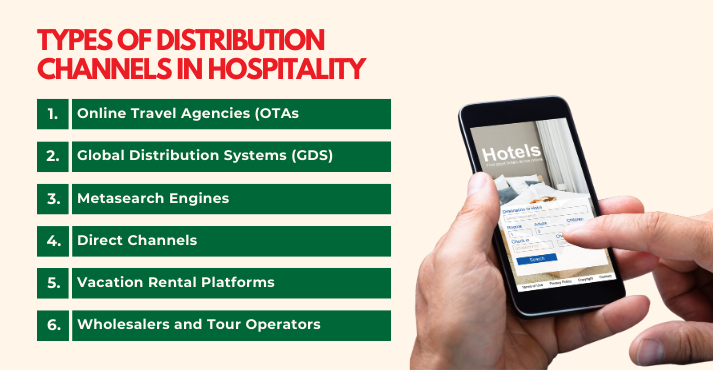
Once a hotel has accurate demand forecasts and pricing strategies in place, the next step is deciding how to sell rooms effectively.
This is where distribution strategy comes in, selecting the right channels to reach the right guests while maximizing revenue and profitability.
For example, online travel agencies (OTAs) like Booking.com and Expedia, global distribution systems (GDS), metasearch engines, direct bookings via the hotel’s website or call center, and vacation rental platforms.
Types of Distribution Channels
A hotel’s choice of distribution channels directly affects revenue, profitability, and guest reach. Therefore, understanding these channels is essential for optimizing occupancy, rate strategies, and revenue.
Key distribution channels include:
1. Online Travel Agencies (OTAs)
Platforms like Booking.com and Expedia provide travelers with a wide selection of hotels, easy comparison tools, and instant booking. OTAs typically charge commissions of 15–25%, but they offer a broad market reach and visibility.
2. Global Distribution Systems (GDS)
These networks connect hotels with travel agents and corporate bookers, providing up-to-date rates and availability. Commission fees typically range from 10–15%, and GDS channels are especially important for business travel and international bookings.
3. Metasearch Engines
Platforms such as Kayak, Trivago, and Google Hotels aggregate listings from OTAs and direct hotel channels, allowing travelers to compare options. Users are redirected to the selected booking site to complete the reservation.
4. Direct Channels
This includes the hotel’s website, booking engine, phone reservations, and email reservations. Direct bookings are the most profitable because they avoid commission fees and capture valuable guest data for marketing and loyalty programs.
5. Vacation Rental Platforms
Airbnb, Vrbo, and similar platforms cater to boutique, unique, or independent stays. They can be particularly valuable for smaller hotels or properties targeting niche travelers.
6. Wholesalers and Tour Operators
These intermediaries distribute room inventory through travel agencies and package deals, often filling bulk bookings that might not be reached via other channels.
Building an Effective Distribution Strategy
To build a profitable distribution strategy, hotels must align channel mix with business objectives. Key steps include:
- Evaluate Channel Performance by tracking RevPAR, NetRevPAR (RevPAR minus distribution costs), conversion rates, and guest segments to identify high‑ and low‑value channels.
- Maintain rate parity to protect brand trust while experimenting with value‑added offers or packages on direct channels.
- Balance direct and indirect bookings. OTAs provide visibility but can lead to commission expenses and limited control over guest data; direct bookings offer higher margins and data ownership.
- Leverage technology such as channel managers to update availability and rates across channels simultaneously, preventing double bookings and ensuring consistent pricing.
- Monitor market trends. Emerging channels such as AI‑driven search and voice assistants could reshape the distribution landscape; staying adaptable ensures continued visibility.
Direct Bookings: The Most Profitable Channel
After selecting and managing distribution channels strategically, hotels often prioritize direct bookings, reservations made through the hotel’s own website, app, phone, or email.
Direct bookings are especially important because they give hotels full control over pricing, branding, and guest experience, while eliminating commission fees charged by OTAs.
Why Guests Book Direct
Guests often book directly with a hotel because it offers advantages that OTAs cannot always provide. Common reasons guests book direct include:
- Price Transparency: Clear, upfront rates without hidden fees.
- Exclusive Offers or Packages: Special deals, bundled experiences, or upgrades only available through the hotel.
- Membership and Loyalty Benefits: Rewards points, perks, or early access for loyalty program members.
- Flexible Cancellation Policies: Easier modifications and cancellations than many third-party platforms allow.
- Seamless Booking Experience: Direct website or app reservations with simple navigation and instant confirmation.
Hotels that offer compelling reasons to book directly often achieve higher conversion rates, lower acquisition costs, and stronger long-term guest loyalty.
Strategies to Increase Direct Bookings
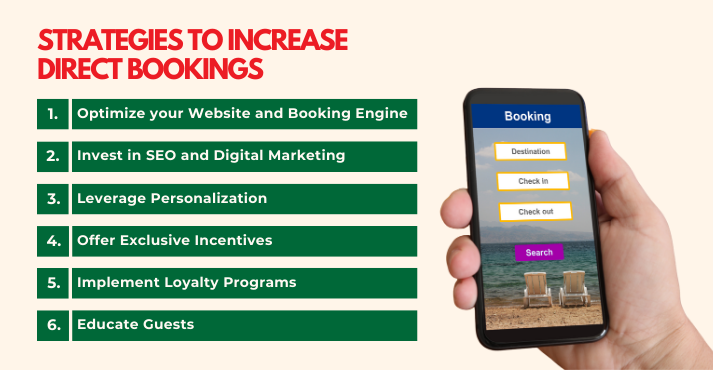
Increasing direct bookings requires a multi-pronged approach that improves the guest experience, highlights unique benefits, and drives traffic to your hotel’s own channels.
Key strategies to boost direct bookings include:
- Optimize your Website and Booking Engine: Ensure a fast, mobile-friendly booking process with accurate information, high-quality images, and clear calls to action.
- Invest in SEO and Digital Marketing: Capture traffic from travelers searching for hotels in your area. Use content marketing, metasearch advertising, and social media campaigns to increase visibility and drive direct traffic.
- Leverage Personalization: Use your PMS and CRM to craft targeted offers, loyalty benefits, and automated pre- and post-stay communications.
- Offer Exclusive Incentives: Provide perks such as complimentary breakfast, free Wi-Fi, or discounted spa packages to make direct bookings more attractive than OTA offers.
- Implement Loyalty Programs: Reward repeat bookings with points, discounts, and personalized perks. Loyalty members often have higher lifetime value and lower cancellation rates.
- Educate Guests: Highlight flexibility, data privacy, and enhanced service. Encourage staff to promote direct bookings during interactions and after checkout.
RFPs & Contracted Business in Revenue Management
A Request for Proposal (RFP) is a formal solicitation from a company or consortia to hotels, detailing required services and requesting bids or negotiated rates.
RFPs are primarily used for corporate and group business; they specify room requirements, meeting facilities, amenities, and often the expected volume of business.
Also, local negotiated rate (LNR) contracts, a form of RFP, offer discounted rates to businesses in exchange for a minimum number of room nights over a specified period.
How RFPs Support Forecasting & Pricing
Requests for Proposals (RFPs) and Long-Term Negotiated (LNR) contracts provide hotels with predictable, committed demand, making it easier to forecast occupancy and revenue accurately.
Corporate and group travel segments often deliver steadier booking patterns year‑round, which supports rate planning and pricing decisions.
Key benefits of LNR contracts include:
- Competitive Positioning: Ensures the hotel remains attractive to corporate clients.
- Forecasting Accuracy: Knowing the volume of LNR business allows revenue managers to adjust rates for transient guests during peak periods.
- Marketing Allocation: Predictable corporate bookings enable smarter budget planning for promotions targeting other segments.
- Repeat Business and Loyalty: Strengthens long-term relationships with corporate clients, encouraging consistent bookings year after year.
Blackout Dates: Strategic Demand & Availability Control
After forecasting demand, setting rates, and managing both direct bookings and RFP contracts, hotels often use blackout dates to protect high-value inventory and optimize revenue.
Blackout dates are specific days when discounts, promotions, or loyalty redemptions are restricted due to anticipated high demand.
For holiday homes or vacation rentals, blackout dates may also be used for owner stays or maintenance. In hotels, blackout dates maximize revenue by ensuring rooms are sold at full rates during peak periods, preventing discounted bookings from filling valuable inventory.
Revenue Impact of Blackout Dates
Implementing blackout dates protects rate integrity and prevents revenue leakage during high‑demand periods.
These dates also signal upcoming peaks, allowing managers to plan staffing, inventory, and marketing campaigns in advance.
However, overly restrictive blackout policies can alienate loyalty members and damage guest perception, so hotels must balance revenue goals with guest satisfaction.
Best Practices for Blackout Dates

To maximize the effectiveness of blackout dates, hotels should adopt data-driven and guest-friendly strategies that protect revenue while maintaining trust and loyalty.
Key best practices include:
- Identify Peak Demand Periods: Use forecasting data, historical occupancy, local events, and market trends to restrict discounts only when demand is expected to exceed capacity.
- Communicate Clearly: Publish blackout dates on your website and inform loyalty program members in advance to set clear expectations and prevent frustration.
- Offer Exceptions for Loyalty Members: Allow top-tier members limited access or benefits during blackout periods to maintain goodwill and encourage repeat bookings.
- Monitor Performance: If blackout periods consistently leave rooms unsold, consider relaxing restrictions or introducing promotions for shoulder periods.
- Review Competitor Practices: Ensure your blackout strategy aligns with market norms to avoid losing guests to alternative brands.
Cancellation Policies as a Revenue Management Tool
Once inventory controls, blackout dates, and direct booking strategies are in place, hotels can use cancellation policies as a strategic lever to protect revenue and shape guest behavior.
Beyond administrative rules, these policies influence booking decisions, forecasting accuracy, and revenue predictability.
Key elements of cancellation policies include:
- Deadlines: How far in advance guests can cancel without penalty.
- Fee Types: Refundable, non-refundable, or partially refundable options.
- No-show Penalties: Charges are applied when guests fail to arrive.
- Group Booking: Specific rules for bulk reservations.
- Refund Timelines: How and when refunds are processed.
Moreover, different policies serve different revenue goals:
- Flexible policies (e.g., free cancellation up to 24–48 hours before arrival) attract guests seeking flexibility but require higher overbooking buffers to mitigate last-minute cancellations.
- Non-refundable rates offer lower prices in exchange for guaranteed revenue, reducing uncertainty for hotels.
- Partially refundable or penalty-based policies strike a balance, giving guests some flexibility while protecting revenue.
In addition, revenue managers can use cancellation policies strategically: differentiate rates by flexibility; enforce longer cancellation windows during peak periods; offer non‑refundable rates to price‑sensitive guests; and leverage deposit requirements to reduce risk.
Upselling, Cross-Selling & Ancillary Revenue Optimization
Revenue management today goes beyond room revenue. Hotels can increase profitability and guest satisfaction by strategically leveraging upselling, cross-selling, and ancillary services.
- Upselling involves offering guests relevant upgrades or add-ons that enhance their stay, such as room upgrades, premium views, early check-in, or late check-out.
- Cross-selling refers to selling complementary products or services, including spa treatments, dining experiences, local tours, or in-room extras like wine or flowers.
Most common examples include:
- Room upgrades and premium suites
- Bundled packages combining rooms with F&B or spa services
- Food and beverage offers, in-room amenities, and personalized experiences
- Local tours, activities, or transportation services
At this point, personalization is key. Using AI and CRM systems, hotels can tailor offers based on guest preferences, booking history, or loyalty status, which drives higher conversion rates, repeat bookings, and long-term loyalty.
Also, optimizing ancillary revenue can significantly boost GOPPAR. By packaging internal services (spa, dining) with external experiences (airport transfers, local activities), hotels diversify income streams and make each guest stay more profitable while enhancing the overall experience.
Technology & Revenue Management Systems (RMS)
Modern revenue management depends on purpose-built systems.
A Revenue Management System (RMS) centralizes data, automates repetitive decisions, and gives revenue teams the tools to forecast, test, and act faster and more accurately.
Here’s what an RMS does:
- Pricing Automation: Pushes dynamic rates across channels based on rules, forecasts, and optimization engines.
- Forecasting: Produces demand, occupancy, and revenue forecasts using historical data, booking curves, and external signals.
- Competitive Benchmarking: Monitors competitor rates and market positioning to inform price moves.
- Channel Optimization: Recommends channel mix and allocation, and can automate open/close rules or inventory pushes.
- Inventory & Restriction Control: Supports overbooking logic, length-of-stay rules, blackout dates, and other demand controls.
- Segmentation & Personalization: Applies different strategies by guest segment (corporate, leisure, groups, loyalty).
- Scenario Modelling & What-ifs: Simulates rate or policy changes to estimate revenue and occupancy impact.
- Reporting & Dashboards: Centralizes KPIs (RevPAR, ADR, GOPPAR, pickup curves) and provides alerts and performance views.
- Integration & Data Unification: Connects with PMS, CRS, POS, channel managers, CRM, and finance systems for a single source of truth.
Common Challenges in Hotel Revenue Management (and How to Overcome Them)
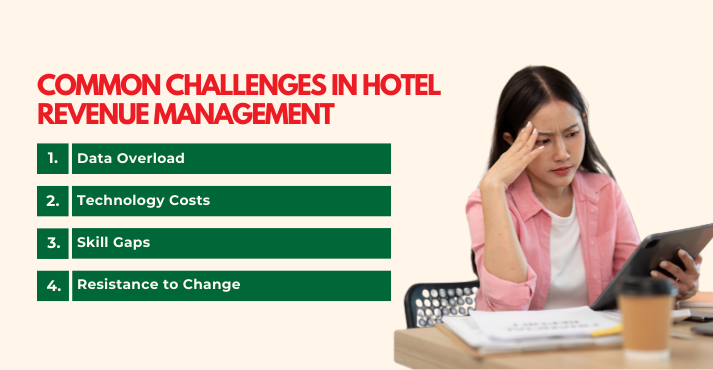
Even with the best systems and strategies, hotels face challenges in revenue management. The good news: each obstacle can be addressed with the right approach.
Here are the key challenges and solutions:
1. Data Overload
Hotels collect massive amounts of booking, market, and operational data. Without proper tools, insights get lost. For this, use RMS, dashboards, and automated analytics to turn raw data into actionable decisions.
2. Technology Costs
Advanced RMS and integrations can be expensive. To reduce cost, scale technology to your property size, prioritize ROI-driven features, and consider cloud-based solutions with flexible pricing.
3. Skill Gaps
Revenue management requires analytical, strategic, and technical skills that may be lacking in staff. To fill the gap, invest in training, workshops, or hire experienced revenue managers to mentor the team.
4. Resistance to Change
Shifting from traditional pricing to data-driven approaches can meet pushback. To address this, demonstrate results through pilot programs, involve key stakeholders, and communicate the benefits clearly.
Addressing these challenges requires a combination of technology adoption, cross‑department collaboration, and continuous learning.
Future Trends in Hotel Revenue Management
The future of hotel revenue management is being shaped by technology, changing guest expectations, and market evolution.
Hotels that adapt early to these trends will gain a competitive edge in profitability, guest satisfaction, and operational efficiency.
1. AI and Machine Learning
AI is transforming revenue management by enabling personalization and real-time optimization. It processes vast datasets, integrates PMS, RMS, CRM, and other platforms, and delivers dynamic pricing recommendations that adapt as conditions change.
Explainable AI systems provide actionable insights, allowing revenue managers to make confident, data-driven decisions.
2. Real-Time Data and Automation
Continuous data feeds allow hotels to monitor competitor rates, market conditions, and booking patterns in real time. Tools such as STR, Lighthouse, and Atomize help hotels keep pricing dynamic and aligned with market trends.
For example, Hyatt uses real-time insights into bookings and occupancy to fine-tune rates, balancing revenue and room utilization.
3. Integration of PMS and RMS
Seamless synchronization between property management systems (PMS) and revenue management systems (RMS) improves data accuracy and operational efficiency.
Tech consolidations, such as Mews acquiring Atomize, point toward all-in-one solutions that automate pricing, inventory management, and guest engagement.
4. Sustainability and Green Pricing
Eco-conscious travelers increasingly seek sustainable practices. Moreover, adopting eco-friendly hotel operations and certifications attracts this segment while differentiating brands.
For example, Scandic Hotels uses energy-efficient technology and local sourcing, and properties that incentivize guests to reduce water usage or forego daily housekeeping.
5. Omnichannel Distribution and AI-Driven Search
The distribution landscape is evolving with legislation, technology, and AI-driven search affecting OTA dominance.
Hotels are implementing omnichannel strategies, leveraging direct websites, OTAs, mobile apps, and AI search tools like ChatGPT and Perplexity.
6. Accommodations and Diversification
The rise of short-term rentals encourages traditional hotels to diversify. Chains are expanding into boutique, alternative accommodations, luxury residences, senior living, and serviced apartments.
Notable examples include Hilton’s acquisition of Graduate Hotels and Hyatt’s acquisition of Apple Leisure Group, which created new revenue streams and helped meet evolving guest preferences.
7. Predictive Procurement & Continuous RFPs
Corporate travel procurement is shifting from annual RFP cycles to continuous, predictive models.
AI-driven analytics allow hotels to adjust negotiated corporate rates in real time, improving the likelihood of winning contracts and optimizing revenue throughout the year.
8. Transparency and Guest-Centric Pricing
Modern guests demand transparent pricing and personalized offers. AI enables guest-centric pricing by considering willingness to pay, loyalty status, and lifetime value.
Real-time personalization enhances conversion rates, fosters loyalty, and ensures each guest receives offers tailored to their preferences.
Conclusion: Building a Sustainable Hotel Revenue Engine
Hotel revenue management is a strategic discipline that integrates pricing, forecasting, distribution, direct bookings, corporate contracts, demand controls, and technology to drive long-term profitability.
Therefore, by leveraging demand forecasting, dynamic pricing, inventory control, and market segmentation, hotels can tailor strategies to guest segments and adjust rates in real time.
Additionally, pricing frameworks such as BAR, open pricing, and booking window strategies, combined with AI-powered RMS and real-time data, ensure proactive, data-driven decision-making.
Moreover, distribution and direct booking strategies optimize visibility, margins, and guest loyalty, while RFPs, blackout dates, and cancellation policies maintain rate integrity and predictability. Upselling, cross-selling, and ancillary revenue optimization further enhance guest experience and GOPPAR.
While challenges such as manual processes, data overload, staff shortages, and dependence on OTAs exist, they can be effectively addressed through automation, cross-department collaboration, and continuous learning.
Looking ahead, emerging trends like AI and machine learning, real-time data monitoring, integrated PMS-RMS systems, sustainability initiatives, omnichannel distribution, and predictive procurement will continue to shape the future of hotel revenue management.
That said, with the right combination of strategy, technology, and people, hotels can build a resilient revenue engine, one that adapts to market changes, maximizes profitability, and consistently delights guests.