Halal ingredient sourcing has moved from a niche religious requirement to a critical operational and strategic consideration in modern food manufacturing.
The global halal food and beverages market was valued at USD 931.21 billion in 2025 and is forecast to reach USD 1.4 trillion by 2034. Asia‑Pacific is by far the largest regional market, accounting for more than 61 % of global sales.
Demand is rising rapidly in the GCC, Malaysia and Indonesia, driven by population growth and heightened awareness about halal integrity. For exporters, halal compliance opens doors to Muslim‑majority markets and delivers a strong “ethical” brand promise that appeals to both Muslim and non‑Muslim consumers.
Conversely, using non‑compliant ingredients can lead to product recalls, import rejections and lasting damage to consumer trust. Traceability, documentation and supplier verification therefore underpin successful halal programs.
Whether you manufacture beverages, confectionery, dairy, snacks or nutraceuticals, understanding halal ingredient sourcing is essential for market access and consumer trust.
What Does “Halal Ingredient Sourcing” Mean?
Halal ingredient sourcing refers to the process of procuring raw materials, additives, processing aids and packaging components that conform to Shariah‑compliant requirements.
A halal food product may be marketed as “halal‑certified,” but if the underlying ingredients come from questionable sources, the certification can be revoked.
Manufacturers must therefore examine the entire supply chain, from farm to factory, ensuring that every substance complies with Islamic dietary law and is free from haraam (forbidden) components such as pork, blood, or intoxicants.
Key distinctions include:
- Halal‑certified products vs. halal shariah-compliant sourcing: Certification verifies that finished goods meet recognized standards, whereas sourcing focuses on the provenance and handling of each ingredient.
- Ingredient origins: The source of an ingredient (animal, plant or synthetic) and the method of slaughter or processing (e.g., mechanical slaughter, enzymatic extraction) determine its permissibility.
- Supply‑chain transparency: Detailed documentation about ingredient sources, handlers and processing aids helps auditors verify compliance and supports traceability through the food supply chain in the event of recalls or consumer queries.
- Halal audit documentation readiness: Businesses must maintain ingredient specifications, halal certificates, process flow diagrams, and facility layouts to demonstrate control over halal integrity.
Therefore, manufacturers must verify:
- Raw‑material origin
- Processing method
- Additives and carriers
- Cross-contamination controls
- Supplier certifications (Such as IFANCA, JAKIM, MUIS, or Halal Food Authority)
Ensuring these inputs come from halal‑certified sources prevents compliance failures later in the production cycle.
Why Halal Ingredient Compliance Matters for F&B Manufacturers
Halal compliance is more than a regulatory checkbox; it is a strategic asset that drives growth, mitigates risk, and builds brand equity.
Market Expansion and Export Opportunities
The global halal food and beverage sector is one of the fastest‑growing segments of the food industry.
The Asia‑Pacific region leads and is projected to grow to USD 1.39 trillion by 2033, reflecting double‑digit compound growth rates. Given this, food import and export trends in the APAC highlight significant opportunity for F&B manufacturers.
Meeting halal requirements allows companies to access Muslim‑majority countries such as Saudi Arabia, Indonesia and Malaysia, where import laws require certification from approved bodies. Manufacturers that implement robust sourcing protocols position themselves to supply this rapidly expanding market.
Regulatory Compliance

Southeast Asian countries enforce strict halal import rules. In Indonesia, halal certification becomes mandatory for all food and beverages by 17 October 2026, and foreign certificates must be issued through bodies accredited by BPJPH.
Malaysia recognizes only certifications issued by JAKIM, which applies the MS 1500:2019 standard and demands extensive audits and supply‑chain traceability.
Similarly, Saudi Arabia requires halal logos on products to be approved by the SFDA and mandates compliance with standards GSO 2055‑1 and GSO 2055‑2. Failure to meet these requirements can result in detentions, fines or shipment rejections.
Brand Trust and Consumer Confidence
Halal consumers look for assurance that products are free from forbidden substances and have been handled ethically.
Surveys of grocery shoppers in Singapore, Indonesia, India and Malaysia found that 74% of respondents prioritised groceries as their largest spending category, and the freshness and ingredients of products were key factors influencing purchase decisions. This reflects broader religious dietary preferences in APAC shaping consumer behavior.
Brands that can provide complete traceability of their ingredients gain a competitive edge and foster loyalty among ethically minded consumers.
Certification Readiness and Operational Efficiency
Investing in proper ingredient sourcing simplifies audits and reduces delays during certification.
During pre‑assessment, certifying bodies require companies to submit product lists, ingredient specifications, process flow diagrams, and facility layouts. They also evaluate cross‑contamination risks and verify that animal‑derived ingredients come from permissible sources.
Common Food Ingredients That Often Fail Halal Compliance
Many everyday ingredients carry hidden animal-derived or alcohol-based risks that can compromise the halal status of a finished product. A lack of awareness about processing aids and carrier systems is a leading cause of non-compliance.
Here’s a reference table for high-risk ingredients and safer alternatives:
| Ingredient | Potential halal risk | Common source | Safer alternative |
| Gelatin | May be derived from pork or cattle not slaughtered according to Islamic rites | Pig skin, bovine bones | Fish or halal‑certified bovine gelatin |
| Enzymes | Many food enzymes (e.g., rennet, lipase) are extracted from animal stomachs or tissues | Calf stomachs, pig pancreas | Microbial or plant‑based enzymes |
| Natural flavors | Can contain animal extracts or use alcohol as a carrier | Animal glands, alcoholic tinctures | Halal‑certified flavors using water or vegetable glycerin carriers |
| Emulsifiers | Mono‑ and diglycerides are often sourced from pork fat or non‑halal tallow | Pork or bovine fat | Plant‑based emulsifiers (e.g., sunflower lecithin) |
| Glycerin | Derived from animal fats; risk of being sourced from non‑halal slaughter | Soap and biodiesel by‑products | Vegetable glycerin derived from palm or coconut oil |
| Shortening | May include lard or beef tallow | Hydrogenated animal fats | Plant‑based shortening (palm oil, soybean oil) |
| Alcohol‑based extracts | Use of ethanol as a solvent can render flavors non‑halal | Vanilla or herbal extracts prepared in ethanol | Alcohol‑free or glycerin‑based extracts |
| Food color carriers | Gelatin or alcohol may be used as carriers in powdered colors | Food dyes with gelatin carriers | Halal‑certified colorants with plant‑derived carriers |
| Whey powders | Whey produced with cheese rennet derived from non‑halal enzymes | Cheese manufacturing | Halal‑certified whey or dairy alternatives |
| Capsules/coatings | Gelatin capsules often come from pork; coatings may use shellac (secretions from insects) | Pharmaceutical and supplement capsules | Vegetarian capsules (cellulose, pullulan) |
Manufacturers should scrutinize these ingredients and request halal certificates from suppliers. Failing to do so could lead to cross‑contamination incidents, where forbidden substances are inadvertently introduced into halal products. These risks also tie directly into broader food additives regulations that manufacturers must monitor.
How to Verify Halal Ingredient Suppliers
A supplier verification program underpins halal ingredient sourcing. The following criteria guide manufacturers in evaluating current and prospective suppliers:
1. Certification Verification
Check that suppliers possess valid halal certificates from internationally recognized bodies such as the Islamic Food and Nutrition Council of America (IFANCA), Malaysia’s JAKIM, Singapore’s MUIS or the Halal Food Authority (HFA).
Certificates should include scope (product categories), validity dates and accreditation details. Some regions, like the UAE, require that certification bodies be accredited by EIAC or ENAS.
2. Documentation Requirements
Request up‑to‑date halal certificates, ingredient declarations, product specifications, traceability records, process flow diagrams and facility layouts. Certifiers evaluate this documentation during pre‑assessment to verify compliance, similar to how food safety audits are conducted.
3. Manufacturing Controls
Confirm that suppliers have documented segregation procedures, sanitation protocols and policies for preventing cross‑contamination on shared lines.
Ask for evidence of cleaning validation and dedicated production equipment when high‑risk ingredients are processed.
4. Supply‑chain Transparency
Trace the source of halal raw materials, including country of origin and upstream suppliers. Batch traceability systems (e.g., ERP software) help track ingredients from receipt through production and distribution, supporting overall food supply chain traceability.
Halal Supplier Verification Checklist
- Confirm certificate legitimacy (accreditation and expiry date).
- Review full ingredient lists and ensure no forbidden substances are used.
- Assess halal food manufacturing practices and cleaning protocols.
- Verify traceability systems and cross‑check lot/batch numbers.
- Perform periodic audits and request updated certificates annually.
- Maintain documentation for each supplier in a central database.
Partner with suppliers who maintain transparent halal documentation and globally recognized certifications.
Building a Halal‑Compliant Supply Chain

Ensuring halal integrity requires more than just sourcing halal-certified ingredients; it demands systemic controls across procurement, production, packaging and distribution.
Step 1: Ingredient Segregation and Storage
Halal and non‑halal materials must be physically separated from the moment they enter the facility. Improper separation of raw materials or finished goods is a major cause of cross‑contamination.
Use clearly labelled storage areas, dedicated freezers and colour-coded containers to avoid accidental mixing. During transportation, segregate halal items in sealed packaging and avoid co‑loading with non‑halal goods.
Step 2: Cross‑contamination Prevention
Cross‑contamination can occur through shared cooking equipment, utensils, gloves or packaging lines. Implement strict sanitation protocols and invest in dedicated equipment or deep‑cleaning procedures between runs.
Train staff regularly on halal handling practices and assign halal compliance officers to monitor adherence. Ensure that alcohol‑based cleaning agents or flavor extracts do not contact halal production lines. Practices like these are increasingly part of broader food safety practices that help prevent biological hazards.
Step 3: Procurement Policies and Supplier Audits
Establish an approved supplier program that requires pre‑qualification, risk assessment and periodic audits. High‑risk ingredients such as gelatin, enzymes and natural flavors should be audited more frequently.
Work with suppliers to standardize documentation and establish contingency plans in case of supply disruptions. Regularly update ingredient specifications to reflect changes in formulation or processing.
Step 4: Digital Traceability
Modern halal supply chains increasingly rely on digital traceability tools to improve transparency, compliance, and product integrity.
- Enterprise Resource Planning (ERP) Systems: Integrate and manage data across procurement, inventory, production, and distribution for end-to-end visibility.
- Blockchain Technology: Provides secure, tamper-proof records of every transaction, enabling transparent farm-to-shelf tracking, a method increasingly used in blockchain for food fraud prevention.
- RFID (Radio Frequency Identification): Tracks products and ingredients in real time through tagged labels, improving inventory accuracy and movement control.
- IoT (Internet of Things) Sensors: Monitor conditions like temperature, humidity, and location during storage and transport to ensure halal integrity.
- Batch Tracking & Serialization Systems: Assign unique identifiers to product batches, allowing precise tracking, recall management, and halal ingredient verification.
Halal Certification Requirements for Manufacturers
Obtaining halal certification involves multiple stages, each requiring preparation and documentation.
Certification steps:
- Application Phase: Submit an application to the chosen certification body. Applicants must provide company details, product lists, ingredient specifications, and process flow diagrams.
- Preliminary Assessment & Documentation Review: The certifier’s technical team evaluates product information, ingredient lists, process flow diagrams, and facility layouts to ensure all inputs and processes align with halal requirements.
- Auditing Phase: A documentation audit assesses compliance with international halal standards and forms an internal halal committee.
- Certification Decision: After successful audits, the certification committee issues a halal production facility registration and product certificate, granting the right to use the halal logo
- Ongoing Compliance: Halal certification is not one‑time. Companies must maintain documentation, conduct internal audits, and update the certification body about any formulation or process changes.
Required documentation
- Ingredient lists and specifications
- Supplier halal certificates and traceability documents
- Standard operating procedures (SOPs)
- Process flow diagrams and facility layout maps
- Halal assurance system policies and records of internal audits
- Cleaning logs and validated sanitation results
- Formation of an internal halal committee, which must also align with broader ISO 22000 certification requirements where applicable.
Regional Halal Regulations Manufacturers Should Know
Halal export regulations vary significantly across regions, making it essential for manufacturers to stay updated on local compliance requirements.
In the GCC countries, unified standards such as GSO 2055-1 and GSO 2055-2 are applied, with Saudi Arabia requiring SFDA-approved halal logos, Qatar mandating certification from approved foreign certifiers along with Arabic labeling and strict segregation, and the UAE enforcing compliance through MOIAT with certifications accepted only from EIAC- or ENAS-accredited bodies.
In Southeast Asia, Malaysia follows a more centralized system where JAKIM is the sole halal authority under MS 1500:2019 standards, requiring rigorous audits, documentation, and ongoing compliance, while Indonesia is moving toward mandatory halal certification.
Meanwhile, in Europe and North America, halal certification remains voluntary but commercially important, driven by consumer demand and retailer requirements, with organizations like HFA and IFANCA playing key roles. This dynamic mirrors broader common dietary restrictions influencing global food labeling.
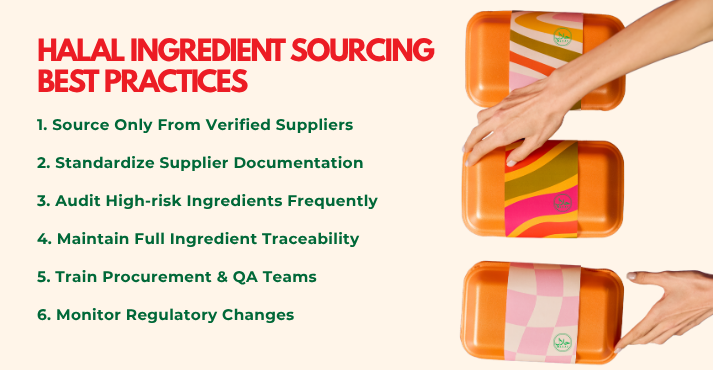
Halal Ingredient Sourcing Best Practices
Adopting best practices helps manufacturers embed halal integrity into everyday operations.
1. Source Only From Verified Suppliers
Work exclusively with suppliers who provide valid halal certificates from recognized bodies. Avoid vendors who cannot produce documentation or whose certifications are nearing expiration.
2. Standardize Supplier Documentation
Create a documentation checklist and require suppliers to update it annually. Use digital platforms to store and manage documents, making them accessible for audits.
3. Audit High‑risk Ingredients Frequently
Identify ingredients with greater risk of non‑compliance (e.g., gelatin) and schedule more frequent supplier audits. Ensure that any changes in formulation trigger a re‑assessment of halal status.
4. Maintain Full Ingredient Traceability
Implement batch tracking from receipt through production to distribution. Digital traceability systems enhance visibility and reduce the time needed to respond to recalls or certification inquiries, an approach also valuable for managing ingredient origin transparency.
5. Train Procurement & QA Teams
Educate employees on halal requirements, ingredient risks, and cross‑contamination controls. Regular training reduces errors due to unfamiliarity or miscommunication.
6. Monitor Regulatory Changes
Halal standards and import regulations evolve. Assign regulatory affairs specialists to monitor updates from bodies such as JAKIM, BPJPH, SFDA, MOIAT, and EU/US certifiers.
Common Halal Sourcing Mistakes to Avoid
These include:
- Assuming natural flavors are automatically halal, as many flavors use alcohol or animal extracts and require verification.
- Ignoring processing aids, such as enzymes, carriers, and anti‑caking agents, can introduce non‑halal elements if sourced improperly.
- Using outdated supplier certificates that are expired or have suspended certifications invalidates halal claims.
- Overlooking shared equipment risks, even with halal ingredients, contamination can occur if equipment or storage areas are not adequately segregated.
Halal Ingredient Sourcing for Different Food Categories
Global food industry challenges are unique for each food category. Tailoring procurement strategies to each category ensures compliance and product quality.
| Food Category | Key Halal Sourcing Focus Areas | Main Risks/Controls |
| Beverages | Alcohol-free flavorings, plant-based emulsifiers, halal clouding agents, compliant vitamin/mineral carriers | Risk of alcohol-based solvents and fermentation; ensure ingredient certification |
| Dairy Products | Halal rennet (microbial or halal animal), certified whey/protein, validated cultures | Cross-contamination with non-halal fats/enzymes; requires dedicated lines and strict cleaning |
| Confectionery | Halal gelatin (bovine/fish), beeswax glazing, certified colorants and flavorings | Hidden non-halal gelatin, alcohol carriers in additives |
| Nutraceuticals & Supplements | Plant-based capsules, halal-certified vitamins, collagen/whey compliance, segregated equipment | High risk from gelatin capsules and shared production equipment |
| Bakery Products | Plant-based fats, vegetable-derived emulsifiers, halal enzymes and dough conditioners | Risk from lard, animal-derived cysteine, and alcohol-based processing aids |
The Future of Halal Ingredient Sourcing
Several megatrends are reshaping halal ingredient sourcing, including:
- Growing demand for traceability and transparency: Blockchain and digital systems are enabling real-time, tamper-proof tracking of ingredients from farm to shelf, while smart contracts help automate the halal certification process and compliance.
- Convergence of halal and clean-label trends: Consumer preference for natural, minimally processed ingredients is aligning with halal requirements, allowing brands to serve both health-conscious and halal markets more effectively, a shift reflected in the future of clean label ingredients.
- Harmonization of halal standards: Efforts by regional bodies like GSO and SMIIC aim to align global halal standards, but differences in labeling, certification, and compliance rules still require country-specific adaptation.
- Sustainability and ethical sourcing: Halal supply chains are increasingly focusing on eco-friendly packaging, reduced waste, and ethical animal welfare, with sustainability now included in some halal certification audits.
- Growth of halal nutraceuticals and functional foods: Demand is rising for halal-certified supplements, vitamins, probiotics, and functional foods, driving innovation in plant-based and health-focused product development, in line with broader functional foods market trends.
Final Thoughts
Halal ingredient sourcing is both a compliance mandate and a business opportunity. By verifying suppliers, documenting every ingredient, implementing segregation and traceability controls, and staying ahead of regulatory changes, manufacturers can deliver products that meet Islamic dietary laws and build consumer trust.
With the halal market projected to grow significantly, and Asia‑Pacific revenues expected to nearly triple by 2033, investing in halal sourcing today sets the stage for long‑term success.
Companies should review their sourcing processes, work with halal‑certified suppliers, strengthen audit readiness, and consult halal compliance experts to ensure global market access.
Frequently Asked Questions About Halal Ingredient Sourcing
What ingredients are commonly considered non‑halal?
Ingredients derived from pork, non‑halal slaughtered animals, blood, alcohol, or certain insects are forbidden (haraam). This includes pork fat and lard, gelatin from non‑halal sources, meat extracts from animals not slaughtered according to Islamic rites, intoxicating alcohols used as solvents or carriers, and additives derived from insects (e.g., shellac).
How can manufacturers verify halal ingredient suppliers?
Here’s how manufacturers can verify halal ingredient suppliers:
- Check certifications from recognized bodies (e.g., IFANCA, JAKIM, MUIS, HFA)
- Review ingredient lists and technical specifications for compliance
- Ensure proper segregation and sanitation practices in production
- Verify traceability through batch numbers and tracking systems
- Conduct regular supplier audits
- Maintain updated centralized records of all supplier documents
Are natural flavors always halal?
No, Natural flavors may use alcohol as a solvent or include extracts from non‑halal animal parts. Manufacturers must request detailed composition statements and halal certificates for flavors and carriers. Halal‑certified flavors typically use water or vegetable glycerin instead of ethanol and derive flavor compounds from permissible plant or microbial sources, an example of the broader shift toward transparency in food labeling.
What halal certifications are globally recognized?
Halal certifications globally recognized include:
- American Halal Foundation (AHF)
- Islamic Food and Nutrition Council of America (IFANCA)
- JAKIM (Department of Islamic Development Malaysia)
- BPJPH (Halal Product Assurance Organizing Agency)
- MUIS (Islamic Religious Council of Singapore)
- Halal Food Authority (HFA)
- MOIAT-approved certification bodies
- SFDA-recognized certification bodies
How do manufacturers prevent halal cross‑contamination?
Manufacturers can prevent halal cross-contamination by:
- Segregating halal and non-halal ingredients and products
- Using dedicated equipment or validated cleaning procedures
- Training staff on halal handling requirements
- Clearly labeling storage and production areas
- Maintaining proper documentation and monitoring systems
- Ensuring strict controls when handling alcohol-based products
Is halal certification mandatory for exporting to Muslim‑majority countries?
In Muslim‑majority countries, halal certification is mandatory for certain categories of food and beverage products. Indonesia requires mandatory certification for all food and beverages by October 17, 2026. Malaysia accepts only JAKIM certification, and Saudi Arabia requires SFDA‑approved logos and compliance with GSO standards. Even in markets where certification is not legally required, retailers often insist on it to meet consumer expectations.
What documentation is required for halal audits?
Manufacturers should maintain comprehensive and up-to-date records to demonstrate compliance during halal audits.
- Ingredient lists and halal certificates
- Product specifications and formulations
- Supplier approvals and supporting documentation
- Process flow diagrams
- Facility layouts and production maps
- Sanitation and cleaning SOPs
- Cleaning and maintenance records
- Batch traceability and production records
- Internal halal assurance system documentation
Can a product be halal if one ingredient is not certified?
No. If any ingredient within a product is non‑halal or its status cannot be verified, the product cannot be considered halal. Even trace amounts of forbidden substances or cross‑contamination can invalidate certification. Manufacturers should reformulate using halal‑approved alternatives or obtain certification for each ingredient before claiming halal status.