The conventional read of hospitality industry trends in 2026 runs something like this: the industry is finally modernising. AI is arriving. Robots are arriving. Biometric check-in and contactless payments are arriving.
Operators are becoming tech-curious, guests are becoming more demanding, and Asian hospitality is at last catching up with the broader technology economy. Read any vendor press release or conference keynote coming out of Asia’s major hospitality events this year, and that framing holds.
Trends in Focus
FutureFWD debuted at FHA 2026 as a brand-new conference and dedicated zone featuring 50+ expert speakers, AI-assisted service, biometric payments, augmented reality, robot-backed kitchens, automated workflows, and faceless check-in, embedded within a show that has run for years.
For a trade event built around procurement, supply chain, and the mechanics of 80,000 buyers negotiating contracts with 2,750 brands, that is not a cosmetic addition. The question is what the debut actually signals.
The answer is not that Asian hospitality operators woke up excited about innovation. Over two-thirds of Southeast Asian hospitality employers now report active talent shortages. And in Singapore alone, labour shortfalls could shave 1.4 percentage points off the hotel sector’s growth, against a projected 6% annual expansion. FutureFWD did not debut at FHA because the market became tech-curious. It debuted because the market exhausted the alternative.
The Thesis
Technology adoption in Asian hospitality in 2026 is a labour-crisis response that became a permanent strategy. The six trends below are the evidence, and the framing matters, because operators who read them as an innovation story will invest in the wrong places.
The Emerging Trends From the Market
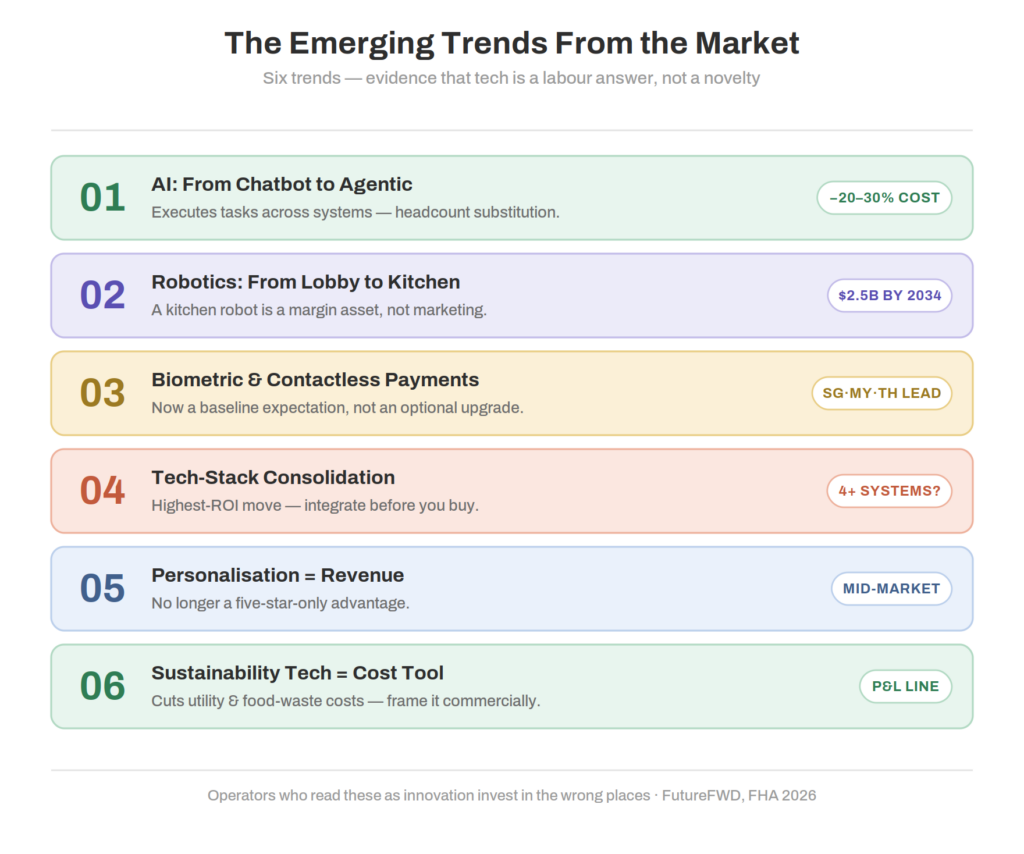
1. AI has Moved from Chatbot to Agentic, and that Distinction Is Now Operationally Material
Traditional AI in hospitality answered questions. Agentic AI executes tasks autonomously across systems without human intervention. A guest messages for late checkout: agentic AI checks occupancy, clears housekeeping, adjusts the PMS, notifies F&B, and confirms, in seconds, without a staff member involved. That is not a chatbot upgrade. That is a headcount substitution.
The AI-powered experience capability can enhance customer satisfaction by 15 to 20 percent, and reduce cost to serve by 20 to 30 percent.
According to Deloitte’s 2025 Travel Industry Outlook, more than 70% of hotel executives are prioritizing AI investment, not just for routine inquiries, but operational deployments. The adoption driver in Asian markets is not guest preference. It is the fact that the alternative, a fully staffed front desk, is increasingly expensive and hard to fill.
2. Robotics has Left the Lobby and Entered the Kitchen
The lobby robot phase is over. The robotics exhibitors at FutureFWD FHA 2026 drawing genuine buyer attention were kitchen-facing: Rolo Robotics and Koomi appeared as named exhibitors, neither selling novelty, both selling commercial deployment.
The market context supports the investment case: hospitality robotics is projected to reach USD 2.5 billion by 2034 at a 17.5% CAGR, with Asia-Pacific leading adoption globally due to labour scarcity. The cost savings projected by operators running automation at scale are the numbers being used to justify CapEx conversations with CFOs right now.
A lobby robot is a marketing asset. A kitchen robot is a margin asset. That location shift is what makes the 2026 wave structurally different from the 2019 wave.
“We believe that future market demand for humanoid robots in Asia and the Southeast Asian region is huge,” ‒ Rong Guoqiang, General Manager of the Shanghai Incubator.
3. Biometric and Contactless Payments have Crossed the Infrastructure Threshold
When guests prioritise hotels with contactless payment options, a feature becomes a baseline expectation. FutureFWD named biometric payments and faceless check-in as explicit programme topics; Razer Fintech/Fiuu appeared as a named exhibitor focused on secure payment transformation across ASEAN (FHA 2026).
“Many hotels are still not capable of taking online payments or tokenizing credit cards. We believe that hotels should connect the payment experience in a more seamless way. In our view, payments should be made almost invisible.” – Lennert De Jong
The adoption gradient matters here and should not be smoothed over. Singapore, Malaysia, and Thailand are furthest along. Cash-dominant markets like Indonesia and Vietnam are moving, but more slowly, meaning the investment window for mid-tier operators in those markets is open now, not in two years.
Operators in Bangkok and Kuala Lumpur who treated contactless payment as an optional upgrade in 2023 are now simply meeting the floor.
4. Tech stack Consolidation is the Most Overlooked High-ROI Move Available in 2026
The biggest technology problem in Asian hospitality in 2026 is not what operators are missing. It is how many incompatible systems they are running simultaneously.
A hotel juggling six or more platforms such as PMS, POS, CRM, inventory, communications, revenue management, and pays a hidden labour tax every day in manual reconciliation, data inconsistency, and operational friction that neither the vendor nor the GM has quantified.
Cloud system consolidation reduces IT infrastructure costs for independent and boutique operators. FutureFWD addressed this directly through four named exhibitors: RestoSuite, Singtel Stack-EZ, Seito, and Xilnex Holdings, each representing a different angle on the same consolidation problem.
The practical instruction before any new technology purchase in 2026: count the systems already in place that do not communicate with each other. If that number exceeds four, consolidation is the higher-ROI decision.
5. Personalisation Technology Now has a Specific Revenue Number Attached to it
For years, personalization in hospitality was treated as a guest experience initiative, a way to make travelers feel recognized and valued. In 2026, it has evolved into something more measurable: a revenue strategy.
The tools making this accessible below the luxury tier are now live and appeared at FutureFWD: Lunchbox Asia, OpenTable, and Zennio as named exhibitors in guest engagement and personalisation.
Marriott’s AI platform for tailored recommendations is the benchmark deployment. The personalisation revenue uplift is no longer a five-star advantage. It is now within reach for the mid-market hotel and restaurant segment that constitutes most of the FHA buyer base.
6. Sustainability technology is a cost tool, and the industry has finally started framing it that way
Sustainability Initiatives as Business Imperative’ was the explicit FutureFWD FHA 2026 programme framing, commercially loaded language, not CSR language.
The reason that framing landed with operators is that energy management systems, automated HVAC and lighting controls, and AI-powered food waste technology deliver measurable utility cost reductions in markets where energy is a significant P&L line.
“Asia’s environmental conditions, such as diverse ecosystems and climate vulnerabilities, require sustainable practices that preserve local habitats. To safeguard local cultural heritage, it is crucial to strike a balance between tourism growth and cultural preservation,” says Samir Thapa, Founding Partner and Director of the American Hospitality Academy IHMS of USA and Chairman/Founder of Silver Mountain School of Hotel Management in Nepal.
The business case does not require values language: sustainable products outpaced the overall market between 2019 and 2024, during a high-inflation period. AI-driven inventory systems aligned to occupancy forecasting reduce food waste and connect sustainability directly to hotel F&B margin.
Operators who present this investment as values-driven to their CFOs are making a harder case than the data requires.
The Counter: Technology Cannot Fix a Culture Problem or a Service Design Failure
Technology vendors will claim that AI, robotics, and integrated platforms solve hospitality’s core challenges. The harder counter is this: technology cannot fix a service design failure.
A hotel with poor check-in processes will have poor AI-assisted check-in. A restaurant with a broken menu will not be saved by an OpenTable integration. Technology amplifies what already works, at scale and at speed, and it amplifies what does not, in exactly the same way.
This limitation is especially relevant in Southeast Asia, where hospitality remains deeply connected to culture, relationships, and personal service. While automation is expanding across housekeeping, reservations, revenue management, and back-office operations, guest-facing roles have a natural ceiling for replacement.
The service warmth that defines ASEAN hospitality is not automatable. The correct framing is not ‘technology will replace hospitality.’ It is ‘technology should handle everything that is not hospitality.’
The Implication for Asian Hotel and F&B Operators
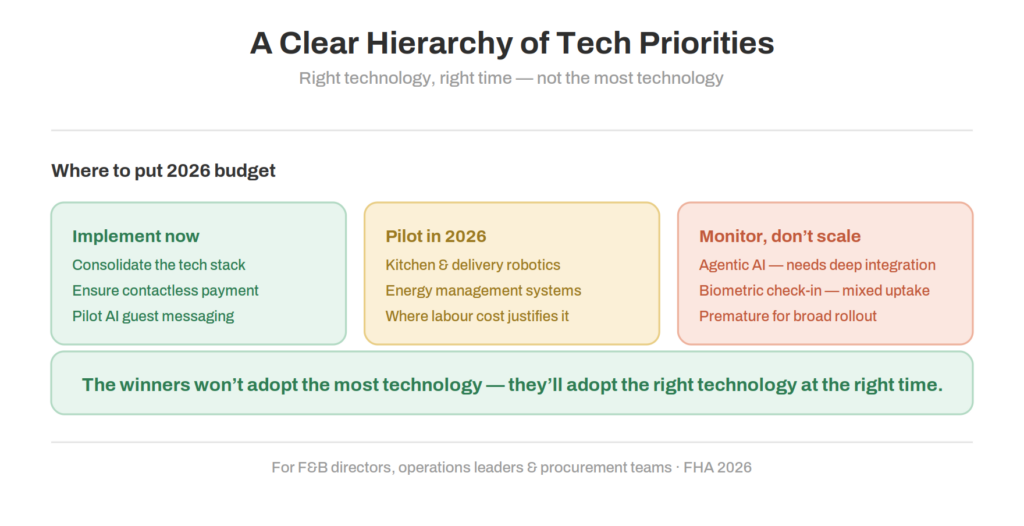
For F&B directors, operations leaders, and procurement teams, the evidence suggests a clear hierarchy of technology priorities.
Implement now:
- Consolidate your technology stack: Operators running four or more disconnected systems may have an opportunity to reduce IT costs. Before purchasing new software, focus on integrating and simplifying existing platforms.
- Ensure contactless payment is available: Contactless transactions have moved beyond convenience and into guest expectation, and lacking it can create unnecessary friction during the guest journey.
- Pilot AI-assisted guest messaging: AI-powered messaging tools can handle common inquiries, reduce staff workload, and deliver measurable efficiency gains from the outset.
Pilot in 2026: Promising for the future:
These technologies warrant testing, particularly where operational pressures justify the investment:
- Kitchen automation and delivery robotics, especially in properties facing persistent labor shortages or rising wage costs.
- Energy management systems, particularly for hotels where utilities represent a significant operating expense.
Monitor, don’t scale yet. Some technologies generate substantial industry attention but remain premature for broad deployment across much of Asia.
- Agentic AI requires deep integration across reservation, operations, CRM, and property management systems. Most operators have not yet reached that level of digital maturity.
- Biometric check-in continues to face varying levels of guest acceptance across different markets and nationalities. While the technology shows promise, the business case remains inconsistent.
The broader lesson is simple: prioritize technologies that solve immediate operational challenges and deliver measurable returns. The winners will not be the operators adopting the most technology, but those adopting the right technology at the right time.
The Forward Look
Two signals will indicate whether this reading holds by FHA 2027. Watch whether FutureFWD expands its dedicated hall space and exhibitor count in year two: if it does, technology has become a permanent structural segment of FHA, not a debut experiment.
And watch Singapore Ministry of Manpower hospitality workforce data in Q3 2026. If labour shortfall figures improve, technology adoption is working. If they worsen, the investment urgency accelerates.
Either outcome confirms the same thesis. The question in Asian hospitality was never whether technology would arrive. It was always what hospitality industry trends force it, and now we know.
Practioner Quote Sources
| Expert | Role | Source |
| Rong Guoqiang | General Manager, Shanghai Incubator | China Daily Asia |
| Samir Thapa | Founding Partner & Director, American Hospitality Academy IHMS USA; Chairman & Founder, Silver Mountain School of Hotel Management, Nepal | Asia Sustainable Travel |
| Lennert De Jong | Hospitality Technology Executive | Planet |