AUTHOR: Wilmos Lee, Assistant Vice President, IT, TungLok Group
Discussions about technology in the food and beverage sector increasingly revolve around artificial intelligence. Much of the narrative focuses on automation, predictive systems, or large-scale digital transformation.
Yet within many real operating environments, the more immediate challenge is often far simpler.
The challenge may not be the absence of technology, but the absence of clear operational visibility.

The Visibility Gap
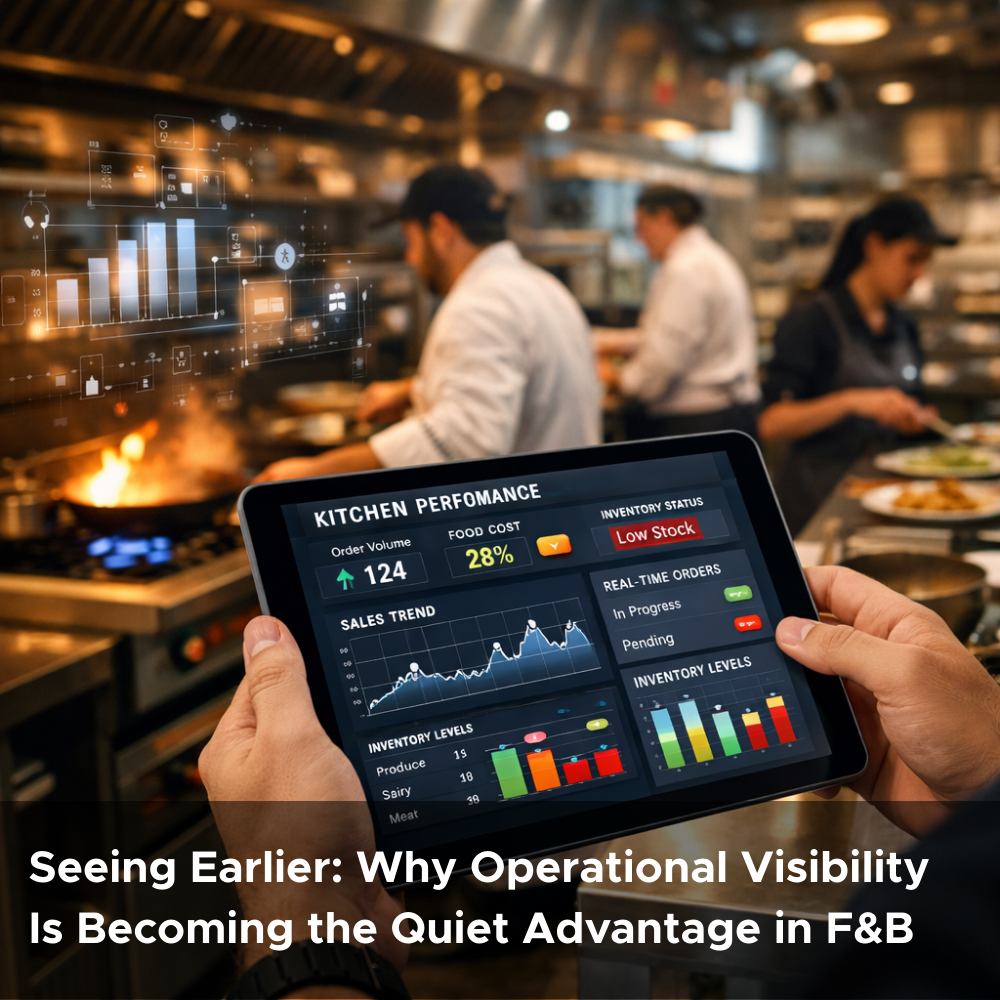
Across many restaurant organisations, information about the business already exists. Sales data resides within point-of-sale systems. Inventory movements are recorded through procurement or back-office tools. Kitchen throughput is often understood through experience and observation rather than structured measurement.
Individually, these information sources are useful.
Collectively, however, they frequently remain siloed.
When operational signals remain separated across systems and teams, leaders often find themselves discovering issues only after they have begun affecting service consistency, staff workload, or financial performance. Demand shifts appear late. Supplier cost changes surface after margins tighten. Operational bottlenecks reveal themselves during peak service rather than before it.
Not because organisations lack data, but because they lack connected visibility of the signals already present within their operations.
The Nervous System
In this context, the role of artificial intelligence may benefit from a quieter reframing.
Rather than viewing AI primarily as an automation engine, its more immediate contribution may lie in something more fundamental: earlier sensing of operational signals.
One way to understand this shift is to think of AI not as a motor that acts on behalf of an organisation, but as a nervous system that improves the organisation’s ability to sense what is happening within its operations.
When operational information becomes more connected and interpretable, patterns begin to surface earlier. Changes in demand can be observed before they translate into excess waste. Ingredient cost movements may become visible sooner, allowing menu decisions to be considered more thoughtfully. Kitchen workflows may reveal inefficiencies that previously remained hidden within the daily rhythm of service.
The advantage here is not dramatic transformation. It is steadiness.
When leaders are able to see operational signals earlier, decisions tend to be made with greater clarity and less urgency. Teams spend less time reacting to unexpected disruptions and more time refining the consistency of service.
Over time, this creates a form of resilience that does not depend on dramatic innovation, but on improved understanding of the organisation’s own operating patterns.
Resilience Through Stewardship
This perspective also reflects a broader shift often associated with Industry 5.0. In this view, technology does not replace human judgment but extends it. Digital systems help organisations observe complex environments more clearly, while leadership remains responsible for interpreting those signals and guiding action.
For food and beverage operators navigating Singapore’s structurally high-cost environment, this distinction may become increasingly important. Artificial intelligence cannot change the market price of rent or labour. However, clearer operational visibility helps organisations ensure that resources are used where they create the most value.
In practice, this suggests that the next phase of technology adoption in the sector may be less about pursuing the newest tools and more about strengthening the organisation’s ability to observe itself clearly.
When visibility improves, leaders are better able to make thoughtful decisions.
And when decisions improve, resilience often follows.
At FutureFWD, hosted by Informa and held from 21–24 April 2026 at Singapore Expo, industry discussions increasingly reflect this shift. Beyond the language of digital transformation, operators and technology leaders are exploring how practical intelligence can stabilise kitchen operations, improve service rhythm, strengthen supply chain awareness, and ultimately support greater resilience in an increasingly complex operating environment.
In such a landscape, technology becomes less about novelty and more about stewardship, the responsible management of an organisation’s rhythm, its resources, and people.
And in many industries, stewardship remains the quiet foundation of lasting success.