
Asia-Pacific has rapidly emerged as the world’s largest engine of consumer demand, poised to overtake North America in global consumption share within the next decade.
The shift in consumer behavior across APAC is driving explosive growth in the region’s consumer market.
Today’s Asian shoppers are more value-conscious, mobile-first, and expectation-heavy than ever before.
In the wake of the pandemic’s lasting effects on shopping habits, APAC consumers have permanently elevated their standards, from seamless digital shopping adoption to higher demands on price and quality.
Retail trends in Asia-Pacific now reflect a “new normal”: shoppers who are intentional in spending, quick to leverage technology, and unwilling to compromise on convenience or trust.
Rather than focusing on short-lived disruptions, brands must recognize that the rise of APAC’s middle classes and digital natives is rewriting the rules of retail and grocery shopping for the long haul.
Who Is the Modern APAC Shopper?
The modern APAC shopper is a dynamic blend of price-savvy deal-seeker and digitally fluent consumer, comfortably straddling both online and offline worlds.
Across the region, shoppers are highly price- and value-conscious, with many adjusting their brand or store choices to prioritize better value and convenience.
Value orientation is a pervasive theme in Asia-Pacific consumer behavior, even as cultural nuances shape how quickly retail and grocery shopping preferences shift across markets.
Alt-text: modern-APAC-shoppers-better-value
1. Value First, Always
Across the region, economic pressures have prompted consumers to trade down, explore private labels, and switch retailers more frequently, a trend especially visible in markets that areadapting quickly to digital shopping alternatives.
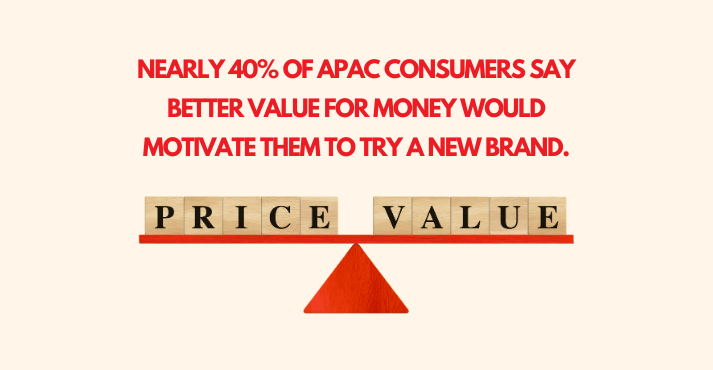
They are highly price- and value-aware: in fact, nearly 40% of APAC consumers say better value for money would motivate them to try a new brand, rising to 48% in Australia and 47% in the Philippines.
2. Digitally Fluent & Mobile-First
Mobile is the dominant interface for APAC shoppers. A plurality, and in many markets a majority, prefer mobile devices for browsing and buying goods online:
Consumers in the Asia-Pacific region lead the world in digital wallet adoption, as reliance on physical cards and cash continues to decline.
Today, digital wallets account for around 70% of online payments and 50% of in-store transactions across the region, making Asia-Pacific the most wallet-driven payments market globally.
3. Omnichannel & “Phygital” Expectations
APAC consumers are comfortable blending online and offline experiences:
- PWC data shows that shoppers use an average of four different grocery shopping channels, exceeding global averages, and adopt non-traditional formats such as on-demand delivery, meal kits, and subscription boxes at higher rates than many other regions.
- Physical and digital channels coexist rather than compete: physical stores remain important even among heavy online spenders.
This “phygital” comfort means shoppers reward brands that make it easy to research online and buy offline (and vice versa), with consistent pricing, inventory visibility, and flexible fulfillment.
Regional Behaviors & Nuances
However, these core APAC consumer behaviors manifest differently across the region’s diverse markets:
1. Southeast Asia – Super Apps & Mobile Wallets
Consumers here are among the most mobile-centric in the region and often leapfrog traditional payment infrastructure, using mobile wallets and integrated platform ecosystems for discovery and purchase.
For example, the transaction value of digital payments in Indonesia was forecast to reach over 700 billion U.S. dollars by 2030.
2. East Asia – Speed & Tech-Enabled Retail
East Asian shoppers typify high expectations for fast, efficient commerce. E-commerce in the region is heavily digital and supported by strong logistics networks.
For example, quick commerce segments in China and India have rapidly expanded, reflecting strong demand for convenience.
3. India – Mobile-Led Scale & Value Orientation
India’s consumer base continues to grow rapidly, driven by mobile-first adoption and strong online engagement, while enduring price sensitivity remains.
4. ANZ (Australia & New Zealand) – Trusted, Balanced & Conscious
Meanwhile, in Australia and New Zealand (ANZ), mature markets blend premium expectations with practicality: shoppers put a premium on trust, product integrity, and sustainability, yet still seek a balance of quality and value for money.
Survey shows that the Australian public increasingly recognizes the long-term impact of their choices, with around 76% of consumers considering sustainability when making shopping decisions.
Value Without Compromise: Why Price Sensitivity Doesn’t Mean “Cheap”
APAC shoppers are highly price-sensitive, but being value-driven is not the same as buying cheap. Consumers across the Asia-Pacific look for fair pricing, dependable quality, safety, and availability.
They want to feel confident that they received good value without sacrificing standards. This is why “better value” consistently ranks as the top reason for brand switching in the region, ahead of taste or health.
Here’s how value-driven behavior shows up
- Shoppers actively compare prices, hunt for deals, and switch brands or retailers to avoid overpaying.
- However, the lowest price alone rarely wins if the quality or trust looks questionable.
- Price sensitivity in APAC demands affordability plus consistency, not bargain-bin trade-offs.
Retailers are redefining value as “affordable quality.” Private-label products are a clear example:
- Across APAC, store brands have shed their “cheap” image and are now seen as reliable, good-value alternatives.
- In Japan and South Korea, private labels are often viewed as trustworthy or even premium.
- In Southeast Asia, improving quality and wider assortments have driven strong adoption, with leading supermarket house brands accounting for a significant share of sales.
APAC shoppers respond strongly to:
- Digital coupons and app-based discounts
- Bulk pricing and loyalty rewards
- Large-scale sales events like 11.11 or Singles’ Day
These mechanics work because they reinforce the feeling of getting more for the money, not just paying less.
Convenience Is Non-Negotiable: Mobile-First, Omnichannel Expectations
Convenience has been redefined. It is no longer just about location; it is about saving time and reducing effort throughout a seamless, connected journey. The smartphone is the primary shopping interface, not a secondary tool.
Key expectations include:
Frictionless Channel Blending
Shoppers expect to research online (via social media, brand sites, or AI tools) and complete purchases offline, or vice-versa, without any disconnect in service, pricing, or inventory visibility.
The Rise of Quick and Social Commerce
The demand for ultra-fast delivery (quick commerce) and shopping directly within social media apps is reshaping the retail landscape, particularly in China and Southeast Asia.
Phygital Experiences
Physical stores are evolving into experiential touchpoints. Data shows that 32% of consumers are likely to engage with in-store experiential moments, seeking immersive brand storytelling that complements online efficiency.
Trust, Safety, and Transparency Matter More Than Ever
When people buy food, baby products, or household staples, they can’t afford to guess, they need reassurance that what’s in the package is safe, real, and exactly what it says on the label.
Shoppers seek reassurance through:
Product quality & safety
Consumers prioritize products that meet safety standards, show clear expiry/handling info, and carry credible certifications. Safety reduces anxiety and prevents costly health or reputation risks for brands.
Clear labeling & sourcing
Transparent ingredient lists, origin details, and traceability give shoppers the facts they need to decide quickly. Good labeling turns uncertainty into confidence at the shelf or checkout.
Brand reliability
Consistent taste, predictable availability, and honest marketing build long-term loyalty. Reliable supply chains and visible quality controls signal that a brand will deliver again and again.
Remember, in a region where memories of past safety incidents linger, shoppers have long memories and high expectations. Earning their trust isn’t easy, but once you have it, it’s one of the most powerful loyalty drivers in the market.
Alt-text: what-good-looks-like-to-apac-shoppers-expectations
Digital Experience ≠ Just Ecommerce: What “Good” Looks Like to APAC Shoppers

It’s not enough for brands in APAC to simply be online; the quality of the digital experience separates winners from losers. Shoppers here have some of the highest digital expectations in the world.
What shoppers now expect and what a good digital experience provides:
- Personalized Offers: Tailored recommendations, context-aware promotions, and helpful nudges. Personalization should feel useful, not creepy.
- Consistent Pricing Across Channels: The same price and clear promotion rules online, in-app, and in-store (or an explicit, explained difference). Price mismatch erodes trust fast.
- Real-time Inventory Visibility: Live stock levels, available pickup slots, and delivery windows so shoppers can complete their journey with confidence.
- Fast, Frictionless Payments & Flows: One-click checkout, saved carts, digital wallets, and local payment methods; mobile UX must be polished.
- Omni-presence Across Platforms: Social commerce, marketplaces, messaging apps, and voice assistants are all valid touchpoints; meet customers where they are.
- Clear Digital Trust Signals: Privacy protections, secure payments, transparent return,s and visible sourcing/labels.
Sustainability & Ethics: Important, But Contextual
Sustainability and ethical business practices do matter to APAC shoppers, but the degree to which they influence purchase decisions is highly contextual.
Key realities:
- Segmented Importance: Sustainability matters most in urban, higher-income segments (and among younger shoppers). In price-sensitive or lower-income groups, affordability usually takes priority.
- Must Fit the Price Equation: Shoppers expect sustainability to align with affordability; they’ll pay a premium only when the value or quality justifies it.
- Trust & Brand Alignment: Ethical claims build confidence and differentiate a brand, but for many grocery and everyday purchases, value, quality, and availability remain the dominant drivers.
What shoppers actually expect
- Reduced Waste: Clear efforts to minimise food and packaging waste (smaller pack sizes, refill options, clear expiry info).
- Ethical Sourcing: Transparent origin and fair-trade or responsibly sourced ingredients, especially for premium or “trust-sensitive” categories (baby, organic, seafood).
- Responsible Packaging: Recyclable, refillable, or minimal packaging with clear disposal guidance.
Here’s how sustainability functions for brands:
- As a Trust Signal: Honest sustainability practices and clear proof points (certifications, traceability, on-pack facts) increase confidence.
- As a Loyalty Driver for Certain Segments: Urban and affluent shoppers often reward consistent, credible sustainability commitments.
- As a Risk Mitigator: Poor sustainability claims or greenwashing can quickly erode trust and damage reputation.
The winners will be those companies that manage to embed sustainability into their value proposition without pricing themselves out of the market, effectively giving consumers the ability to “do good” without sacrifice.
How Expectations Differ Across APAC Regions
While broad trends apply across Asia-Pacific, shopper expectations manifest differently by region.
Here’s a high-level snapshot of how consumer priorities and behaviors differ across key APAC sub-regions:
| Region | Core Shopper Traits | Digital Behavior | Price & Value Mindset | Key Nuance |
| Southeast Asia | Mobile-centric, convenience-driven | Super-apps, e-wallets, social commerce, chat-based buying | Highly promotion-responsive; value-seeking with rising quality expectations | Young, urban shoppers expect fast, integrated, digital-first experiences |
| East Asia | High standards, tech-enabled | Fast delivery, advanced retail tech, mature omnichannel | Value-conscious with an appetite for premium and novelty | China/Korea favor speed & innovation; Japan prioritizes trust and quality |
| South Asia (India) | Scale-driven, mobile-led | App-based shopping and digital payments are mainstream | Extremely price-sensitive; low loyalty if better deals exist | Brands must pair sharp pricing with trust and quality assurance |
| Oceania (ANZ) | Trust-led, quality-focused | Strong omnichannel expectations | Value-oriented but willing to pay for durability and ethics | Shoppers expect fair prices, strong quality, and credible values |
What This Means for Retail & Grocery Brands
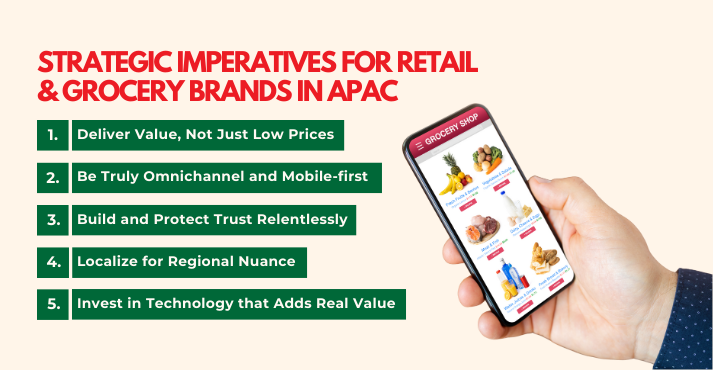
Meeting the modern APAC shopper’s expectations requires raising performance across value, digital experience, trust, localization, and technology. These are not trends; they are strategic imperatives.
1. Deliver Value, Not Just Low Prices
APAC shoppers reward brands that offer “value without compromise.” Competitive pricing must be paired with consistent quality and availability.
Tiered product ranges, private labels, smart promotions, bundles, and loyalty programs help shoppers feel every dollar is well spent. Brands win by competing on perceived value, not price alone.
2. Be Truly Omnichannel and Mobile-first
Seamless integration across apps, websites, social channels, and physical stores is expected. Pricing, inventory, and promotions must be aligned across channels, with services such as click-and-collect and easy returns built in.
Mobile is the primary interface, fast UX, digital wallets, in-app support, and super-app integrations are essential.
3. Build and Protect Trust Relentlessly
Trust is a long-term differentiator. Brands must prioritize product safety, quality control, and transparency, clearly communicating sourcing, certifications, and standards.
In a digitally vocal region, rapid response and honest communication are critical. Brands that earn trust earn loyalty.
4. Localize for Regional Nuance
APAC is not one market. Success depends on adapting to local tastes, payment methods, languages, shopping habits, and regulations. A strong regional strategy, paired with local execution, ensures relevance across promotions, logistics, and store formats.
5. Invest in Technology that Adds Real Value
Innovation should enhance convenience and efficiency, not add complexity.
AI-driven personalization, supply-chain automation, and emerging channels like live or chat commerce can drive growth, provided the basics work flawlessly: smooth checkout, reliable delivery, and responsive support.
Key Takeaways: How Brands Can Win APAC Shoppers Today
Winning in Asia-Pacific requires more than following trends. Today’s APAC consumers are informed, mobile-driven, and highly selective.
They reward brands that respect their time, money, and expectations, while punishing those that create friction or break trust.
The takeaways below capture what matters most right now:
- Shoppers choose brands that offer fair pricing without compromising on quality, safety, or reliability.
- Seamless mobile and omnichannel experiences are expected; consumers want to browse, pay, and engage anytime, anywhere.
- Fast delivery, quick checkout, and one-stop services resonate strongly with APAC’s time-pressed urban shoppers.
- Aligned pricing, accurate inventory, and reliable service across online and offline channels make shoppers feel secure and respected.
- Clear communication around sourcing, pricing, and policies reassures shoppers and encourages repeat purchases.
- Eco-friendly and ethical choices can influence decisions, but only when they don’t add major cost or inconvenience.
Given this, APAC shoppers are not chasing the cheapest option or the newest feature; they’re looking for value, convenience, and confidence.
Thus, brands that deliver consistently across these dimensions earn not just transactions, but long-term loyalty in one of the world’s most competitive consumer markets.
Frequently Asked Questions
What do APAC grocery shoppers value most today?
APAC grocery shoppers value a combination of fair price, reliable quality, and convenience. They are strategic, using digital tools to compare prices and promotions, but they will not compromise on core product integrity to secure a lower price.
How important is mobile shopping in the Asia-Pacific?
Mobile is the dominant shopping channel in APAC. The region’s consumers are famously mobile-first: the majority of e-commerce transactions are done via smartphones. For many, especially younger shoppers, the smartphone is the primary shopping portal.
Are APAC consumers more price-sensitive than Western markets?
Yes, they are differently value-conscious. While highly attuned to price and promotions, APAC markets currently show healthier volume growth compared to the more price-driven growth in North America and Western Europe. This indicates a focus on delivering value, including quality and experience, not just the lowest cost.
Do APAC shoppers care about sustainability?
Yes, but contextually. Sustainability is an important trust and brand-alignment factor, especially among urban and affluent consumers. However, it is often balanced against immediate affordability and value-for-money considerations.
How can retailers meet modern APAC consumer expectations?
Retailers meet modern APAC consumer expectations by building fit-for-purpose, omnichannel business models that prioritize local relevance. This means leveraging data for personalization, ensuring flawless channel integration, competing on a broad definition of value, and fostering trust through transparency and consistency.