Author name: Wilmos Lee, Assistant Vice President, IT, TungLok Group
Understanding structural pressures and finding steadiness through clearer vision and thoughtful transformation
In Singapore today, running an F&B business often feels like moving steadily uphill. Operational cost is no longer shaped by seasons. It has settled into the structure of the industry itself. According to the Singapore Department of Statistics (SingStat), the sector recorded about S$1.0 billion in sales in November 2025, supported by 2.5 percent year-on-year growth. Yet full-service restaurants still experienced a slight contraction, suggesting that even with industry expansion, pressure remains uneven.
Broader numbers paint the same picture. Food inflation has held in the 3 to 4 percent range. Resident wages have risen above 3.5 percent. Commercial rents have continued their steady climb. These shifts accumulate quietly over time, shaping a reality that many operators feel long before it appears in any report.
Across the island, businesses navigate unpredictable ingredient movements and changing dining habits. More Singaporeans are exploring food options in Johor Bahru, naturally shifting demand at home. The fact that many closures involve younger establishments that never reached profitability hints at a structural challenge that determination alone may not overcome.
In such an environment, it may help to move gently away from constant firefighting and toward clearer understanding. Earlier sensing of patterns can bring steadiness in a landscape that often feels uncertain. This is where AI may find its purpose. Not as something dramatic, but as a quiet source of clarity. When used thoughtfully, it helps leaders see a little further ahead and understand operations with more precision. It lightens the invisible load that teams carry, and reduces the surprise movements that often drain an organisation’s energy.
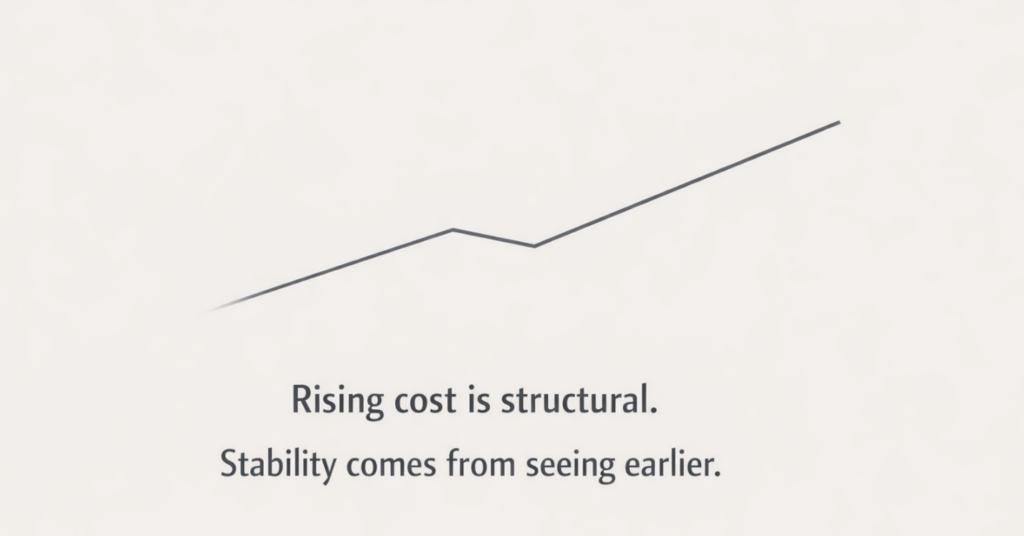
AI does not change rent, or the broader economy surrounding the F&B sector. Yet it may ease uncertainty by making internal rhythms steadier. When decisions are made with clearer visibility, leaders often carry themselves with more calmness. Over time, organisations grow more resilient not because pressures disappear, but because they learn to absorb them more gracefully.
Looking ahead, the next phase of Singapore’s F&B landscape may be shaped by leaders who relate to technology with calm intention. Not rushing, not resisting, but integrating it in ways that support their people and align with their long-term purpose. This reflects the spirit of Industry 5.0, where human judgment and evolving intelligence complement one another, creating workplaces that are steadier, more adaptive, and prepared for the years ahead.
In an era shaped by structural cost, clarity supported by gentle and continuous adaptation may offer a more grounded path forward. At FutureFWD, hosted by Informa, the conversations will move beyond theory as we explore how operators are already using practical intelligence to stabilise kitchen operations, improve service rhythm, strengthen supply chain consistency and build resilience in a landscape where cost pressures continue to rise. Join the conversation as we continue to examine how thoughtful intelligence and steady leadership can help the sector remain centred even as pressures persist.