The Current Reality
The numbers all point up. The APAC health and wellness food market was valued at USD 243.61 billion in 2025 and is forecast to grow at 11.5% CAGR through 2035.
Three in five Asian consumers are incorporating more protein into their routines. And the majority of them view digestive health as very important for the whole body. APAC consumers prioritise physical health when selecting food supplements and nutrition products.
And that said, the Asia Pacific is a wellness gold rush, and operators should get in early. That line is not wrong. It is just useless.
The Real Context
Walk FHA 2026 with the brief of identifying food trends in APAC health wellness, and the contradiction becomes immediate. The FHA Main Stage sessions on nutrition in Japan and Southeast Asia, the Singapore Pavilion’s Gutti gut-health launches, the Sustainability Summit’s fermentation-derived protein presentations, and the South Korean exhibitors with sleep-plus-digestion combo claims, these were not serving the same consumer. They were not even selling to the same operator type. They were serving six different markets under APAC health and wellness food trends 2026.
The Thesis
Wellness in APAC in 2026 is a category umbrella, not a consumer profile. The operators who are using it as a procurement signal rather than a marketing claim, sourcing by country, by channel, by operator tier, are making better decisions than the ones chasing the aggregate trend line.
What the APAC Trends Reveal
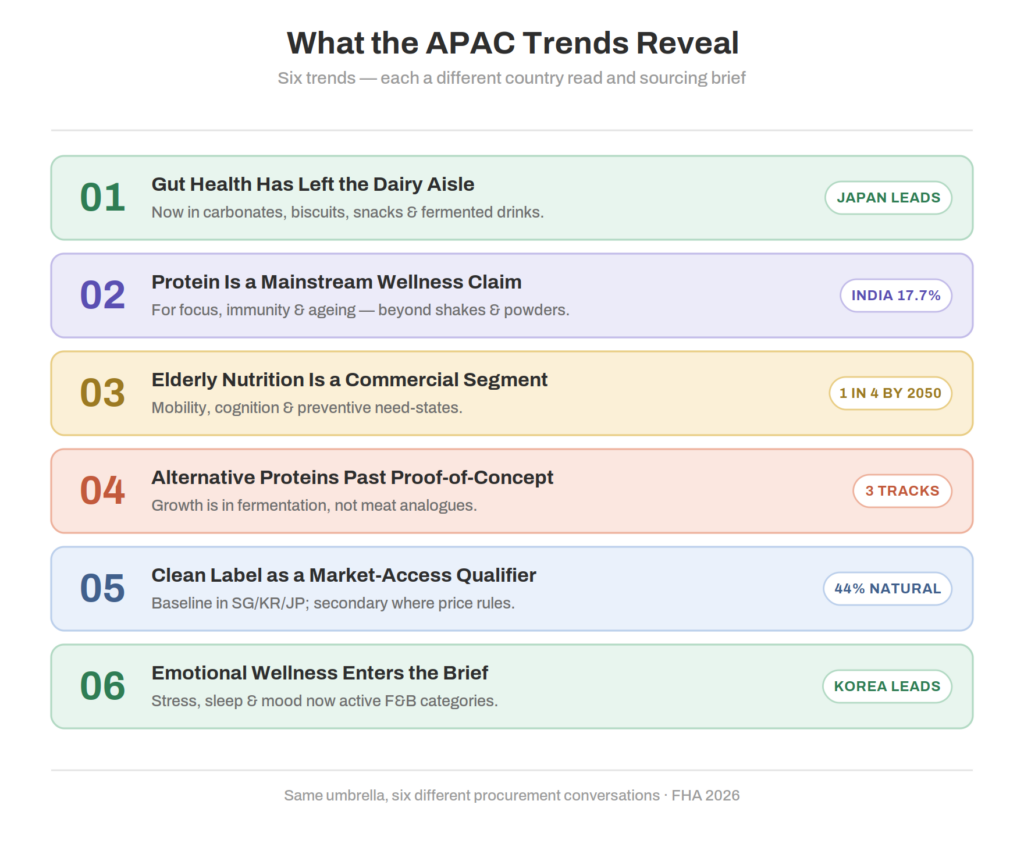
Gut Health Has Left the Dairy Aisle
Gut health food trends in Asia 2026: from yogurt shelf to whole-menu reformulation
Gut health is one of the clearest trends at FHA 2026, and the most misread by operators approaching it as a dairy-aisle refresh. The 55% of Asian consumers who view digestive health as very important for the whole body are not necessarily reaching for probiotic yogurt.
They are encountering gut-health claims in carbonates, savoury biscuits, grain-based snacks, and fermented beverage formats. Probiotics and prebiotics are now merging enjoyment with functionality.
The country reads matters more than the aggregate. Japan leads APAC in gut health through drinking yogurt and fermented beverages, a category it has been developing for decades, now innovating at the ingredient stack level.
South Korea is where the format combination is sharpest: new product launches at FHA featured melatonin and gut-health functional ingredients combined into a single SKU, sleep and digestion as a single claim, designed for an urban professional consumer who wants both problems solved by the same bottle.
Similarly, Singapore is producing innovation in adjacent categories: the Singapore Pavilion at FHA 2026 showcased Gutti by Annabella Patisserie, a high-protein and gut-health-focused product line that reframes gut health as a patisserie format rather than a supplement format.
“If we look back 10 or 15 years, dairy products were generally regarded as healthy. That’s changed. There’s much more skepticism now, even around something as basic as milk. And the perception of products like yogurt has shifted quite a lot.” – Professor Klaus G. Grunter (Aarhus University)
For hotel and restaurant F&B operations, this has a direct procurement implication: the sourcing conversation for gut health ingredients has shifted from the dairy buyer to the whole-menu ingredient team.
Protein Is a Mainstream Wellness Claim
Protein food trends APAC 2026: beyond sports nutrition into everyday format innovation
Protein is no longer primarily a muscle-building story. It is now sought for focus, memory, immunity, and healthy ageing. It is expanding from powders and shakes into savory biscuits, grain-based snacks, and dairy-based drinks.
Research shows that current nutrition needs for the 25–44 age group in China are increasingly prevention-focused, driving protein claims into everyday convenience formats. Whereas India is the fastest-growing protein market in APAC at 17.7% CAGR, with format preferences skewed toward dairy-based drinks.
Japan’s ageing consumer is driving demand for mobility and strength claims, a different product brief than the cognitive-focus messaging leading in Singapore and South Korea.
“High protein yogurt is especially fast-growing in markets where GLP-1 use is popular, because GLP-1 users are losing muscles and they need to compensate it through a higher protein intake.” – Xiaoyu He, Senior Product Strategic Manager, AsPac at Glanbia Nutrition
Adding to this, 44% of Asian consumers say naturalness or minimal processing is the most important attribute in food and beverage selection. Protein claims that cannot be delivered through recognisable, minimally processed ingredients face a credibility problem in the markets with the highest purchasing power.
Elderly Nutrition Is a Commercial F&B Segment
FHA 2026 ageing population nutrition foodservice: the session that should have changed every hotel F&B brief
By 2050, one in four people in Asia and the Pacific will be over 60. FHA 2026 Main Stage sessions treated this as a commercial F&B brief, not a healthcare niche.
Three specific need-states anchored the programming: mobility and strength, cognitive health, and preventive nutrition. Each one requires a different formulation and sourcing strategy, and each has a different leading market.
Japan leads APAC in healthy ageing product launches. Amino acid-enriched drinks, fortified grain formats, and collagen beverages targeting bone, joint, and skin claims are more commercially developed here than anywhere else in the region.
China pairs traditional ingredients, red yeast rice, and green tea extract, with elderly nutrition positioning for urban consumers already familiar with functional formats. Whereas Singapore’s Enterprise Singapore ‘Sip & Savour’ Accelerator is developing elderly nutrition products for global export, making it a supplier pipeline worth tracking now.
“We’re not walking away from what we got started on, which is infant nutrition. But we do see that in most economies around the world, the bigger demographic opportunity is among the middle-aged and elderly.” – Mark Schneider, Former CEO of Nestlé.
Given this, the personalized nutrition Asia market 2026, showcased at the FutureFWD conference at FHA 2026, is making demographic-targeted nutrition programming more executable in hotel settings.
Alternative Proteins Past Proof-of-Concept — but Not Past Fragmentation
Alternative protein APAC market 2026: three tracks, three different sourcing conversations
The FHA Sustainability Summit 2026 covered three distinct tracks: cultivated meat and seafood at an early commercial stage, hybrid plant-and-animal formulations in growth, and fermentation-derived proteins as the most operationally mature option for foodservice. Treating them as one procurement category remains the default mistake.
The first wave of Western-analogue meat substitutes has plateaued below original projections. The APAC plant-based protein market is still forecast at 10.5% CAGR through 2033, but that growth is in fermentation-derived formats, koji, mycoprotein, and precision fermentation, which have reached cost parity with conventional proteins in specific foodservice categories, not in meat substitutes.
“Rising income and urbanization are fuelling a growing demand for animal proteins.” – Sheggen Fan, Chair Professor, China Agricultural University.
When fermentation-derived proteins reach cost parity with conventional dairy in certain categories, the sourcing decision becomes an economic decision, not a values one. That is a materially different conversation than operators were having in 2022.
Clean Label as Market Access Qualifier
Clean label food for Asian consumers: where it works, where it doesn’t, and why the channel split matters more than the market size
Clean label food for Asian consumers is no longer a premium positioning layer. When Asian consumers say naturalness or minimal processing is the most important attribute in food and beverage selection, the category is a mainstream procurement signal.
Health and wellness food trends do not play out uniformly across APAC. In Singapore, South Korea, and Japan, clean label is a baseline expectation in premium modern retail and hotel F&B. In Indonesia, Vietnam, and the Philippines, price remains the primary filter and clean label is secondary.
Food innovation trends that emerge from Singapore or Seoul routinely misread as pan-APAC signals when they are, in practice, high-income urban signals with limited portability into price-sensitive markets.
Hotel F&B can carry clean-label claims without the price sensitivity that makes them unworkable in commodity retail. The procurement implication is timing: clean-label ingredients have longer lead times and narrower supplier bases than commodity equivalents.
Emotional Wellness Has Entered the Functional Food Brief
Emotional wellness functional food beverage Asia 2026: stress, sleep, and mood as F&B product categories
Functional food trends in APAC have historically been physical-health-first. In 2026, emotional wellness has entered the formulation brief. Stress and anxiety, sleep and insomnia, and mood balance are now active product development categories.
The global wellness market is projected to reach nearly $8.5 trillion by 2027, as consumers demand greater control over their health, actively seeking products that can help reduce stress and restore balance.
South Korea is leading: new product launches combine melatonin with gut health ingredients in a sleep-digestion brief migrating from premium toward mainstream retail pricing. Similarly, Japan is developing stress management claims in functional beverage formats. Tetra Pak data shows 23% of consumers cite taste enjoyment as a key driver; emotional wellness products that sacrifice flavour for efficacy will not retain buyers past the first purchase.
“Mental and emotional well-being are increasingly important in markets like Japan, where consumers seek flavors that evoke “relaxation, uplift, comfort, or indulgence.” – Koki Yamano, Director of the Global Flavor Strategy Department at Takasago
For hotel F&B, the integration path is direct. Hotels already invest in stress reduction and sleep quality through spa and in-room programming. A functional beverage or breakfast item with a sleep or stress claim is the natural F&B extension, and with APAC consumers preferring RTD formats, the application runs from minibar to all-day beverage offer.
Counter: Wellness Claims That Sell in Seoul Will Not Land in Surabaya
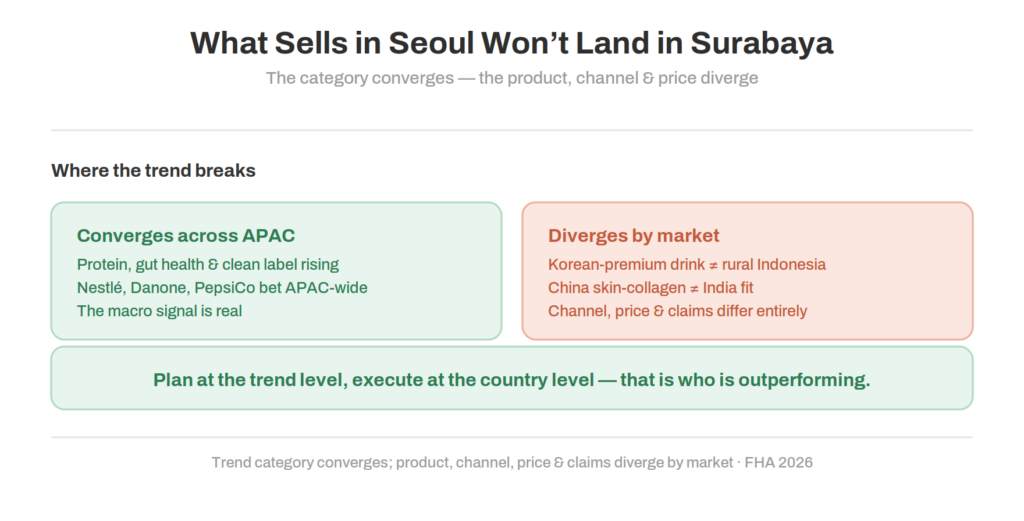
The counter case is legitimate. Protein, gut health, and clean label are rising across every major APAC market simultaneously. Healthy trends worldwide converge on these categories, and brands like Nestlé, Danone, and PepsiCo are making APAC-wide portfolio decisions because the macro signal is real.
The execution is not transferable. A probiotic dairy drink priced at a South Korean premium margin will not achieve volume in rural Indonesia
A collagen beverage positioned around skin health for urban Chinese women aged 25–35 requires a completely different marketing architecture, retail channel, and price point to work in India. The trend category converges. The product, channel, price, and claims framework diverge entirely by market.
Operators who plan at the trend level and execute at the country level are outperforming. Those who plan and execute at the trend level produce strong strategy decks but poor procurement outcomes.
Implications for Hotel F&B Directors and Distributors
The wellness opportunity in APAC is no longer a future trend—it is a present sourcing and menu-planning consideration. However, the priorities differ depending on where you sit in the supply chain.
For Hotel F&B Directors
- Profile guest demographics before redesigning menus.
- Prioritise elderly nutrition and emotional wellness offerings if 20%+ of guests are aged 55+ or if your guest base is largely Japanese, Korean, or Chinese.
- Test demand through breakfast menus and in-room wellness amenities before committing to broader menu changes.
For Distributors
- Focus supplier qualification efforts on clean-label and functional protein products in Singapore, South Korea, and Japan.
- Build capabilities around personalised nutrition, which is increasingly converging with these categories.
- Avoid deploying the same SKU across ASEAN without adapting format, positioning, and pricing to local market conditions.
FHA 2026 provided the clearest snapshot of APAC wellness product supply this year.
Forward Look: What to Watch Before Year-End 2026
Four developments will indicate whether APAC’s wellness market continues to fragment through FHA 2027.
First, any update to Singapore’s functional food regulations could establish the country as the compliance benchmark for gut-health and elderly-nutrition claims across ASEAN. Second, if South Korea’s sleep-and-digestion wellness products move from premium to mid-tier pricing, it would signal that emotional wellness has entered the mainstream.
Third, commercial partnerships emerging from conversations around cultivated meat and fermentation-derived proteins would suggest that sustainability-focused industry events are becoming catalysts for real business deals rather than simply knowledge-sharing platforms.
Finally, growing investment in regional wellness ingredient production and supplier capabilities would point to a more mature Southeast Asian supply base and reshape current assumptions about future nutrition demand.
The broader takeaway is that in Asian F&B, wellness trends are increasingly driven by procurement and supply-chain decisions before they appear in consumer-facing products.
Practitioner/Expert Quote Sources
| Practitioner/Expert | Organisation | Source |
| Professor Klaus G. Grunert | Aarhus University | DairyReporter – Dairy’s health image problem: Why consumers are skeptical |
| Xiaoyu He | Glanbia Nutrition | NutraIngredients – Protein, extracts and biotics trends in Asia’s weight management category |
| Koki Yamano | Takasago | FoodIngredientsFirst – APAC flavor innovation and technology trends |
| Sheggen Fan | China Agricultural University | World Economic Forum – The protein transition in Asia-Pacific |
| Mark Schneider | Former CEO, Nestlé | Financial Times – Interview and commentary on nutrition, health and food industry trends |
Note: Expert perspectives referenced throughout this article were sourced from the publications listed above.