The Conventional Read
Global trade cleared USD 35 trillion in 2025. Supply chains did not collapse, they are being redesigned, under pressure, in real time.
Asia-Pacific GDP growth is projected at 4.4% in 2026, but that figure is already being dampened by tariff materialisation across the bloc.
Rabobank’s global strategist Cyrille Filott put it plainly: “Other markets will be caught in the crossfire.” Tariffs imposed on the US-Brazil and US-Colombia coffee routes have already pushed global price benchmarks upward, landing the cost on Asian buyers who had nothing to do with the policy dispute.
Thus, tariffs may no longer be a temporary disruption but a long-term fixture of the trading environment.
Then You Walk the Halls
The F&B operators in Asia navigating this environment best are not the ones waiting for policy clarity. They are building parallel supplier tracks, activating free trade agreements their compliance teams have barely opened, and using physical trade platforms as intelligence infrastructure.
At FHA 2026, 700 pre-qualified buyers from 23 countries conducted 19,000 meetings across four days. Many of those conversations were not product discovery. They were conducting a supply chain redesign in a room that made it possible in four days.
The five-strategy framework to act on before the next tariff round lands is uncovered.
Five Strategies, One Playbook: Where to Act

Strategy 1: ASEAN Trade Architecture as Tariff Firewall
CPTPP, RCEP, and AFTA: The Agreements Most Operators Know Exist But Haven’t Mapped
ASEAN’s free trade architecture is the most underused tariff-mitigation tool in Asian F&B. Most operators know these agreements exist. Fewer have mapped which specific product categories benefit from reduced or zero tariffs under which agreement. That mapping exercise is now a P&L item, not a trade compliance formality.
Three frameworks deserve active use:
- AFTA (ASEAN Free Trade Area) provides zero or near-zero tariffs on most goods traded within the ASEAN bloc, the baseline architecture for intra-regional sourcing.
- RCEP (Regional Comprehensive Economic Partnership), a 15-country agreement covering China, Japan, Korea, Australia, and New Zealand alongside ASEAN members, opens preferential access across a wider supplier pool, though coverage varies by product code and country pair.
- CPTPP (Comprehensive and Progressive Agreement for Trans-Pacific Partnership), covering 11 countries including Vietnam, Malaysia, and Singapore, provides a different set of advantages, particularly for operators sourcing from or into markets with high applied tariff rates under WTO terms.
The country-level differences matter. Vietnam’s RCEP positioning suits manufacturing-adjacent ingredient categories; processed ambient goods sourced from Vietnamese suppliers often attract preferential rates that Chinese equivalents no longer do.
Malaysia’s established JAKIM halal infrastructure makes it a natural upgrade for buyers needing both certification and RCEP-compliant origin documentation in the same product.
The forward signal is reinforcing this. IndusFood Asia’s debut as a dedicated FHA zone signals a similar repositioning on India’s side: the country is actively building ASEAN-facing supply infrastructure rather than waiting for bilateral deals to mature.
Strategy 2: Diversify the Supplier Panel Before You Need To
FHA 2026 Procurement and the Real Cost of Starting Late
The China+1 strategy has been discussed in Asian F&B procurement for five years. What changed in 2026 is not the strategy; it is the cost of not having executed it already.
Operators who built qualified alternative supplier relationships before the latest tariff round are trading through the disruption. Whereas operators who started looking after the tariff hit are paying a premium for urgency and absorbing qualification risk on untested supply lines.
Building a trusted supplier relationship across proteins, dairy, specialty grains, or packaging takes two to three sourcing cycles to stabilise on volume, grade consistency, and cold chain reliability. That clock cannot be compressed after a tariff shock.
“Bilaterally, we are accelerating the negotiations with Indonesia, the Philippines, Thailand and Malaysia,” says EU Trade Commissioner Maros Sefcovic.
The ASEAN digital economy continues to grow rapidly. Currently valued at around $300 biliion, it is projected to reach $1 trillion by 2030. In fact, Vietnam, Malaysia, Thailand, Indonesia, and the Philippines are all receiving record procurement orders as China+1 diversification accelerates.
But digital platforms find suppliers who list themselves. Physical trade floors find suppliers who are already moving product at scale, a meaningfully different signal when you need a qualified alternative fast.
This is what FHA 2026’s buyer-supplier meeting represented: 2,750+ exhibitors from 115 countries, 700 pre-qualified buyers, 19,000 meetings in four days. For procurement leads comparing that against 12 months of digital RFP outreach, the yield ratio is not close.
FHA 2026 signals that building supply infrastructure is essential to compete on both volume and certification in ASEAN-facing categories, even though supply relationships are still early.
Strategy 3: Traceability and Certification as Trade Access Assets
Halal, EUDR, and the Deadlines That Are Not Optional
Traceability and certification are no longer compliance costs; they are market access assets.
Buyers who can demonstrate clean origin documentation, halal certification, and food safety compliance gain preferential tariff treatment under FTAs, access to halal-mandated markets, and a growing advantage as certification moves from a closing question to a qualifying criterion.
FHA 2026’s Main Stage was direct on this: access to major markets now depends on clear traceability, strong certification, and proof of origin at every supply chain step.
Two hard deadlines warrant immediate procurement attention. Indonesia’s halal mandate requires all imported F&B products to carry certification by October 2026, not a compliance checkbox, but the entry requirement for a 280-million-person market.
The EUDR (EU Deforestation Regulation) sets a December 2026 deadline for large operators across palm oil, cocoa, beef, and soy; suppliers unable to produce due diligence documentation put European retail access at risk.
Strategy 4: From Just-in-Time to Just-in-Case, Selectively
Which Categories Justify Buffer Stock, and Which Don’t
Just-in-time inventory is a casualty of tariff volatility. The global supply chain is becoming resilient, with modular supply networks and just-in-case inventory strategies that will define the winning supplier playbook this year.
But just in case is expensive and ties up working capital. The operators doing it well are making category-by-category calls. Buffer stock is justified where tariff exposure is highest and local alternatives are unavailable or unqualified: proteins, dairy, specialty grains, canned goods, and packaging materials.
However, it does not justify itself for fresh produce, short-shelf-life ingredients, or categories where local sourcing is already viable. Hotel F&B procurement leads have a structural advantage here.
“Eden Farm (Indonesian agritech startup) disaggregates the food supply chain by efficiently leveraging communal farming to provide just-in-time inventory to food wholesalers, resellers, and hotels. The business has an incredible opportunity to decrease food prices and wastage across Indonesia.” — Daniel Veytsblit, Investment Director, Investible.
Strategy 5: Physical Trade Platforms as Supply Chain Intelligence
What the Floor Reveals That the Portal Cannot
Physical trade platforms like FHA are not simply commercial events. In a tariff-volatile sourcing environment, they reveal which suppliers are investing in market presence, which categories are attracting new entrants, and which buyer types are in the room.
Digital platforms find suppliers who list themselves. Trade floors find suppliers already moving product at scale. When you need a qualified alternative in a disrupted category, that distinction is the difference between a fast substitution and a six-month qualification project.
At FHA 2026, the supply chain signals were on the floor for any procurement team reading carefully. The 75+ national government pavilions were not marketing exercises, they were countries using FHA as trade infrastructure, actively redirecting export pipelines toward ASEAN buyers.
Japanese ingredient manufacturers in Hall 7 expanded their halal-certified product lines on display for the first time, a clear signal that Japan is repositioning its F&B export offer to meet Southeast Asian market access requirements rather than waiting for buyers to ask.
The pre-qualified Hosted Buyers at FHA were not browsing; they were active sourcing teams with defined briefs and budget authority.
Before FHA 2027: map your three highest-tariff-exposed categories. Attend with a sourcing brief, not a badge. Know which supplier gaps you need to fill before you walk the floor.
Counter: Not Every Asian F&B Operator Has the Scale
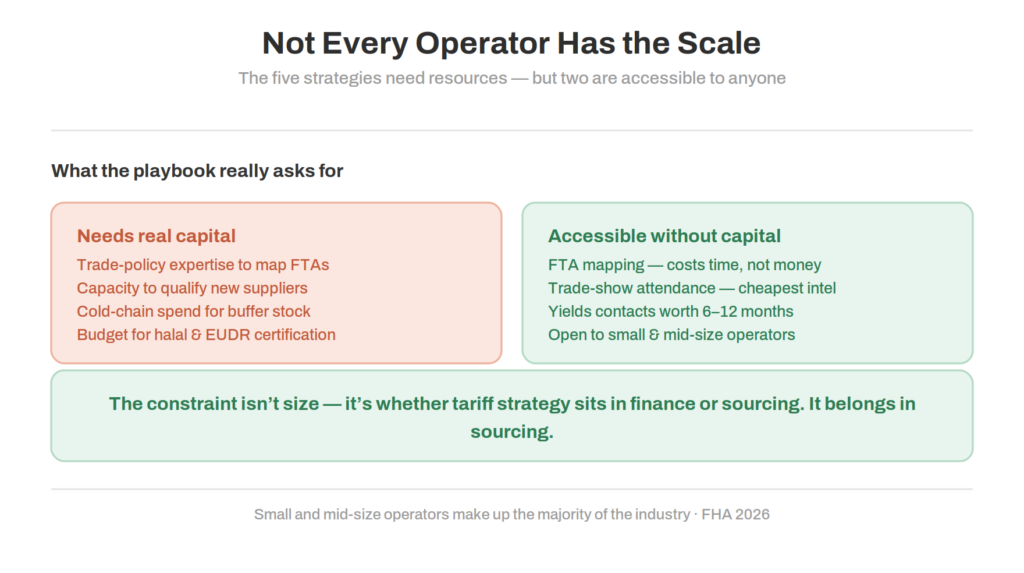
The five strategies above require real resources: trade policy expertise to map FTA benefits, procurement capacity to qualify alternative suppliers, cold chain investment for buffer stock, and compliance budget for halal and EUDR certification.
Small and mid-size operators, who make up the majority of the industry, may not have any of these in meaningful quantities.
The scale requirement is real, but it is not binary. Two strategies are accessible without capital. FTA mapping costs time, not money. The constraint is whether someone treats it as a sourcing function or leaves it sitting in compliance.
And trade show attendance is the cheapest supply chain intelligence available relative to its yield; a well-briefed buyer at FHA returns with qualified supplier contacts that would take six to twelve months to accumulate through digital outreach
The constraint is not size. It is whether the tariff strategy is treated as a finance problem or a sourcing problem. It belongs in sourcing.
Implication for Hotel F&B Procurement Directors
Three actions, specifically for hotel F&B procurement directors in Asia-Pacific:
FTA audit (this week)
Take your top ten imported ingredient categories to your trade compliance team or national trade body. Ask which agreement reduces the duty on each one. SFA and other regional equivalents do this mapping. The exercise takes a day; the value is immediate.
Supplier pre-qualification (next 60 days)
Identify two to three alternative suppliers per high-exposure category: proteins, dairy, and specialty grains. Do not wait for the next tariff event to start qualification. A supplier who passes your quality and cold chain checks now is ten times more useful than one found under pressure.
Certification review (next quarter)
Map your import panel against Indonesia’s October 2026 halal deadline and the EUDR December 2026 large-operator deadline. Both represent market access risk if you are supplying into or sourcing from affected categories. Neither is negotiable on the current timeline.
Forward Look: Trade Variables Worth Watching Before Year-End
Instead of watching broad trends, focus on key developments.
Indonesia’s halal mandate for MSMEs, scheduled for October 2026, could significantly change supplier qualification requirements for companies importing into one of the world’s largest consumer markets.
EU–ASEAN trade negotiations with the Philippines, Thailand, and Malaysia are another important area to monitor. Any formal progress before year-end could affect tariffs and sourcing decisions for European suppliers and buyers operating across ASEAN.
The EUDR deadline in December 2026 is also critical. If the European Commission delays implementation again, companies sourcing palm oil and cocoa for European markets may need to revise their plans once more.
Companies that treat supply chain strategy and trade intelligence as part of the same function will be better prepared for FHA 2027. Trade shows reveal what spreadsheets often miss: which suppliers are investing, which product categories are growing, and where trade flows are heading.
The value comes from attending with a clear objective and knowing what signals to look for.