Technology has quietly become the single biggest competitive advantage in hospitality, foodservice, and retail.
Operators who once competed on menu, decor, or location now compete on how fast they can serve a guest, how personalized that guest’s experience feels, and how efficiently a property runs behind the scenes.
That shift is exactly why FutureFWD FHA 2027 hospitality tech has become one of the most searched terms among hospitality leaders planning their 2027 calendars.
FutureFWD is Food & Hospitality Asia’s dedicated technology conference and showcase, sitting inside one of Asia’s largest food and hospitality trade events. It exists to spotlight innovation, automation, AI, digital transformation, smart operations, and future-ready guest experiences in one focused zone.
As a hotel technology exhibition Singapore has come to rely on for regional benchmarking, FHA FutureFWD draws operators from across Southeast Asia each edition.
This article explains what FutureFWD is, what visitors can expect, who should attend, and why it matters for the future of hospitality.
What Is FutureFWD at FHA 2027?
FutureFWD is FHA’s dedicated technology conference and showcase, purpose-built for the hospitality, foodservice, and retail industries. It combines a technology showcase, conference sessions, live demonstrations, industry networking, and structured innovation discovery into a single zone.
Unlike a generic exhibitor hall, FutureFWD is organized around one question: what technology will define how hospitality operates over the next decade? That framing shapes everything from the seminar agenda to the exhibitor mix on the floor.
Why FutureFWD Was Created
FutureFWD emerged in direct response to pressures reshaping hospitality operations worldwide:
- Rapid digital transformation across hotels, restaurants, and retail
- Persistent labor shortages in front- and back-of-house roles
- Rising customer expectations around speed and personalization
- Accelerating AI adoption across guest-facing and operational systems
- Growing demand for measurable operational efficiency
- The need for technology-driven competitiveness in a crowded regional market
Together, these forces created demand for a platform where operators could evaluate solutions to all of the above in one place, rather than piecing together vendor visits across separate events.
How FutureFWD Fits Within FHA 2027
FutureFWD sits inside the wider FHA ecosystem rather than existing as a standalone show. Attendees can move between traditional F&B and hospitality suppliers and dedicated future-technology providers without leaving the venue, creating a natural bridge between day-to-day hospitality operations and innovation.
FutureFWD was introduced as a dedicated seminar and technology zone alongside FHA’s broader exhibition, giving it both the scale of a major trade event and the focus of a specialist conference.
Why Hospitality Technology Is Becoming a Strategic Priority
Before looking at specific technologies on display, it helps to understand the industry drivers pushing adoption. Hospitality technology has moved from a “nice to have” to a strategic requirement, driven by shifting guest behavior, cost pressure, and new revenue models.
The Shift Toward Digital Hospitality
Guest behavior itself has changed the operating model:
- Contactless experiences from arrival to checkout
- Mobile-first guests who expect to book, pay, and communicate from a phone
- Self-service expectations at check-in, ordering, and payment
- Personalized experiences based on stay history and preferences
- Data-driven decision-making replacing gut-feel management
Rising Operational Pressures
Operators are also managing tighter constraints:
- Ongoing staffing challenges across kitchens, front desks, and housekeeping
- Cost control amid volatile input and labor costs
- Productivity requirements per staff member
- Service consistency across multiple properties or outlets
- Sustainability goals tied to energy, water, and waste
Technology as a Revenue Driver
Technology isn’t only defensive; it is increasingly a direct revenue lever through upselling opportunities at check-in and in-room, better guest retention through consistent digital experiences, loyalty programs built on real usage data, personalization engines that recommend relevant add-ons, and revenue optimization systems that adjust pricing in real time.
Key Technologies Expected to Be Showcased at FutureFWD
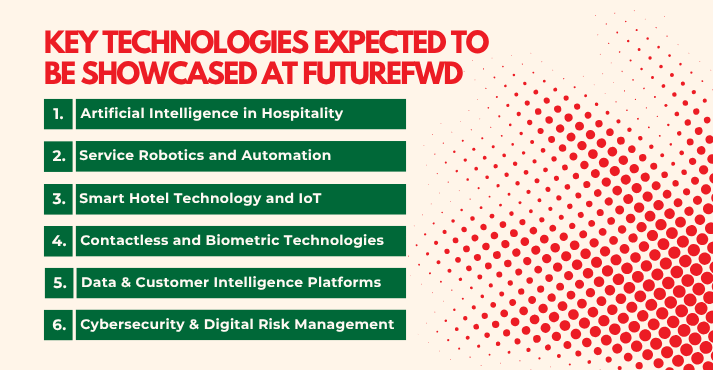
FutureFWD showcases the technologies transforming hospitality, foodservice, and retail operations. The event focuses on practical solutions that improve guest experiences, automate operations, strengthen security, and help businesses make smarter decisions.
The following technology categories are expected to be among the event’s biggest highlights.
1. Artificial Intelligence in Hospitality
Artificial intelligence is becoming an essential tool for hotels and restaurants. It helps businesses automate routine tasks, personalize guest interactions, and make better operational decisions using real-time data.
AI-Powered Guest Service
AI in the hospitality industry improves customer support by providing fast, 24/7 assistance while reducing staff workload.
Common applications include:
- Virtual concierge services
- AI chatbots for bookings and inquiries
- Automated guest messaging systems
These tools shorten response times, improve guest satisfaction, and allow employees to focus on higher-value interactions.
Predictive Analytics
AI also helps operators anticipate demand and optimize daily operations.
Typical use cases include:
- Demand forecasting
- Occupancy prediction
- Inventory management
With better forecasting, businesses can reduce waste, optimize staffing, and improve profitability.
AI Personalization
Hotels increasingly use AI to tailor experiences for individual guests.
Examples include:
- Personalized room and dining recommendations
- Dynamic room pricing
- Guest preference tracking
This creates more relevant experiences while increasing guest loyalty and revenue opportunities.
2. Service Robotics and Automation
Hotel automation technology is expanding beyond manufacturing into everyday hospitality operations. Service robots now support both front-of-house and back-of-house teams by improving speed, consistency, and operational efficiency.
Hotel Service Robots
Hotels are deploying robots to handle routine guest services.
Examples include:
- Room delivery robots
- Concierge robots
- Cleaning robots
These solutions reduce repetitive work and allow staff to spend more time providing personalized guest service.
Restaurant Automation
Foodservice operators are investing in automation to improve kitchen productivity and food consistency.
Common applications include:
- Automated food preparation
- Robotic kitchen assistants
- Beverage automation systems
Automation helps reduce labor shortages, improve food quality, and speed up service.
Back-of-House Automation
Many operational processes are also becoming increasingly automated.
Key technologies include:
- Inventory management software
- Procurement automation
- Workforce scheduling systems
These solutions reduce manual administration while improving inventory accuracy and labor planning.
3. Smart Hotel Technology and IoT
Smart technologies connect hotel rooms, equipment, and operational systems through IoT, creating more efficient and responsive properties.
Connected Guest Rooms
Guests can control room features directly from their smartphones or voice assistants.
Popular features include:
- Smart lighting
- Climate control
- Voice-enabled assistants
These connected rooms improve convenience while supporting energy efficiency.
Energy Management Systems
Hotels use intelligent energy systems to reduce utility costs and support sustainability initiatives.
Examples include:
- Automated HVAC optimization
- Real-time sustainability monitoring
Smart energy management lowers operating costs without compromising guest comfort.
Property-Wide IoT Networks
IoT sensors continuously monitor equipment and assets throughout the property.
Typical applications include:
- Predictive maintenance
- Asset tracking
These systems reduce equipment downtime and improve operational visibility.
4. Contactless and Biometric Technologies
Contactless technology continues to streamline the guest journey while improving convenience and security.
Digital Check-In and Check-Out
Mobile check-in allows guests to skip reception queues and complete arrival and departure digitally.
Mobile Room Access
Smartphone-based room keys eliminate physical key cards while making room access faster and more secure.
Biometric Payments
Fingerprint, facial recognition, and palm authentication enable quick, secure transactions without physical payment cards.
Facial Recognition Solutions
Hotels are also adopting facial recognition for identity verification and loyalty recognition.
Key benefits include:
- Faster guest service
- Improved security
- Reduced wait times
- More seamless customer experiences
5. Data and Customer Intelligence Platforms
Data has become one of hospitality’s most valuable assets. Customer intelligence platforms help businesses understand guest behavior and make smarter decisions.
Common solutions include:
- Customer data platforms (CDPs)
- CRM systems
- Loyalty management platforms
- Real-time analytics dashboards
- Guest behavior analytics
These technologies help operators personalize marketing, improve customer experiences, increase repeat visits, and make more profitable business decisions.
6. Cybersecurity and Digital Risk Management
As hospitality businesses become increasingly digital, protecting guest information and operational systems is more important than ever.
FutureFWD is expected to showcase solutions that help businesses strengthen cybersecurity while supporting digital transformation.
Areas of focus include:
- Hospitality data protection
- Guest privacy management
- Secure payment systems
- Cloud security
- AI security and risk management
Strong cybersecurity reduces business risk, protects customer trust, and ensures digital hospitality systems remain secure as AI and connected technologies continue to evolve.
Future Hospitality Trends Driving Innovation in 2027
The technologies on display at FutureFWD connect to a small number of larger industry trends shaping hospitality through 2027 and beyond. Understanding these trends helps operators prioritize which showcased solutions are worth a closer look.
Hyper-Personalized Guest Experiences
Guests increasingly expect properties to remember them, from room preferences to dietary restrictions, without being asked twice.
Automation Without Losing the Human Touch
FutureFWD places consistent emphasis on the idea that technology should enhance rather than replace hospitality, positioning automation as a way to free staff for higher-value guest interactions rather than eliminate the human element.
Sustainability Through Technology
Technology is helping hospitality businesses meet sustainability goals while reducing operating costs through smarter resource management.
- Waste reduction systems tied to kitchen and inventory data
- Energy optimization across HVAC and lighting
- Resource management dashboards for water and utilities
Unified Omnichannel Customer Journeys
Guests now expect a seamless experience across every stage of their journey, from booking to post-stay engagement. Connected digital platforms help businesses deliver consistent service while strengthening customer relationships.
- Online booking that flows into in-property systems
- Mobile engagement throughout the stay
- In-property experiences informed by prior digital touchpoints
- Post-stay communications that feed loyalty programs
Who Should Attend FutureFWD at FHA 2027?

FutureFWD specifically targets hospitality operators, foodservice businesses, retailers, technology leaders, and executive decision-makers, though the value proposition differs by role.
1. Hotel Owners and Operators
Hotel owners, including those running dual-branded hotels with multiple flags under one roof, can use FutureFWD to discover operational technology, improve guest experiences across brand standards, and reduce costs through automation.
2. Restaurant and Foodservice Leaders
Restaurant technology trends on display include kitchen automation, digital ordering technologies, and labor optimization tools aimed squarely at foodservice margins.
3. Technology and Innovation Teams
IT and digital teams use the floor to evaluate new platforms, compare competing vendors side by side, and benchmark their own roadmap against regional trends.
4. Hospitality Investors and Consultants
Investors and advisors gain market intelligence, visibility into emerging technology trends, and early sight of investment opportunities across the region.
5. C-Suite Decision Makers
Executives use FutureFWD for strategic planning, building digital transformation roadmaps, and sharpening competitive positioning ahead of budget cycles.
What Visitors Can Expect at FutureFWD
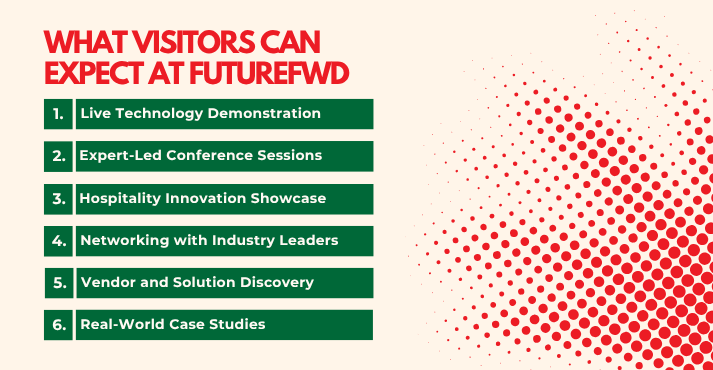
FutureFWD is positioned as a conference and showcase featuring industry speakers, technology demonstrations, networking opportunities, and dedicated innovation showcases across its four days.
Live Technology Demonstrations
Exhibitors run hands-on demos rather than static displays, letting operators see robotics, kitchen automation, and guest-facing systems in action.
Expert-Led Conference Sessions
Sessions bring in operators, consultants, and technology specialists; past editions have featured speakers such as Andrew Cameron of Enzyme Consulting discussing systems-level change across hospitality and foodservice supply chains.
Hospitality Innovation Showcase
A dedicated showcase area groups next-generation solutions together, making it easier to compare categories like AI, robotics, and IoT in a single walkthrough.
Networking with Industry Leaders
Structured networking sessions connect operators directly with exhibitors, speakers, and peers facing similar operational challenges.
Vendor and Solution Discovery
Names appearing in recent editions span operational platforms, point-of-sale and payment technology, and guest engagement tools, giving attendees a realistic cross-section of what’s commercially available today rather than concept demos alone.
Real-World Case Studies
Case studies matter because they let operators evaluate ROI before committing budget, seeing how a specific automation or AI tool performed in a comparable property rather than relying on vendor projections alone.
FutureFWD vs Traditional Hospitality Trade Shows
FutureFWD deliberately positions itself differently from a conventional hospitality trade show floor.
| Traditional Hospitality Shows | FutureFWD |
| Product-focused | Technology-focused |
| Equipment displays | Innovation showcases |
| Supplier sourcing | Transformation strategies |
| Conventional operations | Future-ready solutions |
| Product comparisons | Technology adoption roadmaps |
This distinction matters because most hospitality trade shows are built around sourcing physical products, from kitchen equipment to tableware. FutureFWD fills a growing gap for operators who need a strategic view of where the industry is heading, not just another supplier catalogue.
How FutureFWD Supports Hospitality Digital Transformation
Hospitality digital transformation rarely happens through one purchase; it happens through a sequence of decisions FutureFWD is structured to support.
- Identify Emerging Technologies: Operators get early visibility into tools before they become mainstream, from AI agents to biometric payment systems.
- Benchmark Against Industry Leaders: Seeing what leading operators and brands are already testing helps set realistic internal benchmarks.
- Build Technology Roadmaps: Conference sessions and vendor conversations give teams the input needed to sequence a multi-year technology roadmap rather than adopting tools reactively.
- Discover New Partnerships: Many attendees leave with shortlists of vendors worth a follow-up conversation, rather than a signed contract on the spot.
- Prepare for Future Consumer Expectations: Understanding what’s coming lets operators get ahead of guest expectations instead of reacting once competitors have already adopted a technology.
Why FutureFWD Could Become One of Asia’s Most Important Hospitality Technology Platforms
Several regional trends point toward FutureFWD’s continued growth in relevance: accelerating hospitality technology investment across Asia, AI adoption spreading beyond flagship hotel groups into independent operators, expanding smart hotel development, rising digital guest experience expectations, and rapid ASEAN hospitality market expansion alongside tourism recovery.
FutureFWD’s hospitality technology showcase Asia positioning, combined with its base inside one of the region’s largest food and hospitality events, gives it a structural advantage most standalone tech conferences lack: a built-in audience of tens of thousands of hospitality, foodservice, and retail professionals already at the venue for FHA itself.
Its continued focus on hospitality, foodservice, and retail technology innovation across Asia positions it to grow alongside the region’s broader digital transformation.
Final Thoughts
FutureFWD is more than a technology exhibition bolted onto a food and hospitality trade show.
It is a platform where hospitality businesses come to explore what service looks like next, from AI and automation to analytics and smart operations, all converging around a single goal: better guest experiences delivered more efficiently.
Hospitality leaders attending FHA 2027 should treat FutureFWD as a key destination for innovation discovery, strategic planning, and technology sourcing, not a side attraction to the main event.
Frequently Asked Questions About FutureFWD at FHA 2027
What is FutureFWD at FHA 2027?
FutureFWD is FHA’s dedicated technology conference and showcase focused on innovation across hospitality, foodservice, and retail, running alongside the main FHA exhibition.
Where will FutureFWD be held?
FutureFWD takes place as part of FHA 2027 at the Singapore Expo, from 20 to 23 April 2027.
What technologies will be showcased at FutureFWD?
Technologies showcased at FutureFWD include:
- Expect AI-assisted service
- Service robotics
- Automated kitchens
- Smart rooms and IoT systems
- Biometric payments
- Contactless experiences
- Cybersecurity solutions
Who should attend FutureFWD?
FutureFWD is designed for hospitality professionals looking to discover emerging technologies, evaluate new solutions, and stay ahead of industry trends. The event is particularly valuable for:
- Hotel owners and operators
- Restaurant owners and foodservice leaders
- Hospitality technology and innovation teams
- Hospitality investors
- Hospitality consultants
- C-suite executives and decision-makers
- Operations managers
- Digital transformation leaders
- Procurement and purchasing professionals
- Hospitality entrepreneurs and business developers
How is FutureFWD different from other hospitality trade shows?
Traditional shows focus on product sourcing and equipment displays, while FutureFWD focuses on technology adoption, transformation strategy, and future-ready solutions.
Will AI technologies be featured at FutureFWD?
Yes. AI-powered guest service, predictive analytics, and AI personalization are core categories within the showcase.
Can hotel operators discover automation solutions at FutureFWD?
Yes. Hotel service robots, restaurant automation, and back-of-house automation tools are all represented as part of the showcase.
What are the biggest hospitality technology trends for 2027?
The biggest hospitality technology trends shaping 2027 include:
- Hyper-personalized guest experiences
- Automation balanced with human service
- Sustainability-driven technology
- Unified omnichannel guest journeys
- AI-powered guest services
- Smart hotels and IoT-enabled operations
- Contactless and biometric technologies
- Data-driven customer intelligence
- Cybersecurity and digital risk management
Is FutureFWD focused only on hotels?
No. FutureFWD covers hospitality, foodservice, and retail, making it relevant to restaurants, cafés, and retail operators alongside hotels.
Why is FutureFWD important for hospitality businesses?
It gives operators a single platform to identify emerging technologies, benchmark against industry leaders, and build practical digital transformation roadmaps ahead of shifting guest expectations.
Explore FHA privileges for details on registering and gaining access to FutureFWD as part of FHA 2027.