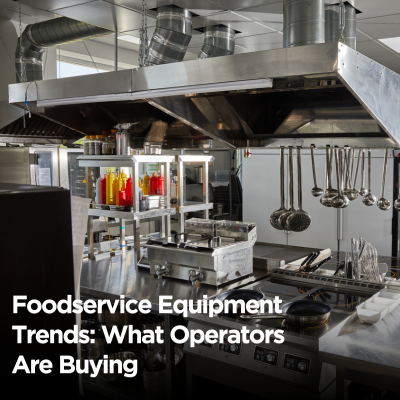
Higher labor costs, ongoing staffing shortages, rising energy expenses, and surging delivery demand are converging on kitchens across the region at once, showing up directly in purchase orders rather than just staffing memos or utility bills.
Understanding today’s foodservice equipment trends in Asia that operators are chasing means looking past capacity and price tags entirely.
Restaurant equipment trends 2026 point to a market that has changed how buying decisions get made. Instead of focusing only on purchase price or production capacity, operators are looking for equipment that delivers long-term value.
They now favor machines that do more with less, less labor, less energy, less floor space, while still hitting output targets during peak service.
Given this, operators are investing in equipment that improves productivity, lowers costs, and delivers measurable ROI, and the fastest-growing categories all share this logic.
What’s Driving Foodservice Equipment Purchases in 2026?

Four forces: labor, energy, off-premise dining, and sustainability are reshaping the capital-expenditure checklist Asia-Pacific operators use today.
Labor Shortages Continue to Influence Equipment Buying
Staffing challenges remain one of the biggest reasons operators are upgrading their kitchens in 2026. Many restaurants continue to struggle with hiring and retaining skilled kitchen employees, making it difficult to maintain service levels during peak hours.
Smaller teams are also expected to handle multiple responsibilities, increasing the need for cross-training and standardized workflows. As a result, operators are investing in restaurant automation equipment that reduces manual tasks and improves consistency.
Automated cooking systems, programmable equipment, and self-monitoring systems help streamline food and beverage preparation, reduce training time, and enable fewer employees to produce consistent results throughout the day.
Rising Energy Costs Are Reshaping Purchasing Priorities
Increasing utility expenses are changing how operators evaluate new equipment purchases. Instead of focusing only on the initial price, businesses are comparing long-term operating costs, maintenance requirements, and expected energy savings.
This shift has increased demand for energy-efficient kitchen equipment, including ENERGY STAR equipment, induction cooking systems, and efficient refrigeration units.
Off-Premise Dining Is Changing Kitchen Design
The continued growth of takeout, delivery, ghost kitchens, and virtual brands is influencing kitchen layouts and equipment selection.
Operators need equipment that supports faster preparation, consistent food quality, and reliable high-volume production during busy delivery periods.
Compact, multifunctional equipment also helps maximize limited kitchen space while maintaining speed and efficiency.
Sustainability Is Moving From Marketing to Operations
Sustainability has become an operational priority rather than simply a branding initiative. Operators are working to reduce food waste, lower energy consumption, conserve water, and meet carbon footprint goals while controlling costs.
Modern commercial kitchen equipment supports these objectives through improved efficiency, smarter resource management, and technologies that minimize waste throughout daily operations, helping businesses achieve both environmental and financial benefits.
Smart Kitchen Technology Is Becoming a Standard Investment
Smart kitchen technology has moved from an experimental add-on to one of the fastest-growing investment categories, as connected kitchens improve productivity, maintenance, food consistency, and equipment lifespan all at once.
IoT-Connected Equipment
Internet of Things (IoT)-connected equipment enables operators to monitor kitchen performance from virtually anywhere.
Connected ovens, refrigeration systems, and dishwashers can provide remote monitoring, performance tracking, predictive maintenance insights, and equipment diagnostics.
These capabilities allow managers to identify potential issues before they become major failures, helping maintain food safety, reduce downtime, and keep kitchens operating efficiently.
Data-Driven Kitchen Operations
Modern commercial kitchens generate valuable operational data that supports continuous improvement.
Real-time reporting, production analytics, equipment usage data, and labor optimization insights help operators understand workflow efficiency, identify bottlenecks, and improve resource allocation.
Access to actionable data allows businesses to make informed decisions that increase productivity while maintaining consistent service quality.
Predictive Maintenance Reduces Downtime
Predictive maintenance helps detect equipment issues early through automated monitoring and service alerts.
Scheduled maintenance based on equipment performance reduces emergency repairs, lowers maintenance costs, and minimizes unexpected breakdowns.
For operators, fewer business interruptions translate into more reliable kitchen operations, longer equipment life, and improved profitability.
Automation Equipment Is One of the Fastest-Growing Categories
Automation is becoming a priority investment across quick-service restaurants, cafés, hotels, cloud kitchens, and full-service restaurants as operators look for practical ways to manage labor shortages and rising operating costs.
Automated Cooking Systems
Automated cooking technology helps standardize food preparation while reducing reliance on manual processes.
These systems improve product consistency, shorten training time for new employees, and allow smaller teams to handle higher order volumes with greater efficiency.
Examples include:
- Automated fryers that maintain precise cooking times and temperatures.
- Programmable ovens that store recipes and cooking settings for consistent results.
- Cooking robotics that automate repetitive preparation tasks.
- Precision cooking technology that delivers accurate temperature control and repeatable food quality.
Self-Service Ordering Technology
Self-service ordering solutions are becoming common in high-traffic restaurants because they simplify ordering while reducing front-of-house workload.
Common solutions include:
- Self-order kiosks.
- Self-checkout systems.
- Digital ordering stations.
Kitchen Workflow Automation
Beyond cooking and ordering, operators are investing in automation that improves back-of-house coordination and overall efficiency.
Popular workflow automation tools include:
- Automated inventory tracking.
- Production scheduling software.
- Order routing systems that direct tickets to the appropriate preparation stations.
Together, these foodservice technologies help kitchens reduce delays, improve communication, minimize waste, and maintain smooth operations even during peak service hours.
Combi Ovens Continue to Dominate Equipment Investment Lists

Combi ovens remain one of the most sought-after equipment investments because they combine versatility, efficiency, and long-term cost savings in a single unit.
As operators face labor shortages, limited kitchen space, and rising utility costs, these ovens help simplify food preparation without compromising quality.
Why Operators Prefer Combi Ovens
Key reasons operators choose combi ovens include:
- Multiple cooking functions in one unit
- Reduced equipment footprint and better use of kitchen space
- Greater menu flexibility for a wider range of food offerings
- Labor savings through automated cooking programs
- Convection cooking for even heat distribution
- Steam cooking to retain moisture and nutrients
ROI Advantages of Combi Ovens
Beyond versatility, combi ovens deliver measurable operational and financial benefits that improve return on investment.
Major advantages include:
- Faster cook times that increase kitchen productivity.
- Lower energy consumption compared with using multiple appliances.
- Consistent cooking results that improve food quality.
- Reduced food waste through precise temperature and humidity control.
Which Foodservice Segments Are Buying Them Most
Demand for combi ovens continues to grow across multiple foodservice sectors, particularly those that require consistent production and high daily output.
The strongest adoption is seen in:
- Quick-service restaurants (QSRs).
- Hotels.
- Healthcare facilities.
- Universities and educational institutions.
- Corporate dining operations.
Energy-Efficient Equipment Is Delivering Strong ROI
Buyers increasingly prioritize operating costs over sticker price, turning what used to be a sustainability talking point into a straightforward cost-control argument finance teams can approve quickly. This is one of the clearest energy-efficient kitchen equipment shifts in the market right now
Induction Cooking Equipment
Induction offers better energy efficiency than gas or electric coil ranges, along with safety benefits from cooler surfaces and faster cooking at lower ambient heat, improving working conditions on the line.
High-Efficiency Refrigeration Systems
Modern refrigeration systems are designed to maintain food safety while minimizing electricity consumption. Advanced technologies help operators improve performance and reduce operating expenses.
Important features include:
- Smart temperature controls for precise cooling
- Energy monitoring to track equipment performance
- Real-time data about inventory in refrigerators
Energy-Saving Dishwashing Systems
Water conservation and heat-recovery systems are now core selling points for warewashing equipment, reclaiming energy older units would waste and cutting utility spend for high-volume operations.
Refrigeration Technology Is Evolving Rapidly
Refrigeration remains a high-stakes category because failures threaten food safety directly, not just throughput, a risk profile that justifies paying more for connected, monitored systems.
Smart Refrigeration Systems
Smart refrigeration systems provide continuous visibility into equipment performance and food storage conditions.
Key capabilities include:
- Real-time temperature monitoring.
- Automatic alerts for temperature fluctuations or equipment issues.
- Improved food safety compliance through continuous monitoring.
These features help operators respond quickly to potential problems before they affect food quality or inventory.
Remote Monitoring and Compliance
Connected refrigeration systems simplify compliance by automating many routine monitoring tasks.
Important functions include:
- HACCP support through continuous temperature tracking.
- Automated reporting for audits and inspections.
- Digital food safety documentation that reduces manual recordkeeping.
Remote access also allows operators to monitor multiple locations and address issues without being on-site.
Sustainability Improvements in Refrigeration
New refrigeration technologies are helping businesses reduce environmental impact while lowering operating expenses.
Major improvements include:
- Natural refrigerants with lower environmental impact.
- Energy-efficient compressors that reduce electricity consumption.
- Compliance with evolving environmental regulations and sustainability standards.
Equipment Supporting Off-Premise Dining Is Seeing Strong Demand
Delivery and takeout growth ties equipment purchases directly to a kitchen’s ability to keep pace with order volume outside the dining room.
These restaurant kitchen upgrades help businesses handle higher delivery volumes while maintaining consistency and customer satisfaction.
High-Speed Ovens
Faster service, real throughput improvements, and compact footprints make high-speed ovens a natural fit for delivery-heavy menus, letting smaller kitchens produce at volumes that once needed far more space.
Holding and Hot Storage Equipment
Delivery quality depends on food staying at proper temperature between the pass and the courier’s bag, so consistent holding equipment protects both food consistency and order staging during busy windows.
Packaging and Production Support Equipment
Assembly stations and order management systems streamline the handoff between cooking and packaging, often becoming the real bottleneck as delivery volume grows rather than the cooking line itself.
Sustainability-Focused Equipment Purchases Are Increasing
Sustainability goals now directly influence capital expenditure rather than sitting in a separate corporate responsibility budget, visible across waste reduction, water conservation, and overall kitchen design.
Waste Reduction Equipment
Food waste reduction systems and inventory management technology cut the volume of product that never reaches a plate, and better tracking reduces over-ordering, compounding the savings.
Water Conservation Technologies
Efficient dishwashers and low-water cleaning systems reduce one of the largest hidden utility costs in any kitchen, particularly valuable in markets facing tightening municipal water regulations.
Sustainable Kitchen Design Trends
Smaller footprints and multifunctional equipment are reshaping how new kitchens get designed, since fewer, more capable machines are simply easier to power, cool, and maintain efficiently. Thus, a pattern is reshaping venues built around bakery and pastry trade show standards.
Which Equipment Categories Are Growing Fastest?

The fastest-growing foodservice equipment categories all address the same business challenge.
| Equipment Category | Primary Benefit | Key Buying Driver | Typical Operators |
| Combi ovens | Multiple cooking functions in one unit | Labor savings, menu flexibility, space optimization | Restaurants, hotels, healthcare, universities |
| Smart refrigeration | Continuous monitoring and food safety | Energy savings, compliance, reduced food waste | Restaurants, grocery retailers, hotels, cloud kitchens |
| Induction cooking | Fast, energy-efficient cooking | Lower utility costs, improved safety | Restaurants, cafés, hotels, institutional kitchens |
| High-speed ovens | Rapid food preparation | Faster service and higher throughput | QSRs, cafés, convenience stores, ghost kitchens |
| Self-service kiosks | Automated customer ordering | Labor reduction and improved order accuracy | QSRs, food courts, fast-casual restaurants |
| Automated fryers | Consistent cooking with minimal supervision | Labor efficiency and standardized quality | QSRs, fried food chains, convenience stores |
| Connected kitchen systems | Real-time equipment monitoring and operational insights | Data-driven decision-making and predictive maintenance | Multi-unit restaurant chains, hotels, institutional kitchens |
| Energy-efficient dishwashers | Reduced water and energy consumption | Lower operating costs and sustainability goals | Restaurants, hotels, healthcare, corporate dining |
Combi ovens and smart refrigeration lead because they touch nearly every operator segment at once, while kiosks and high-speed ovens are growing fastest specifically among delivery-oriented and QSR formats, all part of the same commercial cooking equipment demand curve reshaping the region.
What Different Operator Segments Are Buying
While all operators aim to improve efficiency and control costs, the equipment they prioritize depends on their daily production needs and operational goals.
Quick-Service Restaurants (QSRs)
Quick-service restaurants prioritize equipment that delivers speed, consistency, and operational efficiency.
High-speed ovens, automated fryers, self-service kiosks, and programmable cooking equipment help reduce preparation times, improve order accuracy, and maintain consistent food quality while enabling smaller teams to serve high customer volumes.
Ghost Kitchens
Ghost kitchens focus on maximizing production within limited spaces while meeting fast delivery expectations.
Compact, multifunctional equipment, high-speed cooking systems, efficient prep stations, and streamlined order management solutions help increase throughput, optimize kitchen workflows, and support rapid order fulfillment for multiple delivery brands.
Hotels and Resorts
Hotels need versatility and labor efficiency across banquet, room service, and restaurant operations simultaneously, which is why they remain among the heaviest combi oven and multifunction equipment buyers, part of the broader wave of hotel automation reshaping back-of-house operations.
Healthcare and Senior Living
Food safety, consistency, and nutritional compliance dominate purchasing decisions here, since failures carry higher stakes for vulnerable populations, driving strong demand for connected, monitored equipment.
Universities and Corporate Dining
Volume production and labor management shape purchasing across these programs, which often run some of the highest-volume kitchens in a market while facing the same staffing constraints as smaller restaurants.
Questions Buyers Should Ask Before Investing in New Equipment
Before purchasing new foodservice equipment, operators should evaluate how each investment will affect daily operations, long-term costs, and future business growth.
Here’s your foodservice equipment buying guide checklist:
- What labor problem does this equipment actually solve?
- What is the realistic, documented ROI timeline?
- How much energy can it save compared to what it replaces?
- Does it support future menu expansion?
- Is the equipment connected or smart-enabled?
- What ongoing maintenance requirements come with it?
- Can it meaningfully improve throughput during peak service?
- Does it support broader sustainability goals?
The Future of Foodservice Equipment Purchasing
The latest foodservice equipment trends in Asia for operators reflect a fundamental change in how purchasing decisions are made.
Instead of replacing aging equipment only when it reaches the end of its lifespan, operators are investing in technologies that deliver measurable business outcomes.
Equipment is now evaluated based on its ability to improve productivity, lower operating costs, support smaller teams, increase food consistency, and generate a clear return on investment.
Automation, smart kitchen technology, energy efficiency, sustainability, labor-saving solutions, and data-driven operations have become the leading priorities across restaurants, hotels, healthcare facilities, universities, and cloud kitchens.
From connected refrigeration systems and combi ovens to automated cooking equipment and energy-efficient appliances, operators are selecting equipment that strengthens both day-to-day operations and long-term profitability.
As labor challenges, rising utility costs, and evolving consumer expectations continue to reshape the foodservice industry, these investment priorities are expected to remain at the center of foodservice equipment trends in Asia for operators throughout the rest of 2026 and beyond.
FAQs
What foodservice equipment is trending in 2026?
The strongest-trending categories include:
- Smart, IoT-connected combi ovens and refrigeration
- Self-service ordering kiosks
- Induction cooking equipment
- Automated fryers and cooking robotics
- Energy-efficient dishwashing systems
Why are restaurants investing in automation equipment?
Restaurants are investing in automation primarily to offset chronic labor shortages while maintaining consistent food quality with smaller, less specialized teams. Automated cooking and ordering systems cut training time for new hires and reduce variability from manual technique, offering a more predictable cost structure than competing purely on wages.
What equipment offers the fastest ROI for restaurants?
Equipment with the fastest documented ROI includes:
- Combi ovens (energy savings, reduced footprint)
- Self-service kiosks (higher ticket sizes, lower labor dependency)
- Induction cooking equipment (lower utility costs)
- Predictive-maintenance-enabled refrigeration (reduced downtime)
Are smart kitchens becoming mainstream?
Smart kitchens have moved past the early-adopter phase and are increasingly treated as standard infrastructure rather than a premium upgrade. Connected ovens, refrigeration, and dishwashers now ship with monitoring built in by default, making them the default choice for renovations and new builds alike.
How does energy-efficient equipment reduce operating costs?
Energy-efficient equipment lowers the electricity, gas, and water consumption tied to daily cooking, refrigeration, and warewashing cycles. Induction cooking and heat-recovery dishwashing capture and reuse energy older equipment would waste, while smart refrigeration prevents costly temperature excursions, gains that outweigh any upfront price premium over a unit’s service life.
What equipment supports delivery and takeout growth?
Equipment built for off-premise dining growth includes:
- High-speed, compact ovens for fast throughput
- Holding and hot-storage units that preserve food quality in transit
- Dedicated packaging and order-assembly stations
- Kitchen workflow systems that route orders across dine-in, delivery, and virtual brands