Asia is home to around 60% of the world’s population and produces more than half of the world’s crops. As a global centre for food production, the region not only feeds its own vast population but also supplies a wide network of international markets.
Because of this scale, safety and quality in the food industry in Asia are not just local concerns; they directly affect global markets that depend on these exports.
At the same time, food supply chains are becoming more connected and more complex. Recent food safety incidents have placed manufacturers under greater scrutiny, pushing standards higher across the board.
In response, governments throughout Asia are strengthening regulations, while international buyers increasingly require clear evidence of compliance with recognised safety standards.
Against this backdrop, this blog compares food manufacturing standards across major Asian economies and outlines how businesses can navigate a rapidly changing regulatory environment.
Overview of the Food Manufacturing Landscape in Asia
Asia is the world’s largest food producer and exporter, responsible for about three‑quarters of global fisheries and aquaculture production and the majority of global crop output.
South and Southeast Asia alone account for more than half of the world’s rice, wheat, and vegetable oil production. This dominance makes food manufacturing standards in Asia central to global food security.
Key trends driving food manufacturing in Asia:
1. Innovation and Technology Adoption
Asian food manufacturers are embracing automation, e‑commerce, and data analytics to improve efficiency and quality. Also, e‑commerce, social commerce, and AI are reshaping consumer shopping habits, forcing companies to adopt digital tools and tailored strategies.
2. Globalisation and Changing Diets
Demand for premium, “better‑for‑you” products and affordability coexist with rapid urbanisation. Companies are using herbs and spices to reduce salt and sugar while meeting consumer expectations for healthier options.
3. Sustainability and Decarbonisation
The agri‑food sector accounts for about 26% of Asia’s greenhouse‑gas emissions. Also, rice cultivation, fertiliser use, ruminant livestock, food loss, and deforestation contribute half of Asia’s agri‑food emissions.
Governments and companies are investing in precision farming, resource‑efficient irrigation, and low‑carbon processing to meet climate commitments.
Evolving Regulatory Environment
Asia’s regulatory landscape is dynamic. Countries are updating food laws to address safety concerns, incorporate technological advancements, and facilitate international trade.
For example, Singapore’s 2025 Food Safety and Security Act consolidates existing legislation and strengthens food safety to address novel foods and genetically modified products.
Meanwhile, China’s Food Safety Law requires licensing for producers, mandates proper storage, establishes a food recall system, and holds overseas exporters accountable for compliance with Chinese standards.
Whereas India’s 2006 Food Safety and Standards Act created the Food Safety and Standards Authority of India (FSSAI) to develop science‑based standards and regulate food manufacture, storage, and distribution.
These reforms reflect a broader regional push to align domestic laws with international norms and trade agreements, strengthening food safety regulations in Asia and improving cross-border trade confidence.
Lexical Variation in Food Safety Standards Across Asia
The diversity of Asia’s languages and legal systems leads to varied terminology for food safety regulations. Understanding these differences helps multinational companies avoid confusion and ensure compliance.
Here’s how food quality standards in Asia are labelled:
| Country/Region | Law or Framework | Key Provisions and Standards |
| China | Food Safety Law (FSL), often referred to simply as the “Food Safety Law.” | Requires licensing for food production and operation, mandates safe storage and a recall system, and places responsibility on overseas exporters to ensure that products and labels meet Chinese standards.
Label regulations prescribe detailed information such as origin, ingredients, and additive names. |
| Japan | Food Sanitation Act (Shokuhin Eisei Hō) and Food Safety Basic Act
The Japanese “Food Manufacturing Act” is a shorthand for laws governing quality standards. |
The Food Sanitation Act protects public health by setting specifications for foods, beverages, apparatus, and additives, and prohibits the sale or import of products containing harmful substances.
Multiple acts, including the Food Labeling Law and Health Promotion Law, collectively regulate manufacturing. |
| India | Food Safety and Standards Act (FSSA), popularly recognised by its agency FSSAI. | Establishes FSSAI to develop science‑based standards and regulate manufacture, storage, distribution, sale, and import to ensure safe food. |
| South Korea | Food Sanitation Act, called “식품위생법” in Korean. | Aims to improve public health by preventing sanitation risks, improving nutritional quality, and providing accurate information.
The Act defines food, food additives, apparatus, and business operators and specifies licensing and traceability requirements. |
| Singapore | Food Safety and Security Act (FSSA) 2025. | Consolidates and refreshes existing legislation to strengthen the food safety regime and respond to novel foods.
It introduces offences related to “defined food” and establishes a pre‑market approval framework. |
| Malaysia | Food Act 1983 and Food Regulations 1985. | Designed to protect the public against health hazards and fraud in the preparation, sale, and use of food.
It empowers authorities to close insanitary premises, prohibit the sale of adulterated food, and regulate labelling and advertisements. |
HACCP and Good Hygiene Practices
International standards such as Hazard Analysis and Critical Control Point (HACCP) and Good Hygiene Practices (GHP) form the foundation of many Asian regulations.
According to FAO, HACCP and GHP are preventive systems that control hazards, ensure safe food, and support small producers’ capacity development. Many Asian countries incorporate these principles into local laws or make them prerequisites for licensing.
ISO 22000 Certification
The ISO 22000 standard establishes requirements for a food safety management system, helping organisations of all sizes identify and control hazards.
It reassures consumers and trading partners that products are safe and can cross borders. Thus, numerous Asian exporters pursue ISO 22000 certification to demonstrate compliance with international standards.
Goal-Oriented Intent: Understanding the Main Objectives of Food Manufacturers
Food manufacturers operating in Asia face diverse objectives depending on their business goals.
Understanding these intents helps companies craft strategies that meet legal requirements and customer expectations while seizing market opportunities.
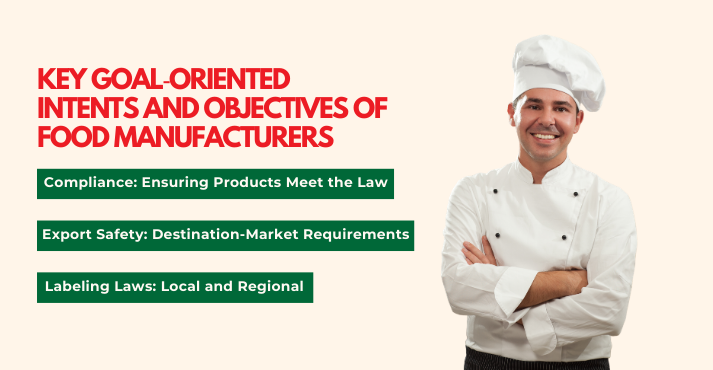
Here are the key goal‑oriented intents and objectives of food manufacturers:
Compliance: Ensuring Products Meet the Law
Manufacturers must align processes with specific laws in each market.
In Japan, the Food Sanitation Act sets specifications for foods and prohibits the sale of products containing harmful substances.
Compliance involves implementing HACCP plans, maintaining sanitary facilities, monitoring additive limits, and keeping traceability records.
In China, obtaining production licences and ensuring labels conform to GB 7718 standards, including information on origin, production date, additives, and licence numbers, is essential.
For India, FSSAI registration and adherence to FSSAI standards cover manufacturing practices, permissible additives, and laboratory testing.
Export Safety: Meeting Destination-Market Requirements
Exporters must satisfy both the home country’s laws and the importing country’s standards.
Japanese exporters should follow the Food Sanitation Act and Food Labeling Law while also meeting the importing nation’s requirements.
Meanwhile, the Chinese Food Safety Law places responsibility on overseas exporters to ensure products and labels comply with Chinese standards and encourages traceability and recall systems.
For novel and genetically modified foods, Singapore’s FSSA requires pre‑market approval. Thus, obtaining internationally recognised certifications (e.g., HACCP, ISO 22000) and participating in third‑party audits can streamline market access.
Labeling Laws: Understanding Local and Regional Labeling Rules
Labeling is a common compliance hurdle across Asia.
China’s regulations require pre‑packaged foods to display product name, net content, production date, list of ingredients, producer information, shelf life, standard code, storage instructions, additive names, and licence number.
In Malaysia, the Food Act prohibits false or misleading labels and advertisements.
FSSAI guidelines govern nutritional labelling, allergen warnings, and claims, and South Korea’s Food Sanitation Act defines labelling and nutrition information requirements.
Therefore, companies should maintain updated label templates and consult local legal counsel to keep pace with changes.
Intent Diversity in Food Manufacturing Regulations
People searching for information about food manufacturing in Asia do not all have the same goal.
Some want to understand the rules, others want to find official regulations, and many want to take action by getting certified or licensed.
Addressing these different intents helps readers find what they need quickly while supporting safer, more compliant food manufacturing across the region.
Let’s break this down into three intents:
1. Informational Intent: How to Navigate Food Manufacturing Standards in Asia
Readers with informational intent are looking for clarity. They want a simple, country-by-country view of how food safety regulations work and what manufacturers are expected to follow.
- China: Governed by the Food Safety Law, China requires manufacturing licences, strict hygiene controls, traceability, recall systems, and detailed food labelling, including origin, ingredients, and additives.
- Japan: Food manufacturing is regulated through multiple laws, including the Food Sanitation Act and Food Labeling Law, covering additives, processing standards, and consumer-facing labels.
- India: The Food Safety and Standards Act sets science-based standards for food production. Licensing, inspections, and compliance are overseen by the national food authority.
- South Korea: The Food Sanitation Act focuses on preventing health risks, requiring licensing, traceability, and accurate labelling throughout the supply chain.
- Singapore: Recent reforms have consolidated food laws, introduced clearer approval pathways for specific food categories, and strengthened pre-market controls.
- Malaysia: The Food Act aims to protect consumers from health risks and fraud, regulating food preparation, manufacturing, and sale.
This overview helps readers compare regulatory approaches across Asia without getting lost in legal detail.
2. Navigational Intent: Food Safety Regulations by Country
Some readers already know what they’re looking for; they just need the right official source. For this intent, clarity and direction matter most.
Key regulatory bodies and official resources:
- China: National food safety standards and labelling rules
- Japan: Ministry of Health, Labour and Welfare
- India: Food Safety and Standards Authority of India
- South Korea: Ministry of Food and Drug Safety
- Singapore: Singapore Food Agency
- Malaysia: Ministry of Health: Food Safety and Quality Division
Pointing readers to the correct authority saves time and reduces the risk of relying on outdated or unofficial information.
3. Transactional Intent: Certification Process for Asian Food Manufacturers
Readers with transactional intent are ready to act. They want practical guidance on how to meet requirements and gain approval to operate or export.
Common steps to get certified:
- Adopt Food Safety Systems: Many regulators expect manufacturers to implement preventive systems such as Good Hygiene Practices (GHP) and Hazard Analysis and Critical Control Points (HACCP).
- Obtain International Certification: Standards like ISO 22000 help businesses identify food safety risks, document controls, and build trust with international buyers.
- Secure Country-Specific Licences: Manufacturers must register with national authorities (such as FSSAI, MFDS, or SFA). Most countries now offer online portals for applications, renewals, and compliance updates.
This step-by-step guidance helps businesses move from understanding regulations to meeting them in practice.
Entity-Based Reformulations and Country-Specific Regulations

Breaking down food manufacturing standards by country helps businesses understand the regulatory frameworks for food production across Asia.
This clarity allows organisations to plan more effectively for Asian food manufacturing compliance, especially when operating across multiple jurisdictions.
1. Japan – Food Sanitation Act and Related Laws
Japan’s food safety regime comprises multiple statutes. The Food Sanitation Act specifies standards for foods, beverages, apparatus, containers, and packaging; prohibits the manufacture and sale of foods containing harmful substances; and provides for inspections and monitoring.
The Food Labeling Law sets requirements for product names, ingredients, allergens, and nutritional information. The Act on Domestic Animal Infectious Diseases Control and the Health Promotion Law also influence food production.
Thus, companies exporting to Japan must ensure that production processes and labels meet these detailed standards.
2. China – Food Safety Law and Labeling Requirements
China’s Food Safety Law sets up a licensing system for producers and requires proper storage, recall procedures, and supervision of import and export.
Overseas exporters bear responsibility for ensuring products comply with Chinese standards; labels must include country of origin, manufacturer information, net content, production date, ingredients, shelf life, standard code, and production licence number.
The law emphasises risk assessment, traceability, and mandatory recall mechanisms. New Decree 248/249 (2022) requires foreign producers to register with Chinese customs and include the Chinese registration number on packaging.
3. India – FSSAI Guidelines and Enforcement
India’s Food Safety and Standards Act created the FSSAI to lay down science‑based standards and regulate manufacture, storage, distribution, sale, and import to ensure safe and wholesome food.
FSSAI standards cover permissible food additives, contaminants, packaging materials, and labelling. The agency conducts inspections and sampling and can order product recalls.
FSSAI’s online licensing portal allows manufacturers and exporters to apply for or renew licences, and it provides guidelines on nutritional labelling and claims.
4. South Korea – Food Sanitation Act and Traceability
South Korea’s Food Sanitation Act aims to improve public health by preventing sanitary risks and providing accurate information.
It defines foods, food additives, apparatus, and containers, and requires licensing for collecting, manufacturing, processing, cooking, storing, or selling foods.
The Act mandates traceability to manage foods showing safety issues, enabling authorities to investigate causes and take corrective action. Also, Korea has separate acts for functional foods, imported food, and children’s dietary safety.
5. Singapore – Food Safety and Security Act 2025
Singapore’s new Food Safety and Security Act consolidates multiple laws and strengthens food safety to address novel challenges.
The Act, passed in January 2025, aims to refresh existing legislation and keep pace with emerging challenges. It introduces “defined food” (novel, genetically modified or insect‑like species) and makes it an offence to supply such foods without pre‑market approval.
The Act also replaces the previous regulation of non‑packaged drinking water and sets standards for water quality management.
6. Malaysia – Food Act 1983 and Food Regulations 1985
Malaysia’s Food Act protects the public against health hazards and fraud in the preparation, sale, and use of food. It empowers authorities to close insanitary premises, prohibit the sale of food not of the nature or quality demanded, and enforce labelling and advertisement rules.
The Food Regulations 1985 complement the Act by specifying standards for labelling, additives, and food categories.
The Importance of Sustainability and Decarbonization in the Agri-Food Industry
The production processes are intertwined with environmental challenges across the food and beverage industry in Asia.
Data shows that agriculture accounts for roughly 26 % of Asia’s greenhouse‑gas emissions, with rice cultivation, fertiliser use, ruminant livestock, food loss, and deforestation contributing half of these emissions.
Southeast Asia and South Asia are particularly emission-intensive. Decarbonising the agri‑food value chain is therefore crucial.
Sustainability initiatives and decarbonisation efforts include:
Precision Agriculture and Resource Efficiency
Practices such as precision irrigation, regenerative farming, and the use of alternative proteins can significantly reduce emissions and water consumption.
Agriculture already uses the majority of Asia’s freshwater, and improving irrigation efficiency is critical to easing future water stress.
Food Waste Reduction
Governments and industry players are focusing on better storage, transport, and cold-chain infrastructure to limit losses.
Digital tools and AI are increasingly used to improve demand forecasting and optimise supply chains, reducing waste at multiple stages.
Carbon Footprint Reporting and Reduction
More food manufacturers are measuring and disclosing emissions, setting science-based targets, and adapting operations to meet buyer and regulatory expectations.
At the same time, governments are exploring incentives and policy tools to encourage lower-carbon food manufacturing.
Audits and Continuous Improvement
A regular food safety audit helps evaluate management systems, verify compliance, and identify risks related to hygiene, storage, sanitation, and employee practices.
When combined with recognised certifications such as HACCP and ISO 22000, audits support both safety and sustainability goals.
Together, these initiatives play a vital role in building a resilient food supply chain, one that can meet growing demand, reduce environmental impact, and maintain consumer trust while adapting to climate and regulatory pressures.
Challenges and Opportunities in Harmonizing Food Manufacturing Standards Across Asia

The region’s legal diversity and differing enforcement capacity make harmonisation difficult, but collaboration, capacity building, and technology can help close the gap. Yet opportunities for collaboration and technological innovation can drive convergence.
Challenges in Food Manufacturing Across Asia
Here are the main obstacles that slow alignment across jurisdictions.
Regulatory Diversity and Trade-Frictions
Divergent licensing procedures, customs rules, and food-safety requirements create non-tariff barriers that raise export costs, especially for small firms. This complexity especially affects cross-border food manufacturing, where differing rules multiply compliance burdens.
No Legally Binding Regional Enforcement
ASEAN’s harmonisation relies largely on voluntary alignment with international standards (eg, Codex Alimentarius); consensus decision-making limits the bloc’s ability to force compliance, and capacity gaps across members slow progress.
Fragmented value chains and limited inspector capacity
The food sector is dominated by many small and medium operators with uneven compliance readiness. Risk-based inspection regimes and targeted capacity building are needed to raise on-the-ground standards.
Opportunities in Aligning Food Manufacturing Standards
Practical steps and opportunities that can help countries converge on common standards:
Codex Adoption and Mutual Recognition
Faster, broader adoption of Codex standards and mutual recognition of certifications (HACCP, ISO 22000, national licences) would reduce duplicative inspections and smooth trade flows.
Targeted Capacity Building
Regional training and risk-based inspection programmes for regulators and industry help lift baseline competence and create shared practices for enforcement. Projects that train inspectors and food business operators support this effort.
Technology and Digital Collaboration
Digital traceability, blockchain, AI, and IoT can speed information sharing, enable remote audits, simplify certification checks, and link SMEs into wider supply networks.
Adoption of food technology, therefore, offers practical pathways to transparency and lower compliance costs.
Conclusion
Asia’s influence on global food supply means that robust and harmonised food manufacturing standards are essential.
While regulations vary, from China’s comprehensive Food Safety Law to Singapore’s novel Food Safety and Security Act, Japan’s Food Sanitation Act, and India’s FSSAI framework, common themes include preventive controls, licensing, labelling, and traceability.
Sustainability and decarbonisation, supported by audits and certifications, are becoming integral to compliance as the region confronts climate change and resource constraints.
For manufacturers, navigating these diverse frameworks requires continual monitoring of national legislation, investing in HACCP and ISO 22000 programmes, and engaging with regulatory bodies.
Thus, leveraging technology to enhance traceability and adopting sustainable practices can not only ensure compliance but also open new market opportunities.
Given this, staying informed and proactive will help businesses in the food industry in Asia thrive amidst evolving standards and contribute to a safer, more resilient global food system.