You’re in your tiny test kitchen at 2 a.m., staring at a ruined batch while an excited buyer texts: Can you do 500 cases by next month?
That jolt, equal parts pride and panic, is a familiar founder moment. It’s the instant your idea stops being a hobby and starts demanding systems, partners, and tough trade-offs.
Scaling up food production is thrilling: the chance to see your product on real shelves, in real fridges, in front of real customers.
Also, it is risky: one supplier glitch, one mislabeled lot, one miscalculated cost can wipe out margins or your reputation.
And it’s operationally complex, as sourcing bulk ingredients, investing in equipment, meeting minimum order quantities (MOQs), and navigating freight costs all test a young company’s resilience.
In this guide, founders and experts break down exactly how to scale a food startup without losing quality, margins, or your sanity.
So, if you’re ready to move beyond your home kitchen, this is your roadmap.
Why Scaling a Food Startup Is Harder Than It Looks
The leap from small‑batch production to regional or national distribution exposes hidden pitfalls.
Scaling a recipe isn’t as simple as multiplying ingredients; heat transfer, mixing, and packaging all behave differently at larger volumes.
Supply chains, cash flow, and regulatory complexity constrain a food startup’s growth.
The Hidden Challenges of Scaling Food Products

Scaling introduces challenges that are often overlooked:
Shelf‑life Issues
The product shelf life depends on moisture, temperature, oxygen, light, and time.
What remains stable for weeks at home may degrade quickly in distribution. Code dates like “Best if used by” are voluntary, but food founders must test shelf life to ensure quality throughout distribution.
Ingredient Sourcing at Volume
Ingredients behave differently when scaled; formulas may require reformulation and functional substitutes. Thus, sourcing large quantities may require new suppliers and can expose quality variations.
Cash‑flow Strain
Packaging suppliers often require minimum runs of 50,000 containers, even when a co‑manufacturer can run 5,000 units. Tying up capital in packaging inventory creates cash‑flow risk.
Manufacturing Consistency
Consistency suffers when equipment, mixing times, and heat transfer change. Thus, each change of equipment alters product characteristics; detailed planning and pilot runs are essential.
Regulatory Hurdles
Food businesses must comply with FDA rules and cGMPs. Hazard analysis and critical control points (HACCP) plans depend on prerequisite programs like Good Manufacturing Practices.
Distribution Complexity
New brands ship less‑than‑truckload (LTL) volumes. The LTL pallets can cost US$100–300 for <300 miles and US$200–400 for 300–800 mile lanes. Small orders mean high per‑unit freight costs.
What Breaks First When You Scale
- Formulas & recipes: Taste or texture changes at larger batch sizes
- Shelf life & product stability: Spoilage risks increase
- Supply chain & contracts: Suppliers struggle to meet volume
- Cash flow & inventory: Upfront costs balloon, tying up capital
- Processes & operations: Consistency gaps in production
- Compliance & paperwork: Regulatory requirements multiply
The 5 Stages of Scaling a Food Startup

Food product commercialization is not a single leap but a sequence of stages.
Growing startups systematically move from test batches to national distribution, focusing on different priorities at each stage.
This framework helps founders identify common mistakes and allocate resources effectively.
A Stage-by-Stage Framework for Scaling From Kitchen to Retail
| Stage | Typical volume | Primary focus | Common mistakes | Founder priority |
| Test | Small batch (home kitchen or shared kitchen) | Product‑market fit and recipe refinement | Scaling too early without feedback | Collect consumer feedback and iterate |
| Local | Farmers markets / local stores | Branding & packaging; pricing | Under‑pricing the product; ignoring margins | Protect margins and gather retailer feedback |
| Regional | Using a co‑packer | Building operations systems | Signing bad contracts or ignoring minimum orders | Ensure reliable supply and refine contracts |
| National | Retail & distributors | Certifications & regulatory compliance | Stockouts due to poor demand planning | Build a resilient supply chain |
| Expansion | Multi‑SKU line across multiple channels | Brand & portfolio management | Overcomplicating operations and losing focus | Invest in systems and strategic planning |
Stage 1: Test
In the test stage, founders make small batches in home or shared kitchens, sell directly, and solicit feedback.
The goal is to confirm that customers love the concept and to iterate quickly. Avoid investing heavily in branding or scale yet; the priority is product‑market fit.
Stage 2: Local
Once a recipe resonates, founders expand to farmers’ markets and local stores. At this stage, packaging becomes important: design, nutrition panels, and basic labeling.
Under‑pricing is common; track the cost of goods sold (COGS) and ensure margins support future growth. Use local feedback to improve packaging functionality.
Stage 3: Regional
Regional distribution often requires partnering with a co‑packer. This stage demands operational systems, inventory tracking, quality control, and supplier contracts.
Common mistakes include signing unfavorable co‑packer agreements or misjudging minimum order quantities (MOQs).
Stage 4: National
National expansion introduces retail chains and distributors. Certifications such as HACCP, organic, and allergen labeling become critical.
Without robust demand planning, brands suffer stockouts or overproduction. Distributors and retailers demand a consistent supply, so founders must build strong supply chains.
Stage 5: Expansion
Beyond a single product, founders launch multiple SKUs or enter new categories. Brand management and portfolio strategy become paramount.
Complexity rises quickly; invest in systems and hire experienced operations managers. Avoid dilution by focusing on core products and profitable channels.
Manufacturing: In-House vs Co-Manufacturing
Determining when to move production from your kitchen to a co‑manufacturer (or “co‑packer”) is one of the toughest decisions for any founder bringing food products to market.
That said, it is a balance between maintaining quality, managing costs, and meeting growing demand, a critical step that can make or break your scaling strategy.
When Should You Move to a Co-Manufacturer?
Founders often start by making everything themselves.
So, if you’re ready for a co‑packer when you don’t want to invest in your own facility, or your operations cannot produce at a larger scale.
Also, co‑packers require demand projections and sufficient shelf life to meet their minimums. If multiple co‑packers decline because your volumes are too low, stay in‑house until sales grow.
Here’s an in‑house vs co‑manufacturing comparison:
| Factor | In‑House | Co‑Manufacturer |
| Control | High control over recipe and process | Medium control; partner determines equipment and processes |
| CapEx | High: must buy equipment and lease space | Low: avoid major capital expenditure |
| Speed | Slow setup, but can iterate quickly | Faster scaling once contracted |
| Risk | Operational: equipment failures and capacity constraints | Dependency on partner; risk of quality issues or slotting out small clients |
| Best for | Early‑stage companies testing products or needing unique processes | Growth‑stage brands with stable recipes and predictable demand |
Signs It’s Time to Switch
- Meeting demand requires more than 40–50 hours of production per week, or you’re turning down orders.
- You’ve validated demand and have purchase orders that exceed your in‑house capacity.
- Your cash flow can cover the co‑packer’s minimum batch and packaging MOQs.
- Your product has a long enough shelf life to handle larger runs.
Questions to Ask Co‑Packers
It is recommended to ask co‑packers about their quality control processes, ingredient sourcing standards, communication channels, pricing, and hidden costs. Also, clarify who owns your recipe and intellectual property. Seek partners with certifications (cGMP, HACCP) and strong food safety records.
Here are some red flags you need to watch out for:
- The co‑packer does not provide documentation of Good Manufacturing Practices or refuses audits.
- Minimum order quantities are ambiguous or unrealistic for your current demand.
- Communication is slow or unresponsive during the evaluation phase.
Maintaining Quality at Scale
Consistent taste, texture, and safety are non‑negotiable as volumes increase. Losing quality will erode customer trust and invite recalls.
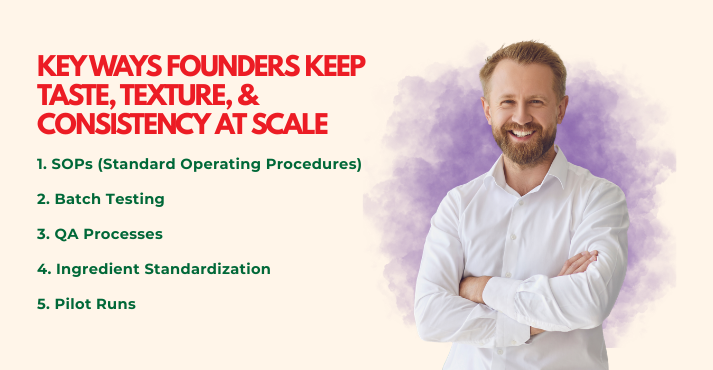
How Founders Keep Taste, Texture, and Consistency at Scale
Here’s how to maintain quality at scale food production:
SOPs (Standard Operating Procedures)
Standard Operating Procedures keep every batch consistent. SOPs define equipment, times, temperatures, and critical control points, ensuring each team member knows exactly how to execute the process.
Batch Testing
Batch testing ensures your product stays true to its original taste and texture. Every batch should be sampled for key characteristics like weight, texture, flavor, and pH or sugar levels.
Keeping a “golden batch” as a reference helps identify deviations quickly, so issues can be corrected before the product reaches customers.
QA Processes
QA processes protect quality at scale. Any deviations are logged with corrective and preventive actions, and every batch is fully traceable to its ingredients, equipment, and operators to maintain accountability and compliance.
Ingredient Standardization
Standardizing ingredients prevents variation that can alter your product. Clear specifications, from fat content to moisture levels, and trusted suppliers ensure consistency.
During food manufacturing scale-up, certificates of analysis and small test adjustments for new lots help maintain quality.
Pilot Runs
Pilot runs act as practice for full-scale production. Start small and gradually increase batch size, testing every aspect, from raw materials to packaging performance.
Sensory panels and shelf-life checks reveal any changes in taste, texture, or stability, allowing SOPs to be refined before full-scale production.
Mini Case Study: How Brand X Preserved Flavor at 20,000 Units/Month
When Brand X, a hypothetical organic salsa company, scaled from 500 jars to 20,000, early co‑packer batches lost the punch that made their product stand out.
Herbs steeped too long, muting brightness, and the overall flavor became bland. Through targeted pilot runs, the founder refined the process: fresh herbs were added later in the cook, salt levels were adjusted, and a pH buffer improved shelf stability.
Weekly sensory tests with the co‑packer’s QC team ensured consistency, while detailed documentation of all parameters created a reliable blueprint for large-scale production.
Costs & Unit Economics of Scaling
Scaling increases expenses beyond raw ingredients. Understanding cost drivers helps founders price products appropriately.
What It Actually Costs to Scale a Food Brand
Expenses fall into several categories:
- Packaging: Costs vary based on materials, sustainability, and custom designs. Premium or imported packaging increases expenses and can affect per-unit pricing.
- Manufacturing & MOQs: Co‑packers often require large minimum batches, and packaging suppliers may have high order minimums. While larger volumes reduce per-unit costs, they tie up capital.
- Certifications: Organic, non‑GMO, or gluten-free certifications involve application, auditing, and licensing fees. Cost-share programs may offset some expenses.
- Freight and Logistics: Transport, pallet prep, labor, storage, and 3PL handling add up quickly. Efficient planning is key to controlling these costs.
- Broker/Distributor Fees: Distributors and brokers take a share of margins. While this reduces gross profit, they provide wider market access.
- Spoilage and Returns: Unsold, expired, or damaged products increase costs. Returns processing in 3PLs also adds expenses.
- Compliance & Labeling: Beyond certifications, nutrition labels and regulatory compliance are required for most scaling food products, adding design, testing, and reporting costs.
Sample Cost Breakdown
Here’s a hypothetical breakdown of the cost of goods sold (COGS) percentages for a shelf‑stable snack sold for $5 at retail (numbers will vary by product):
| Expense | % of COGS | Notes |
| Raw ingredients | 20 % | Ingredients, seasonings, stabilizers |
| Packaging | 15–30 % | Boxes, bags, labels; tariffs can add 25 % |
| Manufacturing & labor | 20 % | Co‑packer fees, overhead, and direct labor |
| Freight/logistics | 10–15 % | LTL pallets, FTL shipments, warehousing |
| Distributor/broker margins | 15–25 % | Distributor margin 8–25 %; broker 3–5 % |
| Certifications & compliance | 2–5 % | Organic, non‑GMO, HACCP audits |
| Spoilage & returns | 2–5 % | Expired products, unsellable goods |
These percentages show why a snack that costs $1.50 to produce may sell for $5 retail: supply chain partners and overhead absorb a large share of revenue.
Certifications, Compliance & Getting Retail-Ready

Regulatory compliance builds consumer trust and ensures retail acceptance. Founders must navigate federal, state, and retailer requirements.
Certifications & Compliance Checklist for National Distribution
Before scaling to national retailers, make sure your food brand meets essential certifications and regulatory requirements to protect quality, safety, and legal compliance.
- FDA Compliance: Register your facility, follow the Food Safety Modernization Act, implement cGMPs, and develop a HACCP or preventive controls plan. cGMPs and prerequisite programs must be in place before HACCP.
- Nutrition Labels: Conduct nutritional analysis and design FDA-compliant labels. Small businesses under certain sales thresholds may qualify for exemptions, but making claims like “low sugar” or “high protein” requires full labeling.
- Shelf-life Testing: Test pH, water activity, and microbiological stability in labs. Factors like moisture, temperature, oxygen, and light affect shelf life. Document results to reassure retailers.
- HACCP/Preventive Controls: Perform hazard analysis, verify critical control points, and keep records of audits and cGMPs.
- Organic & Non-GMO Certifications: Obtain USDA organic certification and submit annual inspections. Non-GMO verification requires full ingredient traceability.
- Insurance: Maintain general liability, product liability, and recall coverage. Large retailers may set minimum coverage requirements.
Distribution & Getting Into Retail
In the food product commercialization journey, choosing the right path for retail distribution for startups shapes everything from margins to brand control.
From Local Stores to National Retail: Distribution Strategy
Startups must weigh efficiency, cost, and growth potential when planning their go-to-market strategy for food.
1. Direct Distribution
Sell directly to independent retailers or via e‑commerce.
- Pros: Full control over pricing, brand messaging, and customer relationships.
- Cons: Shipping to many stores individually is time-consuming and inefficient.
- Best for: Early-stage brands and niche retailers.
2. Distributors
Distributors purchase your product and deliver it to retailers.
- Pros: Rapid scale and access to many stores without handling logistics.
- Cons: Take 20–25 % margins for shelf-stable products, 25–35 % for refrigerated items.
- Best for: Brands ready to scale and maintain a steady supply.
3. Brokers
Act as sales representatives, pitching your brand to buyers.
- Pros: Open doors to distributors and retailers without inventory management.
- Cons: Earn 3–5 % commission; success depends on your product and pitch.
- Best for: Brands seeking fast introductions to retail buyers.
Founder Insight: “What I wish I knew before pitching mt business was how quickly they’d ask for supply-chain proof and sales velocity, not just a great taste.”
Founder Stories
Real stories reveal the grit behind scaling:
TBJ Gourmet – Turning Disaster Into Success
Bacon‑jam startup TBJ Gourmet once discovered that 500 jars of jam turned green because sulfur in garlic oxidized copper.
Instead of discarding the batch, co‑founder Michael Oraschewsky rebranded it as a St Paddy’s Day special. “Tossing 500 jars would not sink the company, but it represented hours of labor… we had Saint Paddy’s Day Bacon Jam!! Never give up”.
The lesson: mistakes happen, use creativity to turn them into marketing opportunities.
Snacklins – Building a Factory Out of Necessity
Samy Kobrosly of Snacklins explains that he tried to outsource production, but co‑manufacturers couldn’t handle his fresh ingredients.
He searched for equipment in China, modified machines, and built his own facility. “We didn’t manufacture because it made us feel good; we manufactured out of necessity”.
The lesson: unique processes may require investing in your own plant to retain control and differentiation.
Brand Z – Switching Co‑Packers After Quality Dip
A nut‑butter startup scaled from 1,000 to 10,000 jars via a co‑packer.
However, the co‑packer switched ingredient suppliers without notice, causing flavor changes and consumer complaints. The founder terminated the contract, found a co‑packer with better communication, and instituted quarterly audits.
Lesson: vet partners thoroughly and monitor quality continuously.
Timeline: How Long Does Scaling Take?

Scaling a food startup takes months or years; expecting overnight national distribution sets you up for disappointment.
How Long Does It Take to Scale a Food Startup?
Here’s a realistic timeline range for scaling up food production:
- Discovery & Alignment (2–4 weeks): Define the product concept, target consumer, and unique value proposition.
- Bench Development (4–12 weeks): Develop prototypes, refine flavor, test ingredients, and iterate based on feedback.
- Scale‑Up & Co‑Manufacturer Selection (6–12+ weeks): Identify co‑packers, negotiate MOQs, conduct pilot runs, and adjust formulations.
- Commercialization & Launch (6–10 weeks): Finalize packaging, pricing, certifications, and distribution agreements. Plan marketing campaigns and coordinate with retailers.
Total: 4–7 months from concept to first retail launch under optimal conditions. Larger projects or highly regulated products may take a year or more.
Step-by-Step Action Plan
A 90‑day roadmap can help founders transition from small batch to regional production. Adjust the timeline to fit your business size and resources.
Your 90-Day Scaling Plan
| Weeks | Focus Area | Key Actions |
| 1–4: Validate and Prepare | Product validation & cost tracking |
|
| 5–8: Operations Setup | Contracts, compliance & certifications |
|
| 9–12: Manufacturing & Retail Prep | Pilot runs, logistics & marketing |
|
Completing this plan positions your brand for regional distribution and sets the foundation for national expansion.
FAQ
What are the biggest challenges to scaling food products?
Scaling introduces shelf‑life risks, sourcing at volume, cash‑flow strain from MOQs, manufacturing consistency issues, and regulatory hurdles. Distribution and freight costs add complexity.
When should startups use co-manufacturers?
Move to a co‑packer when demand exceeds in‑house capacity, you’ve validated product‑market fit, and you can meet co‑packer minimums. Co‑packers reduce capital expenditure but require stable recipes and shelf life.
How much does it cost to scale a food product?
Costs vary widely. Packaging often represents 10–40% of the retail price. Freight can cost US$100–400 per pallet depending on distance. Distributors and retailers take 8–25% and 35–45% margins, respectively. Organic certification costs range from a few hundred to thousands of dollars.
How do you maintain quality at scale?
Develop SOPs, conduct pilot runs, implement QA programs, and monitor critical control points. Adjust recipes for larger batches and standardize ingredients.
What certifications are required to sell nationally?
FDA facility registration, nutrition labels (unless exempt), HACCP or preventive controls plans, and possibly organic, non‑GMO, or allergen certifications. Insurance is essential for liability.
How long does scaling take?
Moving from concept to first retail launch typically takes 4–7 months. Highly regulated or complex products may take longer.
Conclusion
Scaling up food production transforms a beloved kitchen recipe into a brand that reaches thousands of customers.
However, the journey is not just about multiplying ingredients; it requires building robust systems, managing cash flow, mastering logistics, and navigating complex regulations.
Therefore, founders should view scaling not as a single leap but as a series of disciplined stages: validate, optimize, partner, expand, and refine.
Along the way, mistakes are inevitable, but creative problem-solving can turn setbacks into opportunities.
Whether you choose an in-house facility or a co-manufacturer, it is essential to invest in SOPs, quality control, and certifications to safeguard your product’s integrity.
At the same time, remember that packaging, freight, and distributor margins will impact profits, so careful financial planning is crucial.
That said, with thoughtful preparation, a resilient team, and a willingness to learn from every challenge, you can scale smartly, maintain margins, and preserve your sanity while successfully bringing your food innovation to market.