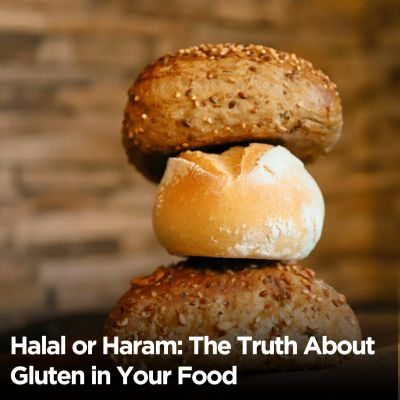
With the rise of gluten-free labels on food products, many Muslims are left wondering: Is gluten halal?
The growing demand for gluten-free foods, driven by health trends and celiac disease awareness, has led to confusion among Muslim consumers trying to understand whether gluten’s halal or haram status aligns with Islamic dietary laws.
For those adhering to Islamic dietary rules, determining is gluten haram in Islam is not always clear-cut. Questions such as can Muslims eat gluten? or is gluten halal or haram? frequently arise, especially when processed foods are involved. Similar concerns also appear when comparing gluten with other religious food frameworks like kosher food.
Common areas of concern include school meals, packaged foods, and everyday bread. Many gluten-free products are advertised as free of wheat or other gluten-containing grains. However, gluten-free labeling standards differ from halal certification, as explained in discussions around gluten-free vs halal diet.
However, they may still contain non-Halal ingredients or be processed with alcohol-based enzymes, making them unsuitable for Muslim consumers. Understanding ingredient transparency is essential, especially in the era of transparency in food labeling.
This overlap of health needs and Islamic dietary rules creates an emotional challenge, as food choices are not only about health but also about religious compliance.
This article breaks down gluten step by step from ingredient definition to Islamic ruling so you can confidently answer whether gluten is halal and make informed food choices.
What Exactly Is Gluten? (Ingredient-Level Breakdown)
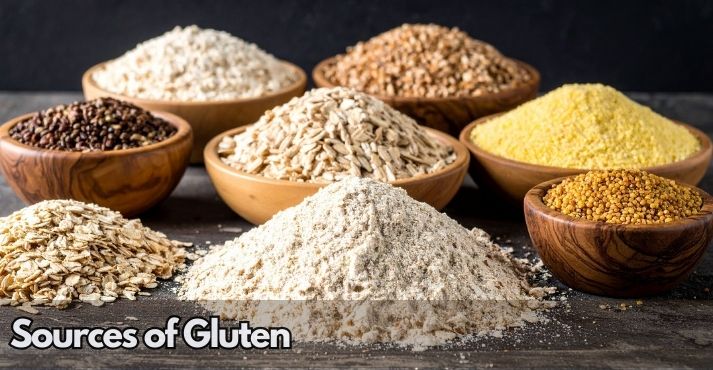
Before answering whether gluten is halal or haram, it’s important to understand the gluten means and its origin.
Gluten is a group of proteins found naturally in certain cereal grains that gives dough and baked goods their elasticity and texture. The science behind fermentation and dough development is further explored in bulk fermentation in bread making.
These proteins, gliadin and glutenin, form a network that helps bread rise and maintain its chewy texture while giving pasta its firm structure.
Natural sources of gluten include:
- Wheat — the most common source
- Barley — used in malt and beer
- Rye — found in certain breads and cereals
Barley’s connection to alcoholic beverages is also linked to broader discussions about beer industry trends and fermentation processes.
Since gluten is plant-derived, scholars agree that gluten is halal by origin unless mixed with haram substances during processing.
Gluten is plant-based and not animal-derived, meaning it doesn’t come from animals or involve animal products. Therefore, gluten itself is inherently permissible in Islam and does not have any Haram implications related to animal impurity.
The demand for gluten-free foods has also grown significantly. In 2024, the global gluten-free products market was valued at USD 7.75 billion, with projections to reach USD 13.67 billion by 2030, driven by increasing consumer awareness of gluten-related disorders and dietary preferences.
This sets the foundation for understanding how gluten fits within dietary and religious contexts like Halal.
Is Gluten Halal or Haram in Islam? (The Core Answer)
Gluten itself is halal by origin.
Gluten does not contain alcohol, is not intoxicating, and is not derived from animals. Therefore, it cannot be classified as najis (impure).
Many Muslims also ask:
-
Is gluten haram?
-
Gluten is it halal?
-
Apakah gluten halal? (Indonesian/Malay: Is gluten halal?)
Islamic scholars generally agree that plants are considered Halal unless they are transformed with Haram substances. Since gluten is a plant-based protein, it does not inherently contain anything that would make it impure.
It does not contain alcohol by default, and gluten does not carry najis (impurity). Therefore, gluten retains its Halal status unless contaminated by non-Halal substances during processing.
The Halal status of gluten remains unaffected as long as the ingredients or processing methods used do not involve forbidden (Haram) substances, such as alcohol-based flavorings or Haram enzymes.
Muslims can generally consume gluten as long as they ensure that it hasn’t been modified in a way that would make it unsuitable for consumption under Islamic law.
So to clarify:
-
Gluten is halal
-
Gluten is not haram by default
-
The issue lies in processing, not the protein itself
Islamic Scholar Consensus & Fiqh Rulings on Gluten
Islamic scholars across the four major Sunni schools of jurisprudence (Hanafi, Maliki, Shafi‘i, and Hanbali) agree on a foundational principle: all plant-based substances are halal by default unless they are harmful or mixed with haram elements.
Since gluten is a naturally occurring plant protein derived from wheat, barley, or rye, it falls under the category of permissible foods.
Key Islamic principles supporting gluten’s permissibility:
-
Al-Asl fil Ashya’ al-Ibahah — The default ruling of things is permissibility.
-
Gluten is not najis (impure)
-
It is not intoxicating.
-
It is not derived from animals.
Therefore, gluten itself is halal by origin.
Scholarly concern only arises when:
-
Gluten is processed using alcohol-based solvents
-
Enzymes are derived from non-halal animal sources
-
It is included in products containing intoxicating substances (e.g., beer)
Adding scholarly grounding increases religious credibility and improves trust signals for Muslim readers searching for fiqh-based rulings.
How Halal Certification Works?
Halal certification ensures that a product complies with Islamic dietary law not only in ingredients but also in processing, storage, and transportation. These standards are closely tied to international food safety systems such as HACCP and structured food safety audits.
When evaluating gluten-containing foods, look for certification from recognized bodies such as:
-
IFANCA (Islamic Food and Nutrition Council of America)
-
HFA (Halal Food Authority – UK)
-
JAKIM (Malaysia)
-
MUIS (Singapore)
-
GCC accreditation bodies
A halal logo typically guarantees:
-
No haram ingredients
-
No cross-contamination
-
No alcohol-based processing
-
Proper slaughter (if applicable)
Important: Gluten-free certification does NOT verify halal compliance. Gluten-free labeling is regulated differently, similar to other labeling systems explained in food labels around the world.
Detailed Ingredient Guide: Halal vs Haram vs Mashbooh
When assessing gluten-containing foods, the gluten protein itself is rarely the issue. The surrounding additives are what require scrutiny.
Generally Halal
-
Wheat gluten
-
Vital wheat gluten
-
Corn gluten
-
Rye protein
-
Barley protein (unless in intoxicating beverages)
-
Plant-based emulsifiers
-
Yeast (standard baking yeast)
Potentially Mashbooh (Questionable)
-
Enzymes (source not specified)
-
Mono- and diglycerides
-
Lecithin (if unspecified source)
-
Malt extract
-
Yeast extract
-
Natural flavorings
Haram (If Confirmed)
-
Alcohol used as an additive
-
Ethanol-based flavor carriers
-
Pork-derived enzymes
-
Animal rennet from non-halal slaughter
-
Intoxicating beverages containing barley
Many of these fall under the broader category of food additives, which require ingredient-level verification.
When Does Gluten Become Questionable (Mashbooh) or Haram?
Though gluten itself is considered halal by origin, there are instances where its status can become questionable (mashbooh) or potentially haram, depending on how the grain proteins are processed.
It is the processing methods, not the gluten itself, that can introduce substances of concern under Islamic dietary principles.
Processing Methods That Can Affect Halal Status
- Fermentation: Some industrial food processes use fermentation systems that may produce alcohol (ethanol) as a by‑product. While naturally occurring traces of ethanol from fermentation are typically minimal, higher levels intentionally produced or added during processing may raise concerns under Islamic dietary guidelines. Understanding the source and amount of alcohol is crucial in evaluating whether a product remains compliant with Halal expectations.
- Alcohol‑Derived Enzymes: Certain enzymes used in the modification or extraction of gluten may be produced using alcohol‑based growth media or solvents. If these enzymes or their production methods involve Haram substances, they can impact the final product’s acceptability from an Islamic perspective.
- Industrial Processing Aids: Large‑scale manufacturing may use processing aids such as solvents, microbial cultures, or additives that introduce non‑Halal elements into gluten‑containing foods. It is these added components, not the gluten protein, that can make a product questionable or haram.
The key takeaway is that gluten often enters foods through complex processing that may introduce other substances. Contaminants or additives, rather than gluten itself, are what can affect the permissibility of the final food.
Gluten vs. Fermentation vs. Alcohol – What Muslims Need to Know
A common worry among Muslim consumers is whether gluten might contain alcohol. Gluten itself does not contain alcohol. Any alcohol present in a food product results from processing methods, not from the gluten protein.
Here’s the practical difference:
- Natural fermentation, such as yeast activity in bread or sourdough, typically produces only trace amounts of alcohol that are part of the baking process and are not intended for intoxication. This type of fermentation does not automatically make a product haram.
- Alcohol‑producing fermentation aims to produce ethanol for beverages such as beer. The presence of significant alcohol levels in the finished product is what matters for Islamic dietary concerns, not the mere act of fermentation itself.
Understanding alcohol content requires knowing what ABV means and how alcohol levels are measured, as explained in ABV (Alcohol by Volume).
Alcohol-producing fermentation aims to produce ethanol for beverages such as beer. For deeper insight into brewing, see how to brew beer.
Common Gluten-Containing Foods – Halal or Not?
Here’s a practical way to understand when gluten‑containing foods are generally Halal and when you should be more cautious based on how they’re made or labeled.
| Food Product | Gluten Source | Halal Status | What to Check on Label |
| Plain bread | Wheat | Usually Halal | Ensure no alcohol, animal fats, or non‑Halal enzymes |
| Pasta | Wheat | Usually Halal | Confirm no alcohol‑derived additives |
| Soy sauce | Wheat (in fermentation) | Be cautious | Look for gluten‑free and Halal certification |
| Seitan | Wheat gluten | Be cautious | Verify no alcohol or Haram flavoring agents |
| Processed snacks | Wheat/barley/rye | Be cautious | Check for hidden gluten and alcohol‑based ingredients |
Gluten contamination remains a real concern even in foods labeled gluten‑free. A 2025 study found that 50.31 % of naturally gluten‑free flours and 16.67 % of certified gluten‑free flours contained gluten above 20 ppm, highlighting that cross‑contamination is common and can occur at several stages of production.
When evaluating whether a gluten‑containing food is Halal, ingredient logic and processing transparency matter most. Look closely at ingredient lists for alcohol‑based carriers, non‑specified enzymes, or other additives that could affect Halal status.
Clear Halal certification and detailed nutritional information help distinguish foods safe for Muslim consumers from those that require additional scrutiny.
Hidden Ingredients Muslims Should Watch For
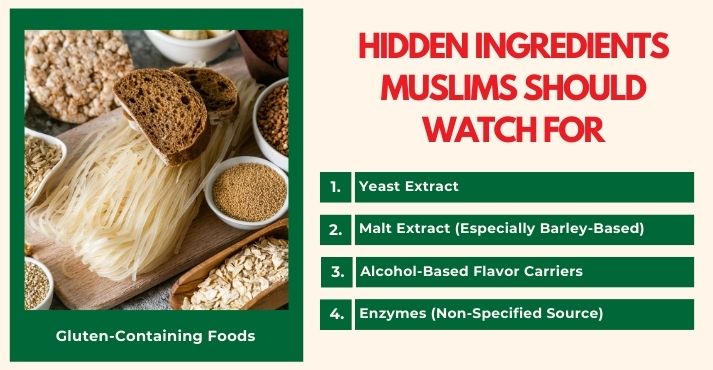
When consuming gluten-containing foods, Muslims should be cautious of certain hidden ingredients that may be introduced during processing.
These ingredients can make a food product unsuitable for those following Islamic dietary laws, even if the primary ingredients seem Halal. It’s essential to carefully check labels for these potential contaminants.
- Yeast Extract: Yeast extract is a common ingredient used for flavoring, but it can sometimes be derived from non-Halal sources or processed with alcohol. It’s important to verify its source and whether it has been processed in compliance with Halal standards.
- Malt Extract (Especially Barley-Based): Malt extract is often derived from barley and used as a sweetener or flavor enhancer. However, barley-based malt extract may be processed with alcohol or other non-Halal ingredients, so it is important to verify whether it is Halal-certified.
- Alcohol-Based Flavor Carriers: Many processed foods contain alcohol-based flavor carriers that help dissolve or enhance the flavors in the product. These alcohols are typically derived from fermentation processes and should be avoided by Muslims who are concerned with Halal compliance. The key is to look for any alcohol derivatives listed on the label.
- Enzymes (Non-Specified Source): Enzymes are commonly used in food technology and processing to enhance texture, color, and taste, particularly in products containing gluten. However, when enzymes are listed without a specified source, there is a chance they might be derived from non-Halal animal sources or produced using alcohol. Always check that the enzymes are Halal-certified or have a clearly identified plant-based origin.
This is particularly relevant in today’s climate of growing demand for ingredient origin transparency across global food supply chains.
Processing methods, including fermentation or enzyme extraction, may inadvertently introduce Haram elements into gluten-containing products, creating confusion for consumers.
The best way to avoid this is to ensure that all products are clearly labeled with Halal certification or detailed ingredient sourcing.
Gluten‑Free vs. Halal – Why They Are NOT the Same
Gluten‑free and Halal labels serve very different purposes, which can lead to confusion.
- Gluten‑free is a medical designation aimed at individuals with celiac disease or gluten sensitivity, ensuring the absence of gluten to prevent health issues.
- Halal, on the other hand, is a religious compliance standard that ensures food aligns with Islamic dietary laws.
Despite being labeled gluten-free, many foods may still contain ingredients or processing methods that violate Halal requirements. These could include alcohol‑based flavor carriers, non‑Halal enzymes, or cross‑contamination during production.
Recent real‑world testing shows the challenge of relying solely on gluten‑free labels. In 2024, analysis of 26 gluten‑free oat products found that five (about 19%) tested positive for quantifiable gluten, indicating that cross‑contact can occur even in foods marketed as gluten‑free.
Here’s a quick comparison to highlight the key differences:
| Aspect | Gluten‑Free | Halal |
| Basis | Health / medical requirement | Religious compliance |
| Intent | Prevent gluten-related health issues | Prevent consumption of Haram substances |
| May still contain | Alcohol, non‑Halal enzymes, cross‑contamination | Gluten, plant‑based proteins (if processed safely) |
| Label guarantees | Gluten content below 20 ppm (medical) | Compliance with Islamic dietary laws |
This comparison makes it clear that gluten‑free does not automatically mean Halal. Each label requires careful verification to ensure compliance with both health and religious standards.
Muslims with Celiac Disease or Gluten Sensitivity
Islam places a high priority on health and well-being. Avoiding gluten for medical reasons, such as celiac disease or gluten sensitivity, is not only valid but encouraged, as it aligns with the Islamic principle of protecting one’s health.
For Muslims managing health conditions that require a gluten-free diet, this is an acceptable necessity, and it should be recognized that Islam permits exceptions when health is at risk.
The intersection of Halal and gluten-free diets can often lead to confusion, particularly in school meal policies. Many schools are beginning to offer gluten-free meals, but institutional confusion arises when the distinction between gluten-free and Halal is not made.
In some cases, gluten-free options may still contain Haram ingredients or be prepared using non-Halal methods.
This highlights the importance of advocacy for proper labeling and certification in food products. Muslims with gluten sensitivities need assurance that their food meets both health and religious requirements.
Schools, hospitals, and food manufacturers must ensure that both dietary needs are met through proper labeling and adherence to both Halal and gluten-free standards.
How to Shop for Gluten Products as a Muslim
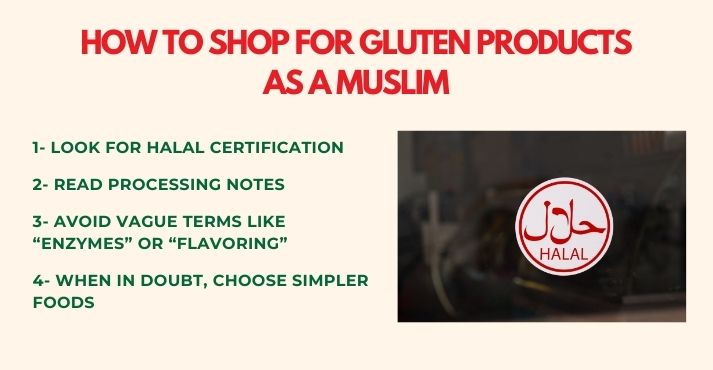
When buying food containing gluten, taking a few simple steps can help ensure your choices align with both Halal principles and your dietary needs. Here’s a practical checklist to guide you:
- Look for halal certification: Products with recognized Halal certification provide added reassurance that the ingredients and processing comply with Islamic dietary standards. Certified items help reduce uncertainty about hidden Haram substances.
- Read processing notes: Carefully check ingredient lists for any mention of processing aids, flavor carriers, or ambiguous terms. Detailed processing notes often reveal whether alcohol‑based agents or non‑Halal production methods were used.
- Avoid vague terms like “enzymes” or “flavoring”: If an ingredient is listed without a defined source, it could be derived from animal or alcohol‑based origins. When in doubt, choose products that specify plant‑based or Halal‑approved sources.
- When in doubt, choose simpler foods: Whole foods such as fruits, vegetables, plain meats, and naturally gluten‑free grains are easier to evaluate and less likely to contain questionable additives.
Real‑world analysis highlights the risk of relying solely on labeling: a meta‑analysis found that 41.5 % of gluten‑free foods at food service outlets tested positive for gluten contamination, indicating that labels and production practices can fall short of expectations.
When in doubt, choose simpler whole foods or products aligned with sustainable foods and clean-label practices.
Optional tip: If you’re unsure about a product, don’t hesitate to ask the manufacturer directly about Halal compliance and processing methods. Choosing certified products and seeking clarity helps make informed decisions that respect both health and faith.
Gluten Halal in Different Countries
Halal standards vary by country.
-
Malaysia (JAKIM) has strict centralized certification.
-
UAE and GCC countries require formal halal compliance for imports.
-
US and Europe rely on private halal certification bodies.
-
Some countries regulate gluten-free labeling (<20 ppm threshold) but do not regulate halal claims.
Important distinction: Gluten-free labeling is legally regulated in many countries. Halal labeling may not be.
Evaluating Halal Status of Gluten in Restaurants & Prepared Foods
Eating out introduces additional complexity.
Even if bread, pasta, or pizza dough contains halal gluten, risks include:
-
Alcohol in sauces
-
Non-halal meat cross-contact
-
Shared utensils with pork products
-
Beer-based marinades
-
Wine in gravies
Best practice questions to ask restaurants:
-
Is alcohol used in sauces or cooking?
-
Are vegetarian dishes cooked separately from pork?
-
Are enzymes or dough conditioners plant-based?
If answers are unclear, choose simpler dishes or certified halal establishments.
Frequently Asked Questions
Is gluten halal in Islam?
Yes, gluten is halal by origin because it is a plant-based protein and does not inherently contain any prohibited substances. However, it’s important to check the processing methods to ensure that no Haram ingredients are added during production.
When Does Gluten Become Haram?
Although gluten is halal, it can become problematic if:
-
Alcohol is added intentionally
-
Pork-derived enzymes are used
-
It is included in intoxicating beverages
This is why the correct question is not simply “is gluten haram?” but rather: Has the gluten-containing product been processed in a halal-compliant way?
Similar ingredient-level debates also arise in modern discussions such as is lab-grown meat halal.
Can Muslims eat wheat gluten?
Wheat gluten is halal unless it has been processed with Haram ingredients, such as alcohol or non-Halal enzymes. Muslims should check labels for hidden additives or cross-contamination that could affect the product’s Halal status.
Is Wheat Gluten Halal?
Another common concern is:
-
Is wheat gluten halal?
-
Is wheat gluten haram?
-
Wheat gluten halal or haram?
Wheat gluten, including vital wheat gluten used in bread and seitan, follows the same ruling. Since it is extracted from wheat (a plant), it remains halal unless processed using alcohol-based solvents, pork-derived enzymes, or other prohibited substances.
So in short: Wheat gluten is halal unless altered with haram ingredients.
Does gluten contain alcohol?
No, gluten itself does not contain alcohol. However, during processing, some gluten-containing foods may involve fermentation or other methods that introduce alcohol, so it’s essential to check the ingredients for any alcohol-based additives.
Can Muslims eat gluten?
Yes, Muslims can eat gluten as long as the final product does not contain alcohol, pork derivatives, or other prohibited ingredients.
Is fermented gluten haram?
Fermented gluten is generally halal, provided the fermentation process does not involve alcohol or Haram substances. Natural fermentation, like in bread, typically doesn’t produce problematic levels of alcohol.
Is gluten in bread halal?
Gluten in bread is halal as long as no Haram ingredients, such as alcohol-based additives or animal fats, are used in the bread-making process. Always check the ingredients and processing methods for full assurance.
Apakah gluten halal?
Ya, gluten halal secara asal kerana ia berasal daripada tumbuhan dan bukan bahan haiwan atau alkohol.
Do scholars agree on gluten?
Yes, Islamic scholars generally agree that gluten is halal by origin because it is derived from plants. The concern arises when gluten is processed with non-Halal substances, so Muslims should ensure the food is prepared according to Halal standards.
Conclusion
To summarize clearly:
-
Gluten is halal by origin
-
Gluten itself is not haram
-
Processing methods determine final permissibility
-
Always verify certification for packaged foods
Understanding whether gluten is halal or haram requires knowledge, not fear. By checking labels and seeking proper halal certification, Muslim consumers can confidently navigate both health needs and religious obligations.
Gluten itself is halal by origin, as it’s a plant-based protein that doesn’t inherently conflict with Islamic dietary laws. However, the processing methods can affect its Halal status.
From fermentation to enzyme extraction, certain production practices may introduce Haram substances like alcohol or non-Halal enzymes.
Knowledge is more important than fear when navigating food choices. Being literate in label reading and ingredient understanding allows Muslim consumers to choose food that meets both health and religious standards confidently.
By staying informed and checking labels for Halal certification and processing details, Muslims can eat with confidence, avoid confusion, and make empowered decisions about their food.