
Hotels have historically delivered strong, resilient long-term returns, supported by consistent travel demand, diversified revenue streams, and the ability to adapt to changing market conditions.
As global mobility continues to recover and expand, hotels remain a compelling asset class for investors seeking income generation and long-term value creation.
The global hospitality industry is projected to reach US$5.8 trillion by 2027, growing at a 5.5% compound annual growth rate (CAGR).
This growth is driven by rising leisure and business travel, expanding middle-class populations, particularly across the Asia-Pacific, and increased demand for experiential and wellness-focused stays.
At the same time, investors are benefiting from advances in hotel technology, evolving design approaches, the rise of dual-branded hotels, and operational insights gained in the post-COVID environment.
This guide is a complete blueprint for hotel investment, covering market outlooks, hotel categories, investment models, emerging trends, design strategies, risk management, franchise buying, leading hotel chains, financial evaluation, and practical guidance for investors at every stage.
Understanding the Global Hotel Industry Today
The global hotel industry continues to operate at scale, supported by recovering travel demand and long-term consumption trends. Industry estimates indicate approximately 17.5 million guestrooms across 187,000 hotels worldwide, reflecting the sector’s size and maturity.
Growth in international tourism, the return of corporate travel, and rising middle-class populations, especially across the Asia-Pacific, are sustaining demand.
At the same time, travellers are increasingly prioritising experiential, wellness-focused, and culturally connected stays, influencing how hotel assets are developed and positioned.
The industry also faces structural challenges that investors must consider. Dependence on online travel agencies (OTAs) affects profitability, competitive saturation places pressure on pricing, and seasonality increases exposure to economic cycles.
Sustainability requirements and regulatory frameworks are shaping both development and operations.
As a result, investment strategies are increasingly focused on digital guest experiences, eco-tourism concepts, smart hotel technologies, and hybrid or experiential business models that support operational efficiency and long-term performance.
Key Market Forces Shaping Hotel Investments
Several structural and operational forces are influencing how hotel assets are developed, operated, and valued. Understanding these forces helps investors assess risk exposure, operational resilience, and long-term return potential across different hotel markets.
Post-COVID Realignment of Guest Expectations
The post-pandemic recovery has reset how hotels operate and how guests assess value. Occupancy has recovered unevenly across markets, with domestic and regional travel leading demand growth, supported by recovery data tracked by the World Travel & Tourism Council.
Operational priorities now emphasise enhanced hygiene standards, simplified service delivery, and flexible operating structures.
Over the longer term, labour shortages, wage inflation, and cost volatility have led hotel owners to prioritise lean staffing models, tighter cost control, and greater operational flexibility.
Technology Adoption as a Core Investment Driver
Technology has become an important investment consideration rather than a supporting feature. Intelligent hotels are increasingly adopting smart check-in systems, connected guest rooms, AI-enabled concierge services, and energy management platforms.
For investors, automation enables reduced labour dependency, predictive maintenance, improved asset utilisation, and more precise revenue management, contributing directly to margin protection and RevPAR optimisation.
Evolving Guest Preferences & Experiential Travel
Guest demand favours boutique-style accommodations, personalised service, and experiences rooted in local culture and design. Wellness-oriented offerings, including spa, fitness, and mental well-being concepts, are becoming more integrated into hotel positioning.
These preferences influence asset selection, design decisions, and brand alignment, particularly in competitive urban and resort markets.
Types of Hotels Investors Should Understand
From an asset perspective, investors typically evaluate hotels across two primary categories: cost structure, operational complexity, and revenue-generating potential.
Understanding the differences between full-service and limited-service hotels helps investors align capital allocation, risk tolerance, and return expectations with the appropriate hotel format.
1. Full-Service Hotels – High-Touch, High-Revenue Assets
Full-service hotels offer a wide range of amenities designed to deliver a comprehensive guest experience. These typically include on-site restaurants and bars, concierge services, meeting and conference facilities, spas, fitness centres, and business services.
They are well-suited to business travellers, luxury guests, and extended-stay visitors seeking convenience and premium service.
From an investment standpoint, full-service hotels require higher capital expenditure (CAPEX) and operating costs (OPEX) due to staffing, facilities, and maintenance requirements.
However, they also offer stronger average daily rates (ADR) and higher RevPAR potential when demand conditions are favourable. Well-known examples include Hilton, Marriott, and Four Seasons.
2. Limited-Service Hotels – Lean, Efficient & Profitable
Limited-service hotels focus on essential accommodations with streamlined operations. These properties typically exclude restaurants and extensive amenities, operate with smaller teams, and rely on standardised service models.
Common locations include highway corridors, airports, and budget-focused urban markets where efficiency and accessibility are priorities.
For investors, limited-service hotels benefit from lower CAPEX requirements, reduced labour dependency, and simpler operational oversight.
Automation and sustainable design features further enhance efficiency and cost control. Examples of this category include Holiday Inn Express, RedDoorz, and Premier Inn.
Hotel Investment Models and Entry Options
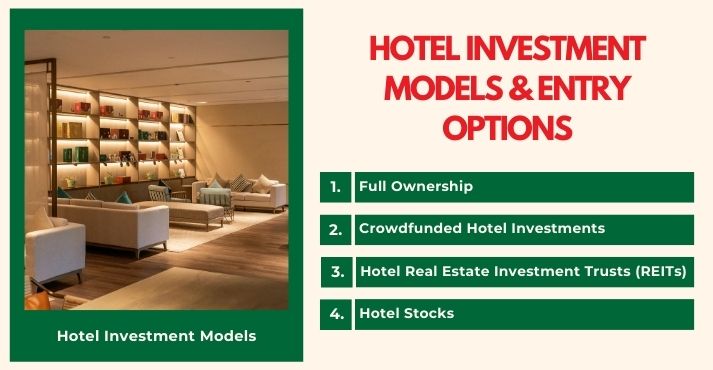
Hotel investors can choose from several investment models depending on available capital, risk tolerance, and desired level of involvement.
These models range from hands-on ownership structures to passive, market-based investments, each offering different risk–return profiles and operational responsibilities.
1. Full Ownership
Full ownership provides investors with complete control over hotel operations, branding, pricing, and strategic direction. This model places responsibility for day-to-day operations, marketing, staffing, property maintenance, and guest service directly with the owner or appointed management team.
Full ownership is best suited to boutique hotels, lifestyle properties, and resort assets where differentiation, brand identity, and operational control play a significant role in value creation.
While this approach offers maximum flexibility and upside potential, it also requires substantial capital investment, operational expertise, and active oversight.
2. Crowdfunded Hotel Investments
Crowdfunded hotel investments allow smaller investors to participate in hospitality assets through pooled capital structures. This model lowers entry barriers and spreads risk across multiple participants, making hotel investment more accessible.
When evaluating crowdfunding opportunities, investors should assess market fundamentals, platform credibility, transparency, regulatory compliance, and the quality of investor communication.
While crowdfunding can provide exposure to unique or boutique projects, outcomes depend heavily on project selection and governance standards.
3. Hotel Real Estate Investment Trusts (REITs)
Hotel REITs offer a passive investment approach through publicly traded shares that represent ownership in diversified hotel portfolios. Benefits include liquidity, regular dividend distributions, and professional asset management.
Returns remain influenced by tourism cycles and economic conditions, which can introduce periods of volatility. Hotel REITs are generally suited to investors seeking income generation with minimal operational involvement.
4. Hotel Stocks
Investing in hotel stocks provides equity exposure to publicly listed hotel companies, with returns generated through share price appreciation and, in some cases, dividends.
Compared with REITs, hotel stocks typically exhibit higher volatility but may offer greater upside during strong market cycles.
Risks include economic downturns, travel disruptions, and sector-specific shocks, making this option more suitable for investors comfortable with market-driven fluctuations.
Emerging Hotel Business Models Worth Investing In
Certain hotel business models are attracting investor interest for their ability to improve space utilisation, diversify revenue streams, and support consistent operational performance.
Dual-branded hotels and intelligent hotels are increasingly applied in urban, mixed-use, and cost-sensitive developments where efficiency and scalability are priorities.
Dual-Branded Hotels – Maximizing Space & Efficiency
Dual-branded hotels operate two hotel brands within a single property, sharing core infrastructure, including back-of-house operations, staffing, and facilities.
This model is commonly used in dense urban locations, mixed-use developments, and transit-oriented sites where land values and construction costs are high.
From an investor perspective, shared operations can reduce overhead costs, while lower capital expenditure per key improves development efficiency.
Serving multiple guest segments, such as short-stay and extended-stay travellers, also supports more balanced demand patterns. Key considerations include brand compatibility and coordinated management to ensure operational clarity and consistent service standards.
Intelligent Hotels – Data-Driven, Automated Hospitality
Intelligent hotels apply automation and connected systems to improve operational control and asset performance.
These properties integrate smart access and check-in, connected room infrastructure, AI-supported service platforms, and IoT-based energy systems into daily operations.
For investors, intelligent hotels support cost control, maintenance planning, and sustainability performance. Automation reduces labour intensity, connected systems support predictive maintenance, and energy optimisation improves operating efficiency.
Over time, these capabilities contribute to stable operations, guest retention, and long-term asset value.
Hotel Design Trends That Influence Investment Value
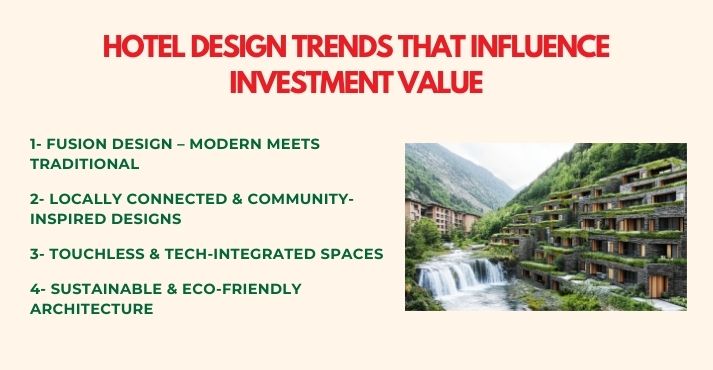
From an investment perspective, hotel design directly affects pricing power, operating efficiency, and long-term asset durability.
Design decisions influence how effectively a property can command premiums, control costs, and remain competitive as market expectations and regulatory requirements evolve.
1. Fusion Design – Modern Meets Traditional
Fusion design combines contemporary layouts and materials with culturally rooted architectural or interior elements. For investors, this approach supports wider market appeal without committing the asset to a narrow design identity.
Properties that balance modern functionality with cultural authenticity often achieve stronger ADR performance while maintaining relevance across both international and regional guest segments.
2. Locally Connected & Community-Inspired Designs
Community-inspired design integrates local materials, craftsmanship, and cultural references into the built environment.
From an investment standpoint, this strengthens destination alignment and supports premium positioning, particularly in leisure-driven and experiential markets.
Assets with strong local identity tend to differentiate more effectively in competitive locations, supporting rate resilience over time.
3. Touchless & Tech-Integrated Spaces
Design increasingly incorporates technology at the spatial level, including automated access points, tech-enabled lobbies, and integrated room controls. These design choices support smoother guest flow, reduce operational friction, and improve space efficiency.
For investors, tech-integrated environments contribute to more predictable operating performance and lower long-term staffing pressure.
4. Sustainable and Eco-Friendly Architecture
Sustainable architecture prioritises energy-efficient systems, responsible material selection, and waste reduction. These design choices directly affect operating expenses and asset lifespans.
Hotels designed with sustainability in mind often benefit from lower OPEX, improved regulatory alignment, and stronger long-term valuation, particularly as environmental standards tighten across markets.
Financial Assessment Framework for Hotel Investors
A structured financial assessment framework is essential for evaluating hotel investments across different market cycles. Investors must assess revenue potential, cost structures, and capital requirements while accounting for the inherent volatility of the hospitality sector.
For example, 2025 performance data show that global RevPAR expanded by approximately 0.2%, supported by a modest increase in ADR even as occupancy softened, reinforcing the importance of pricing discipline and cost control in financial assessments.
Key Investment Metrics and Valuation Methods
Hotel performance is commonly assessed using a combination of operating metrics and valuation tools. Average Daily Rate (ADR) measures pricing strength, while Revenue per Available Room (RevPAR) captures the combined effect of pricing and occupancy.
Net Operating Income (NOI) reflects profitability after operating expenses, and occupancy rate indicates demand consistency.
Valuation analysis typically incorporates capitalisation rates (cap rates), discounted cash flow (DCF) models that project future income, the comparable sales method, and the cost approach, which estimates replacement value relative to acquisition cost.
Budgeting, Forecasting & Capital Planning
Effective investment decisions rely on realistic revenue projections and detailed operating expense (OPEX) analysis.
Investors must evaluate staffing costs, utilities, maintenance, and brand-related fees alongside planned capital expenditure (CapEx) for renovations, upgrades, and repositioning.
Sensitivity analysis remains essential in volatile markets, allowing investors to test performance under varying assumptions for occupancy, rates, and operating costs.
Cash Flow Management & Liquidity Planning
Recent market disruptions have reinforced the importance of disciplined cash flow management. Maintaining adequate cash reserves helps absorb demand fluctuations and unforeseen expenses.
Flexible staffing structures, backup revenue sources such as extended-stay demand or mixed-use components, and lean operating models improve financial resilience.
Strong liquidity planning allows hotel assets to remain operationally stable during periods of uncertainty while protecting long-term investment value.
Risk Mitigation Strategies for Hotel Investors
Hotel investments involve exposure to market cycles, operational risks, and external disruptions. Effective risk mitigation focuses on portfolio construction, disciplined acquisition practices, financial resilience, and adaptable operations.
- Diversification Across Assets & Locations: Spreading investments across multiple properties, regions, and hotel categories reduces reliance on any single asset or market. Diversification across business, leisure, and extended-stay demand segments also helps stabilise performance during localized downturns or seasonal fluctuations.
- Deep Due Diligence Before Acquisition: Thorough due diligence enables investors to identify operational, financial, and regulatory risks before committing capital. This includes evaluating market fundamentals, supply pipelines, historical performance, asset condition, management capability, and compliance with zoning and legal requirements.
- Sound Financial Planning & Conservative Leverage: Maintaining disciplined financial structures supports long-term stability. Investors should incorporate contingency reserves, limit leverage levels, and stress-test financial models against changes in occupancy, room rates, and operating costs to ensure resilience under adverse scenarios.
- Insurance & Legal Protections: Comprehensive insurance coverage helps protect against property damage, liability exposure, and business interruption. Legal safeguards, including well-structured contracts and compliance frameworks, reduce exposure to operational and regulatory risks.
- Operational Agility & Market Responsiveness: Hotels that can adjust pricing, staffing, and service offerings quickly are better equipped to manage market volatility. Flexible operating models and responsive management support revenue continuity and protect asset performance during periods of uncertainty.
Buying a Hotel Franchise – Complete Step-by-Step Guide

Buying a hotel franchise requires a structured approach that balances brand alignment, financial feasibility, and long-term operational commitments. A clear, sequential process helps investors manage risk, clarify obligations, and evaluate the commercial viability of a franchise opportunity.
Step 1 — Market Research & Franchise Selection
- Brand reputation and performance history: Assess the franchisor’s track record, brand recognition, and historical performance across comparable markets.
- Fees, support, and target audience: Review franchise fees, royalty structures, marketing contributions, and the level of operational and training support provided. Alignment between the brand’s target audience and local market demand remains essential.
Step 2 — Negotiation & Deal Structuring
- Commercial terms and incentives: Negotiate royalty fees, marketing fees, renewal terms, and any available incentives tied to development timelines or performance.
- Support and training provisions: Clarify pre-opening assistance, ongoing training, and operational support to ensure expectations are clearly defined from the outset.
Step 3 — Legal Documentation & Compliance
- Core agreements and disclosures: Review the Franchise Agreement, Franchise Disclosure Document (FDD), and Non-Disclosure Agreement (NDA) to understand rights, obligations, and potential exposure.
- Property and intellectual property terms: Examine lease contracts, intellectual property agreements, renewal conditions, and compliance requirements to ensure legal and operational clarity.
Step 4 — Financing & Funding Options
- Debt and equity structures: Funding may include bank loans, SBA-backed financing (where applicable), franchisor financing, private investors, crowdfunding, or seller financing.
- Capital structure alignment: The financing mix should support cash flow stability while allowing flexibility during early operating periods.
Step 5 — Finalising the Deal & Onboarding
- Execution and payments: Complete contract signing, pay franchise and initial fees, and finalise financing arrangements.
- Training and pre-opening support: Participate in franchisor-led training programmes and pre-opening support to ensure operational readiness and brand compliance before opening.
Top Global Hotel Chains Investors Should Know
Global hotel chains offer investors brand strength, operating systems, and demand generation that can materially influence asset performance. Different chain categories appeal to different investment objectives, from premium pricing to scale-driven efficiency.
Luxury Chains
Marriott International, Hilton Worldwide, Hyatt Hotels Corporation
Luxury hotel groups are associated with strong average daily rates (ADR), established loyalty programmes, and high brand recognition. These chains support premium positioning, particularly in gateway cities and resort destinations, where brand equity and service consistency influence pricing power and long-term asset value.
Fast-Growing Asian Chains
OYO, Jin Jiang Hotels
Rapidly expanding Asian hotel groups benefit from scale, asset-light expansion models, and strong regional demand. These chains are attractive in growth markets where standardisation, speed of deployment, and cost discipline support expansion across secondary and tertiary cities.
Budget & Value Chains
RedDoorz, Premier Inn, Motel One
Budget and value-focused chains prioritise operational efficiency, standardised service models, and high occupancy levels. These brands perform well in price-sensitive markets, transport hubs, and urban locations where consistency and affordability drive steady demand.
Extended-Stay Chains
Extended Stay America, Ascott
Extended-stay operators benefit from longer guest booking cycles and more stable occupancy patterns. These chains are well-suited to business travel, relocation demand, and long-term stays, offering investors predictable cash flows and lower guest turnover.
Luxury Hospitality Insights – Lessons from High-End Hotels
Luxury hotels provide insight into how premium assets generate value through pricing strength, brand recognition, and experience-led demand.
Properties such as the Burj Al Arab, Mandarin Oriental, Marina Bay Sands, and Ashford Castle highlight how high-end hotels operate within a different economic framework from mass-market assets.
- High ADR Power: Luxury hotels operate at the upper end of the rate spectrum, supported by limited supply, brand recognition, and destination appeal. This allows operators to sustain premium ADRs even during softer demand periods.
- Experiential Premium: Revenue generation extends beyond accommodation through curated dining, wellness, cultural programming, and personalised services. These elements support higher total spend per guest and reduce reliance on room revenue alone.
- Strong Global PR Impact: Iconic luxury properties benefit from consistent international media exposure and alignment with destination marketing. This visibility supports sustained demand from high-value traveller segments.
- Fierce Brand Loyalty: Repeat visitation and loyalty programme participation are common within the luxury segment, contributing to demand stability and predictable revenue streams across market cycles.
Future Trends Shaping Hotel Investments (2025–2030)
The next phase of hotel investment will be influenced by structural changes in operations, traveller expectations, and capital allocation priorities. These trends are shaping how hotel assets are developed, managed, and valued over the medium to long term.
- Automation and AI: Automation and artificial intelligence are being applied to pricing, forecasting, maintenance planning, and guest service workflows. These tools support operational efficiency, data-driven decision-making, and margin management.
- Sustainability & ESG-Focused Reporting: Environmental and social performance metrics are playing a larger role in investment decisions. Hotels with strong ESG frameworks can benefit from improved capital access, regulatory alignment, and lower operating costs.
- Contactless Services: Digital check-in, mobile access, and integrated service platforms support operational consistency and guest convenience while enabling leaner staffing structures.
- Boutique and Experiential Travel: Demand for smaller-scale, experience-driven properties remains strong in both leisure and urban markets. These assets often support higher ADRs through differentiation and local relevance.
- Wellness and Medical Tourism: Wellness-oriented accommodation, preventative health travel, and medical tourism continue to expand demand beyond traditional leisure segments, supporting longer stays and off-peak occupancy.
- Mixed-Use and Co-Living Models: Developments that combine hotels with residential, retail, or co-working components allow for diversified income streams and improved land use efficiency.
- AI-Driven Revenue Management Systems: Advanced revenue platforms integrate real-time demand data, pricing algorithms, and distribution controls, improving forecasting accuracy and rate optimisation.
Step-by-Step Guide for New Hotel Investors
This step-by-step framework outlines the execution sequence new hotel investors typically follow, from opportunity screening to long-term asset planning.
- Market Research: Identify target markets based on demand stability, competitive supply, seasonality patterns, and future development pipelines before shortlisting opportunities.
- Property and Brand Assessment: Assess asset condition, location quality, brand fit, and alignment with the intended guest segment to ensure operational and commercial compatibility.
- Financial Modelling: Prepare detailed projections covering revenue, operating costs, capital expenditure, and financing assumptions to evaluate feasibility and return potential.
- Risk Assessment: Review exposure across market, operational, regulatory, and financial dimensions to understand downside scenarios and tolerance limits.
- Operational Strategy: Define the management structure, service scope, staffing approach, and operating standards required to support the chosen hotel model.
- Technology Integration: Select systems that support property management, revenue control, reporting, and operational coordination without overcomplicating workflows.
- Long-Term Growth Planning: Plan for renovation cycles, asset repositioning, brand transitions, and exit options to maintain relevance and value over the investment horizon.
FAQs for Prospective Hotel Investors
Are hotels profitable?
Hotels can be profitable when demand, pricing, and operating costs are well managed. Profitability varies by location, asset type, and management efficiency, making disciplined analysis essential before investing.
What is the minimum capital needed to invest in hotels?
Capital requirements vary widely depending on the investment model. Options range from lower entry points through REITs, stocks, or crowdfunding to significantly higher capital for full ownership or franchise development.
How can I buy hotel shares?
Hotel shares can be purchased through public stock exchanges by investing in listed hotel companies or hotel-focused REITs. This approach offers liquidity and indirect exposure without operational involvement.
Do design trends improve ROI?
Design choices can influence pricing power, operating costs, and asset longevity. When aligned with market demand, design upgrades may support higher rates and improved long-term value.
Should I invest in hotel technology upgrades?
Technology upgrades can improve efficiency, cost control, and revenue optimisation. Investments should be evaluated based on operational impact, scalability, and alignment with the hotel’s positioning.
What is the safest hotel investment model?
Lower-risk options typically include diversified REITs or established franchises with proven operating systems. Risk levels depend on leverage, market exposure, and management structure.
Are franchises better than independent hotels?
Franchises offer brand recognition, systems, and support, while independent hotels provide greater control and flexibility. The better option depends on capital, experience, and investment objectives.
Conclusion
Hotels remain a strong long-term investment for investors who understand market fundamentals, operational discipline, technology adoption, design impact, and risk management.
While performance varies across cycles, research-driven, diversified strategies help manage volatility and deliver sustainable returns.
As the industry continues to change, innovation and evolving guest expectations will shape how hotel assets are developed and operated. Advances in automation, sustainability, experiential travel, and new accommodation models are influencing investment outcomes.
Investors who remain informed, adaptable, and forward-looking will be better positioned to navigate opportunities and challenges in the next decade of hotel investment.