The culinary world has undergone a seismic shift.
Once defined solely by technical skill and creativity in the kitchen, today’s most successful chefs have evolved into entrepreneurs, brand builders, and global business leaders.
Rather than limiting their influence to a single restaurant, they are creating scalable ventures, international restaurant groups, consumer products, media platforms, and hospitality brands.
This evolution defines culinary entrepreneurship: the ability to translate culinary expertise into structured, repeatable, growth-oriented business models.
In other words, modern chefs are no longer just crafting dishes; they are building systems, managing brands, and expanding across borders.
For chefs aspiring to turn their talent into a global enterprise, this shift requires more than passion or recognition. It demands a new mindset, one focused on scalability, brand consistency, and long-term value creation.
This article breaks down the real, actionable strategies used by chefs who have turned their culinary passion into global empires.
What Is Culinary Entrepreneurship?
Culinary entrepreneurship is the practice of turning culinary skill into scalable business ventures. It goes far beyond owning or managing a single restaurant.
Today, culinary entrepreneurs build brands that extend into product lines, media platforms, licensing, franchising, and hospitality ventures.
Unlike traditional chefs, whose primary focus is kitchen execution and daily operations, entrepreneurial chefs operate at a strategic level. They develop personal brands, launch consumer products such as sauces or cookware, license their name across markets, and use media to reach global audiences.
The mindset shift is significant: it requires thinking like a strategist and CEO rather than only a kitchen craftsman. Instead of just executing recipes, chef-entrepreneurs plan business growth, marketing, and partnerships.
Why Personal Brand Is the Foundation of Scalable Chef Businesses
Before the first franchise agreement is signed, a powerful personal brand must be established.
This brand, built on trust, authenticity, and a compelling story, is the launchpad for all future expansion. It answers the question “why you?” before “what you sell.”
Thus, personal branding typically comes before scale, not after. And successful chefs use multiple channels to build this brand equity:
- Media & Content: Television shows, podcasts, and digital content create mass visibility and establish authority.
- Storytelling & Values: Advocacy for causes such as healthier school meals or sustainability creates deep, authentic connections that endure business setbacks.
- Education: Cookbooks, online courses, and mentorship programs extend the brand’s reach into customers’ homes, building loyalty that is independent of physical location.
This brand foundation transforms a chef from a service provider into a trusted icon, making every subsequent product or restaurant launch an event rather than a risk.
Case Studies: Chefs Who Built International Brands
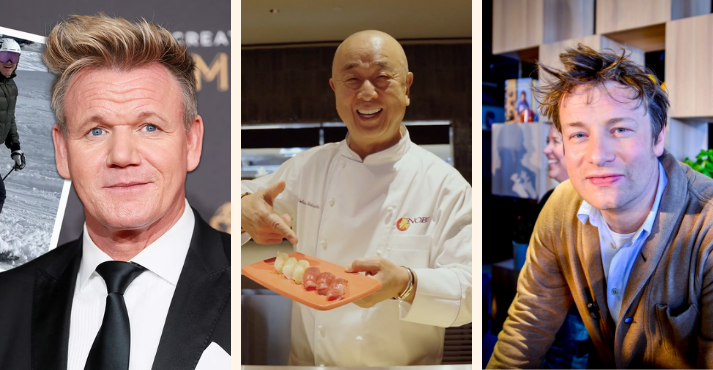
Real-world food-industry success stories show how chefs have scaledfrom one kitchen to global enterprises. Let’s look at the top three chef-entrepreneurs:
Gordon Ramsay: Media Power Meets Multi-Brand Restaurants
Chef Gordon Ramsay, known for his fiery personality, has used media fame to build a global restaurant empire.
Gordon Ramsay’s rise from a celebrated London chef to a global culinary entrepreneur demonstrates how media can function as a powerful growth engine.
His television presence, through shows such as Hell’s Kitchen and Kitchen Nightmares, did more than build fame. It established a clear, recognizable brand defined by excellence, intensity, and high standards.
Building on this visibility, Ramsay developed a multi-brand restaurant portfolio designed for different customer segments.
Under Gordon Ramsay Restaurants, he operates Michelin-starred fine dining, casual concepts, and pub-style venues. This tiered approach allows global reach while preserving core brand values. Each concept is distinct, yet unmistakably “Ramsay” in quality and execution.
As Ramsay noted, “You don’t want 100% ownership in a tiny pool, but 50% in a big pool…”
Importantly, Ramsay’s scale is driven by systems, leadership teams, and strict brand control. Recognizing he cannot be everywhere, he relies on trained chefs, managers, and standardized operating procedures to maintain consistency across locations.
Jamie Oliver: Content, Products, and Global Reach
Chef Jamie Oliver built a global audience through TV and books, which later powered his product lines and advocacy work.
Rising to fame as The Naked Chef on BBC television, Oliver connected with audiences through an approachable cooking style and relatable personality.
From the outset, he positioned content as the core of his brand. His television shows and cookbooks worked together to make cooking feel simple and enjoyable, turning him into one of the world’s best-selling cookbook authors, with more than 50 million copies sold globally.
Rather than relying primarily on restaurants, Oliver used media to achieve global distribution without physical presence. His books were translated into dozens of languages, and his shows reached households worldwide.
Although Oliver did expand into restaurants, including the Jamie’s Italian chain with around 60 locations at its peak, his brand was never restaurant-dependent. He diversified into cookware, pantry products, and licensing, while also leading influential food advocacy campaigns focused on healthier eating.
Nobu Matsuhisa: Luxury, Licensing, and Hospitality Integration
The entrance of a Nobu restaurant at Atlantis Paradise Island, Bahamas, is part of Nobu’s expansion into luxury hotels and resorts.
Nobu Matsuhisa offers a masterclass in elite brand positioning and strategic partnerships. His evolution from a single sushi restaurant to a global luxury hospitality brand was driven by two deliberate choices: maintaining exclusivity and integrating dining with high-end hospitality.
Nobu’s rise began in Los Angeles, where his Japanese–Peruvian fusion cuisine attracted a celebrity following. One of those patrons, actor Robert De Niro, recognized the brand potential and encouraged Nobu to expand.
That relationship led to the founding of Nobu Hospitality in 1994, alongside De Niro and producer Meir Teper, with a flagship restaurant in New York’s Tribeca.
Expansion followed a controlled, prestige-led strategy. Rather than pursuing scale for its own sake, Nobu entered select global cities through partnerships with high-end local operators.
The defining move came with hospitality integration. Nobu extended beyond restaurants into boutique luxury hotels, allowing guests to fully “live the brand.” Today, Nobu Hospitality operates more than 58 restaurants and 18 hotels across five continents.
Strategic partnerships remain central to the model. Celebrity backing provided visibility, while carefully selected hospitality partners supplied capital, local expertise, and operational strength.
Business Models Used by Successful Culinary Entrepreneurs
Below, we compare some common business models chefs use to grow their businesses, each with its pros, risks, and ideal fit.
| Business Model | Pros | Risks/Cons | Best Suited For |
| Owned Restaurants | Full control over concept and quality; retain all operating profits; strongest expression of personal vision. | High capital and operating costs; slower food brand expansion; full management burden; high risk if a location fails. | Chefs seeking tight control with strong operational skills and funding; often ideal for a flagship location to build brand credibility. |
| Franchising (Franchisor) | Rapid restaurant expansion using franchisee capital; wide geographic reach; recurring revenue from fees and royalties; local owners drive performance. | Reduced day-to-day control; quality risks without strong training systems; brand reputation vulnerable to weak operators; requires robust support infrastructure. | Chefs with a proven, easily replicable concept and strong brand appeal, especially in fast-casual or casual dining formats. |
| Licensing (Brand or Name Usage) | Low investment and risk; passive income through royalties; enables expansion into products, hotels, or new markets; leverages partners’ expertise. | Limited control over execution; brand damage risk if partners underperform; lower profit share than ownership; risk of brand dilution if overused. | Chefs with strong brand recognition who want to monetize their name without managing operations directly. |
| Consumer Products (CPG) | Highly scalable through retail and e-commerce; diversified revenue; brand presence in consumers’ homes; less labor-intensive than restaurants. | Competitive retail environment; quality misalignment can harmthe brand; complex manufacturing and distribution; thin margins without strong marketing. | Chefs with signature recipes or a large home-cook audience often work best alongside media or publishing platforms. |
| Media & Content (TV, Books, Digital) | Global reach with relatively low overhead; strengthens personal brand; multiple revenue streams; promotes restaurants and products indirectly. | Requires charisma and consistent content; audience attention can shift; public scrutiny is high; dependence on media partners. | Chefs who are strong storytellers or educators aiming to build celebrity status and fuel other business ventures. |
Key insight: Savvy chef-entrepreneurs often mix and match models to balance control, scale, and risk. For example, a chef might own a flagship fine-dining restaurant (owned model for quality flag-bearing), franchise a fast-casual concept to reach more cities, license their name to a hotel restaurant, sell a line of sauces in stores, and host a TV show, all at once.
Scaling Internationally: What Actually Works (and What Fails)
Growing from a local hit to an international brand is a dream for many chefs, but it’s also a minefield of challenges.
To address these challenges, chefs must consider these key strategies:
- Standardized Systems & Training: Documented recipes, service standards, and intensive training programs are non-negotiable for consistency.
- Cultural Adaptability: Menus and concepts must respect local tastes while maintaining brand DNA (e.g., Ramsay’s Lucky Cat adapting for Miami).
- Strategic Local Partnerships: Partners with local market knowledge, capital, and operational expertise are crucial for navigating new regions.
- Strong Brand Governance: A central team must vigilantly protect brand standards, quality, and the core customer experience across all locations.
Common Mistakes Chef Entrepreneurs Make
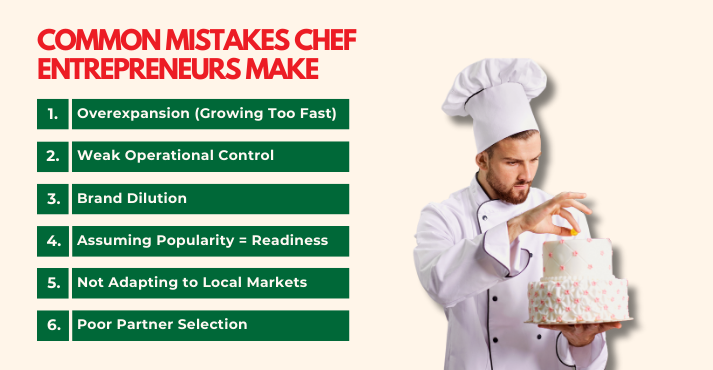
Expanding globally is fraught with potential missteps. Here are some of the most common mistakes that have derailed chefs’ international dreams:
1. Overexpansion (Growing Too Fast)
The most frequent mistake is expanding at breakneck speed without the infrastructure to support it.
Achef opens one successful restaurant, then quickly opens five more in new cities within a year, only to find quality slipping, costs ballooning, or management stretched too thin. Overexpansion can dilute what made the original great.
2. Weak Operational Control
As chefs scale, inconsistency becomes a major threat. Without strong operational controls, multiple locations can lose control of quality and consistency.
Common symptoms include dishes that don’t taste the same across outlets, inconsistent service standards, or hygiene and maintenance neglected far from headquarters.
3. Brand Dilution
Overusing a chef’s name on mismatched products or locations can erode trust and prestige. Every new venture should align with the brand’s core identity.
Maintaining a brand’s prestige often means saying no to opportunities that don’t fit. Each new venture should enhance or at least be consistent with the story you want your brand to tell.
4. Assuming Popularity = Readiness
Just because you’re a hit in one arena (say, you have a hit TV show or a famous restaurant in your city) doesn’t automatically mean you’re ready to go international.
This mistake is often an ego trap; chefs or their business teams may assume that a big social media following or a lot of press means any new project will succeed.
5. Not Adapting to Local Markets
This is worth emphasizing: a copy-paste approach, or “one-size-fits-all strategy,” is a recipe for failure in global franchising and expansion.
Whether it’s failing to adjust recipes to local tastes, ignoring local dining customs, or neglecting to hire a culturally attuned management team, a lack of adaptation can alienate customers.
6. Poor Partner Selection
Partnering can be a double-edged sword. When chefs collaborate with franchisees or investors internationally, a common mistake is to partner primarily for financial gain without assessing fit.
A bad franchise partner might cut corners to save costs, damaging the brand. Or they might lack the hospitality know-how to execute the concept.
Chefs have learned (sometimes the hard way) that it’s better to delay expansion than to say yes to an unqualified partner. Warning signs include partners who don’t value quality as much, or whose vision for the brand conflicts with the chef’s.
Beyond Restaurants: How Chefs Build Long-Term Brand Equity
Many of the world’s top chefs will tell you that if your entire empire is just restaurants, you’re putting all your eggs in one basket.
Beyond the dining room, there’s a whole universe of opportunities to grow a global culinary brand and make it enduring.
Also, diversification isn’t just about making more money; it’s also about reducing risk and increasing the ways you can connect with your audience.
Here’s how chefs are expanding beyond restaurants to build long-term brand equity:
Product Lines & Consumer Goods
Consumer products, such as sauces, spices, packaged foods, or cookware, allow chefs to reach audiences far beyond their restaurants.
These products keep the brand present in daily life, scale globally, and often provide more stable income than restaurants. Success depends on quality alignment with the chef’s reputation.
Media, Publishing, and Content
Cookbooks, TV shows, streaming content, podcasts, and digital platforms position chefs as authorities while delivering global reach.
Media often becomes a standalone pillar of the business, fueling other ventures by building trust, visibility, and long-term relevance.
Education and Mentorship
Cooking schools, online courses, and masterclasses allow chefs to share expertise while strengthening prestige and legacy. Educational platforms generate revenue and reinforce the chef’s role as a leader, shaping the next generation.
Licensing and Hospitality Ventures
Licensing chef brands into hotels, resorts, food halls, and lifestyle ventures enables capital-light expansion. Strategic hospitality partnerships elevate brand perception while extending it into travel, retail, and experiential spaces.
Digital Communities and Memberships
Subscription platforms, apps, and private communities turn fans into loyal members. These channels create recurring revenue, strong engagement, and direct access to the chef’s most committed audience, without intermediaries.
All these avenues build brand equity, making the chef’s name larger than any single restaurant. When locations close or trends shift, diversified brands can adapt and endure.
Alt-text: key-lessons-for-aspiring-culinary-entrepreneurs
Key Lessons for Aspiring Culinary Entrepreneurs
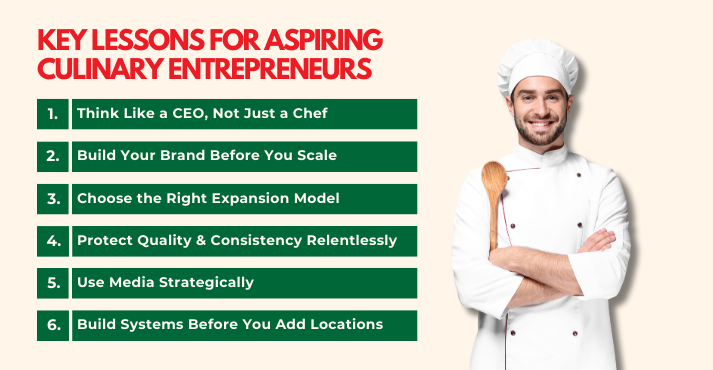
If you’re an aspiring chef-entrepreneur aiming to scale up, here are some key lessons distilled from the successes and failures of those who’ve done it. These are actionable takeaways you can start applying to your own journey:
1. Think Like a CEO, Not Just a Chef
Scaling requires business leadership, not just culinary skill. Learn finance, marketing, and people management, or partner with those who have that expertise. Work on the business, not only in it.
2. Build Your Brand Before You Scale
A strong brand attracts customers, talent, and opportunities. Define what you stand for early and reinforce it consistently. Brand equity becomes your growth engine.
3. Choose the Right Expansion Model
There’s no single path to growth. Owned locations, franchising, licensing, products, and media all have trade-offs. Expand in ways that match your strengths, capital, and risk tolerance, and be ready to pivot.
4. Protect Quality and Consistency Relentlessly
Your reputation is only as strong as the last experience under your name. Invest in training, systems, and trusted leaders to ensure consistency across every touchpoint.
5. Use Media Strategically
Media builds demand before you expand. Social platforms, press, and content serve as low-cost marketing channels that attract customers, partners, and investors. Become your own brand amplifier.
6. Build Systems Before You Add Locations
Infrastructure must come before scale. Strong operations, supply chains, and leadership enable sustainable growth. Expansion without systems leads to chaos.
Bottom line: culinary success is driven by strategy, discipline, and intentional growth, not speed alone.
Frequently Asked Questions
How do chefs turn expertise into a global brand?
Chefs turn their culinary expertise into a global brand by building a strong personal image through media, then expanding via restaurants, franchising, product lines, and educational ventures. By diversifying across channels, they reach audiences worldwide while maintaining consistent quality. Over time, their name becomes synonymous with a signature experience, turning culinary skill into an internationally recognized brand.
Is franchising better than owning restaurants?
Owning restaurants gives full control and profits, but requires more capital and grows slowly. Franchising enables faster, lower-cost expansion but risks quality consistency. Many chefs use a hybrid: own flagship locations for standards, franchise others for reach.
Do chefs need media exposure to scale their businesses?
Media isn’t strictly required, but it can dramatically accelerate a chef’s growth. TV, social media, and online content build brand awareness, drive demand, and create additional revenue streams. Even local press or curated social profiles help engage audiences and strengthen loyalty. Chefs can scale through reputation alone, but leveraging media coverage or a PR strategy is a powerful way to expand influence and build brand equity.
How long does it take to build a chef-led brand?
Building a chef-led business typically takes years, often a decade or more. The first 5–10 years are typically spent establishing a reputation and a flagship concept, followed by national expansion and international growth through restaurants, products, or partnerships. Even with rapid growth, turning recognition into a sustainable global brand requires time, strategic planning, and consistent quality.
Can small chefs build international brands?
Yes, small or unknown chefs can build international brands, even without celebrity status, by excelling in a niche, offering exceptional food, or creating a unique concept. Recognition can come through awards, Michelin stars, social media, or viral content. Strategic partnerships, like with hotels, product lines, or pop-ups, can help enter new markets. While fame helps, what matters most is standing out, building a loyal following, and scaling step by step.
Conclusion: From Culinary Passion to Global Impact
Transforming culinary passion into a global brand requires vision, strategy, and adaptability.
Successful chef-entrepreneurs combine creativity with business acumen, building trusted personal brands before expanding widely. They choose scalable business models, maintain consistent quality, and leverage media and technology to amplify their reach.
Moreover, they diversify into products, education, or hospitality ventures, reinforcing their brand while reducing risk.
The biggest takeaway is that global success in the restaurant industry is intentional. Chefs set clear goals, assemble aligned teams, and learn from setbacks, knowing when to innovate and when to pause to protect their brand.
For aspiring chefs reading this, the stories of Ramsay, Oliver, Nobu, and others should be motivating. These figures started with nothing more than a love for cooking and a lot of hard work.
But the core principles of culinary entrepreneurship apply at any scale: think beyond the kitchen, be strategic, uphold your values, and deliver excellence consistently.
So, dream big but plan smart. Your kitchen talent is the foundation; your entrepreneurial vision and execution are the structure that will rise from it.