Guest expectations in hotels have changed. Travelers now expect comfort and practical technology that makes their stay easier.
IoT devices in hotels connect thermostats, door locks, lighting, and service systems, allowing rooms to adapt to guest preferences without requiring extra steps.
These connected devices also deliver real-time data to staff and managers so they can respond faster, reduce energy use, and plan maintenance before problems arise.
Analysts estimate that the Internet of Things market will generate approximately $1.06 trillion in revenue worldwide in 2025, highlighting the growing importance of these technologies to hospitality operations.
For hotel leaders, IoT offers clear benefits: more consistent service with fewer routine interventions, lower running costs, and better insight into guest behavior.
For guests, the payoff is quicker check-in, rooms set to their liking, and on-demand services that feel personal and reliable. Adopting them is now essential for properties that want to stay competitive.
What Is IoT and How Does It Work in Hotels?
IoT brings the digital transformation of hotels to life by connecting devices and systems so they share data in real-time. This interconnected setup provides a foundation for smart hotel technology that enhances operational efficiency and elevates guest comfort.
Industry leaders often explore the latest IoT innovations at trade shows showcasing hospitality technology, where new solutions for hotels are presented and tested.
What Is IoT?
IoT stands for Internet of Things. It refers to devices and systems that connect via the internet, enabling continuous data exchange and automated responses.
In the hotel industry, this means smart thermostats fine-tune room temperature, motion sensors adjust lighting, and maintenance alerts signal issues before they escalate. All this supports smoother operations and better guest satisfaction.
IoT Devices in Hotels
Hotels rely on a variety of IoT innovations to deliver enhanced experiences and streamlined services. Examples include:
- Climate systems and lighting controls that adapt when guests enter or leave.
- Automated door locks and curtains that respond to presence.
- Voice assistants like Alexa or Google Assistant for voice-activated requests.
- Smart mirrors that provide tailored information and services.
- Energy management systems that use real-time data to minimize waste.
One example involves digital keys. Guests can simply use their smartphones to unlock rooms, eliminating the need for physical key cards and enabling contactless, efficient check-in and check-out.
How IoT Enhances the Guest Experience
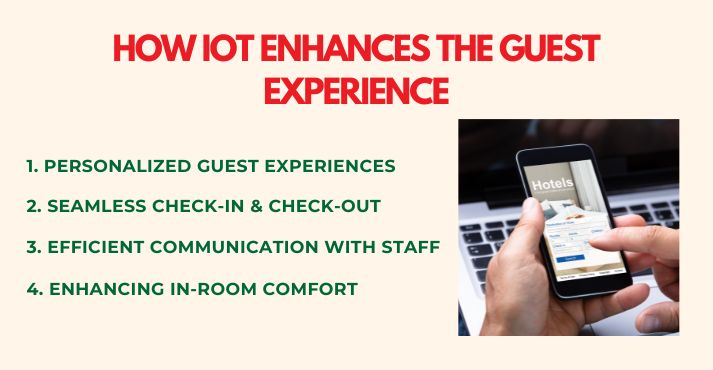
In the hotel industry, hospitality IoT applications are changing how comfort, efficiency, and personalization are delivered. By using connected devices, hotels can anticipate needs, automate services, and give guests greater control over their stay.
These innovations also help operators improve efficiency, optimize resources, and respond to requests faster.
1. Personalized Guest Experiences
Through smart room customization, guests can adjust temperature, lighting, and entertainment using mobile apps or voice commands. The system can remember preferences from previous stays, ensuring familiar settings on arrival.
At Wynn Las Vegas, for example, every room is equipped with an Amazon Echo device, allowing guests to control lights, curtains, and climate through simple voice commands.
This type of setup enables guests to walk into a room that already matches their preferred environment, thereby increasing satisfaction from the moment they arrive.
2. Seamless Check-In and Check-Out
Mobile key access allows guests to check in online, skip the front desk, and use their smartphones as room keys. For example, Marriott’s Bonvoy app allows guests to check in before arrival, receive a notification when their room is ready, and access it using their phone.
Hilton’s Digital Key, available in over 80% of its hotels, has been used to open more than 135 million guestroom doors since its launch. These systems also improve security by activating keys only for the duration of the stay.
3. Efficient Communication with Staff
In-room tablets and smart assistants act as a direct channel to hotel staff, replacing the need to call reception.
At The Peninsula Hotels, in-room tablets allow guests to order room service, control entertainment, book spa appointments, or adjust room settings all from the comfort of their bed.
For staff, requests appear instantly in the service management system, enabling quick task assignment and tracking of completion times. This type of hotel automation not only improves responsiveness but also helps manage staffing more efficiently.
4. Enhancing In-Room Comfort
Voice-controlled rooms let guests adjust lighting, temperature, and entertainment using assistants such as Alexa. These systems can also answer questions about hotel amenities, provide weather updates, or suggest local attractions.
Some hotels integrate voice assistants with IoT-enabled energy management systems, allowing devices and equipment to power down when rooms are unoccupied. This reduces energy waste while maintaining guest comfort.
According to Medallia, 61% of consumers are willing to spend more for personalized experiences, but only 23% of hotel stays deliver this level of service.
This gap highlights a significant opportunity for hotels to use IoT applications to improve satisfaction while also enhancing hotel safety in key areas, such as surveillance and access control.
The Business Benefits of IoT for Hotels
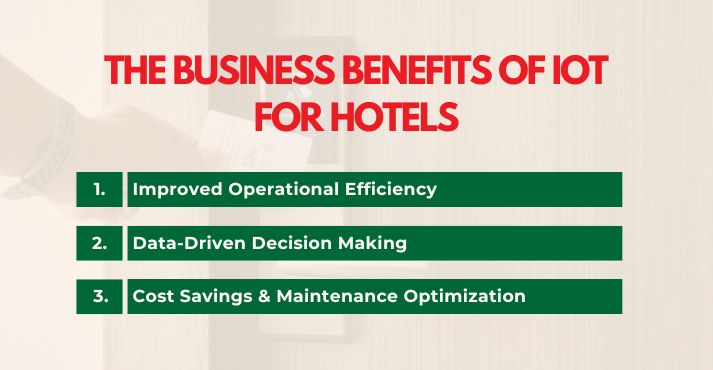
Adopting IoT solutions for hotels offers a strong platform to improve hotel operations through streamlined processes and informed decision-making. These systems support better guest satisfaction while delivering cost savings and operational agility.
1. Improved Operational Efficiency
IoT-enabled energy management systems use sensors to detect room occupancy and dynamically adjust heating, cooling, and lighting. This smart room technology responds in real-time to changes in usage, optimizing energy use without requiring manual intervention.
For example, SensorFlow reports that smart HVAC automation alone can reduce a hotel’s HVAC energy costs by up to 30%. Additionally, when systems detect open windows with the air conditioning running, further savings of about 20% are possible.
2. Data-Driven Decision Making
IoT solutions continue to collect data for hotels. Insights from guest preferences, in-room usage, and system performance are integrated into analytics platforms that inform targeted marketing strategies and drive operational improvements.
Hotel marketing teams can use these insights to deliver timely promotions or personalized service messages based on guest behavior.
Industry reports note that IoT implementations often lead to significant improvements in guest satisfaction scores — sometimes as high as 23%.
3. Cost Savings and Maintenance Optimization
Predictive maintenance powered by IoT sensors can detect early signs of equipment inefficiencies or wear in HVAC systems, elevators, and plumbing. This enables hotels to address issues before they escalate into costly breakdowns.
Studies show that comprehensive IoT systems yield returns within 18 to 24 months through energy savings, better operational efficiency, and reduced downtime.
Challenges in Implementing IoT in Hotels
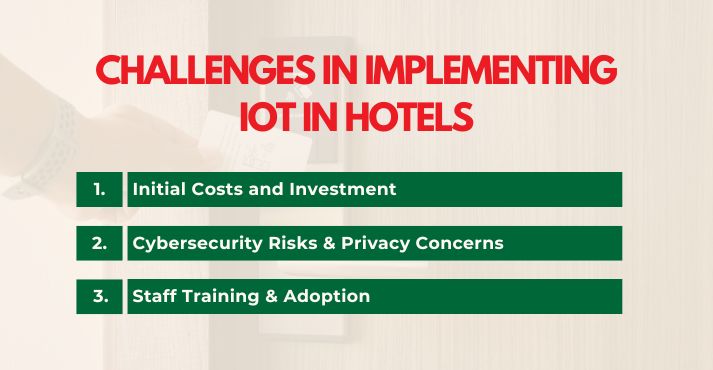
Adopting IoT for hotels promises many benefits, but several obstacles must be addressed. From high upfront investment to data privacy and the learning curve for staff, each challenge can slow progress toward enhancing guest experience in the hotel environment.
1. Initial Costs and Investment
Installing IoT devices often requires a significant investment, not just in the hardware itself, but also in infrastructure upgrades and integration with legacy systems, such as online reservation systems and property management software.
Small or mid-scale types of hotels may struggle with these costs. Rolling out sensors, smart locks, and connected HVAC systems, plus integrating them with existing platforms, can be prohibitively expensive without a clear ROI plan.
2. Cybersecurity Risks and Privacy Concerns
As hotels connect more devices, their exposure to cyber threats grows. In fact, 83% of hotels have experienced at least one security breach related to IoT devices in the past three years, and 95% of hoteliers cite concerns such as customer data theft and reputational harm as top risks.
One real-world case involved a hotel in Austria whose electronic lock system was compromised, locking guests out and forcing the hotel to pay a ransom.
Hotels must enforce robust cybersecurity practices, including network segmentation, regular firmware updates, encryption, and access controls, to protect both their systems and guest data.
3. Staff Training and Adoption
IoT success depends on hotel staff understanding how to operate connected systems and assisting guests in their use. Without proper training in these new systems, operational teams may struggle to troubleshoot or manage smart room technology, limiting its potential.
Hotels need to invest in training programs so staff can confidently assist guests, maintain IoT infrastructure, and complete requests efficiently. This step is as essential as the technology itself in ensuring smooth operations and consistent service quality.
The Future of IoT in Hospitality
As IoT technology advances, hotels are preparing for greater integration with systems that enhance operational efficiency and guest convenience. The future will bring innovations that increase connectivity across devices and services.
This evolution will support contactless hospitality experiences and tighter integration with hospitality management systems, allowing hotels to offer guests seamless and responsive stays.
Integration with Artificial Intelligence
In the coming years, IoT devices will increasingly collaborate with AI technologies to predict guest needs and automate routine tasks.
For instance, AI could analyze guest arrival patterns to prepare rooms in advance, adjusting lighting, climate, and entertainment settings before check-in.
This proactive approach improves comfort while allowing staff to focus on higher-value service. AI-driven analytics will also enable hotels to customize promotions and manage resources more efficiently based on real-time IoT data.
IoT-Enabled Smart Cities and Hospitality
The rise of smart cities will extend IoT connectivity beyond hotel walls, creating a fully connected experience as guests move through urban environments.
Hotels integrated with city-wide IoT systems can link with public transportation schedules, local entertainment venues, and municipal services to offer guests real-time updates and seamless transitions.
For example, a guest could receive notifications about nearby events or transportation options directly through the hotel’s app, making their stay more immersive and convenient.
Conclusion
IoT devices are changing how hotels serve their guests and run their operations. By connecting different systems, hotels can offer guests increased comfort and convenience while reducing waste and maintenance issues.
Over time, this helps lower costs and keeps things running smoothly. For hotel managers, using these technologies is important to meet guest needs and stay ahead in the market.
Bringing in IoT now will make hotels better prepared for the future and help deliver improved service every day.