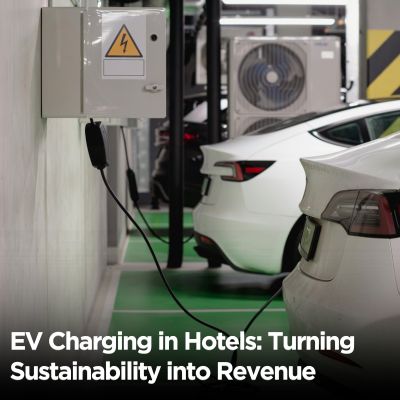
Electric vehicles are becoming a common choice for travelers across APAC and around the world. As more people switch to electric cars, access to EV charging in hotels is moving from being a convenience to an expected part of the guest experience.
Hotels are exploring ways to integrate this service into their operations, considering both the practical and environmental aspects. Installing EV chargers allows properties to cater to the needs of modern travelers while supporting their long-term sustainability goals.
With infrastructure becoming easier to implement and more accessible, hotels have an opportunity to prepare for the changing expectations of guests who plan their stays around available amenities.
This article examines why hotels are installing EV chargers, the benefits for guests and the business, potential return on investment, and strategies for implementing charging solutions effectively.
Why EV Charging Matters for Hotels Today
The rise of electric vehicles has created new expectations for travelers. Many guests consider the availability of EV charging when choosing a hotel, and properties without this service may miss out on bookings from travelers who rely on charging facilities during their stay.
In the hotel industry, investing in EV infrastructure shows that a property values its guests’ needs and is committed to sustainable practices.
Providing hotel EV charging solutions allows properties to serve eco-conscious visitors while enhancing convenience and improving overall satisfaction.
In 2024, more than 1.3 million public charging points were added globally, marking a 30% increase from the previous year. This rapid expansion shows the rising demand for charging facilities and emphasizes the importance of hotels in providing them.
Offering EV charging also helps hotels stand out in the market. As more travelers prioritize environmentally responsible choices, properties with charging facilities are better positioned to remain relevant and appeal to a wider audience.
Benefits of EV Charging for Hotels
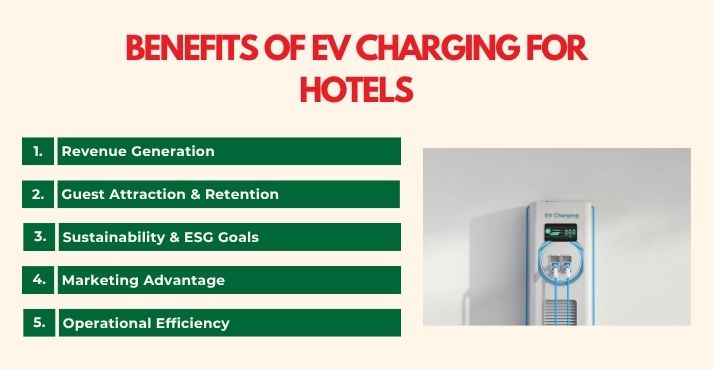
Investing in EV charging brings several advantages for hotels. Properties with EV infrastructure can generate additional revenue, attract eco-conscious travelers, support sustainability goals, and reinforce their brand in the competitive hospitality market.
1. Revenue Generation
Hotels can earn additional income by offering direct billing for EV charging. Research by Green Hotelier shows that properties charging for EV use may see total revenue per guest increase by 5-10%.
While vehicles are charging, guests often spend more on food, beverages, or other on-site services, further boosting earnings.
EV-ready hotels can also include charging fees in room packages or loyalty programs, creating flexible income opportunities without affecting the guest experience.
2. Guest Attraction and Retention
Eco-conscious travelers often opt for accommodations that align with their values. Hotels with EV charging points attract this segment, encouraging repeat stays and positive reviews.
Meeting these preferences helps properties build guest loyalty and appeal to travelers who prioritize environmentally responsible options.
3. Sustainability and ESG Goals
Installing EV chargers helps lower the carbon footprint and advances ESG objectives. Properties can include EV infrastructure in green certifications to show their commitment to sustainability to both guests and corporate partners.
Many eco hotels feature these initiatives in their marketing materials to emphasize their environmental responsibility.
4. Marketing Advantage
EV charging stations clearly show a hotel’s forward-thinking approach. Promoting the availability of charging facilities helps hotels appear innovative and eco-friendly, stand out from competitors, and attract travelers who prioritize sustainable travel options.
5. Operational Efficiency
Modern EV chargers come with smart features such as load balancing and energy optimization. These capabilities help hotels manage electricity consumption efficiently, lowering operational costs while ensuring reliable service for guests.
Integrating these systems can make properties more sustainable and cost-effective over time.
Traditional Hotel Amenities vs. EV Charging
Traditional hotel amenities, such as spas, gyms, and high-speed Wi-Fi, have long been used to attract guests and enhance their satisfaction.
Electric vehicle charging in hospitality is increasingly seen as a service that can influence booking decisions, especially for travelers with electric vehicles.
Comparing ROI: EV Charging vs. Traditional Amenities
https://docs.google.com/spreadsheets/d/1V6ugJuWS1n-HCLfEvV2-AkfOBhmh2FDMLOwAdiAqJgY/edit?gid=1341522601#gid=1341522601
Hotels with EV charging points attract travelers seeking accommodations that support electric vehicles, enhancing occupancy and guest satisfaction. Unlike many traditional amenities, EV charging also generates direct revenue through usage fees or bundled service packages.
Choosing the Right EV Charging Solution for Hospitality
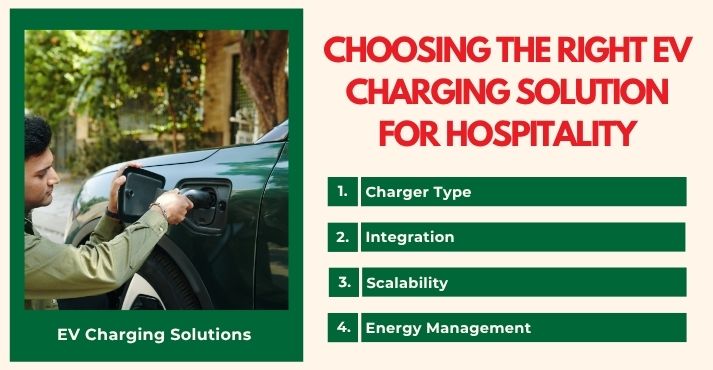
Selecting the right charging solution is crucial to meet guest expectations and maximize the benefits of hotel EV charging stations. The main factors to evaluate include:
- Charger Type: Level 2 chargers are ideal for overnight stays, providing sufficient power while guests sleep. Level 3 fast chargers deliver rapid charging for short stays or high-turnover locations, making them suitable for hotels with a mix of long and short-stay guests.
- Integration: Smart billing and reservation systems streamline guest management. Integration with PMS/CRM and the central reservation system allows hotels to display charger availability during booking and track usage efficiently.
- Scalability: Hotels can start with a limited number of chargers and expand as demand grows. A phased approach helps manage initial investment while adapting to changing guest needs.
- Energy Management: Load balancing ensures multiple vehicles can charge simultaneously without overloading the system. Energy optimization features help reduce electricity costs and improve operational efficiency.
When implementing these strategies, many hotels partner with trusted providers such as ChargePoint, Tesla, Blink, EVBox, or Wallbox. These partnerships simplify installation, ensure ongoing technical support, and guarantee reliable performance.
Case Studies: Hotels Leading with EV Charging
Hotels around the world are no longer treating charging as an experiment but as part of their long-term strategy. Global chains and regional players alike are now showcasing how EV charging stations can add value, boost occupancy, and improve guest satisfaction.
Hilton
Hilton announced a large-scale rollout with Tesla to install up to 20,000 Universal Wall Connectors at roughly 2,000 hotels across the US, Canada, and Mexico, with multiple chargers planned at each site.
The rollout focuses on overnight charging for guests and aims to create one of the largest hospitality charging networks in North America.
Marriott
Marriott named EV Connect as a preferred charging provider to expand charging availability across thousands of properties.
The partnership provides Marriott hotels with a managed platform for locating, billing, and operating chargers, reflecting a corporate-level effort to scale charging infrastructure across multiple brands and markets.
The Fullerton Hotel Singapore
The Fullerton Hotel opened an EV charging station in September 2024 through Volt. The setup includes one 60 kW DC charger and two 22 kW AC chargers. These serve not only its guests but also visitors to the broader Fullerton Heritage precinct.
Rates are approximately SGD 0.48/kWh during launch promotions, and the hotel ties promotions for dining offers to guests who use the chargers.
Accor and Regional Implementations
Accor properties in APAC, such as Mercure hotels, are starting to offer EV charging as part of their guest services. In Singapore, specifically, several 5-star and luxury hotels, such as Fairmont Singapore and PARKROYAL COLLECTION Pickering, publicly advertise EV charging facilities.
Research indicates that installing just one EV charging station can increase annual spending at a nearby business by more than $1,400, showing that guests are likely to spend more on-site while waiting for their vehicles to charge.
At the same time, parking-related revenues in US hotels grew by over 23% between 2019 and 2023, reinforcing the revenue potential of parking-linked services such as managed EV charging.
Taken together, these examples highlight three lessons for hoteliers: large chains are moving from pilot projects to scaled rollouts, partnerships with established charging providers simplify operations, and on-site charging creates opportunities to boost guest spending while strengthening brand value.
Sustainability and ESG Compliance Through EV Charging
For today’s hospitality sector, sustainability is no longer optional but a standard that both regulators and guests expect.
Installing charging stations directly ties into sustainability strategies in hotels, helping properties reduce emissions associated with guest travel while meeting corporate responsibility goals.
EV charging also supports compliance with environmental, social, and governance (ESG) frameworks.
Many international and regional reporting guidelines encourage companies to show measurable action on lowering carbon intensity, and providing charging facilities offers hotels a practical way to include this in their reporting.
Certifications such as Green Key, LEED, and Singapore’s BCA Green Mark recognize infrastructure that reduces environmental impact.
Hotels that integrate charging points can strengthen applications for these certifications, which in turn adds credibility with eco-conscious travelers and corporate clients.
By integrating EV charging into ESG initiatives and certification pathways, hotels address environmental responsibilities while appealing to a market that actively seeks responsible and future-focused accommodation.
Challenges and How to Overcome Them
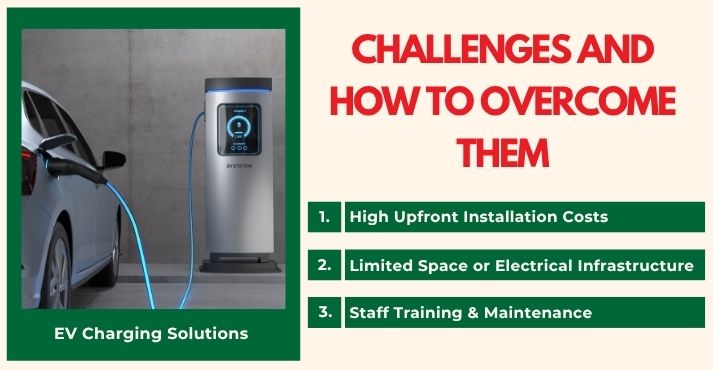
While EV charging amenities in hotels are becoming an essential part of guest services, the path to implementation is not without hurdles. Hoteliers often face several barriers that need careful planning and practical solutions.
1. High Upfront Installation Costs
The expense of purchasing and installing chargers, especially fast-charging units, can be significant. Hotels can address this by applying for government grants or subsidies.
For example, Singapore offers incentive schemes that reduce the financial burden on businesses installing charging stations.
2. Limited Space or Electrical Infrastructure
Some properties may lack sufficient parking spaces or the electrical capacity required to support multiple chargers. A phased rollout, beginning with a small number of chargers, allows hotels to manage demand while gradually upgrading infrastructure as adoption increases.
3. Staff Training and Maintenance
Running charging facilities requires basic technical knowledge and ongoing monitoring. Partnering with established charging networks or energy companies helps hotels manage maintenance, billing, and technical support efficiently, ensuring a reliable guest experience.
By anticipating these challenges and addressing them through phased investments, partnerships, and available subsidies, hotels can make EV charging a feasible and valuable addition to their operations.
FAQs
Do hotels make money from EV charging stations?
Yes. Hotels can earn revenue directly from charging fees and indirectly through higher guest spending, while cars charge. Research shows that chargers can boost nearby business spending and parking revenues.
What type of EV chargers should hotels install?
Level 2 chargers are most common for hotels, as they balance cost, charging speed, and guest dwell times. Fast DC chargers may be considered for high-traffic or premium locations.
How do EV chargers improve guest satisfaction?
They provide convenience and peace of mind for EV drivers, making the hotel more attractive compared to properties without charging amenities. This can influence booking decisions.
Are EV chargers required for ESG compliance?
They are not mandatory, but installing them supports sustainability in hotels and helps meet green certification standards such as LEED, Green Key, or BCA Green Mark.
Which hotel chains already offer EV charging?
Global brands such as Hilton, Marriott, and Accor have announced the rollout of EV charging amenities in their hotels, with regional adoption seen in properties across the APAC, US, and Europe.
Conclusion
EV charging is both a sustainability initiative and a way for hotels to support guest needs. Providing charging stations helps attract eco-conscious travelers, improve occupancy, and align with ESG commitments.
In Singapore and across APAC, hotels that introduce charging facilities today can better meet rising expectations as electric vehicles become more common.
Looking ahead, charging will be an essential part of the hospitality tech stack, just like Wi-Fi or reservation systems. Hotels that prepare early will be ready to serve future demand and position themselves as leaders in sustainable hospitality.