In the fiercely competitive hospitality sector, where razor-thin margins are the norm, controlling costs is a necessity for survival and growth.
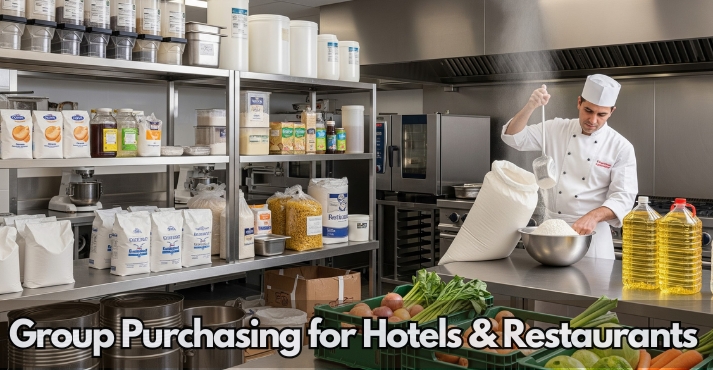
Group purchasing for hotels and restaurants has emerged as a powerful, practical strategy to achieve significant financial and operational advantages.
By leveraging collective buying power, individual establishments can compete with large chains on price and terms. This approach directly addresses core challenges like rising food costs, unpredictable supply chains, and inefficient procurement processes.
For any hotelier or restaurateur looking to strengthen their bottom line, understanding and implementing a group purchasing strategy is no longer a luxury, but a smart business imperative.
What is Group Purchasing for Hotels & Restaurants?
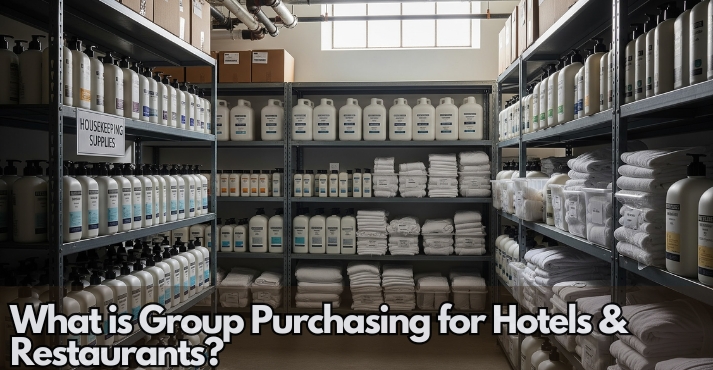
At its core, group purchasing is a simple yet powerful concept: multiple businesses consolidate their purchasing volume to buy goods and services as a single, powerful entity.
This is typically facilitated by a Group Purchasing Organization (GPO), which acts as an intermediary that negotiates contracts with suppliers on behalf of its members.
For an independent hotel or a local restaurant chain, this means you are no longer negotiating alone.
Instead, your monthly order for linens, cleaning supplies, or poultry is combined with the orders of hundreds of other similar businesses.
This higher volume gives the GPO tremendous leverage to secure preferential pricing, better payment terms, and value-added services that would be impossible for a single entity to obtain.
It’s a democratization of buying power, allowing small and mid-sized businesses to access the same economies of scale as their largest competitors.
How Hospitality Group Purchasing Works in Practice
The process is designed for simplicity and efficiency.
- A hotel or restaurant joins a GPO, often for a minimal fee or a percentage of the realized savings.
- They then gain access to a curated network of pre-vetted suppliers and a dedicated online portal, a key tool for any modern operation, including intelligent hotels.
- Through this portal, members can place orders for everything from kitchen equipment and food staples to amenities and uniform rentals at the pre-negotiated group rates.
- The GPO manages the supplier relationships, ensures contract compliance, and provides support, freeing up management to focus on daily operations and guest experience.
Key Benefits of Group Purchasing for Hotels & Restaurants
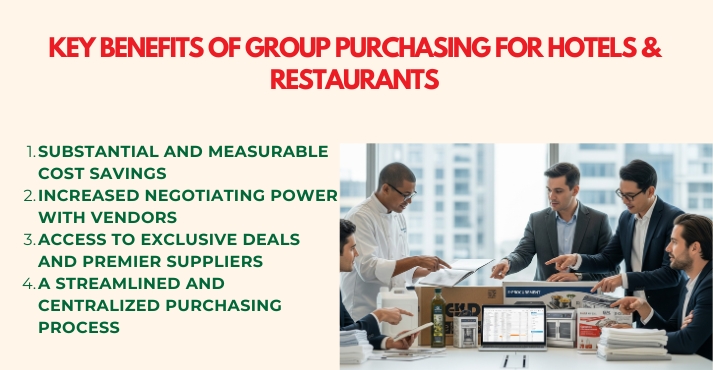
The advantages of adopting a hospitality group purchasing solution extend far beyond just a lower price tag. They create a perfect combination of efficiency and stability across the entire operation.
Substantial and Measurable Cost Savings
The most immediate and compelling benefit is a direct reduction in procurement costs. By buying in bulk, GPOs can secure discounts of 10% to 20% on a wide range of essential items.
For a restaurant, this could mean lower prices on high-cost proteins and produce, which is fundamental to knowing how to control your restaurant’s food cost. For a hotel, it translates to better rates on linens, toiletries, and cleaning chemicals.
These savings go straight to the bottom line, directly improving profitability without any need to increase sales or room rates.
Increased Negotiating Power with Vendors
A single restaurant negotiating with a national food distributor has limited influence. However, a GPO representing hundreds of restaurants commands attention and respect.
This increased negotiating power allows the group to lock in not only better prices but also more favorable terms like extended payment cycles, guaranteed quality standards, and dedicated account management.
This shifts the dynamic from a price-taker to a valued partner, simplifying the process of how to find wholesale vendors.
Access to Exclusive Deals and Premier Suppliers
Many suppliers create special programs, rebates, and product launches exclusively for large GPO networks.
This means your hotel could gain access to premium amenity brands or your restaurant could be among the first to trial a new, innovative ingredient: all at preferential pricing.
These exclusive deals provide a competitive edge that is simply unavailable on the open market, even giving you an advantage when sourcing from specialized wholesale food suppliers in Singapore.
A Streamlined and Centralized Purchasing Process
Juggling multiple suppliers, invoices, and delivery schedules is a massive administrative burden. A group purchasing platform consolidates this chaos.
Instead of managing dozens of vendor relationships, you have one central point of access for a vast majority of your procurement needs.
This standardization drastically reduces administrative overhead, minimizes errors, and saves valuable staff time, allowing your team to focus on more strategic tasks.
Integrating this system with your existing restaurant inventory management software creates a seamless operational flow.
How GPOs Enhance Flexibility for Hotels and Restaurants
A common misconception is that group purchasing locks businesses into rigid, one-size-fits-all contracts. In reality, modern GPOs are built on flexibility and choice.
Flexibility in Supplier and Product Selection
A high-quality GPO does not force you to use a single supplier for a category. Instead, it offers a menu of different options.
For example, a restaurant group might have access to three different meat suppliers through their GPO, each with its own strengths in pricing, delivery schedules, or product specialization (e.g., organic, halal, specific cuts).
This allows each restaurant manager to choose the supplier that best aligns with their specific menu needs and operational rhythm, all while enjoying the group’s protected pricing.
Improved Inventory Management Through Group Purchasing
Effective inventory control is critical for controlling your restaurant’s food cost and minimizing waste. Group purchasing provides the tools and stability to master this complex task.
Better Demand Forecasting and Consistency
With reliable pricing and supply secured through GPO contracts, managers can forecast their needs with greater accuracy. The fear of sudden price spikes or shortages that lead to panic-buying and over-ordering is greatly reduced.
A hotel, for instance, can confidently plan its annual linen requirements, knowing it has a consistent supply at a stable price, which is fundamental to improved inventory management.
This predictability allows for tighter inventory control, reducing both stockouts and the capital tied up in excess inventory.
Optimization Through Data and Reporting
Many GPO platforms provide detailed reporting and analytics on purchasing patterns. This data is invaluable for identifying trends, spotting inefficiencies, and negotiating even better terms during the next contract cycle.
By understanding exactly what, when, and how much you are buying, you can make data-driven decisions to further optimize your restaurant inventory management practices and reduce waste.
Building Long-Term Relationships with Suppliers
In the hospitality industry, reliable partnerships are worth their weight in gold. Group purchasing programs are fundamentally designed to promote these strong, long-term relationships between buyers and suppliers.
The Power of Strategic Partnerships
When a supplier works with a GPO, they gain a stable, predictable, and high-volume customer base. In return, they are often willing to offer their best service and support.
This will ultimately lead to priority delivery during busy seasons, more lenient minimum-order requirements, and a higher level of customer care.
For a hotel, this might mean a linen supplier ensuring you never run out of towels during a peak holiday weekend. For a restaurant, it could mean a produce vendor giving you a heads-up on a potential shortage, allowing you to adjust your menu proactively.
The Synergy of Group Purchasing, Technology, and Sustainability
Modern cost-saving strategies for hotels and restaurants must align with the growing demand for sustainable and tech-driven practices.
Group purchasing naturally supports this goal.
By consolidating deliveries from multiple suppliers into more efficient logistics networks, GPOs help reduce the carbon footprint associated with transportation.
Furthermore, many GPOs now offer screened portfolios of eco-friendly products, from smart energy management systems and LED lighting to biodegradable cleaning supplies and organic food options.
This makes it easier for businesses to meet their ESG compliance in hotel procurement goals and contribute to broader sustainability in the hospitality industry.
The data and efficiency gained from a GPO are a natural complement to other technological advancements, such as those that are IoT redefining guest experience in hotels, by ensuring the backend procurement is as smart and connected as the frontend guest services.
Conclusion
The evidence is clear: group purchasing for hotels and restaurants is not a peripheral tactic but a core strategy for building a more resilient, profitable, and efficient operation.
In an industry where every dollar and every minute counts, the collective power of a GPO provides a definitive edge.
The benefits collectively address the most pressing pain points faced by hospitality operators today.
Optimizing your procurement requires moving from seeing yourself as an independent buyer to recognizing the strength that comes from collaboration.
The first step is to research and identify reputable Group Purchasing Organizations for the hospitality industry that align with your business’s size, values, and specific needs, whether you’re a standalone boutique hotel or a multi-location restaurant group.
The next step is a thorough audit of your current spending, comparing your existing supplier contracts against the deals offered through the GPO.
You will likely find significant gaps, particularly in categories like food and beverage, linens, and operating supplies.
Utilizing this model is a proactive move toward future-proofing your business.