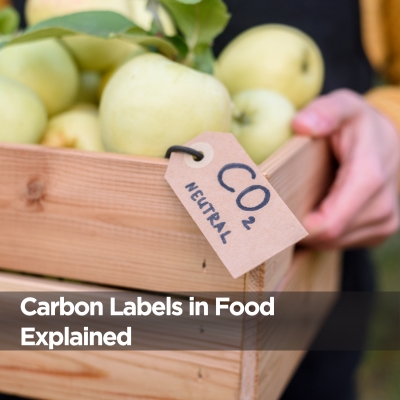
Carbon labels are becoming a powerful tool for food companies across the Asia-Pacific, and understanding carbon labels in food is now essential for staying competitive.
As more buyers, retailers, and regulators push for transparency, APAC food exporters are expected to show how their products impact the environment.
That’s where carbon labels come in!
They help consumers quickly understand the carbon footprint of a product, from farming and processing to packaging and shipping.
For APAC exporters, these labels are a practical way to build trust, meet global standards, and stand out in crowded international markets. They also help companies track their own emissions and make smarter sustainability decisions.
This guide breaks down what carbon labels really are, how they’re calculated, and why they matter for export success.
Whether you’re selling snacks, seafood, beverages, or fresh produce, you’ll learn how carbon labels work and how to use them to strengthen your brand and meet the growing demand for low-impact, environmentally responsible foods.
What is a Carbon Label?
Imagine a nutrition label, but for the planet. A carbon label is a simple, visible mark on a product’s packaging that tells you the total amount of greenhouse gases emitted throughout its life.
This is its carbon footprint, measured in carbon dioxide equivalents (CO2e).
For APAC food exporters, it’s a transparent way to show consumers you are accountable for your product’s environmental impact.
This footprint isn’t just about the factory where the food is made. It measures emissions from every single stage:
- Production: Emissions from farming, including fertilizers, machinery, and livestock methane.
- Processing: The energy used in manufacturing, cleaning, and cooking the ingredients.
- Packaging: The carbon emissions from creating the wrapper, box, or tin.
- Transportation: The fuel burned to ship your product by sea, air, and land to the store.
- End-of-Life: Emissions from waste, like when unused food or packaging ends up in a landfill.
To ensure everyone measures this consistently, global standards like PAS 2050 and organizations like the Carbon Trust provide the rulebook.
This means a carbon label on a product from Thailand is calculated the same way as one from Japan, building trust and credibility for your exports.
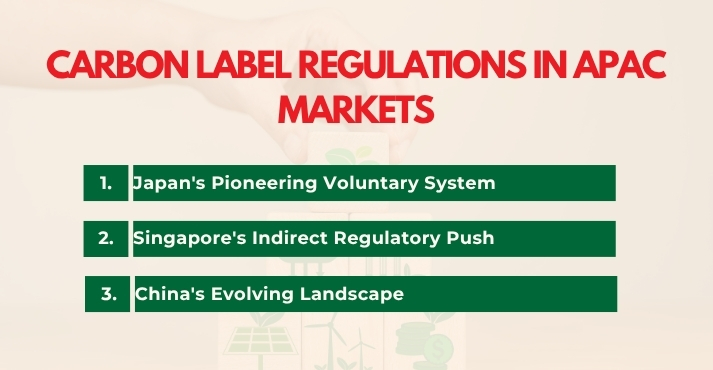
Carbon Label Regulations in APAC Markets
For APAC food exporters, the rules for carbon labeling are a combination of voluntary initiatives and emerging mandatory frameworks.
No single law covers the entire region yet, but key markets are moving quickly, making compliance essential for market access.
Understanding each country’s approach is your first step to a successful export strategy.
Japan’s Pioneering Voluntary System
Japan has been a regional leader since launching its Carbon Footprint Labeling Scheme. This program is voluntary but widely adopted.
Products display a recognizable “CFP” mark with the total CO2e, allowing climate-conscious consumers to make informed, lower-carbon choices. While not mandated by law, its success has set a powerful precedent for the entire APAC region.
Singapore’s Indirect Regulatory Push
Singapore does not yet have mandatory carbon labels for food, but it is building the foundation through its Mandatory Packaging Reporting framework.
This requires companies to account for their packaging waste, a major contributor to a product’s carbon footprint. This creates strong pressure for environmental accountability and paves the way for more direct carbon emissions reporting in the future.
China’s Evolving Landscape
Driven by its national “dual carbon” goals, China’s carbon labeling scene is rapidly developing.
The China Carbon Labeling program is a growing voluntary initiative.
However, given the government’s top-down approach to environmental policy, APAC exporters should monitor this space closely, as a shift to a mandatory system for certain product categories could happen swiftly.
Currently, no major APAC market universally requires carbon labels by law. The landscape is dominated by voluntary schemes that offer a competitive edge.
However, these initiatives are often supported by strong government encouragement and are increasingly becoming a de facto requirement for entering premium retail channels and appealing to a growing base of climate-conscious consumers.
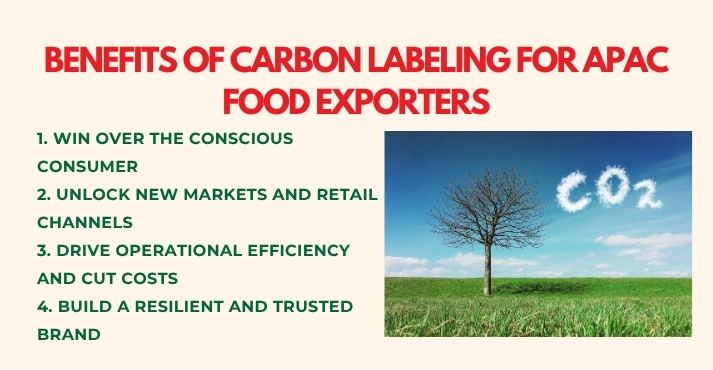
Benefits of Carbon Labeling for APAC Food Exporters
Adopting a carbon label is far more than an environmental gesture; for APAC food exporters, it’s a powerful business strategy that delivers a direct competitive advantage.
In a crowded marketplace, it transforms your product from a simple commodity into a statement of transparency and responsibility.
Here’s how this small label can create significant value for your business.
Win Over the Conscious Consumer
A carbon label speaks directly to a growing and influential demographic. These shoppers actively look for proof of a brand’s sustainability claims.
By displaying a verified carbon footprint, you provide the transparency they demand, making their purchasing decision easier and building immediate trust. This aligns perfectly with the rise of climate-conscious consumers who are reshaping markets across the region.
Unlock New Markets and Retail Channels
Many premium supermarkets and green retailers in markets like Japan and Singapore are increasingly prioritizing products with proven environmental credentials.
A carbon label acts as a passport, helping your products meet the vendor requirements for these lucrative shelves. It future-proofs your business against the carbon labeling regulations that are emerging across the APAC region.
Drive Operational Efficiency and Cut Costs
The process of measuring your carbon footprint is itself a valuable business exercise. It forces a deep analysis of your supply chain, often revealing hidden inefficiencies.
You might discover opportunities to reduce energy consumption in processing, optimize shipping routes to lower carbon emissions, or switch to more efficient packaging, all of which directly improve your bottom line.
Build a Resilient and Trusted Brand
In an era of “greenwashing” accusations, a third-party verified carbon label is undeniable proof of your commitment. This builds deep, lasting trust not only with consumers but also with investors and business partners.
It strengthens your brand reputation, making it more resilient to market shifts and positioning you as a leader in the global shift toward sustainable food systems.
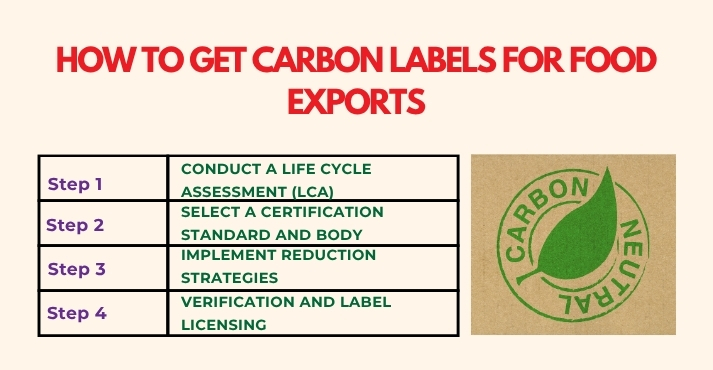
How to Get Carbon Labels for Food Exports
Navigating the path to certification might seem complex, but for APAC food exporters, it can be broken down into a clear, manageable process. Obtaining a carbon label is a systematic journey of measurement, verification, and commitment.
Here is your step-by-step guide to getting your products certified and market-ready.
Step 1: Conduct a Life Cycle Assessment (LCA)
This is the essential, non-negotiable first step. You must calculate the total greenhouse gas emissions of your product from start to finish. This means working with a sustainability consultant or using specialized LCA software to analyze every stage:
- Raw Material Sourcing: Emissions from agriculture and ingredient extraction.
- Manufacturing & Processing: Energy used in your factory.
- Packaging: Emissions from producing your packaging materials.
- Transportation & Distribution: Fuel used by ships, planes, and trucks.
- End-of-Life: Emissions from consumer waste and disposal.
Step 2: Select a Certification Standard and Body
Next, choose a recognized standard, such as PAS 2050, to ensure your LCA is credible. Then, select an accredited certification body to validate your findings. Organizations like the Carbon Trust are globally recognized, but regional certifiers may also be available and better suited to local APAC contexts.
Step 3: Implement Reduction Strategies
Before final certification, analyze your LCA data to identify “hotspots” of high emissions. This is your opportunity to lower your carbon footprint. You might:
- Switch to a supplier that uses renewable energy.
- Redesign packaging to use less material.
- Optimize logistics to reduce food miles.
A lower footprint is not only better for the planet but also more marketable.
Step 4: Verification and Label Licensing
The certifying body will audit your LCA and reduction plans. Upon successful verification, they will grant you a license to use their specific carbon label on your packaging. This license is typically valid for two years, after which you must recertify to account for changes in your supply chain or operations.
What to Expect: Timelines, Costs, and Challenges
- Timeline: The entire process, from LCA to certification, typically takes 3 to 6 months, depending on product complexity and data availability.
- Costs: Investment varies widely. A simple product LCA might start around $3,000 – $5,000, with certification fees adding $1,000 – $3,000+ per product annually. Complex products with long supply chains cost significantly more.
- Common Challenges: The biggest hurdles are data collection from multiple suppliers and the initial cost. However, the long-term benefits in operational savings and market access often outweigh these initial obstacles.
Different Types of Carbon Labels
Not all carbon labels are created equal. For APAC food exporters, choosing the right one depends on your target market, customer base, and sustainability goals.
Understanding the different certifications available helps you select the most effective and credible label for your products.
Carbon Footprint Label
This is the most transparent type of label. It displays the exact carbon footprint of a product, quantified in grams or kilograms of CO2e.
- Pros: Highly educational for consumers; demonstrates full transparency; used in Japan’s popular CFP program.
- Cons: The number alone may be confusing without context; it doesn’t automatically imply the company is reducing emissions.
Carbon Neutral Certification
This label indicates that the net carbon emissions of a product have been reduced to zero. This is achieved by first minimizing emissions and then purchasing verified carbon offsets to cancel out the remainder.
- Pros: A powerful, easily understood claim; demonstrates a strong commitment to climate action.
- Cons: Relies on the purchase of offsets, which requires careful vetting to ensure quality and credibility.
Reduction Promise Label
Offered by organizations like the Carbon Trust, this label not only states the current footprint but also features a public pledge from the company to reduce its emissions over a specified period.
- Pros: Shows a commitment to continuous improvement; builds long-term consumer trust.
- Cons: Requires ongoing effort and public reporting on progress.
Global Standards and APAC Alignment
The most common global standard for product footprints is PAS 2050. It provides the consistent methodology used by many certifiers, including the Carbon Trust.
For APAC food exporters, this is crucial: using a global standard like PAS 2050 ensures your carbon footprint labeling is recognized and respected internationally, while still allowing you to meet specific local market expectations, such as those in Japan or Singapore.
Comparing Carbon Labels and Other Eco-Certifications for Food
It’s important to understand that a carbon label is different from other well-known eco-friendly food certifications. Here’s a quick comparison:
| Certification | Primary Focus | What It Tells the Consumer |
| Carbon Label | Climate Change | The total greenhouse gas emissions (CO2e) from the product’s lifecycle. |
| Fair Trade | Social Equity | Farmers and workers received fair prices and wages. |
| Organic | Farming Practices | Grown without synthetic pesticides, GMOs, or fertilizers. |
| EU Ecolabel | Broad Environmental Impact | Meets high environmental standards throughout its life-cycle. |
The Cost of Carbon Labeling for Food Exporters
Understanding the investment required is a critical step for any APAC food exporter considering carbon footprint labeling. While costs vary, viewing this as a strategic investment rather than a mere expense is key to realizing its full value.
Here’s a transparent breakdown of what you can expect:
Breaking Down the Certification Costs
The total cost depends heavily on your product’s complexity and supply chain length, but generally falls into three categories:
- Life Cycle Assessment (LCA): This is the most significant variable cost. For a single, simple product with a straightforward supply chain, an LCA can start from $3,000 – $7,000. For complex products with multiple ingredients sourced globally, this can easily rise to $15,000 – $25,000+ due to the intensive data collection and analysis required.
- Certification and Licensing Fees: After the LCA, the certifying body (like the Carbon Trust) charges for verifying the data and licensing their label. This typically ranges from $1,000 to $5,000 per product, per year.
- Ongoing Monitoring and Recertification: Carbon labels are not one-time achievements. You must annually monitor your footprint and undergo a full recertification every 2-3 years, which involves updated LCAs and more fees, representing a recurring operational cost.
Carbon Labeling vs. Other Eco-Certifications
How does this compare to other eco-friendly food certifications?
- Generally, Mid-Range: The cost of carbon labeling is often higher than a basic organic certification for a single ingredient but can be lower than achieving a full B Corporation certification, which involves a comprehensive assessment of your entire company’s social and environmental performance.
- Different Value Proposition: Unlike some certifications, the process of carbon labeling directly identifies operational inefficiencies. The cost savings from reducing energy use or optimizing logistics can often offset a significant portion of the certification fee over time, making its Return on Investment (ROI) particularly compelling for forward-thinking exporters.
Marketability of Carbon-Labeled Food Products in APAC
In today’s competitive marketplace, a carbon label is a powerful marketing tool that can significantly increase the appeal and perceived value of your food exports.
For APAC food exporters, this small label provides a clear, credible story that resonates deeply with a growing consumer base, directly translating into commercial advantage.
A Direct Line to the Conscious Consumer
A carbon label acts as an instant signal to climate-conscious consumers. It cuts through the noise of generic “green” claims by providing verified, quantitative data. This transparency builds immediate trust and simplifies the decision-making process for shoppers who want to make environmentally responsible choices.
In a region where consumers are increasingly aware of their environmental impact, this label provides the proof they are looking for, as detailed in our analysis of climate-conscious consumers.
Justifying Premium Pricing and Enhancing Brand Value
Products with a lower carbon footprint are often associated with higher quality, innovation, and ethical production. This perception allows brands to command a premium price.
Consumers are increasingly willing to pay more for products that align with their values, and a carbon label provides the justification for that premium. This strategy not only boosts sales but also improves the entire brand, positioning your company as a leader in the shift towards sustainable food systems.
Industry Success Stories
While widespread adoption is still growing, early movers are seeing clear benefits. For instance, Oatly prints its carbon footprint prominently on its packaging, using it as a core part of its brand identity to differentiate itself in the plant-based milk category. This transparent approach has been instrumental in building a loyal, global customer base.
Similarly, some Australian wineries have begun using carbon labels to appeal to environmentally conscious buyers in European and Asian markets, creating a unique selling proposition in a crowded category.
By integrating a carbon label into your marketing narrative, you are not just selling a product, you are inviting consumers to be part of a solution. This builds a deeper, more meaningful connection that promotes loyalty and drives long-term growth.
Carbon Labels vs. Other Eco-Certifications for Food Exports
For APAC food exporters, understanding sustainability certifications can be confusing. While carbon labels are gaining prominence, they exist alongside established eco-friendly food certifications.
Understanding how they differ and complement each other is crucial for building a credible and marketable sustainability profile.
Here is a clear comparison to help you understand the distinct benefits of each:
| Certification | Primary Focus | What It Tells the Consumer | Key Benefit for Exporters |
| Carbon Label | Climate Change | The total greenhouse gas emissions (CO2e) from the product’s lifecycle. | Appeals to climate-conscious consumers; demonstrates operational efficiency and transparency. |
| Organic | Farming & Production | Grown without synthetic pesticides, GMOs, or chemical fertilizers. | Meets demand for “clean” ingredients; often commands a significant price premium. |
| Fair Trade | Social Equity | Farmers and workers received fair prices, wages, and work in safe conditions. | Builds a story of ethical sourcing and community support; strong emotional appeal. |
| Rainforest Alliance | Biodiversity & Livelihoods | Sourced from farms that promote sustainable livelihoods and conserve nature. | Addresses deforestation and ecosystem health; a holistic environmental and social seal. |
A Combined Strategy for Maximum Impact
The most powerful approach for APAC food exporters is often to combine certifications. For example, a coffee exporter could source Fair Trade and organic beans and then use a carbon label to show the low emissions from shipping by sea instead of air.
This creates a comprehensive story of social responsibility, agricultural purity, and environmental accountability that resonates powerfully with modern consumers and aligns with the broader movement toward sustainable eating habits.
Conclusion
For APAC food exporters, especially those paying close attention to carbon labels in food, carbon labels have become a strategic imperative.
The trajectory of consumer demand, regulatory evolution, and market competition all point in one direction: toward greater transparency and accountability for our environmental impact.
Adopting carbon footprint labeling is about seizing a significant competitive edge. It is the tool that allows you to prove your commitment to the growing legion of climate-conscious consumers, to unlock premium retail channels, and to future-proof your business against the regulations that are inevitably coming.
The initial investment in measurement and certification is far outweighed by the returns in brand loyalty, operational savings, and market access.
The question for forward-thinking exporters is no longer if you should adopt this standard, but how soon you can integrate it into your brand story.
Do not view it as a cost, but as an investment in your product’s passport to the global market. The first movers who embrace carbon labeling will be the ones who define the future of food in APAC, turning the challenge of sustainability into their most powerful advantage.