Food companies often face long R&D cycles, high costs, and disconnected supplier networks that slow product development.
Managing multiple partners for testing and production can complicate the process and delay product launches. Many brands want to innovate faster but lack the coordination and technical support to do it efficiently.
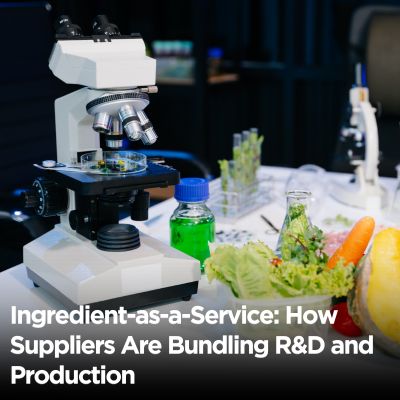
Ingredient-as-a-Service is a model in which suppliers combine their research labs and production facilities to provide comprehensive solutions.
They assist with formulation, pilot testing, and scaling, giving manufacturers access to both expertise and equipment in one place. This reduces development time and makes the entire process more streamlined.
The outcome is quicker product launches, lower risks, and better collaboration between suppliers and food brands.
When suppliers and manufacturers work together from the beginning, it leads to stronger partnerships, better product quality, and more efficient use of resources.
What is Ingredient-as-a-Service?
Ingredient-as-a-Service is a service-based model where suppliers combine R&D and production capabilities within their ingredient offerings.
Rather than simply supplying raw materials, they work with manufacturers to provide formulation support, application testing, and process scaling.
This approach allows suppliers to share their technical knowledge during product development, helping food companies create formulations that meet performance, sensory, and regulatory standards.
Unlike the traditional approach of selling bulk ingredients, this model focuses on collaboration. Manufacturers can use supplier facilities, consult with food scientists, and access formulation support without needing extensive in-house resources.
It improves speed to market, maintains consistent quality, and reduces production risks while providing manufacturers with more flexibility in testing and scaling products.
The concept has become more relevant in areas such as plant-based proteins and functional ingredients. Rising interest in clean-label, sustainable, and nutritionally balanced foods has made this model an effective way for suppliers and manufacturers to create products that meet modern consumer expectations.
Why Food Companies Are Turning to Ingredient-as-a-Service
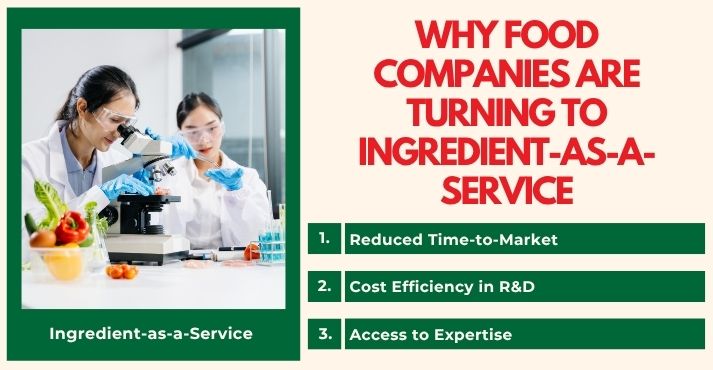
Food companies are turning to Ingredient-as-a-Service to address the challenges of bringing new products to market. Many brands now rely on suppliers not just for ingredients but also for R&D support.
A 2024 survey of bakery industry product developers found that 58% of brands view their ingredient suppliers as a source for new product ideas, and 62% seek reformulation or prototype support. This shows how collaboration with suppliers is becoming a critical part of innovation.
Partnering with suppliers that combine R&D labs, pilot production, and technical expertise allows brands to speed up prototyping, lower development costs, and access specialized knowledge.
These advantages make it easier to innovate efficiently, maintain product quality, and build stronger supplier relationships.
1. Reduced Time-to-Market
Suppliers with in-house R&D labs and pilot production facilities help brands prototype and test new products more rapidly. Quicker iteration and recipe refinement shorten the time required to bring products to market.
For example, New School Foods, a Canadian startup, uses advanced freezing technology and scaffolding techniques to create plant-based salmon that mimics the texture and appearance of raw fish, supporting faster scaling of their product.
2. Cost Efficiency in R&D
Outsourcing R&D to specialized suppliers eliminates the need for food companies to invest in expensive in-house laboratories and equipment. This reduces capital expenditures and allows companies to use resources more effectively.
Fragmented R&D efforts can lead to inefficiencies and inconsistent results, but bundling services through Ingredient-as-a-Service ensures coordinated development and consistent product quality.
In 2024, 76% of food and beverage brands reported plans to increase spending on new product development, showing the demand for more efficient ways to innovate with supplier support.
3. Access to Expertise
Working with suppliers that offer comprehensive services provides food companies with access to specialists, including food scientists, flavorists, and regulatory experts.
Manufacturers benefit from this expertise throughout product development, improving formulation quality, ensuring compliance with regulations, and supporting efficient innovation.
Close collaboration with knowledgeable suppliers builds strong, long-term partnerships that maintain consistent product performance and reliability.
Comparing Ingredient-as-a-Service vs. Traditional Supply Models
Food companies face a choice between traditional ingredient sourcing and Ingredient-as-a-Service.
While traditional models focus on bulk ingredient supply, the service-based approach combines ingredients with R&D and production support, helping brands innovate faster, reduce costs, and manage risks more effectively.
The table below highlights the differences between the two approaches:
| Aspect | Traditional Supply | Ingredient-as-a-Service |
|---|---|---|
| What’s Provided | Bulk ingredients only | Ingredients plus R&D labs, formulation support, and scaling production |
| Speed | Slower innovation cycles | Faster prototyping and go-to-market |
| Costs | Higher internal R&D burden | Shared R&D costs reduce overhead |
| Risk | Fragmented suppliers, inconsistent results | Integrated model reduces trial-and-error |
| Partnership Type | Transactional | Collaborative, long-term innovation partnership |
What’s Provided
Traditional suppliers deliver only raw ingredients, leaving formulation and product development entirely to the manufacturer. Ingredient-as-a-Service bundles R&D and ingredient supply, giving brands access to pilot facilities, formulation expertise, and scalable production.
Ever Fresh, for example, provides formulated ingredient systems that combine flavor, function, and scalability.
Speed
Innovation cycles in traditional supply models are often slower because manufacturers must coordinate with multiple vendors and internal teams. Ingredient-as-a-Service consolidates resources so brands can prototype and refine recipes more efficiently.
For example, PlantJammer, a startup specializing in plant-based sweeteners, worked with Südzucker to integrate a new digital tool into their product development, helping the company scale plant-based recipes faster.
Costs and Risk
Maintaining separate suppliers and in-house R&D increases costs and introduces inconsistencies. Ingredient-as-a-Service reduces overhead by sharing development resources and providing cohesive support.
IFPC assists manufacturers with formulation, compliance, and ingredient selection, thereby minimizing trial-and-error and enhancing product reliability.
Partnership Type
Traditional supply relationships are short-term and transactional. Ingredient-as-a-Service builds collaborative food tech ingredient partnerships, where brands and suppliers work together on product development.
For instance, Plantible Foods, a startup developing plant-based protein ingredients, partners with food manufacturers to co-develop products and provide ongoing support from formulation to scaling production.
Industries and Use Cases Benefiting Most
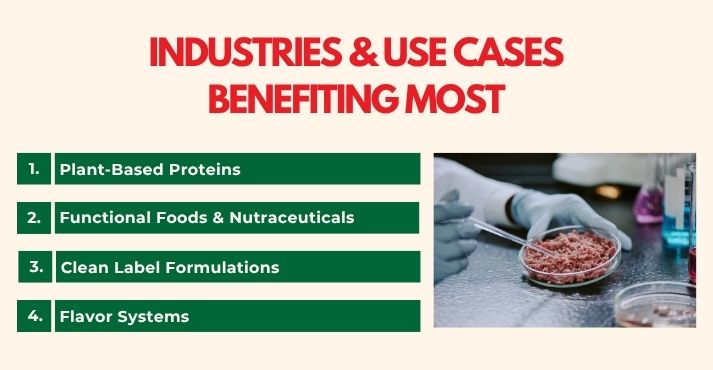
Ingredient-as-a-Service is being adopted across several food industry sectors where speed, flexibility, and technical expertise are essential.
By combining formulation support, R&D, and scalable production, suppliers help brands develop new products efficiently while maintaining quality and meeting regulatory requirements.
1. Plant-Based Proteins
Meat and dairy alternatives benefit from faster iteration cycles, as startups and established brands experiment with new textures, flavors, and nutritional profiles.
For example, Meati Foods works with ingredient suppliers to test and scale mycelium-based protein products efficiently, shortening the time from prototype to market. Integrating R&D with production support helps ensure consistent results at larger volumes.
2. Functional Foods and Nutraceuticals
Products like probiotics, fortified beverages, and vitamin-enriched snacks require precise formulation and stability testing. Ingredient-as-a-Service provides technical expertise and pilot-scale production to support the development of reliable, compliant products.
Companies such as Ganeden work with suppliers to bring functional ingredients to market with fewer trial-and-error cycles and more predictable costs.
3. Clean Label Formulations
Simplified compliance, traceability, and transparency are important in clean-label products. Bundled services help brands meet regulatory standards while maintaining ingredient integrity.
Ingredient suppliers provide support with documentation, sourcing verification, and reformulation, allowing manufacturers to respond quickly to consumer demand for natural, minimally processed foods.
4. Flavor Systems
Customized flavor systems for regional tastes benefit from integrated R&D and production. Brands can develop and test profiles efficiently, ensuring consistency across batches and markets.
For example, Flavaroma, a flavor development company, helps food and beverage brands adapt their flavor profiles to meet diverse consumer preferences worldwide, while accounting for cultural nuances and local tastes.
Risks and Considerations for Retailers & Food Brands
While Ingredient-as-a-Service offers various benefits, food brands must also consider potential risks. Being aware of these factors helps companies manage challenges and get the most value from integrated supplier partnerships.
1. Dependency on Supplier Innovation
Relying heavily on suppliers for R&D and production can create a risk of losing in-house technical knowledge. Brands should maintain a core team capable of understanding formulations and processes to ensure continuity and long-term innovation.
2. Intellectual Property Protection
Questions about ownership of formulations and proprietary processes can arise when suppliers lead product development.
Clear agreements on intellectual property, including patents and trade secrets, are essential in any contract ingredient development partnership to protect both parties’ innovations.
3. Compliance Risks
Ingredient-as-a-Service involves multiple regulatory touchpoints. Food brands must ensure that suppliers adhere to FDA, FSMA, GFSI, ISO, and BRCGS standards. Thorough audits and transparent documentation help minimize compliance issues.
4. Scalability Challenges
Moving from pilot-scale production to mass manufacturing can present technical and operational hurdles. Suppliers with experience in scaling complex formulations reduce the likelihood of inconsistencies, but brands should plan for validation and quality control at larger volumes.
By understanding these risks, food brands can fully benefit from Ingredient-as-a-Service while maintaining control over quality, compliance, and intellectual property.
How to Choose the Right Ingredient-as-a-Service Partner
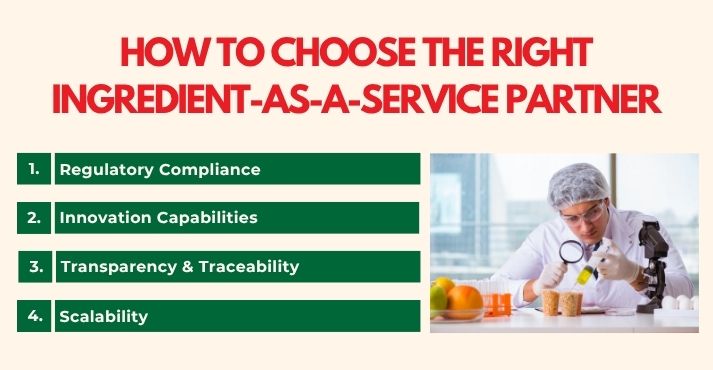
Selecting the right Ingredient-as-a-Service partner is critical for food brands aiming to innovate efficiently while managing risk.
A careful evaluation ensures that the supplier can support product development, maintain compliance, and scale production without compromising quality or safety.
1. Regulatory Compliance
Ensure the supplier meets industry standards, including those of the FDA, ISO 22000, and BRCGS. Certifications and audit reports assure that production processes are safe, consistent, and meet regulatory requirements.
Businesses should review compliance documentation and verify that suppliers maintain up-to-date certifications.
2. Innovation Capabilities
Assess whether the supplier has in-house R&D labs, pilot plants, and digital monitoring systems. Suppliers with strong innovation capabilities can support formulation testing, rapid prototyping, and process optimization.
Reviewing past projects or case studies helps assess the supplier’s technical expertise and ability to solve formulation challenges.
3. Transparency & Traceability
Check if the supplier offers digital platforms or reporting systems for ingredient traceability and compliance. Ingredient transparency is essential to track sourcing, quality checks, and regulatory documentation.
Transparent reporting allows brands to maintain accountability and respond quickly to quality or compliance inquiries.
4. Scalability
Evaluate whether the supplier can handle both small trials and large-scale production. Scalability is crucial for avoiding bottlenecks when transitioning from pilot runs to commercial volumes. Consider their experience with similar product types and production capacity.
Due Diligence Checklist
- Verify certifications and regulatory compliance.
- Review R&D and production capabilities.
- Confirm digital tracking for ingredient transparency and traceability.
- Assess scalability and past experience with similar products.
- Clarify IP ownership and contractual agreements for co-developed formulations.
Future of Ingredient-as-a-Service in Food Tech
Ingredient-as-a-Service is influencing the digital transformation of food safety, supply chains, and product development.
Digital HACCP tools, IoT sensors, and AI-based formulation platforms help brands monitor production in real time, optimize recipes, and maintain compliance with regulatory standards while ensuring product quality.
The Asia-Pacific region is seeing growth in plant-based foods, functional ingredients, and clean-label products.
Suppliers that combine R&D and production support help brands scale new products efficiently, reduce trial-and-error, and meet consumer expectations for quality and safety.
Partnerships between food brands and suppliers are becoming more strategic, creating collaborative ecosystems where knowledge, technology, and production capabilities are shared.
Events like sustainable food trade shows give brands the chance to explore new ingredient solutions and digital tools, encouraging collaboration and innovation across the supply chain and allowing faster product launches.
FAQs — Answering Common Questions
What is ingredient-as-a-service?
Ingredient-as-a-service is a model where suppliers combine ingredients with R&D, formulation support, and scalable production, allowing brands to develop and launch products faster without maintaining all capabilities in-house.
How does it differ from contract manufacturing?
Unlike contract manufacturing, which focuses primarily on producing a finished product, ingredient-as-a-service includes collaborative innovation, formulation guidance, and pilot-scale testing alongside production.
Which industries benefit most from this model?
Plant-based proteins, functional foods, clean-label products, and beverages gain the most, as they require rapid prototyping, precise formulation, and consistent quality at scale.
How does ingredient-as-a-service reduce costs?
Brands save on capital investment for in-house labs, pilot plants, and staffing, while reducing trial-and-error expenses through shared R&D resources provided by the supplier.
What are the compliance risks?
Compliance risks include meeting FDA, FSMA, ISO, and BRCGS standards. Brands must verify supplier certifications and track ingredient traceability to minimize regulatory issues.
Who are the leading suppliers in this space?
Companies such as Plantible Foods, Ganeden, and Flavaroma are active in ingredient-as-a-service, offering integrated R&D, production support, and expertise for plant-based, functional, and flavor-driven products.
Conclusion
Ingredient-as-a-Service combines research, development, and production within one model, helping food and beverage companies innovate faster while controlling costs and reducing risk. By collaborating with suppliers that provide integrated support, brands can simplify product development and bring new concepts to market more efficiently.
Companies that use this model early gain a competitive edge in meeting changing consumer preferences and maintaining quality standards.
As the industry advances through digital and sustainable practices, this is an ideal time for businesses to review their supply chain strategies and explore partnerships with suppliers offering Ingredient-as-a-Service solutions.