Did you know that inefficiencies in Southeast Asia’s food supply chain cost the region billions of dollars every year and lead to substantial food loss and waste?
Globally, around 40% of all food produced is lost or wasted before it can be eaten, showing how essential strong and reliable supply chain systems are.
The food supply chain in Southeast Asia includes farms, processors, wholesalers, distributors, suppliers, and retailers, all working together to move food from producers to consumers. Each step ensures that food reaches households efficiently, safely, and at an affordable cost.
A well-managed supply chain is essential to meeting food demand in the region, supporting the economy, and providing access to nutritious meals for millions of people.
It also helps reduce losses and maintain stability in food prices, which is especially important for vulnerable communities.
This blog will explain the main stages of the Southeast Asian food supply chain, describe the key players involved, discuss the challenges they face, and examine recent trends and innovations in food distribution across the region.
What is the Food Supply Chain?
The food supply chain is the network of activities that moves food from farms to consumers. It connects farmers, processors, wholesalers, distributors, retailers, and households, forming a continuous flow that efficiently delivers food.
Each part of the chain depends on the others, so delays or issues in one area can affect the entire system. By connecting all these elements, the food supply chain ensures that food reaches people in the correct quantity, at the right time, and in a safe condition.
Understanding how this network operates is essential for managing supply, reducing waste, and maintaining a reliable food system in Southeast Asia and beyond.
Stages of the Food Supply Chain in Southeast Asia
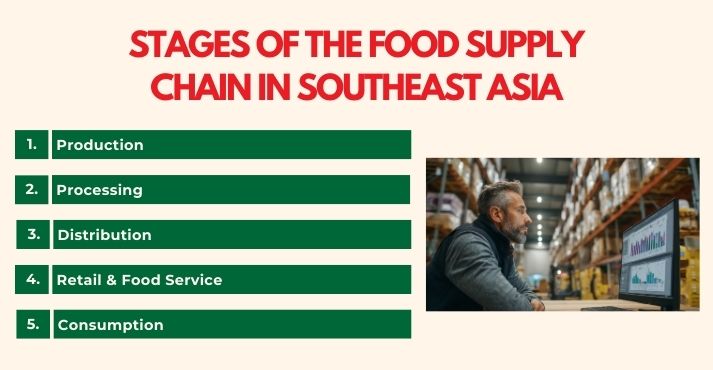
The food supply chain in Southeast Asia moves food from farms to consumers through five interconnected stages. Each stage involves key players and processes that ensure food is delivered safely, efficiently, and reliably.
1. Production
Production includes farming, livestock rearing, and aquaculture. Farmers cultivate crops and raise animals, while fisheries supply seafood to local and regional markets.
Southeast Asia has seen the adoption of precision agriculture, which uses sensors and data analytics to optimize water, fertilizer, and pesticide use, improving yields and reducing waste.
Urban vertical farms are also emerging, growing fresh produce near cities to shorten transportation time and improve availability.
2. Processing
After harvest, raw products are processed into consumable foods through cleaning, sorting, milling, refining, canning, and packaging.
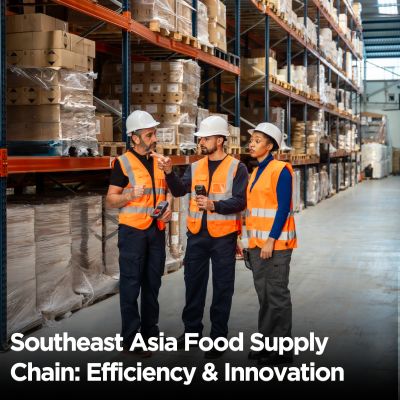
Processing ensures safety, quality, and extended shelf life. Many facilities are integrated with warehousing operations, using temperature-controlled storage, humidity regulation, and strict hygiene standards to maintain product integrity.
Automated inventory systems and quality control checks ensure consistent supply and efficient order fulfillment, particularly for perishable items such as seafood, dairy, and tropical fruits.
3. Distribution
Distribution moves processed food from producers or warehouses to retailers and food-service providers. Key distributors handle transportation, storage, and inventory management, often using cold-chain logistics to preserve freshness.
In Singapore, companies like Angliss distribute meat and seafood at scale, while FoodXervices supplies wholesale food to restaurants and retailers.
These distributors coordinate with warehouses to ensure timely delivery and prevent shortages, maintaining smooth operations across the region.
4. Retail and Food Service
Food reaches consumers through supermarkets, specialty stores, restaurants, cafes, and catering services. Retailers manage inventory, organize stock, and offer a wide selection of products.
Food-service operators prepare and serve meals across dine-in, takeaway, and institutional settings. Catering companies handle everything from menu planning to delivery logistics, ensuring meals are delivered on time and in good condition.
5. Consumption
The final stage is when consumers purchase, prepare, and consume food. In Southeast Asia, consumption patterns reflect convenience, health considerations, and lifestyle choices.
Ready-to-eat meals, catering, and restaurant services allow households and institutions to access nutritious and diverse food with ease.
Consumer preferences feed back into the supply chain, influencing production, processing, distribution, and retail operations to meet changing demand.
Importance of Food Supply Chain Management in Southeast Asia
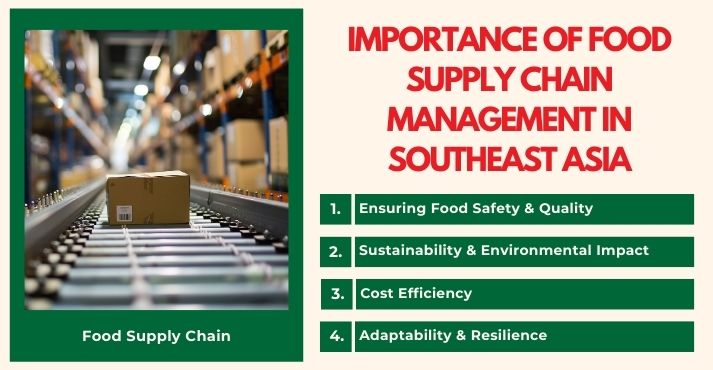
Effective management of the food supply chain helps keep food safe, affordable, and consistently available across Southeast Asia. Strong systems maintain quality, reduce waste, manage costs, and support access even during disruptions.
1. Ensuring Food Safety and Quality
Food safety standards, certifications, and monitoring systems help keep food safe from production through consumption.
Singapore Food Agency (SFA), for example, applies a strict “farm-to-fork” approach, requiring import accreditation, routine inspections, and risk-based controls.
According to its 2024 food statistics, Singapore imports food from about 187 countries while enforcing quality and safety at every stage.
These safety measures reduce contamination risks and ensure high-quality food products for consumers, especially in sensitive categories like meat, eggs, and dairy.
2. Sustainability and Environmental Impact
Sustainable practices are becoming a major focus in food-supply-chain planning as countries work to reduce waste and lessen environmental pressure.
An example is GREENFEED Vietnam, recognized for its sustainable supply-chain governance. The company prioritizes certified raw-material suppliers, improves traceability, reduces plastic use, and adopts circular-economy practices that help lower waste and resource consumption.
3. Cost Efficiency
Optimizing the supply chain lowers operational costs by improving sourcing, logistics, and production workflows.
For instance, Thai Union Group uses a global procurement organisation with centralized sourcing to manage raw material supply across oceans, helping balance supply and control costs across its production cycle.
In addition, Indonesia’s Indofood has optimized its distribution network to reduce fuel costs and improve delivery efficiency across the archipelago, ensuring stable food prices for consumers.
4. Adaptability and Resilience
Supply chain management helps businesses respond effectively to disruptions caused by climate events, disease outbreaks, or market fluctuations. Resilient systems identify potential risks early, adjust sourcing and inventory strategies, and maintain supply continuity.
Key practices include diversifying suppliers and transportation routes, maintaining buffer stocks, and implementing monitoring systems to track inventory levels, delivery times, and product quality.
These measures help ensure that food remains available, affordable, and safe for consumers, even in the face of unexpected challenges.
Challenges in the Southeast Asian Food Supply Chain
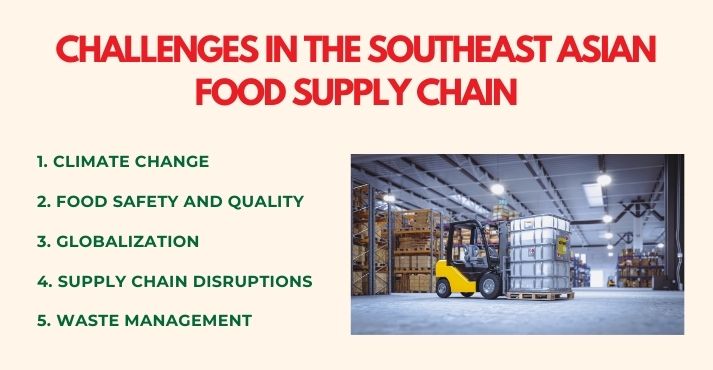
Southeast Asia’s food supply chain faces multiple challenges that affect production, distribution, and consumption. These challenges are influenced by regional conditions and global trends.
1. Climate Change
Climate change impacts crop yields, livestock health, and seafood availability, causing price fluctuations and supply uncertainty. Extreme weather events like floods, droughts, and typhoons can damage farms, delay transportation, and disrupt the food supply.
Innovations such as vertical farming are being adopted in urban areas, allowing for controlled-environment agriculture that reduces dependence on climate-sensitive outdoor farming.
2. Food Safety and Quality
Maintaining food safety and quality is especially challenging in the region’s hot and humid climate. Food importers ensure quality by enforcing strict temperature-controlled storage, proper packaging, and compliance with local regulations.
These practices help prevent spoilage and contamination, ensuring products meet safety standards across the supply chain.
3. Globalization
Global sourcing creates dependencies on international markets, making Southeast Asian supply chains vulnerable to trade disruptions, currency fluctuations, and geopolitical risks.
Food importers address these challenges by coordinating with multiple suppliers, adhering to international standards, and balancing local and imported products to ensure a stable supply.
4. Supply Chain Disruptions
Disruptions caused by pandemics, natural disasters, or political instability can halt production or delay distribution.
Food brokers mitigate these risks by connecting suppliers and buyers, negotiating contracts, and offering alternative sourcing options to maintain supply flow. Their oversight ensures that goods reach retailers and consumers even during crises.
5. Waste Management
Food waste remains a major challenge in Southeast Asia due to inefficient logistics, poor storage, and overproduction.
Recent estimates show that Eastern and Southeast Asia lose around 7.5% of food between harvest and distribution, and losses for perishable produce like fruits and vegetables can reach up to 50% due to inadequate handling and storage practices.
Food warehousing practices help reduce waste through temperature-controlled storage, organized inventory management, and timely dispatch of perishable goods.
Implementing food recovery systems also allows surplus products to be redirected to those in need, improving sustainability and efficiency.
Innovations in the Southeast Asian Food Supply Chain
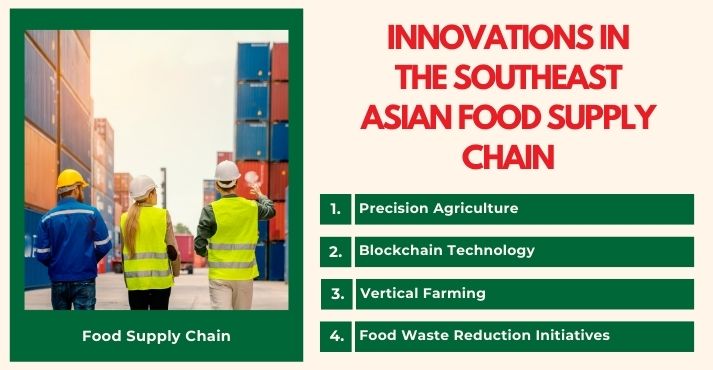
New technologies and improved practices are helping Southeast Asia build a more reliable, efficient, and sustainable food supply chain. These developments address challenges such as limited farmland, climate pressure, and the need for stronger quality control.
1. Precision Agriculture
Precision agriculture uses data, sensors, and automated systems to fine-tune farming decisions.
Tools such as satellite imagery, soil sensors, and smart irrigation systems provide farmers with accurate information on field conditions, helping them adjust water, fertilizer, and crop protection with greater precision.
This approach supports higher yields, lowers resource use, and helps maintain consistent crop quality.
2. Blockchain Technology
Blockchain improves traceability by recording every step of the supply chain in a secure, transparent manner. Stakeholders can track where food was produced, how it was handled, and whether storage requirements were met.
This improves safety assurance, reduces the risk of mislabeling, and helps build consumer trust in high-risk categories such as seafood, meat, and perishables.
3. Vertical Farming
Vertical farming allows crops to be grown in stacked layers using controlled lighting, nutrients, and climate settings. It is well-suited for dense urban areas with limited agricultural land.
This method supports steady, year-round production and reduces transportation distance since produce is grown closer to consumers. It also offers predictable harvest cycles, regardless of monsoon seasons or heat waves.
4. Food Waste Reduction Initiatives
Innovations targeting waste reduction address loss at production, transport, retail, and food-service levels. Examples include:
- AI waste-monitoring tools for commercial kitchens.
- Forecasting platforms that align supply with demand.
- Advanced warehouse practices such as batch tracking and optimized scheduling.
These efforts reduce spoilage, improve stock management, and support regional food-security goals.
Conclusion
The food supply chain in Southeast Asia relies on several critical stages, from production and processing to distribution and retail, each contributing to food safety, quality, and availability.
Managing these stages efficiently is essential for reducing waste, improving traceability, and protecting both consumers and businesses.
Today, food service operators, manufacturers, and wholesalers are adapting to rising consumer expectations, stricter regulations, and operational challenges through smarter, more connected systems.
As digital tools, automation, and data-driven processes become more common, the region’s food industry is moving toward a more reliable, secure, and efficient supply chain.