Hotel operations involve managing bookings, room availability, staff coordination, and guest services, all of which rely on multiple software systems.
Many hotels face challenges with legacy systems that are rigid, difficult to connect with other applications, and expensive to maintain. These limitations can slow operations and make it harder to deliver a consistent guest experience.
Hotel tech migration addresses these challenges by moving to modern, flexible platforms. API-first systems allow different applications, such as property management systems, booking engines, and analytics platforms, to work together seamlessly.
This integration helps hotels streamline operations, improve data accuracy, and increase efficiency.
This blog explains what API-first systems are, provides practical steps for migrating hotel technology, describes available platforms, identifies common migration challenges, and discusses future trends in hotel IT infrastructure.
What is an API-First System in Hospitality?
API-first hotel systems are designed so that every component is built to connect and communicate with other software from the start.
Unlike traditional legacy platforms, which often operate in isolation, the API-first approach allows applications to exchange data in real time.
This enables a hotel to integrate its PMS, CRS, and RMS with other platforms, such as point-of-sale and customer relationship management systems, resulting in a seamless workflow and enhanced overall efficiency in hotel operations.
With modularity, interoperability, and scalability, API-first systems allow hotels to adapt quickly, update individual components independently, and provide consistent service to guests while preparing the technology for future growth.
Definition of API-First Architecture
API-first architecture is a design approach where each software component is created with built-in communication interfaces, or APIs. These interfaces allow modules to interact seamlessly, exchanging data in real time.
Modular design means systems such as the PMS, CRS, and RMS can operate independently while still contributing to the hotel’s overall ecosystem.
Real-time data exchange is crucial because it ensures that availability, pricing, and guest information remain accurate and up to date.
How API-First Differs from Legacy Systems
Legacy hotel systems are often monolithic, making updates slow and integration with other platforms difficult. API-first architecture overcomes these limitations by providing modular, connected software.
- Modular vs. Monolithic: Modules can be updated or replaced independently without affecting the entire system.
- Real-Time Data vs. Batch Updates: Instant data exchange allows accurate room availability, dynamic pricing, and improved guest experience.
- Scalability and Future-Proofing: Hotels can adopt new technology or expand services without overhauling existing infrastructure.
Key Components of API-First Hotel Systems
API-first systems rely on essential components that work together seamlessly:
- PMS (Property Management System): Manages check-in and check-out, room inventory, and housekeeping coordination.
- CRS (Central Reservation System): Handles bookings across multiple channels and maintains consistent availability and rates.
- RMS (Revenue Management System): Optimizes pricing and revenue strategies based on real-time occupancy and market data.
- POS and CRM Integration: Combines point of sale and customer relationship management to track spending, manage loyalty programs, and improve service personalization.
Why Hotels Should Migrate from Legacy Systems
Legacy systems limit a hotel’s ability to operate efficiently and keep up with modern operational demands. Migrating to API-first platforms helps hotels modernize their technology, streamline workflows, and achieve greater efficiency across departments.
More than 70% of hotel executives are now adopting automation tools to enhance operations and increase staff productivity, showing how technology is helping hotels optimize efficiency and daily workflows.
Challenges of Legacy Systems
Legacy systems create operational bottlenecks and slow staff workflows. They can reduce efficiency and increase the risk of errors in bookings, pricing, and guest information.
1. Vendor Lock-In
Many legacy systems restrict a hotel’s ability to switch or add software. Hotels may be forced to continue using outdated solutions even if better options exist, limiting innovation and flexibility.
This makes it difficult for them to respond to market changes or integrate with emerging platforms. Over time, it can result in higher costs and reduced competitiveness.
2. Limited Interoperability
Older platforms often fail to communicate effectively with other systems. A lack of hospitality software interoperability can create data silos, leading to errors in bookings, inventory, and pricing, and increasing staff workload.
According to the 2024 Lodging Technology Study, 69% of hoteliers report that integrating new technologies with legacy systems remains a major challenge. This also slows down reporting and analytics, making strategic decision-making less efficient.
3. High Maintenance Costs
Legacy systems require frequent IT support, software patches, and troubleshooting. This results in higher operational expenses and can disrupt daily activities during downtime. Hotels may also require specialized staff or external consultants, which can further increase costs.
4. Slow Innovation
Introducing new features or services can be difficult and time-consuming. Hotels may struggle to keep up with guest expectations, and delays in updates can affect competitiveness and potential revenue.
According to recent findings, only 45% of hoteliers view themselves as technologically mature, while 23% rate their digital maturity at 3 or lower on a 5-point scale, indicating many are still in the early stages of innovation due to legacy limitations.
Benefits of API-First Migration
Migrating to API-first systems improves efficiency and reduces risks. Hotels gain flexibility, smoother workflows, and better accuracy across departments.
1. Improved System Integration
API-first systems seamlessly connect PMS, CRS, RMS, POS, and CRM. Real-time data exchange reduces manual work, prevents errors, and ensures accurate information across departments.
Staff can focus on delivering guest services instead of reconciling data across platforms.
2. Flexibility in Choosing Solutions
Hotels can integrate best-in-breed applications independently, adjusting their technology stack to meet specific needs without replacing the entire system. This approach allows faster implementation of new technologies and keeps the hotel agile in a changing market.
3. Enhanced Guest Experience
Integrated data allows personalized services, faster responses to requests, and smoother check-in, check-out, and in-stay experiences, boosting satisfaction and loyalty. Guests receive consistent service across channels, improving their overall perception of the brand.
4. Reduced Downtime
Modular updates allow software components to be upgraded or replaced without affecting other systems. Hotels can implement improvements continuously while maintaining smooth day-to-day operations and minimizing disruptions to staff and guests.
Key Steps in Hotel Tech Migration
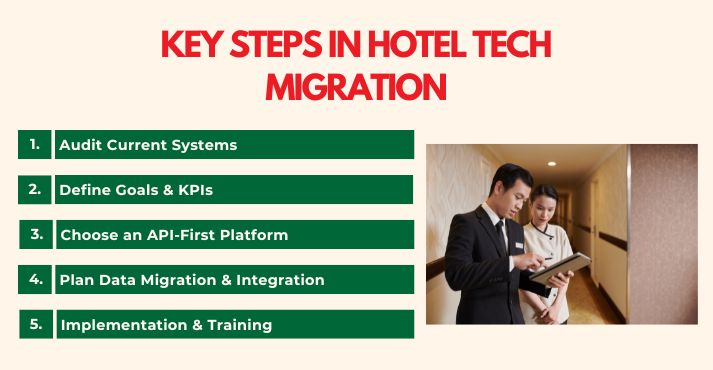
Migrating to API-first systems requires careful planning and coordination to minimize disruption and maximize benefits.
A structured approach helps IT teams and operations managers track progress, maintain data accuracy, and ensure seamless integration across all connected systems.
Following a step-by-step process reduces risks, builds staff confidence, and allows hotels to use modern technology fully.
1. Audit Current Systems
Before migration, hotels should review their existing technology to identify outdated software, hardware limitations, and processes that slow down workflows. This step provides a comprehensive view of current systems and pinpoints areas that need improvement:
- Assess usage of PMS, CRS, RMS, POS, and CRM to determine how each system contributes to daily workflows.
- Identify data silos and bottlenecks that prevent smooth communication between platforms.
- Determine integration pain points where manual workarounds or errors frequently occur.
2. Define Goals and KPIs
Establishing specific objectives and expected outcomes provides direction for the migration process. Setting these goals allows hotels to track progress, monitor results, and ensure improvements across operations, guest experience, and IT performance:
- Operational KPIs, such as occupancy, ADR, and RevPAR, track financial performance and workflow efficiency.
- Guest experience metrics, like NPS and satisfaction scores, measure improvements in service quality and personalization.
- IT performance metrics, including uptime and API response times, confirm that the technical infrastructure meets requirements.
3. Choose an API-First Platform
Selecting the right platform is critical for a successful migration and future scalability. Open API hotel platforms allow integration of existing systems and addition of new applications without disruption.
Careful evaluation of platform features helps ensure long-term efficiency and flexibility:
- Evaluate scalability, modularity, and vendor support to confirm the platform can grow with hotel needs.
- Compare leading API-first vendors, including Oracle OPERA, Mews, Cloudbeds, SiteMinder, Duetto, and IDeaS, for features, compatibility, and reliability.
4. Plan Data Migration & Integration
Careful planning of data migration ensures accuracy and minimizes downtime. Mapping, cleaning, and connecting data properly guarantees that workflows operate smoothly after the migration:
- Conduct data mapping and cleaning to standardize formats and remove duplicates.
- Set up middleware/API connectivity to enable real-time communication between systems.
- Perform testing and validation to identify errors and confirm that all workflows function correctly before going live.
5. Implementation and Training
A phased rollout of new systems helps maintain operations while staff adjust to the new technology. Adoption and productivity improve when hotels focus on training, change management, and ongoing monitoring:
- Conduct staff onboarding and training sessions to familiarize employees with new interfaces and workflows.
- Apply change management strategies to communicate responsibilities, address concerns, and guide adoption.
- Establish feedback loops and continuous improvement processes to track issues and optimize system usage over time.
Common Migration Challenges and How to Overcome Them
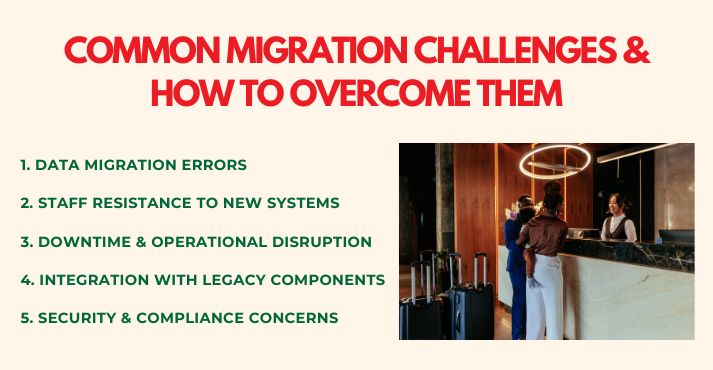
Transitioning to modern hotel technology improves efficiency and guest satisfaction, but it also introduces several practical challenges. Anticipating these issues helps hotels plan ahead, minimize risk, and maintain service quality throughout the migration process.
1. Data Migration Errors
Transferring guest, reservation, and financial data can lead to inconsistencies if not carefully managed. Hotels should map and clean data before migration and test transfers in smaller stages to ensure accuracy.
Wyndham Hotels & Resorts, for example, redesigned its data architecture with PwC, reducing processing time from 2.5 days to just 5 minutes. This improvement strengthened accuracy and operational speed.
2. Staff Resistance to New Systems
Staff hesitation often arises when technology disrupts familiar workflows. These staffing challenges can be minimized through hands-on training, early involvement in testing, and open communication about the benefits of the new systems. Recognizing staff adaptability also helps strengthen confidence during transition.
3. Downtime and Operational Disruption
System downtime during migration can delay check-ins, billing, and booking updates. Hotels can avoid this by scheduling migrations during low-occupancy periods, keeping temporary backups, and validating integrations before going live.
This approach helps ensure that core services continue running smoothly throughout the transition.
4. Integration with Legacy Components
Older systems may not integrate easily with new platforms, leading to manual processes and duplicate entries. Using middleware or standardized APIs ensures consistent data flow while allowing gradual modernization without halting daily operations.
5. Security and Compliance Concerns
Protecting guest data remains critical during and after migration. Encrypting sensitive information, limiting user access, and maintaining compliance with standards such as GDPR and PCI DSS are essential steps. Post-migration audits further ensure ongoing security and trust.
Top API-First Hotel Platforms
Choosing the right technology vendors is essential for a successful migration. Modern API-first solutions connect every part of hotel operations, from reservations and pricing to guest experience management, through modular and scalable integrations.
Below is an overview of leading platforms and their strengths across different categories of cloud-based hotel management systems:
PMS Platforms
- Oracle OPERA: A widely used enterprise-grade system offering extensive functionality for large hotels and chains. It supports centralized management, detailed reporting, and multi-property operations. Its integration ecosystem allows hotels to maintain scalability and meet compliance standards.
- Mews: Known for its intuitive interface and automation, Mews simplifies front-desk operations and integrates smoothly with third-party applications. It’s well-suited for independent hotels and boutique brands seeking flexibility and ease of use.
- Cloudbeds: Offers an all-in-one platform that combines PMS, a booking engine, and channel management. Cloudbeds stands out for its accessibility, quick setup, and strong customer support, making it a practical option for hotels of all sizes.
CRS Platforms
- SiteMinder: A global leader in distribution and booking management that connects directly with PMS and RMS platforms. It allows hotels to manage rates, availability, and reservations across multiple channels from a single dashboard.
- Amadeus: Provides a powerful CRS with advanced analytics and distribution capabilities. Its compatibility with Oracle OPERA and other PMS platforms helps hotel groups manage global inventory and pricing efficiently.
RMS Platforms
- Duetto: Focuses on data-driven revenue management, using predictive analytics to optimize pricing and inventory. Its open API connections support seamless communication with PMS and CRS platforms.
- IDeaS: A trusted RMS provider that applies machine learning to forecast demand and automate pricing. It is widely used by hotel chains for its analytical depth and proven track record of revenue growth.
- Atomize: Specializes in real-time pricing automation. Atomize adjusts room rates based on demand and market conditions, making it effective for regional and mid-market hotels.
Middleware and Integration Tools
Middleware solutions, such as RESTful APIs, webhooks, and connectors, help hotel systems exchange data efficiently and maintain consistency in reservations, guest information, and financial records across applications.
Cloud Providers
AWS, Microsoft Azure, and Google Cloud offer scalable and secure hosting with high uptime and strong data protection. These platforms help hotels manage heavy traffic, deploy global applications, and meet international data compliance standards.
Best Practices for a Successful API-First Migration
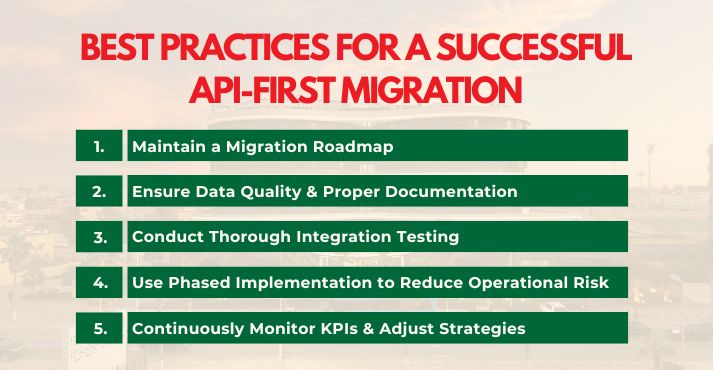
An API-first migration succeeds when it’s backed by solid planning, precise execution, and continuous optimization. These best practices help hotels minimize risk, maintain data accuracy, and ensure system stability throughout the process.
1. Maintain a Migration Roadmap
Define a roadmap that outlines timelines, dependencies, and responsibilities for each migration phase. This keeps IT and operations teams aligned and prevents confusion during system transitions.
2. Ensure Data Quality and Proper Documentation
Clean and validate data before migration to remove duplicates and inconsistencies. Maintain detailed documentation of APIs, endpoints, and integrations to support smoother troubleshooting and long-term scalability.
3. Conduct Thorough Integration Testing
Test all connections between PMS, CRS, and RMS systems to confirm they function correctly after migration. Early testing helps detect communication issues, preventing downtime and service interruptions.
4. Use Phased Implementation to Reduce Operational Risk
Rolling out systems in stages helps teams test functionality, train staff, and resolve issues before full deployment.
For example, Mandarin Oriental Hotel Group executed a phased migration of its financial and property management systems, starting with two pilot hotels to refine workflows and training before expanding across all properties. This strategy helped the brand maintain service quality during the transition.
5. Continuously Monitor KPIs and Adjust Strategies
Track key metrics, including system uptime, booking accuracy, and staff efficiency. Regular reviews help identify performance gaps and ensure the migration continues to meet changing business needs.
Future of Interoperability in Hospitality Tech
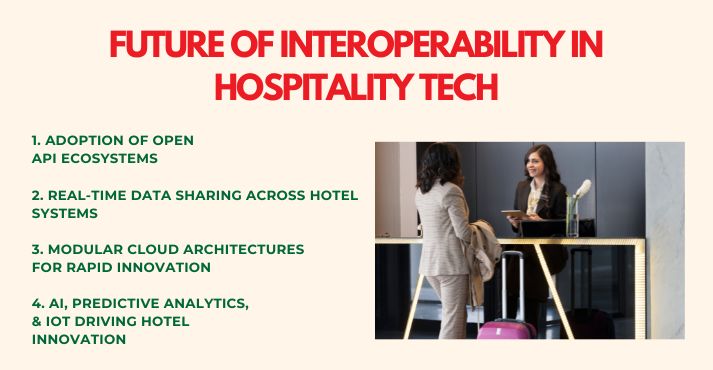
Rising guest expectations, stricter data standards, and increasing competition have made scalable, cloud-based API-first ecosystems essential for hotels. The next phase of hospitality technology will focus on open interfaces and instant data exchange.
Modular architectures will remove the limitations of legacy hotel software replacement, while IoT, predictive analytics, and AI continue to change how connected hotel systems operate.
1. Adoption of Open API Ecosystems
More hotels are choosing platforms that use open APIs so different systems can connect smoothly. Open standards minimize vendor lock-in, enhance interoperability, and facilitate more efficient integrations between property management, reservations, and guest-facing applications.
2. Real-Time Data Sharing Across Hotel Systems
Instant synchronization of data, such as availability, pricing, and guest preferences, improves accuracy and consistency. Hotels using real-time connections experience fewer booking errors, better rate alignment across channels, and faster guest service.
3. Modular Cloud Architectures for Rapid Innovation
Cloud-based hotel management systems with modular designs let hotels add or update features without replacing the entire platform. This flexibility simplifies scaling, reduces hardware costs, and allows continuous improvement as market needs change.
4. AI, Predictive Analytics, and IoT Driving Hotel Innovation
AI and predictive analytics help hotels forecast demand, dynamically adjust pricing, and deliver more personalized experiences. IoT devices, such as smart thermostats, lighting systems, and occupancy sensors, optimize energy use and improve guest comfort.
Conclusion
Migrating from legacy systems to API-first platforms helps hotels simplify operations, improve connectivity, and deliver a more personalized guest journey.
With modern integrations across PMS, CRS, RMS, POS, and CRM, hotels can enhance efficiency, reduce downtime, and stay prepared for future innovations.
To succeed, decision-makers should plan their migration carefully, evaluate vendors based on long-term scalability, and apply structured best practices throughout the transition.
A migration assessment or consultation with experienced hospitality technology partners can help identify gaps and guide effective implementation, ensuring sustainable business growth.