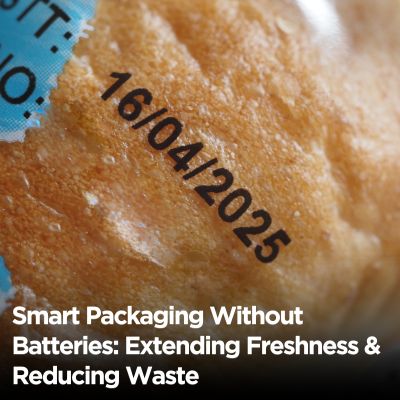
According to UNEP, about 1.05 billion tonnes of food were wasted globally in 2022. That is nearly 19% of all food available to consumers.
This waste places heavy strain on natural resources and creates costs and risks for businesses in production, transportation, storage, retail, and supply chains.
With pressure rising from consumers, regulators, and investors, companies are expected to deliver packaging that does more than just contain food.
Freshness retention, safety monitoring, and reduced environmental burden are now essential expectations. Traditional packaging can fall short in meeting these expectations without becoming wasteful itself.
Smart packaging without batteries is emerging as an innovation that addresses these needs. This technology enables freshness monitoring, spoilage detection, and response — all without embedded power sources. It offers potential to reduce waste, protect food quality, and support sustainability goals.
In this blog, we’ll explain how this technology works, what benefits it delivers, industry use cases, and where it is headed next.
What is Battery-Free Smart Packaging?
Battery-free smart packaging is an advancement in food packaging technology that removes the need for built-in batteries.
Earlier forms of smart packaging often used small batteries to power sensors or indicators, but these added cost, created disposal issues, and made recycling more difficult.
Battery-free systems avoid these problems by using energy-harvesting methods and passive components that can be integrated directly into packaging materials.
This type of packaging works through printed electronics, enzyme-based sensors, and NFC or RFID energy harvesting. For example, sensors can detect gases released during spoilage, while energy is supplied externally by a smartphone or warehouse scanner.
In other cases, passive freshness indicators such as color-changing labels provide a clear visual cue without requiring any power source.
By removing batteries, this approach reduces hazardous waste, supports easier recycling, and makes packaging safer and more sustainable for large-scale use.
How It Extends Freshness and Safety
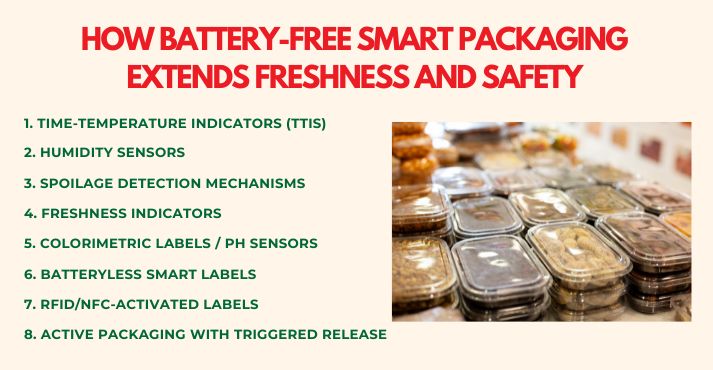
Battery-free smart packaging uses multiple techniques to monitor conditions that impact product freshness and safety.
Time-temperature indicators (TTIs) track heat exposure over time, humidity sensors detect moisture that can promote microbial growth, and spoilage detection mechanisms identify gases or chemical changes associated with decay.
These systems enable producers and retailers to spot compromised products long before visible signs appear.
For consumer packaged goods, such systems build trust because quality indicators are integrated directly into the packaging, eliminating the need for an internal battery.
For instance, a study titled “Battery-free, Stretchable, and Autonomous Smart Packaging” used gas sensors with NFC energy harvesting to monitor fish and trigger the release of antioxidant and antibacterial agents when spoilage began, extending shelf life by up to 14 days.
In dairy, freshness indicators and TTIs in milk or yogurt change color if the cold chain is broken. For seafood and meat, colorimetric labels or sensors detect volatile amines or pH changes to signal decay.
Some innovations use batteryless smart labels, allowing retailers and consumers to scan or visually check freshness without any power source.
Labels activated by RFID or NFC fields can report freshness data, while passive indicators, such as color-changing labels, clearly show spoilage.
These methods enhance food safety by reducing the risk of unsafe consumption and minimizing waste through reliable signals of remaining product quality.
Reducing Waste Across the Food Supply Chain
Better monitoring of food quality helps reduce food waste by stopping products from being discarded too early.
When freshness indicators, time-temperature tracking, or spoilage sensors accurately reflect real conditions, rather than relying solely on expiry dates, retailers can avoid returns and markdowns.
Producers and distributors also benefit since they can keep products moving through the food supply chain without shipping items that are already compromised.
Managing food waste becomes more effective when decisions are based on actual conditions rather than conservative assumptions.
Packaging waste is also a significant issue. Around 40% of plastic waste worldwide comes from packaging.
Smart passive packaging that avoids embedded batteries or complex composite materials makes recycling easier and supports a more circular approach.
When designs are kept simple, they can be easily recovered and reused, reducing the creation of additional single-use plastic waste.
An example of this is Evigence, a company that provides time-temperature indicators already used by food retailers and meal kit providers.
Their technology has helped extend shelf life by around 20% and cut food waste by approximately 30%, giving businesses reliable insights into freshness while lowering costs tied to returns and spoilage.
Battery-Free vs. Battery-Powered Smart Packaging: A Comparison
Battery-free smart packaging and battery-powered solutions both aim to enhance food safety and monitoring, but they differ in terms of cost, sustainability, and long-term feasibility.
The table below compares the two approaches:
| Factor | Battery-Free Smart Packaging | Battery-Powered Smart Packaging |
| Cost per unit | Lower due to printed electronics and passive indicators | Higher because of embedded batteries and complex components |
| Environmental impact | Fewer hazardous materials, easier to recycle, avoids battery waste | Creates e-waste from batteries and mixed materials |
| Shelf life compatibility | Effective for short and medium shelf-life items such as dairy, seafood, and fresh produce | Can support longer shelf-life monitoring but adds cost and bulk |
| Ease of recycling | Higher, as designs remain simpler and use fewer composite layers | Lower, because of mixed materials and batteries |
| Industry adoption stage | Early adoption with pilots and first commercial rollouts | More established in niche uses but under pressure from regulators and sustainability goals |
Battery-free solutions offer cost advantages and help companies meet environmental regulations more easily. They make it possible to monitor freshness without creating complex recycling challenges.
The limitation is that adoption is still in the early stages, and scaling to global volumes remains a hurdle.
Who Is Leading This Innovation?
Several established firms and emerging startups are advancing passive smart packaging, creating solutions that trace, monitor, and protect products across the food distribution network.
For example, Stora Enso has introduced its ECO RFID tag technology, which uses paper-based, plastic-free labels for tracking, tracing, and authentication throughout the supply chain. Its “ECO Meal” tag is microwave-safe and designed for recycling with paper and board.
Avery Dennison offers digital ID technologies, RFID tags and labels, and labeling materials that improve transparency and sustainability.
Their expansion in India with a new RFID facility in Pune brings advanced labeling solutions closer to the regional food, pharmaceutical, and healthcare industries.
Thinfilm focuses on printed electronics and NFC solutions. Their OpenSense and SpeedTap tags have been used for packaging authentication, temperature tracking, and interactive consumer engagement in pharmaceuticals, beverages, and supplements.
Regulatory frameworks guide the development and deployment of these technologies. The EU’s Packaging and Packaging Waste Regulation, as well as its food contact material rules, define standards for recyclability and safety.
In the United States, FDA requirements set the criteria for packaging materials approved for use with food.
Adoption is strongest in the food & beverage, pharmaceutical, and logistics sectors. Stora Enso’s ECO RFID tags, for example, are already in use for ready meals and packaging authentication, enabling food items to be traced at the item level throughout the supply chain.
Cold chain logistics companies are also testing battery-free and low-power labels to track temperature during transit without relying on conventional batteries.
Benefits for Businesses and Consumers
Battery-free solutions bring value across the food ecosystem, from manufacturers and retailers to end customers. The advantages can be grouped into three areas:
For businesses:
- Lower operating costs by reducing product loss and limiting unnecessary returns through more accurate freshness monitoring.
- Alignment with ESG goals through reduced spoilage and more efficient resource utilization.
- Compliance readiness for stricter packaging regulations in both the EU and the US.
For consumers:
- Greater transparency through labels and indicators that show freshness levels.
- Safer products by reducing the risk of spoiled or mishandled food reaching shelves.
- Higher confidence when buying perishable items such as seafood, dairy, or prepared meals.
For the planet:
- Less electronic waste since self-powered smart packaging eliminates the need for built-in batteries.
- Reduction in food waste as better tracking extends shelf life, with some solutions adding as much as 10 days of freshness.
- Less packaging waste overall as materials support sustainable packaging goals through recyclability.
Challenges and Considerations
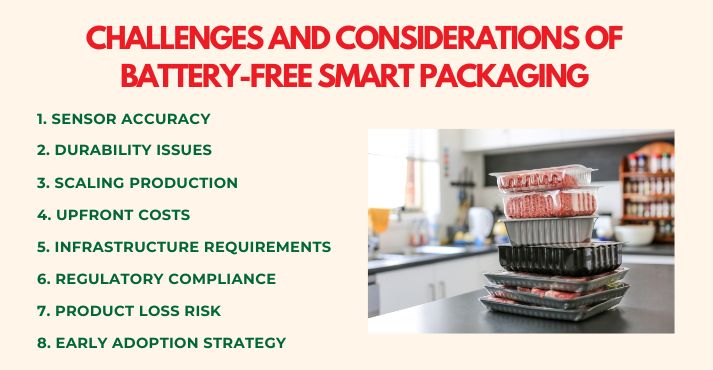
Battery-free smart packaging faces several limitations that businesses must consider. Sensor accuracy can be affected by fluctuations in temperature within cold chains, and durability may be compromised by exposure to moisture, improper handling, or mechanical stress.
Scaling production from prototypes to mass-manufactured units with consistent quality also requires careful planning and investment.
Cost is another factor. While battery‑free solutions can reduce long-term losses, the upfront cost per unit is higher than that of traditional packaging.
Companies producing large volumes must weigh whether reduced waste or premium pricing justifies the investment, especially if there is no existing infrastructure to read freshness indicators.
Compliance with food labeling requirements adds further complexity. Materials must meet food-grade standards, and local regulations govern how freshness, use-by dates, and safety information are displayed.
A recent study found that improper temperature control during the transportation and storage of perishable foods can result in up to 35% product loss before reaching retail.
Early adoption strategies, such as pilot programs with short-shelf-life products, help businesses test effectiveness, ensure compliance, and refine processes before scaling.
Future of Sustainable Smart Packaging
The future of smart packaging includes biodegradable sensors, circular packaging loops, and energy-harvesting packaging that collects small amounts of environmental energy to operate indicators.
These technologies aim to reduce environmental impact while providing manufacturers with real-time insights into product conditions throughout the food supply chain.
Integrating battery-free smart packaging with IoT dashboards and retail analytics offers opportunities to predict spoilage, optimize inventory, and improve logistics efficiency.
Manufacturers can monitor trends across multiple locations, detect anomalies quickly, and make informed decisions to reduce waste and improve margins.
Battery-free smart packaging is increasingly viewed as more than just technology and is becoming an important part of the circular economy.
By combining sustainability, real-time monitoring, and integration with data systems, businesses can enhance freshness, reduce waste, and meet the rising expectations of consumers and regulators.
FAQs Section
What is battery-free smart packaging?
Battery-free smart packaging uses printed electronics, enzyme-based sensors, or energy-harvesting technologies to monitor freshness and quality without embedded batteries.
How does it reduce food waste?
By providing real-time information on product condition, it allows retailers and consumers to make informed decisions, avoiding premature disposal of food.
Is it cheaper than battery-powered smart labels?
Unit costs can be lower due to simpler components and the absence of batteries, although upfront costs may still be higher than those of traditional packaging without smart features.
Which industries are adopting it fastest?
The food and beverage, pharmaceutical, and logistics sectors are leading the adoption due to the need for traceability, freshness monitoring, and compliance.
Can battery-free packaging be recycled?
Yes, most battery-free designs use simpler materials and avoid hazardous battery waste, making them easier to recycle compared with battery-powered alternatives.
Conclusion
Battery-free smart packaging provides businesses and consumers with a new level of confidence in product freshness and safety, while supporting sustainable food practices.
By eliminating batteries, reducing waste, and integrating with energy-harvesting technologies, it lowers environmental impact and simplifies recycling.
For manufacturers, these solutions help control costs, improve compliance, and enhance transparency across the supply chain. Consumers benefit from safer products and clearer information on freshness, which helps build trust and satisfaction.
As the food industry focuses on sustainability and efficiency, battery-free packaging is becoming more than a choice. At Food&HotelAsia, discover how packaging leaders are leading this transition and see innovations firsthand.