Across the global food industry, ingredient origin transparency is gaining importance. More people want to know not just what is in their food, but where each ingredient comes from. This awareness is influencing how food is produced, packaged, and exported around the world.
Research indicates that 75% of consumers prioritize clear and honest information about the products they purchase. Nearly two-thirds say they are willing to move to brands that offer better visibility into ingredient sourcing.
This rising demand is encouraging food exporters and manufacturers to rethink how they present and verify product information.
New digital systems are helping companies trace the journey of ingredients from source to shelf. At the same time, government regulations in many countries are changing to support this growing expectation.
As transparency becomes a deciding factor in what people choose to buy, businesses involved in food exports must be prepared to meet these demands.
Focusing on ingredient origin transparency is not just about meeting consumer interest; it is becoming essential for staying competitive in the global marketplace.
What Is Ingredient Origin Transparency?
Ingredient origin transparency refers to the clear and accurate disclosure of the origin of each ingredient in a food product.
It is not limited to stating the country of origin. It also includes detailed information about how ingredients are sourced, the conditions in which they are produced, and the ethical practices followed throughout the supply chain.
This kind of openness gives buyers, whether they are consumers, importers, or regulators, a clearer understanding of the product they are dealing with.
It helps identify producers who are committed to responsible sourcing and sets them apart from those who provide limited or generic information.
This approach supports trust, strengthens accountability, and helps meet the expectations of modern food markets.
Key Components of Transparency
- Traceability: This means knowing exactly where each ingredient comes from and how it moves through the supply chain. This includes every step from the farm or fishery to processing, packaging, and delivery. A clear farm-to-table record supports supply chain transparency, helping exporters verify sourcing claims, maintain food safety, and meet import requirements. It also allows buyers to confirm that products are handled properly at each stage.
- Ethical sourcing: Ethical sourcing examines how individuals involved in production are treated. This includes fair wages, safe working conditions, and respect for labor rights. Many importers now require evidence that ingredients are not linked to forced labor or unsafe working conditions. Transparency in this area helps build long-term relationships and shows that a business values responsible trade.
- Sustainability: Transparency also includes environmental impact. Exporters are expected to measure their carbon footprint, use fewer natural resources, and reduce waste. Companies that adopt sustainable food sourcing practices, such as local farming or eco-friendly transportation, are better positioned to meet buyer expectations. Effective waste management during production, storage, and transportation not only protects the environment but also reduces costs and enhances operational efficiency.
Why Ingredient Origin Transparency Matters More Than Ever
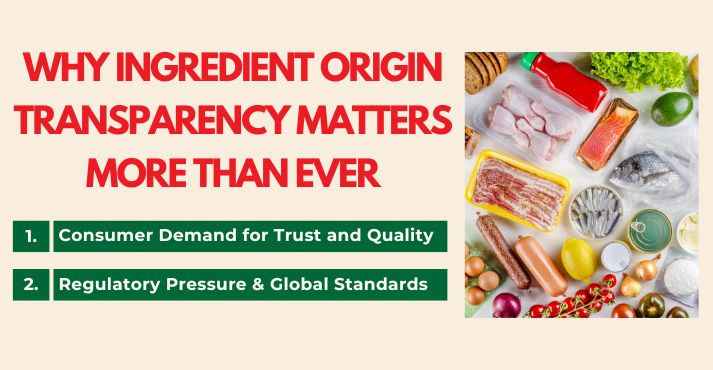
Ingredient origin transparency is no longer just a nice-to-have. It has become a clear expectation for companies involved in food exports.
Buyers, regulators, and end consumers want to know where ingredients come from, how they’re sourced, and whether the process meets standards for safety, quality, and ethics.
Expectations are rising on both the consumer and regulatory side, making transparency an essential part of how food products are assessed and approved in global markets.
1. Consumer Demand for Trust and Quality
People are more careful than ever about what they eat. Concerns about personal health, environmental impact, and food production are prompting companies to be more transparent about their ingredient sourcing.
This rise in consumer demand for transparency is influencing what gets stocked on shelves and approved for import.
More consumers are checking labels for certifications like non-GMO, organic, and fair trade. They are also inquiring about the origin of ingredients and their handling process.
Interest in organic ingredients continues to climb. According to the Organic Trade Association, sales of organic packaged snacks increased by 14% in 2024, showing that demand is not slowing down.
In many cases, trust is tied directly to transparency. Products that show clear sourcing practices, such as how farms operate, how workers are treated, or whether pesticides are used, are more likely to win consumer approval.
This is especially important in export markets where buyers are focused on food safety and long-term product quality.
2. Regulatory Pressure and Global Standards
Stricter rules around transparency in food labeling are being enforced across major food-importing countries.
In the European Union, the United States, Singapore, and other markets, new and updated regulations are requiring exporters to provide more detailed information about the origin, processing, and environmental impact of ingredients.
These updated food export regulations often require more than traditional documentation. Authorities now expect clear sourcing records and may require exporters to show how they track ingredient movement through the supply chain.
This is where digital traceability systems, such as blockchain, are becoming common. These systems help document the entire journey of ingredients, providing buyers and regulators with confidence in the product’s origin and handling.
Companies that invest in traceability are not just responding to policy. They are also avoiding delays at customs, improving risk management, and maintaining access to competitive markets.
These days, transparency about ingredient origins supports both compliance and credibility. For exporters, staying relevant in a changing global food economy has become a basic requirement.
How Ingredient Origin Transparency Enhances Global Food Exports
Transparency in ingredient sourcing is no longer optional for food exporters. It directly influences market access, regulatory compliance, and consumer preference.
As global food export trends shift toward accountability, brands that provide clear sourcing information gain a competitive edge in both emerging and established markets.
1. Building Consumer Trust and Brand Loyalty
Consumers are increasingly favoring brands that disclose where and how their ingredients are sourced.
Patagonia Provisions, for example, emphasizes sustainable sourcing in food by detailing its regenerative agriculture practices, which have strengthened its reputation among environmentally conscious buyers.
Similarly, Fair Trade USA’s certification model ensures ethical labor and farming conditions, creating lasting customer relationships..
Transparency doesn’t just attract buyers, but also retains them. When importers and retailers can verify claims like non-GMO food or organic certification through documented supply chains, they are more likely to form lasting partnerships.
This reliability reduces risks for distributors and builds trust across the entire supply chain.
2. Meeting International Market Demands
Asia’s strict food safety regulations make traceability critical for exporters. Japan and South Korea require detailed documentation on origin, pesticides, and processing methods, particularly for meat, dairy, and grains.
China’s growing middle class also prioritizes food traceability technology, with QR codes on packaging allowing consumers to scan production histories.
In developed markets like the US and EU, transparency isn’t just about compliance, but a selling point. Buyers in these regions prefer suppliers that use blockchain or other verification tools to prove authenticity.
For example, Europe’s retail sector has implemented strict corporate responsibility policies that require sustainable sourcing in food. These requirements have led exporters to implement more transparent labeling and sourcing practices to maintain access to these valuable markets.
By aligning with these expectations, food exporters can avoid costly border rejections and position themselves as preferred suppliers in high-value markets.
Technological Innovations Driving Ingredient Transparency
As global food exports face stricter regulations and consumers ask more questions about the sourcing of their ingredients, technology is helping businesses trace the origin of their ingredients.
Blockchain, sensor tracking, and digital platforms now support a more ethical food supply chain, making it possible to verify sourcing claims with accurate data.
Blockchain and Food Traceability
Blockchain is helping companies enhance their ability to track ingredients across complex supply chains.
Once information about a product is recorded, such as harvest dates, origin, or processing steps, it becomes permanent and cannot be changed. This makes blockchain especially useful for verifying food traceability technology.
IBM Food Trust is one example. Walmart and Nestlé use the platform to trace products like pork and mangoes across borders. In one case, tracking the origin of mangoes was reduced from nearly a week to just over two seconds.
In China, Walmart used blockchain to track pork through every stage of the supply chain, from farms to warehouses. This helped improve product traceability, giving regulators and consumers greater confidence in food safety.
These systems allow buyers to verify traceable food products without relying on paperwork or third-party claims. It is a way to confirm that sourcing, handling, and transportation have met expectations at every step.
Digital Platforms and IoT
Digital platforms and connected devices are also helping exporters provide better visibility into where ingredients come from and how they are handled.
These systems collect real-time data during storage and shipping. If ingredients are exposed to unsafe temperatures or experience handling issues, alerts are triggered, allowing action to be taken before they reach the importer.
The “Thank My Farmer” app, supported by IBM, shows how traceability can reach consumers. Using a QR code on packaging, people can view the exact farm where their coffee beans were grown, the processing method used, and the sustainability programs followed.
This supports ongoing efforts to enhance ingredient transparency, enabling brands to connect with markets that prioritize social and environmental responsibility.
These technologies are not just helping exporters meet regulations. They are supporting a more transparent food supply chain that builds trust with buyers and consumers worldwide.
Challenges in Achieving Ingredient Origin Transparency
While ingredient origin transparency is becoming a priority in the global food trade, implementing it is not always straightforward. Many exporters and manufacturers face structural, financial, and operational barriers that make achieving full transparency difficult.
1. High Costs of Tracking and Certification
Building transparent supply chains often requires investment in digital systems, third-party audits, and updated logistics processes.
For small to mid-sized companies, the cost of traceability platforms, certification programs, and compliance documentation can be challenging to manage. Even larger producers may face budget pressure when expanding traceability across product lines or international markets.
Third-party verification for claims such as non-GMO, organic, or fair trade adds another layer of cost.
While these certifications help build trust, the ongoing expense of renewal, inspection, and reporting can discourage companies from pursuing complete transparency unless required by regulation or demanded by key buyers.
2. Lack of Standardized Global Regulations
Regulations around ingredient transparency vary widely between countries. What qualifies as traceable in the European Union may not meet expectations in the United States, Japan, or emerging markets.
For global exporters, this patchwork of rules creates confusion and compliance challenges. In some regions, transparency is legally enforced, while in others, it remains voluntary or loosely defined.
Without international standards, exporters must adapt their labeling and documentation practices to meet the requirements of each destination.
This increases administrative workload and the risk of noncompliance, especially when working with complex supply chains or multiple sourcing regions.
3. Complexity of Managing Traceability for Large-Scale Producers
Larger producers often work with hundreds of suppliers across different commodities and countries. Ensuring consistent traceability across all ingredients becomes a major logistical task.
Even with digital support, tracking every input through planting, processing, storage, and transport can expose gaps in documentation or communication.
Disruptions in the supply chain, such as crop failures, political instability, or transportation delays, further complicate the situation. When ingredients are substituted due to seasonal shortages or cost fluctuations, maintaining origin transparency becomes even harder.
Companies must build flexible systems that still meet the expectations of importing markets and retail partners while handling real-world complexity.
The Future of Ingredient Transparency: What to Expect by 2030
By 2030, ingredient origin transparency is expected to become a basic requirement in global food trade. Regulatory authorities in the European Union, the United States, and parts of Asia are already enforcing stricter rules around sourcing and labeling.
Exporters will likely be asked to provide clear, end-to-end documentation for every ingredient used in their products.
Many companies are turning to digital systems that can track product movement from the farm to the shipping container. Blockchain is one example being used to store permanent records that cannot be altered.
This level of traceability helps reduce fraud, supports compliance, and makes it easier to manage disruptions. These efforts contribute to building a more resilient supply chain that can meet both regulatory and buyer expectations without delays.
At the same time, consumers are paying closer attention to food sourcing and the production of ingredients. They want clarity on farming practices, labor conditions, and sustainability.
Brands are responding by offering more detailed product information through packaging, QR codes, and digital platforms. This trend indicates a rise in consumer-driven food transparency, where purchasing decisions are influenced by verified sourcing claims.
Companies that act now by improving traceability systems, training sourcing teams, and staying current with regulations will be better prepared to meet future export requirements.
Transparency is no longer just a benefit for branding. It has become a basic expectation in the global food trade.
Conclusion
Ingredient origin transparency is becoming essential for the future of global food exports. As consumers ask more questions and regulations become stricter, the ability to trace and verify where ingredients come from is moving from a competitive edge to a basic requirement.
Exporters, manufacturers, and supply chain managers should take clear steps now. This includes improving traceability, working with suppliers who provide reliable sourcing information, and keeping up with changes in food labeling laws.
These efforts help meet buyer expectations, support compliance, and build trust in both established and emerging markets.
Ingredient transparency is no longer a secondary concern. It is now a necessary part of global trade, and by 2030, it may determine which businesses are ready to grow and which fall behind.