Digital twin technology is becoming more common in manufacturing, and food production is starting to see its benefits.
A digital twin is a real-time digital version of a physical process, machine, or production line. It uses live data from equipment and sensors to mirror what is happening on the factory floor.
In food manufacturing, this allows producers to track operations closely. They can monitor cooking times, temperature changes, storage conditions, and packaging performance without interrupting the actual workflow.
This helps teams identify problems early, reduce waste, and maintain consistent quality across batches.
Interest in digital twin systems is increasing across industries. The global market is expected to grow from approximately $24.48 billion in 2025 to $259.32 billion by 2032.
For food manufacturers facing pressure to improve efficiency, meet safety standards, and reduce costs, digital twins offer a way to work smarter by understanding and improving processes in real-time.
What is a Digital Twin?
A digital twin is a working model of a physical process or piece of equipment that runs in parallel with the real thing.
It collects data from sensors installed on machines or systems and uses that information to display what is happening in real-time. This includes conditions like temperature, speed, or pressure during production.
The system typically includes sensors for data input, a software model to simulate behavior, and a mechanism to send updates or alerts based on the data’s findings. It helps manufacturers watch how their systems are performing and adjust them as needed.
Digital twins are now used to support food manufacturing efficiency by helping teams spot small issues before they cause downtime or waste. They can also be used to test production changes or schedule adjustments before trying them on the floor.
How It Works in Food Production
In food manufacturing, digital twins are being used to improve how products are developed and how equipment is maintained.
For example, a mixing process can be tested virtually to see what happens when ingredient ratios or temperatures are adjusted. This can accelerate development without requiring repeated physical trials.
These systems are also used for real-time production monitoring. Instead of waiting for a shift report or a breakdown, managers can see what’s going on with a line as it runs and act quickly if something is off.
Production planning can also improve. A digital twin can simulate various workflows or output levels, allowing teams to plan based on accurate predictions rather than guesswork.
For food manufacturers, this means better use of time, fewer stoppages, and more control over quality and output.
As food technology gains importance in plant operations, digital twins are helping manufacturers transition from reacting to issues to proactively managing them.
The Role of Digital Twins in Food Manufacturing
Digital twin technology is helping food manufacturers gain better control over how products are made, moved, and maintained. By connecting machines, sensors, and systems into a live digital model, teams can monitor performance, test improvements, and avoid disruptions.
Unlike static reports or occasional checks, this model updates with real-time information, enabling production teams to identify problems early and make informed adjustments throughout the day.
The use of digital twins is becoming a significant component of smart manufacturing in the food industry, particularly where precision and consistency are crucial.
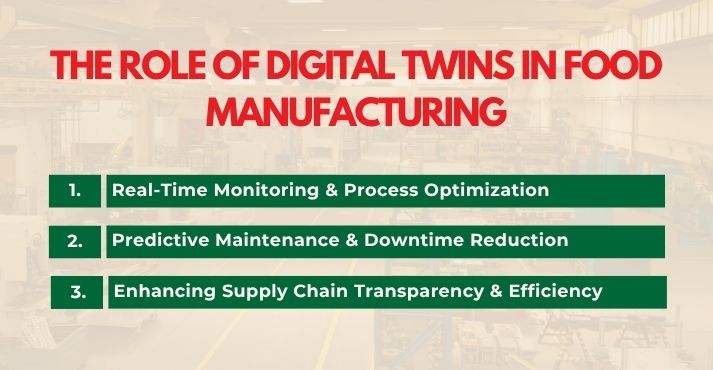
1. Real-Time Monitoring and Process Optimization
Food production involves numerous steps, where even minor errors can result in significant losses. A digital twin allows teams to follow each part of the process in real time, from cooking and mixing to packaging.
If the temperature drops too low or the conveyor slows down, the system immediately indicates this. This helps teams respond quickly before it affects the entire batch.
Live monitoring also makes it easier to test changes. For example, adjusting oven settings or mixing times can be tested during actual production without stopping the line. This improves output and helps maintain quality across shifts.
Digital twin simulation provides manufacturers with a reliable method for evaluating adjustments using real-time data. This leads to better decision-making and smoother operations throughout the production cycle.
2. Predictive Maintenance and Downtime Reduction
Breakdowns during production often result in delays, wasted product, and increased labor costs. Digital twins can reduce these problems by tracking how machines behave over time.
If a motor starts running hotter than usual or a mixer shows signs of strain, the system detects these changes. With this early warning, maintenance can be planned to prevent equipment failure.
This means fewer surprises and less time spent on repairs. It also avoids the cost of replacing parts too soon.
Many food manufacturers are now using digital twins to maintain steady production while avoiding over-servicing equipment that doesn’t require it. This approach supports food manufacturing innovation by keeping lines moving and teams focused.
3. Enhancing Supply Chain Transparency and Efficiency
Managing supply chains in food production can be challenging, especially with changing demand, seasonal ingredients, and tight delivery windows.
Digital twins help by providing a clearer view of how materials move from sourcing to delivery. They can test what happens when orders increase or when a supplier is delayed.
For example, if a shipment of ingredients is expected to arrive late, the system can show how that delay would affect production and suggest adjustments to the schedule. It also helps with planning storage, delivery routes, and staffing more effectively.
This level of planning enhances both visibility and timing, allowing teams to make quicker decisions and avoid last-minute changes.
Digital twins give manufacturers a way to stay ahead of supply chain problems by identifying potential disruptions early and allowing time to adjust plans before they affect production.
Key Benefits of Digital Twin Technology in Food Manufacturing
Digital twin technology is helping food manufacturers improve efficiency, control costs, maintain product quality, and strengthen supply chain visibility. These benefits are driving its wider use across food processing and production:
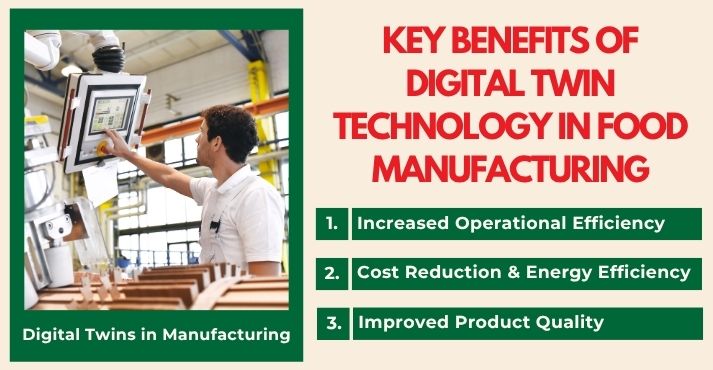
1. Increased Operational Efficiency
Access to real-time production monitoring enables plant teams to act swiftly when issues arise, such as temperature change or machinery slowdown.
Digital twins in supply chains and food processing lines allow operators to test adjustments virtually, helping refine settings without pausing production.
A global survey of manufacturers showed that early adopters of this manufacturing efficiency technology achieved around 25% gains in operational efficiency within their first year. This translates to faster throughput, fewer interruptions, and more efficient resource utilization.
2. Cost Reduction and Energy Efficiency
Energy costs and unnecessary expenditures often go unnoticed in busy food plants. Implementing digital twin simulation, which combines live data with predictive models, can reduce energy use by as much as 15-20%.
These systems also anticipate maintenance needs, reducing unplanned downtime and limiting waste from over-servicing. Using AI in food production systems supports smarter scheduling, improves equipment performance, and leads to clearer financial savings.
3. Improved Product Quality and Consistency
A digital twin continuously monitors factors such as temperature, pressure, and mixing speed to ensure that each batch meets the specifications. This level of oversight boosts food security by reducing the chance of defects and ensuring consistent taste, texture, and safety.
Studies show that digital twins help reduce waste management issues by minimizing spoilage and defects, thereby improving compliance with safety standards and lowering recall risks.
By supporting smarter decision-making at every stage, including process control, equipment maintenance, and supply chain forecasting, digital twins are showing measurable value in food production.
Case Studies: Digital Twin Technology in Action
Here are real-world examples showing how digital twin technology is being used by food and related manufacturers.
Nestlé: Optimizing Production Lines and Supply Chains
At Nestlé’s Juuka bouillon plant in Finland, a digital twin was created to mirror the production line, using sensors and software to simulate operations. This digital model helped the plant make changes that led to significant cost savings over time.
In the UK, Nestlé partnered with GXO and Swisslog to build a highly automated distribution center. While not a digital twin in the traditional sense, its use of intelligent analytics to optimize order flow illustrates how digital models can drive efficiency, improving picking rates from 200 to 900 cases per operator-hour, a 77.7% increase.
These efforts show how data-driven food manufacturing practices can streamline both production and distribution activities.
PepsiCo: Predictive Maintenance to Avoid Disruptions
PepsiCo began a predictive maintenance pilot at one of its facilities by installing sensors to track vibration, temperature, and pressure on key equipment.
The system predicted potential failures, resulting in a 30% reduction in unplanned downtime and a 20% decrease in maintenance costs.
Based on this success, PepsiCo expanded the program globally and integrated it into everyday operations, improving equipment reliability and production consistency.
This case highlights the power of combining digital twins and predictive insights to prevent equipment failures before they occur.
Seafood Industry: Tracking Fish Quality from Farm to Packaging
In the seafood sector, the iFishIENCi project developed a digital twin of fish behavior and physiology. By collecting data on fish conditions and environment, the system can predict feeding needs and monitor fish health.
This reduces waste, improves feeding efficiency, and enhances food security throughout the supply chain. This example shows how digital twins in supply chains can bring transparency and control not just in factories but also at the source.
Each example shows how digital twin technology supports data-driven food manufacturing, whether through production optimization, predictive care, or quality monitoring from source to shelf.
Challenges and Barriers to Adopting Digital Twin Technology
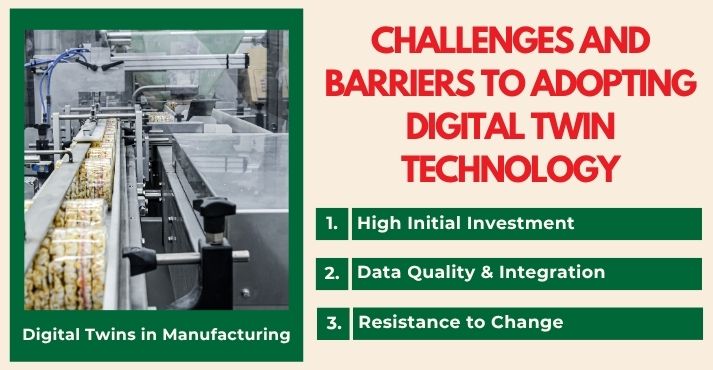
While digital twin technology offers numerous advantages for food manufacturing, implementing it presents a range of challenges. From high upfront costs to internal resistance and data issues, manufacturers often face several roadblocks when starting the transition.
1. High Initial Investment
Setting up a digital twin system requires a significant upfront commitment. Costs include purchasing sensors, upgrading infrastructure, and investing in software that can run detailed models.
Beyond equipment, companies must also allocate time and budget for staff training, system setup, and ongoing support.
For many small to mid-sized manufacturers, this investment can be difficult to justify without a guaranteed return.
A phased rollout, starting with a specific line or process, may be more manageable, but the overall expense remains a key consideration. These cost concerns can delay decisions, even when the long-term benefits seem promising.
2. Data Quality and Integration
For digital twins to function reliably, the input data must be accurate, consistent, and well-integrated.
In many plants, production data comes from multiple systems that may not communicate easily with one another. Some machines may lack modern sensors, while others produce incomplete or irregular readings.
When data streams are not properly aligned, the digital model becomes unreliable. This leads to poor insights, delayed reactions, or even incorrect adjustments on the production line. Integrating new systems while maintaining production schedules is another layer of complexity.
Even in facilities using AI in food production, the success of digital twins depends on maintaining reliable data inputs from the ground up. Without clean and synchronized data, the system cannot accurately reflect the real process.
3. Resistance to Change
One of the less visible but equally important challenges is internal resistance. In many traditional manufacturing plants, teams are used to well-established routines.
Introducing new systems, especially those that collect and track detailed performance data, can be seen as disruptive or unnecessary.
Some employees may worry that new technologies could replace their roles or add to their workload. Others may question the reliability of the digital model or prefer hands-on troubleshooting.
Addressing these concerns requires clear communication, practical training, and leadership support. Teams need to understand not just how the system works, but why it matters.
Without early buy-in from operators and supervisors, digital twin projects are more likely to stall or be underused.
The Future of Digital Twin Technology in Food Manufacturing
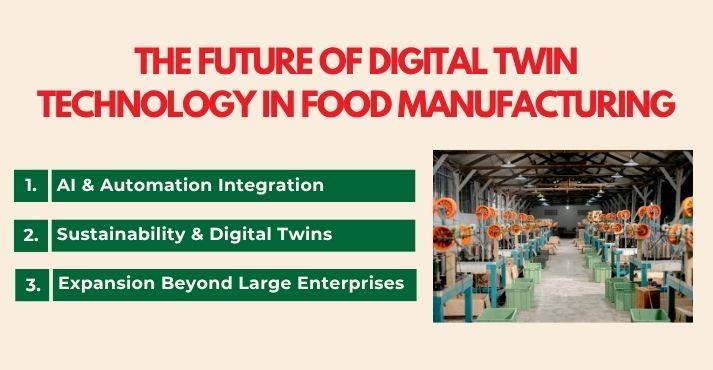
Digital twin technology is expected to become more widely used in food production as systems improve, support sustainable practices, and become easier to adopt, even for smaller manufacturers.
1. AI and Automation Integration
Digital twins that include automation and predictive insights are becoming more capable of adjusting operations with little human input.
For example, a twin combined with automated controls can detect a shift in oven temperature and automatically adjust heating to maintain consistency. Factory operators then receive alerts only when manual intervention is needed.
This level of control improves production efficiency and helps prevent quality issues before they happen. A recent industry survey found that more than 54% of manufacturers now use digital twins for energy management and predictive care.
These developments show how AI in food production can facilitate smooth operations while maintaining high standards.
2. Sustainability and Digital Twins
Digital twins offer strong support for sustainable production. By modeling resource use across the entire value chain, including energy, water, and materials, manufacturers can identify areas where to reduce waste and emissions.
For example, studies show that improving plant energy efficiency by as little as 1% can prevent 70 million tons of carbon emissions annually.
In real-world terms, digital twins help plants reduce energy use by up to 30% and material waste by 17% through the virtual testing of new processes. This makes them a valuable resource for both cost savings and environmental responsibility.
3. Expansion Beyond Large Enterprises
New technologies like cloud computing, modular software, and shared analytics platforms are making digital twins more affordable and accessible.
These advances allow smaller food producers to start with basic models, perhaps focusing on a single production line before scaling up.
With more manufacturers using this technology, implementation costs continue to fall. This trend is opening doors for a wider range of companies to explore data-driven food manufacturing without requiring a large upfront investment.
Conclusion
Digital twin technology is changing the way food manufacturers plan, monitor, and improve their operations.
By offering real-time insights, better control over processes, and stronger predictive capabilities, digital twins support higher efficiency, lower costs, and more consistent product quality.
From reducing downtime to managing energy use and improving traceability, the benefits are already apparent in companies that have adopted the technology.
For food manufacturers seeking to enhance their operations and remain competitive, digital twins are no longer exclusive to large enterprises. As systems become more scalable and affordable, now is a good time to explore where this technology can bring value.
Whether it’s improving a single production line or enhancing site-wide performance, digital twins can support long-term digital strategies aimed at smarter, more reliable production.