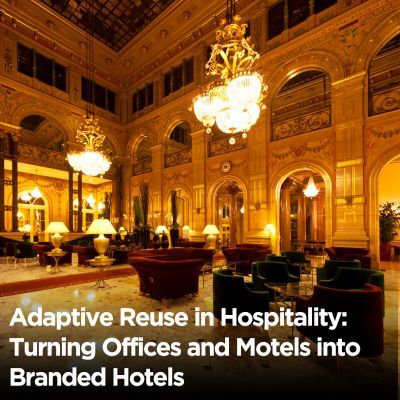
Across city skylines and suburban corridors, a quiet revolution is reshaping the hospitality sector. Adaptive reuse in hospitality is emerging as a powerful strategy for developers and hotel brands looking to expand their portfolios creatively and sustainably.
This approach involves transforming underutilized or vacant buildings (particularly offices and aging motels) into vibrant, branded hotel properties.
Rather than constructing from the ground up, developers are breathing new life into existing structures, creating unique guest experiences while addressing urban vacancy issues.
The trend represents a fundamental shift in how we think about real estate development, offering faster project timelines, significant cost advantages, and compelling environmental benefits that align with modern sustainability goals.
What is Adaptive Reuse in Hospitality?
Adaptive reuse in the hospitality context refers to the ‘process of repurposing existing buildings for hotel use while preserving their essential structural character’.
Unlike renovation, which typically updates a space for its original purpose, adaptive reuse involves a fundamental transformation; turning something that was never a hotel into one.
This creative approach to hotel development is gaining momentum as developers seek smarter ways to grow their portfolios.
The concept differs dramatically from new construction. While building from scratch offers complete design freedom, adaptive reuse projects work within an existing framework, turning architectural constraints into unique design features.
An office building’s large floor plates become spacious guest suites, while a motel’s roadside accessibility transforms into convenient urban access.
This process isn’t just about saving money; it’s about creating hotels with authentic character and history that new constructions often struggle to replicate.
The Benefits of Adaptive Reuse for Hotels
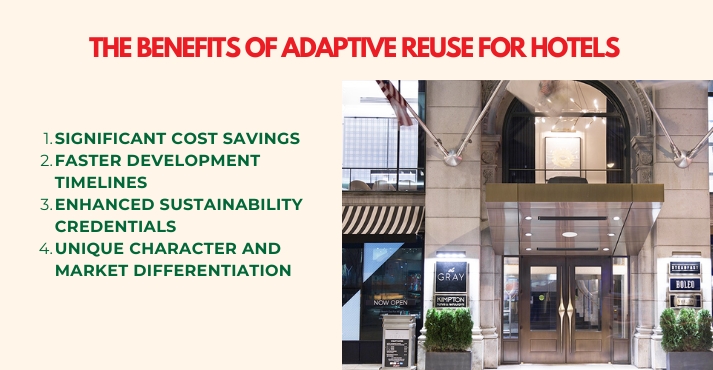
The growing popularity of adaptive reuse in hospitality stems from its compelling advantages across financial, environmental, and operational dimensions.
These benefits make conversion projects particularly attractive in today’s competitive market.
Significant Cost Savings
Converting an existing building typically costs 20-30% less than new construction. The foundation, structural shell, and basic utilities are already in place, reducing both material and labor expenses.
This cost efficiency allows developers to allocate more budget toward high-impact areas like interior design and guest amenities.
Faster Development Timelines
Adaptive reuse projects often shave 6-12 months off typical development schedules. Since the building envelope already exists, projects can bypass extensive site preparation and structural work.
This accelerated timeline means hotels can generate revenue sooner, improving overall project economics and ROI.
Enhanced Sustainability Credentials
Reusing buildings dramatically reduces construction waste and embodied carbon. The conversion process typically generates 50-75% less waste than demolition and new construction.
This strong environmental benefit aligns perfectly with the growing demand for sustainable hotel development among both guests and investors.
Unique Character and Market Differentiation
Converted hotels offer authentic architectural features that new builds struggle to replicate.
Exposed brick, original timber beams, or mid-century facades provide instant character, creating memorable guest experiences that stand out in competitive markets.
Types of Properties Commonly Converted into Hotels
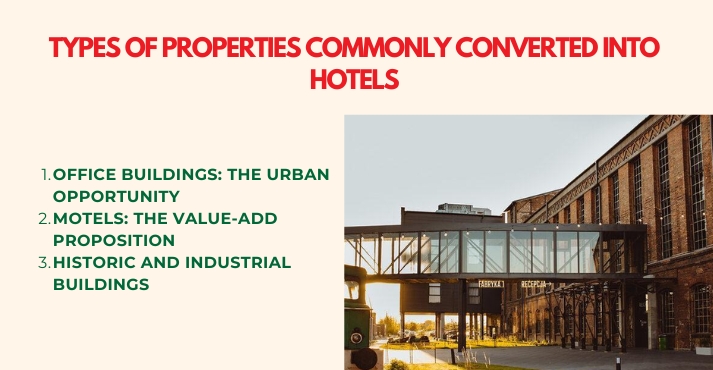
Certain property types have proven particularly well-suited for hotel conversions, each offering distinct advantages for developers and hotel brands.
Office Buildings: The Urban Opportunity
Vacant office buildings represent one of the most promising conversion opportunities. Their central locations, infrastructure, and large floor plates make them ideal for boutique hotel conversions.
These large, often unconventional floor plans challenge designers to create unique and functional spaces, requiring a wealth of creative hotel room design ideas to turn former office suites into welcoming guest accommodations.
Motels: The Value-Add Proposition
Older motels, particularly those along highways or in transitioning neighborhoods, offer excellent potential for motel-to-hotel transformation.
Their simple construction, convenient locations, and existing hospitality zoning make them perfect candidates for repositioning as branded hotels targeting budget-conscious travelers.
Historic and Industrial Buildings
Warehouses, factories, and historic civic buildings provide unique opportunities for creating distinctive hotel experiences.
Their generous proportions, high ceilings, and architectural character allow for dramatic interior spaces that command premium rates and attract design-conscious guests.
The Adaptive Reuse Process: How Offices and Motels are Turned into Hotels
Successful adaptive reuse projects follow a systematic approach that balances creative vision with practical considerations.
Step 1: Comprehensive Feasibility Assessment
The process begins with a thorough evaluation of the candidate property. This includes structural analysis, zoning verification, and market study to determine if conversion makes financial and operational sense.
Key considerations include floor plate efficiency, column spacing, and existing mechanical systems.
Step 2: Navigating Zoning and Regulatory Requirements
Converting a building to hotel use often requires managing complex zoning changes and building code adaptations.
This phase involves securing necessary permits and ensuring the project meets all safety, accessibility, and operational requirements for hospitality use.
Step 3: Creative Design and Strategic Renovation
This is where the vision comes to life. Architects and designers reimagine the space, working with the building’s existing features while integrating modern hotel requirements.
The design must balance preservation with functionality, creating spaces that meet brand standards while celebrating the building’s original character.
Being familiar with the current hotel design trends is crucial at this stage to ensure the converted property feels fresh, relevant, and appealing to modern travelers.
Step 4: Brand Integration and Market Positioning
The final phase involves aligning the converted property with its target brand and market segment.
This includes implementing brand standards, developing operational protocols, and sourcing everything from linens to high-quality tableware and hospitality supplies to create marketing strategies that highlight the property’s unique story and features.
Key Challenges in Adaptive Reuse Hotel Projects
While the benefits are compelling, adaptive reuse projects present unique challenges that require careful management.
Structural and Layout Limitations
Existing buildings often present spatial constraints that don’t align with conventional hotel layouts.
Small windows in office buildings or narrow room configurations in motels require creative design solutions to meet guest expectations and operational needs.
This is especially true for planning an efficient kitchen layout, which must be carefully designed within the existing footprint to support food and beverage services.
Regulatory and Zoning Hurdles
Converting a building from one use to another frequently triggers complex zoning reviews and building code requirements.
Projects may need to address parking, accessibility, fire safety, and other regulations that differ significantly from the original use.
Hidden Costs and Condition Surprises
Existing buildings often conceal unexpected issues (outdated electrical systems, asbestos, or structural weaknesses) that can significantly impact budgets and timelines.
Thorough due diligence and contingency planning are essential for managing these risks effectively.
Balancing Preservation and Modernization
Projects involving historic buildings require careful negotiation between preservation requirements and modern hotel operational needs. This balance must be struck while maintaining the building’s character and meeting brand standards.
Adaptive Reuse vs. New Hotel Construction
Understanding the trade-offs between conversion and new construction helps developers make informed decisions about their projects.
| Consideration | Adaptive Reuse | New Construction |
| Development Cost | 20-30% lower due to existing structure | Higher due to complete build-out |
| Timeline | 6-12 months faster | Longer due to site work and construction |
| Design Flexibility | Limited by existing structure | Complete creative freedom |
| Sustainability | Significant waste reduction and embodied carbon savings | Higher environmental impact |
| Location Options | Often prime, established locations | May be limited to available land parcels |
| Project Risk | Higher uncertainty regarding existing conditions | More predictable but subject to market shifts |
Sustainability and ESG Considerations in Adaptive Reuse
The sustainability benefits of adaptive reuse extend far beyond cost savings, making these projects particularly attractive in today’s ESG-focused investment landscape.
Reduced Environmental Impact
Building reuse typically consumes fewer materials and generates less waste than new construction.
The preserved “embodied energy” in existing structures represents a significant environmental saving that aligns with circular economy principles and sustainable development goals.
Energy Efficiency Opportunities
Conversion projects provide the perfect opportunity to upgrade building systems for optimal performance.
Modern HVAC, lighting, and insulation can be integrated into the existing shell, creating highly efficient operations that reduce long-term environmental impact.
Community Revitalization Benefits
Adaptive reuse projects often catalyze neighborhood renewal by activating underutilized properties and bringing new energy to stagnant areas. This community benefit represents the “social” component of ESG, creating positive relationships with local stakeholders.
Case Studies: Successful Adaptive Reuse Hotel Projects
Real-world examples demonstrate the creative potential and business case for hotel conversions.
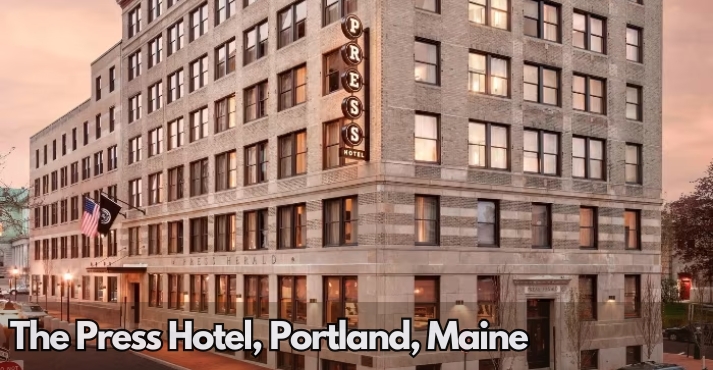
The Press Hotel, Portland, Maine
Alt-text: The Press Hotel, Portland, Maine
This luxury boutique hotel transformed the former Portland Press Herald newspaper headquarters into a 110-room property that celebrates its journalistic heritage.
The conversion preserved historic features like exposed brick and high ceilings while incorporating modern amenities.
The project’s success demonstrates how adaptive reuse can create unique, market-defining properties that command premium rates.
Motel 6 to Hyatt House Conversion
In a notable motel-to-hotel transformation, a former Motel 6 property was completely reimagined as a Hyatt House extended-stay hotel.
The project involved reconfiguring guest rooms into suites with kitchenettes, adding modern amenities, and a dramatic upgrade of the building’s facade.
Exploring innovative hotel exterior design ideas was key to completely repositioning the property in the market. The conversion achieved significantly higher rates and occupancy than the previous operation.
Office-to-Hotel Conversion in Singapore
A vacant 1970s office building in Singapore’s central business district was converted into a 300-room ‘The Fullerton Hotel Singapore’. The project involved reconfiguring the deep floor plates to create efficient guest room layouts and adding a new glass curtain wall to modernize the exterior.
The conversion achieved significant cost savings compared to new construction while creating a profitable hotel in a prime location.
The Future of Adaptive Reuse in Hospitality
The trajectory of adaptive reuse in hospitality points toward continued growth and innovation as market conditions evolve.
Technology-Enabled Conversions
Advanced scanning technologies and BIM (Building Information Modeling) are making conversion projects more predictable and efficient.
These tools allow developers to better understand existing conditions and plan renovations with greater accuracy, reducing risks and unexpected costs.
Brand-Led Conversion Programs
Major hotel brands are developing standardized conversion protocols that make it easier for developers to adapt existing buildings to brand standards.
These programs streamline the process and reduce the time and cost of bringing converted properties into brand portfolios.
Regulatory Support and Incentives
Many municipalities are creating incentives for building conversions as a strategy for addressing urban vacancy and promoting sustainable development.
These policies may include tax abatements, streamlined permitting, or density bonuses for adaptive reuse projects.
Conclusion: Embracing the Adaptive Reuse Opportunity
The rise of adaptive reuse in hospitality represents more than just a development trend; it signals a fundamental shift in how we approach hotel growth and urban development.
By transforming underutilized offices and aging motels into vibrant branded hotels, developers and operators are unlocking value in existing real estate while creating unique guest experiences that stand out in competitive markets.
The compelling combination of cost efficiency, faster timelines, and strong sustainability credentials makes adaptive reuse an increasingly attractive option for portfolio expansion.
Looking ahead, the success of these projects will depend on thoughtful execution that balances creative vision with practical considerations.
As hotel brands and developers continue to refine their approach to conversions, we can expect to see even more innovative examples of urban hotel revitalization that preserve architectural heritage while meeting modern hospitality needs.
For industry professionals considering their next project, adaptive reuse offers a pathway to growth that aligns with contemporary values of sustainability, efficiency, and community engagement.